
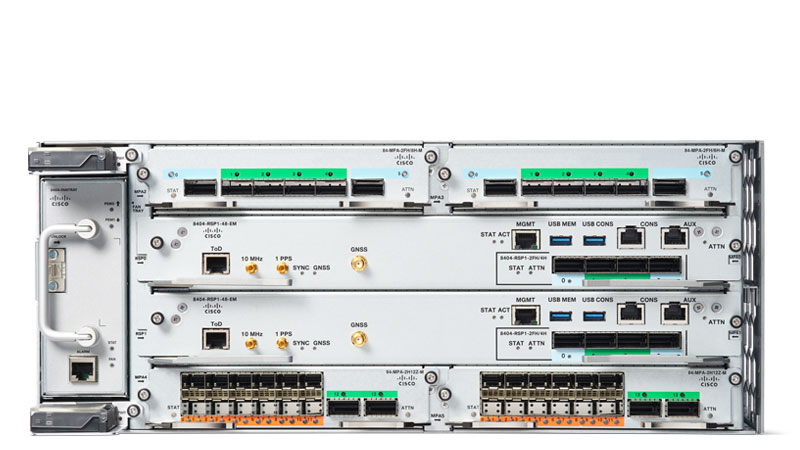
The Cisco ISR 4331 Integrated Services Router (PID ISR4331/K9) has been a workhorse at the branch edge for the better part of a decade. It replaced the venerable 2900-series, introduced modular service-container architecture to mid-range branches, and shipped in tens of thousands of federal, healthcare, and enterprise sites. That run is now ending. Cisco has placed the ISR 4331 on its formal end-of-life track, and the calendar has consequences that an asset owner cannot defer indefinitely. This guide explains exactly what each milestone means for a router you are still running, why the recommended successor, the Catalyst C8200-1N-4T Edge Platform, is a genuine generational step rather than a like-for-like swap, and how to execute the migration cleanly.
The ISR 4331 end-of-life timeline, and why it matters now
Cisco published the ISR 4000 end-of-life bulletin covering the ISR4331/K9 with a clear set of dates. Each one closes a door, and they do not reopen. The full detail for this exact PID lives on our ISR 4331 end-of-life page, but here is what each date means in operational terms.
- End of Sale, November 7, 2023: You can no longer buy the ISR 4331 new through Cisco. Any new unit you encounter today is channel-remaining stock or secondary-market gear, which matters for TAA and warranty.
- End of Software Maintenance, August 31, 2025: This date has already passed. Cisco no longer ships maintenance IOS-XE rebuilds for the platform. Critically, that means no more routine bug-fix or PSIRT security patches for the ISR 4331 software train. A new critical vulnerability in IOS-XE will not get a fixed release for this hardware.
- Last Day of Support (LDoS), November 30, 2028: After this date Cisco TAC will not open cases, RMA hardware replacement ends, and the contract is effectively unserviceable. The device becomes a liability that you operate entirely at your own risk.
The practical takeaway: the window for an orderly, budgeted refresh is open now and narrows every quarter. Waiting until 2028 forces an emergency procurement during a period when remaining ISR 4331 spares are scarce and expensive, and when you have zero patch coverage in the interim. You can see where this unit sits relative to the rest of your fleet on the Cisco EoL hub.
What you have today: ISR 4331 in specifics
To judge the replacement fairly, anchor on what the ISR 4331 actually delivers. The chassis is a multicore x86 platform running IOS-XE with control-plane and data-plane separation. Aggregate forwarding throughput is governed by a performance license, with the default tier around 100 Mbps and a Performance license unlocking up to roughly 300 Mbps of system throughput. It provides three onboard GE ports (RJ-45 with SFP combo options), two NIM (Network Interface Module) slots, one ISC slot, one SM-X service-module slot, onboard DSP resources for voice, and a single internal power supply with optional PoE boost via an internal power module. Licensing followed the classic ISR 4000 model: technology-package right-to-use licenses (appx/security/uc) layered on a throughput license, managed largely by hand.
The replacement: Catalyst C8200-1N-4T, and what is concretely better
Cisco's named successor is the Catalyst C8200-1N-4T Edge Platform. The C8200 family is the branch-tier member of the Catalyst 8000 edge portfolio, purpose-built as the SD-WAN-native generation that replaces the ISR 4000 line. The C8200-1N-4T provides four onboard GE WAN/LAN ports plus a single NIM slot in a compact, fanless-class 1RU form factor with lower power draw than the ISR 4331. The differences that matter:
- Throughput headroom: The C8200-1N-4T is built for materially higher aggregate and IPsec/encrypted throughput than the ISR 4331's ~300 Mbps ceiling, with hardware crypto acceleration sized for modern WAN circuits and SASE tunnels rather than the T1/low-hundreds-of-Mbps era the 4331 was designed around.
- SD-WAN as a first-class citizen: The Catalyst 8200 runs current IOS-XE SD-WAN (Cisco Catalyst SD-WAN, formerly Viptela) natively. The ISR 4331 can run SD-WAN, but the C8200 is architected and licensed for it, with cleaner onboarding to vManage/Catalyst SD-WAN Manager and full support for application-aware routing, on-box analytics, and cloud on-ramp.
- Modern silicon and security: Newer multicore CPU, more memory headroom, and current Trust Anchor / secure-boot hardware for supply-chain integrity, exactly what federal supply-chain risk-management programs now expect.
- DNA / Smart Licensing: The C8200 moves off the ISR 4331's manual right-to-use model to the DNA Software for SD-WAN and Routing subscription tiers (Network Essentials / Advantage / Premier) administered through Smart Licensing Using Policy (SLUP). This is term- or perpetual-DNA based, pooled across the fleet in Smart Account, and far easier to true-up for audit than per-box RTU keys.
A practical migration plan
1. Assessment and inventory
Pull a definitive inventory of every ISR4331/K9 in service: serial numbers, current IOS-XE version, installed NIM/SM-X modules, active technology packages, and the WAN circuit and handoff at each site. Capture the running config and a 'show tech' from each device. Flag any site using onboard voice DSPs or specialized service modules, those determine which NIM you carry over or replace on the C8200.
2. License transition
Map each ISR 4331's feature set to a C8200 DNA tier. Branches running plain routing and basic security typically land on Network Essentials or Advantage; sites needing full SD-WAN application policy and advanced security map to Advantage or Premier. Order DNA subscriptions into your Smart Account in parallel with hardware so licenses are ready to deploy at activation.
3. Config and feature-parity translation
Because both platforms run IOS-XE, most interface, routing, QoS, and security CLI ports over with minimal change, but do not assume a blind copy/paste. Validate interface naming (the C8200 port map differs from the 4331's three-GE + NIM layout), re-create any zone-based firewall, NAT, IPsec, and DMVPN/FlexVPN configs against current IOS-XE syntax, and rebuild voice/DSP configuration if applicable. If you are moving to Catalyst SD-WAN, this is the moment to convert from a CLI-managed config to a vManage device template rather than lifting the old config wholesale.
4. Physical, power, and connectivity
The C8200-1N-4T is a compact 1RU unit with lower power draw than the ISR 4331, so rack and power are rarely a constraint, but confirm rail kits, PDU outlet type, and that any copper-to-SFP optics from the 4331 are supported and TAA-compliant on the new platform. Verify your single NIM carries the modules you need; if the ISR 4331 used two NIMs or an SM-X slot, plan how those functions consolidate onto the C8200 or move to a different model in the family.
5. Phased cutover
Stage and pre-provision each C8200 in the lab against its SD-WAN template or golden config, validate reachability and policy, then cut over site by site during a maintenance window with the ISR 4331 kept on standby for fast rollback. Pilot one or two representative branches first, confirm application performance and failover, then scale the rollout in waves.
6. Secure decommission
Once a site is stable on the C8200, securely wipe the ISR 4331: erase startup-config and any stored credentials/keys, clear the bootflash, and follow your data-handling policy for media sanitization. For federal and DoD sites, document the sanitization for chain-of-custody and dispose through an approved channel.
Procurement notes for government and enterprise buyers
For US federal, DoD, and SLED buyers, source the C8200-1N-4T new from an authorized Cisco partner to guarantee TAA compliance, genuine hardware with valid Trust Anchor, and a clean warranty and Smart Account entitlement path, grey-market or refurbished ISR 4331 spares carry neither patch coverage nor supply-chain assurance. Expect lead times to vary with DNA subscription bundling, so order early. We accept GPC/purchase-card payment for in-threshold orders and support standard quote-to-PO workflows; uniqcli holds no GSA MAS, SEWP, or NASPO contract vehicle. You can browse the replacement on our catalog.
Frequently asked questions
When does the Cisco ISR 4331 (ISR4331/K9) reach end of support?
The ISR 4331 went End of Sale on November 7, 2023, and reached End of Software Maintenance on August 31, 2025, meaning no more IOS-XE bug-fix or security patches. The Last Day of Support (LDoS), after which Cisco TAC and hardware RMA end entirely, is November 30, 2028.
What is the recommended replacement for the ISR 4331?
Cisco's named successor is the Catalyst C8200-1N-4T Edge Platform. It is the current-generation branch edge router that supersedes the ISR 4000 line, with four onboard GE ports, a NIM slot, higher encrypted throughput, native Catalyst SD-WAN, modern silicon, and DNA Smart Licensing.
Can I reuse my ISR 4331 licenses on the Catalyst C8200?
No. The ISR 4331's manual right-to-use technology-package licenses do not transfer. The C8200 uses DNA Software for SD-WAN and Routing subscriptions (Network Essentials, Advantage, or Premier) administered through a Cisco Smart Account with Smart Licensing Using Policy. Provision the Smart Account before deployment.
Will my ISR 4331 configuration move to the C8200-1N-4T?
Largely, since both run IOS-XE, most routing, QoS, NAT, and IPsec/VPN CLI ports over with minor changes. But interface naming differs, voice/DSP and service-module functions must be re-mapped, and moving to Catalyst SD-WAN is best handled by rebuilding into a vManage device template rather than copying the old config verbatim.
Is it safe to keep running the ISR 4331 past 2025?
It runs, but it no longer receives security patches as of August 31, 2025, so any new IOS-XE vulnerability stays unfixed on that hardware. For FISMA, HIPAA, FedRAMP, or PCI environments that is an audit-exposure risk. Plan the refresh now rather than waiting for the November 30, 2028 LDoS.
Uniqcli Team
The Uniqcli Team is an authorized Cisco partner specializing in Catalyst wireless, switching, datacenter fabric, licensing, and managed services for U.S. federal, state, local, and education customers. We scope Cisco bills of materials, validate procurement paths (TAA, FIPS, contract vehicles), and deliver design, deployment, and managed operations.
Ready to scope your Cisco build?
Build a quoteRelated reading
View all → Guides
Cisco 1941W EoL: Migrate to Catalyst 8200 C8200-1N-4T
The Cisco 1941W reached Last Day of Support on December 31, 2021, no patches, no TAC, no RMA. Here is what the EoL milestones mean and how to migrate cleanly to the Catalyst 8200 Edge Platform (C8200-1N-4T), including the licensing and wireless changes that catch teams off guard.
April 22, 2026 · 6 min readGuidesCisco ISR 4321 (ISR4321/K9) to Catalyst C8200 Migration Guide
The Cisco ISR 4321 (ISR4321/K9) is end-of-sale and past software maintenance, here is a concrete plan to migrate to the Catalyst C8200-1N-4T before Last Day of Support.
November 25, 2025 · 8 min readGuidesCisco 2911 (CISCO2911/K9) End of Life: ISR 4331 Refresh Guide
The Cisco 2911 ISR G2 reached last day of support on December 31, 2022; here is a practical, partner-vetted plan to migrate it to the Cisco ISR 4331 (and Catalyst 8300) without breaking your branch.
December 8, 2025 · 7 min readGuidesCisco 2921 (CISCO2921/K9) End of Life: ISR 4331 Migration Guide
The Cisco 2921 ISR G2 is past its last day of support, here is what each EoL milestone means and how to migrate cleanly to the IOS XE-based ISR 4331.
December 10, 2025 · 8 min readGuidesCisco 7606-S EoL: Migrating to the Catalyst 8500 (C8500-12X)
The Cisco 7606-S (CISCO7606-S) passed Last Day of Support on July 31, 2021. Here is why the chassis must come out and how to migrate its WAN-edge roles cleanly to the IOS XE-based Catalyst 8500 (C8500-12X).
May 7, 2026 · 7 min readGuidesASR 1002-X End of Life: Catalyst 8500-12X Migration Guide
The ASR1002-X reaches Last Day of Support on July 31, 2027, here is exactly what to migrate to the Catalyst 8500-12X and how to do it cleanly.
October 11, 2025 · 8 min read