
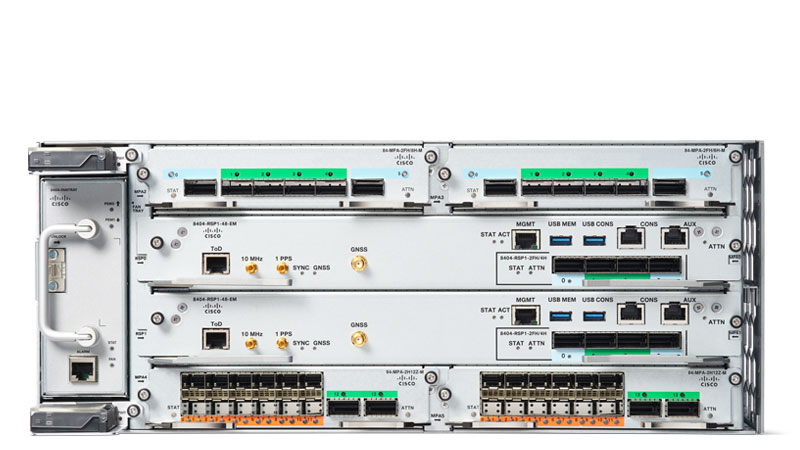
The Cisco 2921 Integrated Services Router (PID CISCO2921/K9) was the throughput and DSP-heavy member of the ISR G2 2900 family, built for medium branch offices that needed three onboard Gigabit Ethernet ports, four EHWIC slots, two SM slots, three onboard PVDM3 (DSP) sockets for voice, and a multicore services-ready engine. It earned its keep as a CUBE, SRST, and rich-media voice gateway. But that platform is now fully retired. Cisco issued the last-day-of-support milestone of December 31, 2022, which means the 2921 is past every support boundary that matters for a production network. If you still have one forwarding traffic at a branch, a federal site, or a clinic closet, it is running unsupported, unpatched code on hardware that can no longer be replaced under contract.
Why the 2921 EoL situation demands action now
End-of-life is not a single event; it is a sequence of doors closing. The 2921 has passed all of them. The practical effect is twofold and both halves are serious. First, there are no more PSIRT security fixes. Cisco's Product Security Incident Response Team stopped producing patched IOS 15.x images for this platform after software maintenance ended, so any vulnerability disclosed after that date, including critical, remotely exploitable IKE, SSH, SNMP, or web-UI flaws that routinely affect classic IOS, will never be remediated on a 2921. The device is frozen at its last vulnerable image. Second, there is no TAC and no RMA. After the last day of support you cannot open a technical assistance case, and a failed unit cannot be advance-replaced. A power-supply or motherboard failure becomes an unplanned outage with no covered path to recovery beyond gray-market spares of unknown provenance.
What each milestone date actually means
End of Sale, December 9, 2017
Cisco stopped accepting new orders for CISCO2921/K9 through normal channels. From this point the install base only shrinks; you cannot grow a 2921 fleet from the vendor. This also started the clock on every downstream milestone.
End of Software Maintenance, December 9, 2020
This is the milestone most teams underestimate. After this date Cisco no longer produced maintenance or security rebuilds of IOS for the 2921. Every CVE disclosed afterward is permanent on this hardware. If your vulnerability scanner still flags these routers, this is why, and the finding is accurate.
Last Day of Support, December 31, 2022
The final door. No TAC cases, no RMA hardware replacement, no contract-backed assistance of any kind. Any 2921 still in service after this date is running on borrowed time with no safety net. For risk and procurement purposes, treat these units as already failed: they simply have not failed yet.
The recommended replacement: Cisco ISR 4331
Cisco's documented migration path for the 2921 is the ISR 4331 (PID ISR4331/K9), and it is a generational leap rather than a like-for-like swap. The single most important difference is the move from classic IOS 15 to IOS XE. IOS XE is a Linux-based, modular control plane with a separated data plane (the QuantumFlow-derived forwarding engine), which brings restartable processes, far better software-defined networking support, and, critically, a native path to Cisco SD-WAN. The 2921 has no real SD-WAN story; the 4331 can run the SD-WAN (vManage/Viptela) feature set directly, which is the architecture most distributed-branch buyers are standardizing on today.
Throughput is the other headline. A 2921 in real-world branch conditions delivers roughly 100 Mbps-class practical forwarding with services enabled. The ISR 4331 scales to about 2 Gbps aggregate when uplifted with a performance license (it ships throttled, typically around 100 Mbps, and unlocks via licensing). It carries 3 GE ports like the 2921 but pairs them with 2 NIM slots and 1 SM slot, and ships standard with 4 GB DRAM and 4 GB flash, a large memory increase over the 2921, which matters for IOS XE, telemetry, and modern feature sets.
Licensing: the model changed
The 2921 used right-to-use feature licenses (IP Base, Security, UC, Data) tied to the device. The 4331 uses Cisco Smart Licensing under the IOS XE model, with performance and throughput tiers and the Network Stack (Network Essentials/Advantage on newer trains) plus DNA software subscriptions for SD-WAN and automation. Plan the license transition as a distinct workstream, you are buying entitlements into a Smart Account, not transferring paper PAKs. The 4331 in the recommended bundle ships with IP Base equivalent; security and SD-WAN features layer on as subscriptions.
Voice and modules do not carry over
This is the migration's sharpest edge. The 2921's PVDM3 DSPs and EHWIC interface cards are physically and electrically incompatible with the 4331. Voice moves to PVDM4 DSP modules that seat on NIM carriers, and your EHWIC WAN/LAN cards must be re-specified as NIM equivalents. CUBE, SRST, and analog/digital gateway roles are all supported on the 4331, but the hardware bill of materials must be rebuilt, budget for it explicitly.
A practical migration plan
1. Assessment and inventory
Catalog every 2921 by serial, site, and role. Pull running configs and capture show version, show inventory, and show license. Document each unit's WAN circuits, EHWIC/SM modules, PVDM3 channel counts, QoS policies, crypto maps/IKE configuration, and voice dial-peers. This is your parity baseline.
2. License and feature-parity design
Map old feature licenses to the 4331's Smart Licensing tiers and choose the throughput license that matches each site's circuit. Translate classic-IOS constructs to IOS XE syntax, most CLI carries over, but verify ZBFW, NAT, NetFlow (now Flexible NetFlow/NBAR2), and crypto (IKEv2/GETVPN/FlexVPN) line by line. Decide now whether the site joins SD-WAN or stays autonomous; that choice drives the image and subscription.
3. Physical: rack, power, uplinks, optics
The 4331 is a 1RU chassis (the 2921 is 2RU), so you reclaim rack space and reduce power draw. Confirm SFP optics, onboard ports are RJ-45 GE with SFP options on the 4331; reuse compatible optics where possible. Order PVDM4 and NIM modules ahead of cutover and stage them in the chassis before the window.
4. Phased cutover
Never flash-cut a fleet. Pilot one representative site, validate voice quality (jitter, MOS), VPN re-establishment, and routing convergence, then template the verified config and roll out in waves. Pre-stage each 4331, run it in parallel where the circuit allows, and keep the 2921 cabled but shut down for a defined rollback window before removal.
5. Secure decommission
A retired 2921 still holds your keys. Run write erase, wipe the configuration and any stored crypto material, and remove it from monitoring, AAA, and inventory. For federal and DoD sites follow your media-sanitization policy (NIST SP 800-88) and obtain a certificate of destruction or sanitization for the audit file before the unit leaves the building.
Procurement notes for government and enterprise
- TAA compliance: confirm country-of-origin on the ISR4331/K9 for federal and DoD buys; we source TAA-compliant, genuine Cisco units with documentation.
- Authorized-partner sourcing: buying the replacement through an authorized Cisco partner guarantees Smart License registration to your account and warranty/SmartNet eligibility, gray-market 4331s often cannot be registered or covered.
- GPC and contract vehicles: micro-purchase and Government Purchase Card payment is supported, along with quoting against your existing vehicles for larger refreshes.
- Lead times: plan for current-generation lead times on chassis, NIM/PVDM4 modules, and optics; bundle the full BOM in one quote to avoid partial shipments stalling a cutover.
- Verify EoL details: cross-check the milestone dates and the full replacement BOM on the CISCO2921/K9 EoL detail page before you order.
The bottom line: a 2921 in production today is an unsupported, unpatchable asset that is one hardware fault or one audit away from becoming an incident. The ISR 4331 closes that gap with IOS XE, roughly 20x the practical throughput, far more memory, and a clean path to SD-WAN. Review the full end-of-life picture on our EoL hub, browse the replacement in the catalog, and when you are ready to scope your sites, request a refresh quote, we will build the 4331 (or Catalyst 8300) BOM, licensing, and TAA documentation for you.
Frequently asked questions
Is the Cisco 2921 (CISCO2921/K9) still supported?
No. The 2921 reached end of sale on December 9, 2017, end of software maintenance on December 9, 2020, and last day of support on December 31, 2022. Cisco no longer issues PSIRT security patches and TAC cannot open cases or process RMAs for it, so any 2921 in production runs unsupported, unpatched code.
What is the recommended replacement for the Cisco 2921?
Cisco's documented migration path is the ISR 4331 (ISR4331/K9): 3 GE ports, 2 NIM and 1 SM slots, 4 GB DRAM, 4 GB flash, IP Base. It runs IOS XE instead of classic IOS 15, scales to about 2 Gbps with a performance license, and supports Cisco SD-WAN. The current shipping equivalent is the Catalyst 8300 if you want a longer support runway.
Can I move my 2921 voice and EHWIC modules to the ISR 4331?
No. The 2921's PVDM3 DSPs and EHWIC interface cards are not compatible with the 4331. Voice moves to PVDM4 DSP modules on NIM carriers, and EHWIC cards must be re-specified as NIM equivalents. CUBE, SRST, and analog/digital gateway roles are all supported on the 4331, but the hardware BOM must be rebuilt.
How much faster is the ISR 4331 than the 2921?
The 2921 delivers roughly 100 Mbps-class practical forwarding with services enabled. The ISR 4331 scales to about 2 Gbps aggregate once uplifted with a performance license, close to a 20x increase, and ships with far more memory to support IOS XE and modern feature sets.
What changes with licensing when moving from the 2921 to the 4331?
The 2921 used device-tied right-to-use feature licenses (IP Base, Security, UC, Data) via PAK. The 4331 uses Cisco Smart Licensing under IOS XE, with performance/throughput tiers, the Network Stack license, and DNA subscriptions for SD-WAN and automation. Plan the license transition as its own workstream registered to your Smart Account through an authorized partner.
Uniqcli Team
The Uniqcli Team is an authorized Cisco partner specializing in Catalyst wireless, switching, datacenter fabric, licensing, and managed services for U.S. federal, state, local, and education customers. We scope Cisco bills of materials, validate procurement paths (TAA, FIPS, contract vehicles), and deliver design, deployment, and managed operations.
Ready to scope your Cisco build?
Build a quoteRelated reading
View all →GuidesCisco 2911 (CISCO2911/K9) End of Life: ISR 4331 Refresh Guide
The Cisco 2911 ISR G2 reached last day of support on December 31, 2022; here is a practical, partner-vetted plan to migrate it to the Cisco ISR 4331 (and Catalyst 8300) without breaking your branch.
December 8, 2025 · 7 min readGuidesISR 4331 End of Life: Migrating to the Catalyst C8200-1N-4T
A practical, partner-grade guide to replacing the end-of-life Cisco ISR 4331 (ISR4331/K9) with the Catalyst C8200-1N-4T edge platform before Last Day of Support on November 30, 2028.
November 27, 2025 · 8 min readGuidesCisco 2951 (CISCO2951/K9) Replacement: ISR 4351 Migration Guide
The Cisco 2951 ISR hit Last Day of Support on December 31, 2022; here is what each end-of-life milestone means and how to plan a clean migration to the ISR 4351.
December 12, 2025 · 8 min readGuidesCisco ISR 4351 (ISR4351/K9) to Catalyst 8300 Migration Guide
A practical, specs-level guide to retiring the end-of-life Cisco ISR 4351 and refreshing to the Catalyst C8300-2N2S-6T Edge Platform.
November 29, 2025 · 7 min read Guides
Cisco C819HG-4G-G-K9 EoL: Migrate to the Catalyst IR1101
The 819 Hardened ISR (C819HG-4G-G-K9) passed Last Day of Support on December 31, 2021, no patches, no TAC, no RMA, and a cellular modem on bands carriers are sunsetting. Here's how to migrate cleanly to the Catalyst IR1101.
April 24, 2026 · 8 min readGuidesCisco 1941W EoL: Migrate to Catalyst 8200 C8200-1N-4T
The Cisco 1941W reached Last Day of Support on December 31, 2021, no patches, no TAC, no RMA. Here is what the EoL milestones mean and how to migrate cleanly to the Catalyst 8200 Edge Platform (C8200-1N-4T), including the licensing and wireless changes that catch teams off guard.
April 22, 2026 · 6 min read