
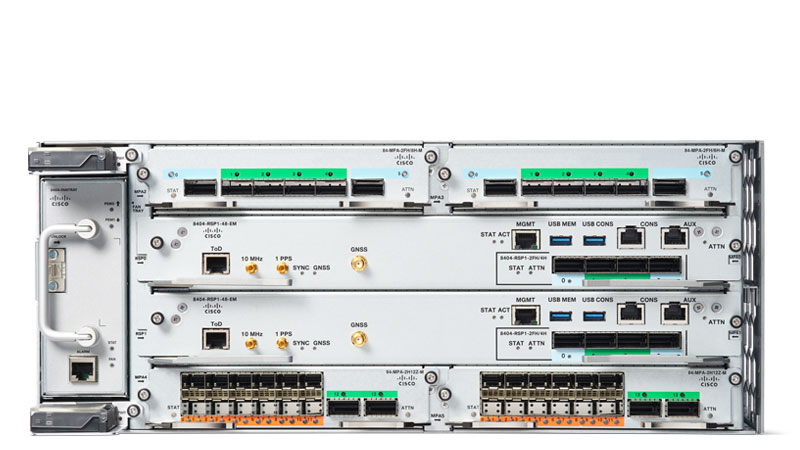
If you still run a Cisco ASR 1002-X (PID ASR1002-X) at a WAN aggregation point, internet edge, or DMVPN/SD-WAN headend, the clock is now the most important spec on the box. Cisco moved this platform End of Sale on August 1, 2022, ended software maintenance releases on August 1, 2023, and has set the Last Day of Support (LDoS) at July 31, 2027. The recommended successor is the Cisco Catalyst 8500-12X Edge Platform (PID C8500-12X). This guide is written for the engineers and acquisition teams who actually have to plan, fund, and execute that swap, not a restatement of the bulletin.
Why the ASR 1002-X EoL matters now, not in 2027
The ASR 1002-X is a capable fixed router: a single integrated Embedded Services Processor (the ESP-5/10/20/40 class depending on order), a built-in Route Processor, six onboard Gigabit Ethernet ports, and a modular bay for a SPA or EPA (commonly 10GE EPAs). Its defining feature was upgradable throughput, you bought the chassis at a base aggregate forwarding rate (typically 5 Gbps) and unlocked higher tiers up to roughly 36 Gbps via a right-to-use throughput license rather than a hardware change. That flexibility is exactly why so many of these are still in production. It is also why the EoL is easy to ignore until it bites.
The risk is not that the router stops forwarding packets on August 1, 2027. It is that the support scaffolding around it disappears. After software maintenance ended in 2023, you stopped getting new feature and maintenance trains. After LDoS in July 2027, three things end simultaneously: TAC will not open hardware or software cases, RMA replacement of a failed unit ends, and, critically for regulated buyers, Cisco PSIRT will no longer publish fixes for new IOS XE vulnerabilities affecting this platform. An edge router with no path to patch a future CVE is an audit finding waiting to happen.
What each milestone date actually means
- End of Sale, Aug 1, 2022: You can no longer buy a new ASR1002-X through Cisco. Remaining inventory is partner stock or refurbished; net-new standardization on this platform stopped here.
- End of SW Maintenance, Aug 1, 2023: No more maintenance/feature IOS XE releases for the platform. 17.9 is the last supported train; you will not get a 17.12 or later for this box.
- Last Day of Support, Jul 31, 2027: Final day for TAC, RMA, and PSIRT remediation. After this, the device is fully unsupported and contracts cannot be renewed against it.
The replacement: Catalyst 8500-12X (C8500-12X)
The Catalyst 8500-12X is Cisco's purpose-built successor for the high-end fixed ASR 1000 edge role, and it is a generational jump rather than a like-for-like. Where the ASR 1002-X centered on a multicore control plane plus a fixed-function QFP (Quantum Flow Processor) ESP, the 8500-12X is built on a multi-core x86 architecture that runs the data plane in software-accelerated form, which is what makes its SD-WAN and crypto numbers so much higher.
- Interfaces: twelve fixed 10GE SFP+ ports on the 8500-12X versus the ASR 1002-X's six built-in GE ports plus one EPA/SPA bay. You go from a handful of gig handoffs to a dozen native 10G handoffs with no module to provision.
- Throughput: the ASR 1002-X topped out near 36 Gbps with the highest throughput license. The 8500-12X targets multi-tens-to-~100 Gbps of aggregate forwarding and dramatically higher IPsec crypto throughput, so a single box absorbs both today's traffic and several refresh cycles of growth.
- SD-WAN native: the 8500-12X is a first-class Cisco Catalyst SD-WAN (formerly Viptela/vManage) edge. The ASR 1002-X could run SD-WAN on 16.x/17.x but was never the design center for it. If you are consolidating MPLS + internet underlay into SD-WAN, this is the platform Cisco optimized for it.
- Software: both end on IOS XE, but the ASR 1002-X is frozen at 17.9 while the 8500-12X continues to receive current IOS XE trains and PSIRT coverage, the entire point of moving.
The licensing change you must plan for
This is the single biggest non-physical difference. The ASR 1002-X used the older RTU/PAK-style throughput and feature licensing, you bought a throughput tier and feature set (e.g., Advanced IP Services / Advanced Enterprise Services) tied to the chassis. The Catalyst 8500-12X uses Cisco Smart Licensing for Routing under the Catalyst 8000 DNA tiers (DNA Essentials, Advantage, Premier) plus a tier or HSEC (high-security/crypto) entitlement, managed in Smart Software Manager (SSM) or a satellite/on-prem SSM for air-gapped sites. Your old throughput RTU does not port over. Map your current feature set and required crypto throughput to the right Catalyst 8000 DNA subscription before you order, and decide on cloud-connected vs. on-prem SSM early if you are in a closed network.
A practical migration plan
1. Assess and inventory
Pull the running config, show version, show license, and show platform from each ASR 1002-X. Record the ordered ESP class and current throughput license, the EPA/SPA populated in the bay, optics in use (SR/LR/ER SFP/SFP+), and the actual feature set in production (BGP/OSPF tables, VRFs, NAT scale, IPsec/DMVPN tunnels, QoS policies, NetFlow). This inventory drives both the DNA tier and the optics bill of materials. Our ASR 1002-X EoL detail page summarizes the dates and successor mapping for stakeholder sign-off.
2. License transition
Stand up (or confirm access to) your Smart Account and Virtual Account, choose Catalyst 8000 DNA Essentials/Advantage/Premier to match feature parity, and size the throughput/HSEC entitlement to your real crypto load, not the marketing ceiling. For DoD/air-gapped environments, deploy on-prem SSM and register devices to it. Confirm export-control eligibility for HSEC well ahead of cutover; this can add lead time.
3. Config and feature parity
Most IOS XE config migrates cleanly because both platforms speak the same CLI, but do not blind-paste. Re-validate interface naming (you are moving to TenGigabitEthernet 0/0/0–11), confirm any QFP-specific or ESP-specific behavior is not assumed, and rebuild SD-WAN attachment via vManage/Catalyst SD-WAN Manager templates rather than copying device configs. Lab the converted config on a 8500-12X (or 8500L for lower-throughput sites) before touching production. Verify scale numbers, route tables, NAT translations, tunnel counts, against the new platform's data sheet limits.
4. Physical: rack, power, optics, uplinks
Both are compact 1RU/2RU-class edge boxes, confirm exact RU and depth against your cabinet. Check power: the 8500-12X uses dual AC or DC supplies; validate your PDU/circuit and whether you want A/B feed redundancy you may not have had on a single-supply ASR. The router is not a PoE device, so there is no PoE budget to plan, but you do need to plan optics: twelve SFP+ cages means you may need additional 10G optics and the move from GE handoffs to 10G handoffs may require provider or LAN-side changes. Pre-stage breakout or LR/SR optics to match each peering and uplink.
5. Phased cutover
Deploy the 8500-12X in parallel, bring up routing adjacencies in a passive/lab VRF or with admin-down peers, then migrate one circuit or tunnel group at a time during a maintenance window with a tested rollback (keep the ASR 1002-X cabled and ready to re-home). For SD-WAN sites, onboard the new edge to the overlay first and shift traffic via control policy. Confirm BFD, IPsec rekey, and BGP convergence before declaring success.
6. Secure decommission
Once traffic is steady on the new platform, wipe the ASR 1002-X: erase startup/running config, remove keys and certificates, and for classified/CUI environments follow your NIST 800-88 media sanitization process for any storage. De-register old licenses and document disposal for the audit trail.
Procurement notes for government and enterprise buyers
For federal, DoD, and SLED buyers, source the C8500-12X and DNA subscriptions through an authorized Cisco partner so you get genuine, TAA-compliant hardware with valid warranty and Smart Account provisioning, gray-market edge routers are a non-starter for a security boundary. We support TAA documentation, GPC/purchase-card payment for smaller line items, FAR-based purchase orders under Simplified Acquisition Procedures for larger refreshes, and current Cisco lead-time guidance so cutover dates do not slip. We do not hold a GSA Schedule or other contract vehicle. With HSEC/export-control steps and optics often on longer lead times, start the order well before your maintenance window.
See the full Cisco EoL hub for other affected platforms, and browse the Catalyst 8500-12X and replacement options to confirm configuration. When you are ready, our team can size the DNA tier, build the optics BOM, and quote the swap.
Frequently asked questions
When does the Cisco ASR 1002-X actually stop being supported?
End of Sale was August 1, 2022 and end of software maintenance was August 1, 2023, so 17.9 is the last supported IOS XE train. Last Day of Support (LDoS) is July 31, 2027, after that there is no TAC, no RMA, and no PSIRT security fixes for the platform.
What is the recommended replacement for the ASR1002-X?
Cisco recommends the Catalyst 8500-12X Edge Platform (PID C8500-12X). It offers twelve fixed 10GE SFP+ ports, much higher aggregate and IPsec throughput, native Catalyst SD-WAN support, and continued IOS XE and PSIRT coverage. For lower-throughput sites the Catalyst 8500L is the smaller alternative.
Do my ASR 1002-X throughput and feature licenses transfer to the Catalyst 8500-12X?
No. The ASR 1002-X used older RTU/PAK throughput and feature-set licensing tied to the chassis. The 8500-12X uses Smart Licensing with Catalyst 8000 DNA tiers (Essentials, Advantage, Premier) plus a throughput/HSEC entitlement managed in SSM or on-prem SSM. You must size and purchase new subscriptions; the old throughput RTU does not carry over.
Is the Catalyst 8500-12X a drop-in for my ASR 1002-X config?
Largely, but not blindly. Both run IOS XE with the same CLI, so most routing, NAT, and crypto config migrates with edits, mainly interface renaming to TenGigabitEthernet 0/0/0–11 and rebuilding SD-WAN through Catalyst SD-WAN Manager templates. Lab the converted config and validate scale (routes, NAT, tunnels) before production cutover.
Why replace the ASR 1002-X before 2027 if it still works?
Because the support, not the hardware, expires. After LDoS you cannot RMA a failed unit, open a TAC case, or receive PSIRT fixes for new vulnerabilities. For FedRAMP, CMMC, HIPAA, PCI, or DoD RMF environments, an unpatchable edge router is a documented flaw-remediation control gap and a likely audit finding, so plan the refresh in a budgeted fiscal year rather than after a failure.
Uniqcli Team
The Uniqcli Team is an authorized Cisco partner specializing in Catalyst wireless, switching, datacenter fabric, licensing, and managed services for U.S. federal, state, local, and education customers. We scope Cisco bills of materials, validate procurement paths (TAA, FIPS, contract vehicles), and deliver design, deployment, and managed operations.
Ready to scope your Cisco build?
Build a quoteRelated reading
View all →GuidesCisco ASR 1002 End-of-Life: Migration to the ASR1002-X (and What Comes Next)
The ASR 1002 reached Last Day of Support on April 30, 2021; here is how to migrate to the ASR1002-X and plan for its Catalyst 8500 successor without breaking aggregation services or compliance.
October 9, 2025 · 8 min readGuidesCisco ASR 1001 End-of-Life: Migration to ASR1001-X
The Cisco ASR1001 hit Last Day of Support on April 30, 2021, so here is a practical, specs-driven plan to refresh to the ASR1001-X and modern Smart Licensing.
October 5, 2025 · 8 min read Guides
Cisco 1941W EoL: Migrate to Catalyst 8200 C8200-1N-4T
The Cisco 1941W reached Last Day of Support on December 31, 2021, no patches, no TAC, no RMA. Here is what the EoL milestones mean and how to migrate cleanly to the Catalyst 8200 Edge Platform (C8200-1N-4T), including the licensing and wireless changes that catch teams off guard.
April 22, 2026 · 6 min readGuidesASR1001-X End of Life: Migrate to Catalyst 8500L
The ASR1001-X is past End of Software Maintenance with Last Day of Support in July 2027, here is how to migrate cleanly to the Catalyst 8500L (C8500L-8S4X).
October 7, 2025 · 7 min readGuidesCisco 7606-S EoL: Migrating to the Catalyst 8500 (C8500-12X)
The Cisco 7606-S (CISCO7606-S) passed Last Day of Support on July 31, 2021. Here is why the chassis must come out and how to migrate its WAN-edge roles cleanly to the IOS XE-based Catalyst 8500 (C8500-12X).
May 7, 2026 · 7 min read Guides
Cisco Catalyst 3560V2 (WS-C3560V2-48PS-S) to Catalyst 9200 Migration Guide
The WS-C3560V2-48PS-S reached Last Day of Support on May 31, 2021, no PSIRT patches, no TAC, no RMA. Here is a practical, specs-driven plan to migrate from the Fast Ethernet 3560V2 to the gigabit, IOS-XE Catalyst 9200 (C9200-48P-A).
May 13, 2026 · 7 min read