
What Is Cisco XDR? Extended Detection and Response Explained for Security Teams
What is Cisco XDR? It is a cloud-native platform that correlates telemetry from endpoint, network, firewall, identity, email, and DNS into one prioritized incident. Here is how it works and how it differs from SIEM, EDR, and SOAR.
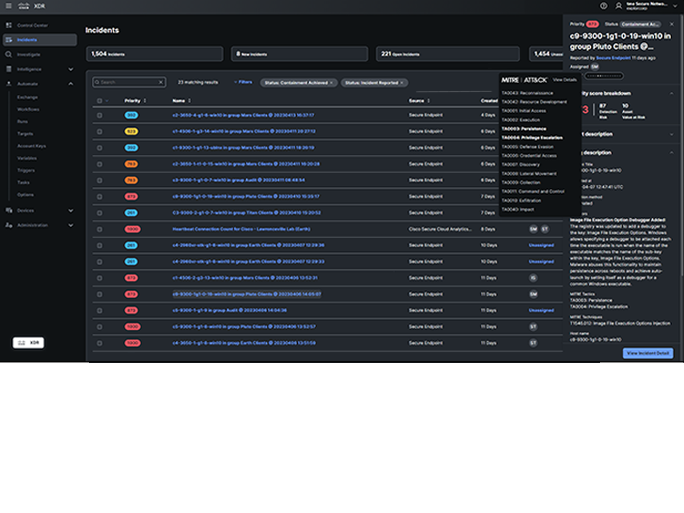
Security operations teams are drowning in alerts. A typical Security Operations Center (SOC) runs a stack of point tools, each firing its own notifications, each with its own console, and none of them telling the analyst whether ten separate alerts are actually one coordinated attack. Extended Detection and Response, or XDR, exists to fix exactly that problem. This guide explains what Cisco XDR is, how it differs from the SIEM, EDR, and SOAR tools you may already run, and how it correlates telemetry across firewall, endpoint, identity, email, network, and DNS into a single prioritized incident.
If you are evaluating Cisco XDR for a federal, DoD, SLED, healthcare, or enterprise environment, this is the top-of-funnel explainer. For the full product breakdown, editions, and a scoped quote path, the Cisco XDR pillar page goes deeper, and our broader Cisco security portfolio overview shows how XDR fits alongside firewall, identity, and zero-trust access.
What is Cisco XDR? A plain-English definition
Cisco XDR is a cloud-native, SaaS-delivered extended detection and response platform. It unifies telemetry from across your security stack, applies machine learning and analytics, and produces correlated, prioritized incidents so SOC teams can move from endless investigation to fast, confident response. Instead of an analyst pivoting between an endpoint console, a firewall log, and an identity dashboard to piece together what happened, XDR does the correlation for you and presents one incident with a timeline and an attack graph.
The defining word in XDR is extended. Where older approaches looked at one layer at a time, Cisco XDR natively analyzes the six telemetry sources SOC operators consider critical: endpoint, network, firewall, email, identity, and DNS. On top of those native sources it adds Cisco-curated integrations with leading third-party tools, so you are not forced to rip and replace the products you already own. The goal is to replace log-centric, days-long investigation workflows with telemetry-centric detection that delivers outcomes in minutes.
The core problem XDR solves: Alert overload and tool sprawl. A lean team cannot manually correlate signals from six different products at 2 a.m. Cisco XDR ingests those signals, correlates related events over time into a single incident, and scores it so the analyst knows what to work first.
XDR vs SIEM vs EDR vs SOAR: how the acronyms differ
The security tooling alphabet soup confuses a lot of buyers, so it helps to draw clean lines. Each category was built for a different job, and Cisco XDR is designed to sit across several of them rather than simply replace one. Understanding where each tool stops is the fastest way to see why teams reach for XDR.
EDR: endpoint-only visibility
Endpoint Detection and Response watches the endpoint and only the endpoint. It is excellent at catching malware execution, suspicious process trees, and host-level persistence. But a multi-stage attack that moves laterally over the network, abuses stolen identity credentials, or arrives by email never fully reveals itself to an endpoint-only tool. Cisco XDR extends detection across network, firewall, email, identity, and DNS so attacks that never touch a monitored endpoint are still caught and correlated.
SIEM: log-centric and often slow
A Security Information and Event Management platform like Splunk Enterprise Security is log-centric. It collects everything, and analysts write queries and correlation rules against those logs. SIEMs are powerful, but outcomes are often measured in days, and the analyst still does most of the assembly by hand. This is the heart of the Cisco XDR vs SIEM question: XDR is telemetry-centric with prebuilt correlation and response in minutes, and it integrates Splunk as a data source rather than replacing the analyst workflow. It is worth noting Splunk is now a Cisco company, so the two are designed to complement each other.
SOAR: automation, not detection
Security Orchestration, Automation, and Response handles the playbook side: when something is detected, run these steps automatically. Historically SOAR was a separate product you bought and integrated. Cisco XDR folds that capability in with built-in, low/no-code automation and guided playbooks, so you get orchestration without standing up a separate platform.
- EDR answers: what happened on this host?
- SIEM answers: what do all my logs say, if I query them correctly?
- SOAR answers: now that we know, what actions do we run?
- XDR answers all three at once: it correlates telemetry across vectors into one scored incident and can respond automatically.
How Cisco XDR correlates telemetry across firewall, endpoint, identity, and network
Correlation is where Cisco XDR earns its keep. A built-in analytics engine ingests events and telemetry from Cisco and third-party sources, correlates security events over time into a single incident, and plots the activity on a timeline and an attack graph. The analyst sees the who, what, where, and when of a multi-stage attack in one view instead of reconstructing it across five consoles.
Consider a realistic chain: a phishing email lands (email telemetry), the user clicks and the host beacons to a malicious domain (DNS), the endpoint runs a suspicious payload (endpoint), the attacker pivots to another subnet (network flow), and the compromised account authenticates somewhere it never has before (identity). Five tools would fire five disconnected alerts. Cisco XDR stitches them into one incident on a single timeline, because its analytics and correlation engine is watching all six native sources at once.
Network-led detection is the differentiator
Cisco XDR is network-led and agent-optional, which sets it apart from endpoint-anchored competitors. By ingesting NetFlow/IPFIX, SPAN traffic, Network Visibility Module endpoint flow logs, and cloud flow logs, it builds behavioral baselines to spot blind-spot threats and lateral movement that endpoint-only or log-only tools miss. That telemetry is collected through the XDR Connector (for NetFlow, SPAN, and firewall logs), the Cisco Telemetry Broker, and the Network Visibility Module inside cloud-managed Cisco Secure Client. For public cloud, agentless monitoring of AWS, Microsoft Azure, and Google Cloud arrives through API integrations and flow logs, so workloads outside the data center are not a blind spot.
Risk-based prioritization so you work the right incident first
Every incident is assigned a priority score from 1 to 1000. That score combines a Detection Risk score (1 to 100, built from MITRE ATT&CK technique financial-risk scoring, the number of techniques observed, and source severity) with a user-assigned Asset Value (1 to 10). The practical effect is that a noisy alert on a test laptop never outranks a real intrusion against a domain controller. Analysts always work the most materially impactful incidents first, which is exactly what a lean team needs.
Asset and identity context behind every score
The Asset Value that feeds prioritization does not come from nowhere. Asset Insights builds a unified device and user inventory from Cisco and third-party sources, merges duplicate records into a single asset, and draws identity context from Cisco Identity Intelligence. Pairing XDR with Cisco identity tooling means each incident carries the user and device behind the activity, not just an IP address, which sharpens both triage and response.
Key capabilities that define Cisco XDR
Beyond correlation and scoring, several capabilities show up repeatedly when teams describe why they chose the platform. Each maps to a concrete SOC pain point.
- Attack Storyboard with Instant Attack Verification: agentic AI autonomously verifies whether an alert is a real attack and assembles a storyboard, turning hours of manual triage into minutes. It is included across every license tier, even Essentials.
- MITRE ATT&CK mapping and coverage assessment: native detections map to ATT&CK tactics and techniques, and the platform models your detection coverage against selected adversary techniques, including Secure Endpoint Configuration Insights that flag misconfigurations reducing coverage.
- Guided playbooks and automation: a product-agnostic Response Playbook follows the SANS PICERL model, and analysts build custom workflows with a drag-and-drop editor, trigger them by incident, schedule, or webhook, and install curated content from the Automation Exchange in one click.
- Automated Ransomware Recovery: integrations with backup partners such as Cohesity, Rubrik, Veeam, and Pure Storage drive automated snapshots and restore to a last-known-good state, so teams can recover without paying ransom.
- Cisco Talos threat intelligence: built-in Talos intel enriches every incident starting at Essentials, and underpins the Premier managed service and the Talos Incident Response retainer.
- XDR Forensics: on the Advantage and Premier tiers, it collects 350+ endpoint artifacts plus a remote interactive response capability for containment and eradication.
- Threat hunting with Investigate: the Investigate feature queries all integrations for local and global intelligence and prior sightings, renders an artifact relations graph with an adjustable timeline, and can even pivot from pasted text such as a threat-research blog post.
Cisco XDR editions: Essentials, Advantage, and Premier
Cisco XDR ships in three nested tiers. Each higher tier includes everything below it, so the choice comes down to how much third-party integration breadth and managed service you need.
XDR Essentials
Essentials delivers the full XDR feature set across the Cisco Security portfolio: analytics and correlation, Talos threat intelligence, threat hunting, response actions, 1-to-1000 prioritization, asset and user context, custom automation, and the Attack Storyboard with Instant Attack Verification. Threat-intelligence and IT Service Management (ITSM) third-party integrations are included at this tier too, which surprises buyers who expect to pay extra for ServiceNow or Jira ticketing hooks.
XDR Advantage
Advantage adds commercially supported, Cisco-curated integrations with select third-party tools (EDR, Email Threat Defense, NGFW, NDR, and SIEM) plus XDR Forensics. This is the tier for teams keeping a multi-vendor stack who want to respond regardless of vector or vendor, and it is where the 350+ artifact collection and remote response capability become available.
XDR Premier
Premier delivers full Advantage capabilities as a Cisco-managed detection and response service (MXDR), run by Cisco security experts around the clock, with security validation via penetration testing and select Cisco Talos Incident Response retainer services. It suits organizations without a full 24x7 SOC of their own, and customers such as Mansfield Independent School District use this model to get expert coverage without staffing a night shift.
A note on pricing: Cisco does not publish a flat list price for XDR, and you should be wary of any source that quotes one. Real cost is driven by your tier (Essentials, Advantage, or Premier), the number of users, your data retention window (90 days by default, with 180- and 365-day options), and ingestion volume (2 GB per user per month by default, with add-on GB available). The cleanest way to get an accurate number is to scope it. Build a configuration on our request a quote page and we size it to your environment.
Consolidating a multi-vendor stack without rip-and-replace
One of the most common reasons teams adopt Cisco XDR is that they do not have to throw away existing investments. If you run CrowdStrike Falcon or SentinelOne on the endpoint, Microsoft Defender or Proofpoint on email, Palo Alto or Fortinet at the firewall, or Splunk and Microsoft Sentinel as your SIEM, those become curated telemetry sources feeding XDR. You keep the tools your team already knows and gain cross-vendor correlation plus one-click or automated response on top, extending the return on tools you already own.
This open, vendor-neutral posture is the practical difference between Cisco XDR and its main rivals. Microsoft Defender XDR is strongest inside the Microsoft 365, Entra, and Azure estate. Palo Alto Cortex XDR is endpoint and agent-centric and deepest within the Palo Alto stack. CrowdStrike anchors on its endpoint agent and cloud platform. Cisco XDR is telemetry-centric across six native sources, including network and DNS, and it integrates Cortex, Falcon, and Defender as third-party sources rather than favoring a single ecosystem. The unified security platform approach is the point: correlate across what you have, not just within one vendor's walled garden.
Cisco XDR for US public sector: compliance and zero trust
For federal, DoD, SLED, and healthcare buyers, Cisco XDR aligns well with public-sector security priorities. Its native MITRE ATT&CK mapping supports a threat-informed defense, and its correlation across identity, endpoint, network, and DNS maps cleanly to the pillars of the CISA Zero Trust Maturity Model, including the cross-cutting visibility, analytics, automation, and orchestration capabilities. XDR also supports US Government Community Cloud (GCC) integrations, including Microsoft Defender for Office 365 GCC and Microsoft Defender for Endpoint GCC, which matters for agencies on Microsoft government clouds.
A word of caution on authorization status: do not assume a specific FedRAMP authorization, DoDIN APL listing, or impact level for XDR without confirming the current posture. As of 2025 and 2026, several adjacent Cisco cloud services have achieved or are pursuing FedRAMP authorization, and Cisco XDR relies on Cisco Security Cloud Control for identity data, so verify each component on the FedRAMP Marketplace at time of purchase. As an authorized Cisco partner, Uniqcli can scope the compliant SKU, confirm contract-vehicle eligibility, handle Trade Agreements Act (TAA) requirements, and accept the Government Purchase Card (GPC) for eligible procurements.
Is Cisco XDR right for your SOC? Next steps
If your team is buried in disconnected alerts, juggling consoles from half a dozen vendors, or trying to deliver SOC-grade outcomes without a 24x7 staff, Cisco XDR is built for exactly that situation. Lean teams use it to consolidate detection, investigation, and response into one prioritized queue, and organizations without a full SOC adopt the Premier tier to have Cisco experts monitor and respond around the clock. To go deeper on capabilities, editions, and deployment, start with the Cisco XDR overview, and when you are ready to size a tier, retention window, and ingestion to your environment, request a quote and we will scope it as your authorized Cisco partner.
Frequently asked questions
What is Cisco XDR in simple terms?
Cisco XDR is a cloud-delivered extended detection and response platform that collects security telemetry from your endpoint, network, firewall, email, identity, and DNS sources, then correlates related events into a single prioritized incident. Instead of an analyst manually piecing together alerts from many tools, XDR does the correlation and scoring automatically so the team can respond in minutes. It is delivered as software-as-a-service, so there is no on-premises console to maintain.
What is the difference between XDR and SIEM?
A SIEM like Splunk is log-centric. It collects logs and relies on analysts writing queries and rules, with outcomes often measured in days. Cisco XDR is telemetry-centric with prebuilt correlation and automated response, so incidents are assembled and scored for you in minutes. Cisco XDR integrates a SIEM as a data source rather than replacing it, and Splunk is now a Cisco company.
How is Cisco XDR different from EDR like CrowdStrike?
EDR watches only the endpoint, so multi-stage attacks that move over the network, abuse identity, or arrive by email can slip past it. Cisco XDR is network-led and agent-optional, extending detection across six telemetry sources. It supports CrowdStrike Falcon, SentinelOne, and Microsoft Defender as curated EDR integrations, so you can keep your existing endpoint tool while gaining cross-vendor correlation.
How much does Cisco XDR cost?
Cisco does not publish a flat list price for XDR. Cost is driven by the edition you choose (Essentials, Advantage, or Premier), your number of users, your data retention window (90, 180, or 365 days), and your ingestion volume (2 GB per user per month by default, with add-ons). The accurate way to get a number is to have it scoped, which Uniqcli can do as an authorized Cisco partner through a request for quote.
What editions of Cisco XDR are available?
There are three nested tiers. Essentials delivers the full XDR feature set across the Cisco Security portfolio. Advantage adds curated third-party integrations (EDR, email, NGFW, NDR, SIEM) and XDR Forensics. Premier delivers Advantage capabilities as a fully Cisco-managed MXDR service with around-the-clock monitoring and Talos Incident Response retainer options.
Is Cisco XDR FedRAMP authorized for federal agencies?
Do not assume a specific FedRAMP authorization, DoDIN APL listing, or impact level for Cisco XDR without confirming current status, because it varies by component and changes over time. Cisco XDR supports GCC integrations and relies on Cisco Security Cloud Control for identity data, so verify each component on the FedRAMP Marketplace at purchase. As an authorized Cisco partner, Uniqcli can confirm the compliant SKU and contract-vehicle eligibility.
Uniqcli Team
The Uniqcli Team is an authorized Cisco partner specializing in Catalyst wireless, switching, datacenter fabric, licensing, and managed services for U.S. federal, state, local, and education customers. We scope Cisco bills of materials, validate procurement paths (TAA, FIPS, contract vehicles), and deliver design, deployment, and managed operations.
Ready to scope your Cisco build?
Build a quoteRelated reading
View all → Guides
Cisco XDR vs Splunk: Detection & Response vs SIEM
Cisco XDR vs Splunk is not a rivalry to resolve. XDR is the fast, cross-telemetry detection and response layer; Splunk is the SIEM and system of record, and both now sit inside Cisco.
July 11, 2026 · 5 min read Insights
Cisco XDR vs Secure Endpoint vs SIEM: Which Detection Layer Do You Actually Need?
Cisco XDR vs Secure Endpoint vs SIEM, decoded: EDR watches the host, a SIEM hoards the logs, and XDR correlates across both. Here is how each layer fits, where each one stops, and how to decide what your team actually needs.
June 13, 2026 · 11 min read Guides
Cisco Duo Editions and Pricing Guide (2026): Essentials vs. Advantage vs. Premier
Cisco Duo ships in four editions with clearly split feature lines. Here is what Free, Essentials, Advantage, and Premier actually include, how per-user licensing works, and how to buy it through a partner.
July 3, 2026 · 8 min readComplianceZoom vs Webex Security vs Teams: A Compliance Buyer's Guide
The zoom vs webex security question rarely has one answer, it depends on your compliance regime. Here's how Webex, Zoom, and Microsoft Teams actually compare on encryption, data residency, FedRAMP, and DoD authorization.
July 12, 2026 · 7 min read News
NewsCisco SD-WAN Manager Zero-Day (CVE-2026-20245): What Federal and Enterprise Teams Should Do Now
Cisco disclosed an actively exploited flaw in Catalyst SD-WAN Manager that turns netadmin access into root. Here is who is affected, why it matters now, and the concrete steps federal and enterprise teams should take while patches roll out.
June 6, 2026 · 8 min read Insights
Cisco Secure Firewall, FTD, and XDR: How Firewall Telemetry Powers Better Detection
Cisco Firepower Threat Defense (FTD) running on Cisco Secure Firewall is one of the richest telemetry sources in your stack. Here is how that firewall data feeds Cisco XDR to turn raw events into correlated, prioritized incidents.
May 30, 2026 · 9 min read