
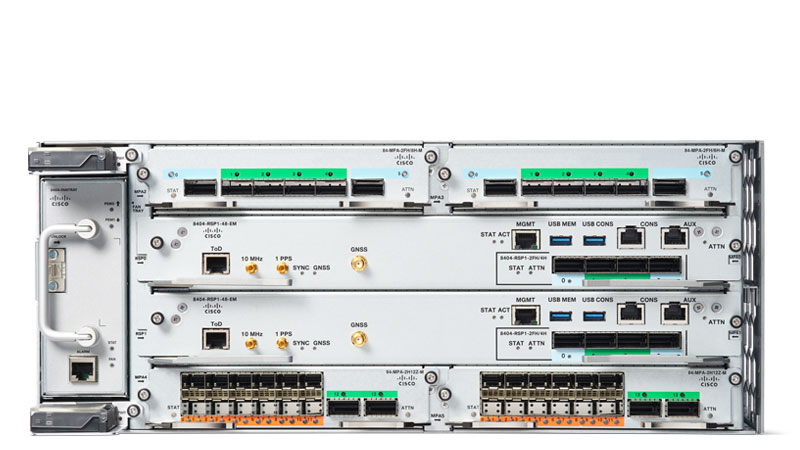
The Cisco ISR 4321 (PID ISR4321/K9) was the entry point into the ISR 4000 branch family and, for years, the default place to land a Cisco 1900-series router when that earlier generation went end-of-life. Now the 4321 is itself end-of-sale, and Cisco is steering its replacement traffic to the Catalyst 8200 Edge Platform, specifically the C8200-1N-4T. If you still run 4321s in branch offices, remote sites, or tactical/field racks, the clock on this platform is no longer theoretical. This guide lays out exactly what the milestone dates mean, why the C8200-1N-4T is the right successor for this class of router, and how to execute a clean migration that holds up to a federal or healthcare audit.
Where the ISR 4321 stands in its lifecycle
Cisco has published the full end-of-life schedule for ISR4321/K9. Three dates govern everything that follows, and they do not mean the same thing in practice:
- End of Sale: 2023-11-07. Cisco stopped taking new orders for the 4321 through normal channels on this date. Any genuinely new unit in the supply chain after this is pre-build inventory; everything else is refurbished or gray-market.
- End of SW maintenance: 2025-08-31. This is the date that should already worry you. After this point Cisco no longer produces maintenance releases or bug fixes for the IOS-XE images that run on the 4321. Critically, that includes the practical end of routine PSIRT security patching for the platform, new vulnerabilities found in its software train will generally not be remediated on this hardware.
- Last Day of Support (LDoS): 2028-11-30. The hard wall. After this date there is no TAC support, no RMA hardware replacement, and no entitlement under any SmartNet/Cisco service contract. A failed unit becomes a paperweight, and you carry the spare risk yourself.
The compliance angle is the part teams underestimate. Auditors increasingly treat 'past end of software maintenance' as equivalent to 'unsupported software' for control families like NIST SP 800-53 SI-2 (flaw remediation) and CM-6. You cannot remediate a flaw the vendor will not patch. The honest answer in an assessment is a documented refresh plan with a date, which is exactly what this guide helps you build. You can confirm the live milestone data on our ISR 4321 end-of-life page and see the broader picture on the Cisco EoL hub.
Why the Catalyst C8200-1N-4T is the right replacement
The C8200-1N-4T is not a like-for-like rebadge of the 4321, it is a generational jump on the same branch-edge mission. Both are 1RU fanless-class branch routers built around IOS-XE, but the architecture, performance ceiling, and licensing model are materially different.
Throughput and architecture
The ISR 4321 ships with a 50 Mbps aggregate throughput entitlement by default, upgradeable to 100 Mbps with a Performance (Boost) license. That was reasonable for a 2015-era branch with a T1/E1 or low-tens-of-megabits WAN. It is undersized for a modern site running broadband, fiber, or SD-WAN overlays with encryption. The C8200-1N-4T is engineered for multi-hundred-megabit to multi-gigabit branch throughput with IPsec/crypto handled in hardware, so encrypted SD-WAN tunnels do not collapse your forwarding rate the way they can on a maxed-out 4321. For most branches this removes the router as the WAN bottleneck entirely.
Ports, slots, and modularity
The 4321 provides 2 onboard GE WAN ports (one RJ-45, one RJ-45/SFP combo) plus a single NIM slot and an ISC slot, a constrained footprint that often forced compromises. The C8200-1N-4T's name describes its layout: 1 Network Interface Module (NIM) slot and 4 onboard 1G Ethernet (4T) ports. That gives you more native routed interfaces out of the box and preserves NIM investment for serial, T1/E1, LTE/5G, or DSL where you still need it. The Catalyst 8200 series also offers the C8200-1N-4T's sibling with pluggable interfaces, but for a 4321 swap the 4T is the natural fit.
SD-WAN and IOS-XE alignment
This is the strategic reason Cisco points 4321 customers at the 8200. The Catalyst 8200 is a first-class citizen of Cisco's unified IOS-XE SD-WAN (formerly Viptela) fabric, managed through Catalyst SD-WAN Manager (vManage). A 4321 can run SD-WAN, but it sits at the bottom of the supported envelope and its throughput headroom evaporates under overlay encryption and deep services. The 8200 is purpose-built for the autonomous-or-controller IOS-XE model and carries the platform forward as your branch architecture moves from traditional routing to policy-driven SD-WAN.
Licensing: from PAK/RTU to Smart Licensing and DNA
The 4321 era straddled old licensing, Right-to-Use (RTU) and PAK-based feature/performance licenses tied to the device. The C8200 runs entirely under Cisco Smart Licensing Using Policy (SLP) with tiered subscriptions: Network Essentials or Network Advantage for on-box features, layered with DNA Essentials/Advantage (or the SD-WAN subscription) for fabric, automation, and assurance. This is a real change to plan for: licenses live in your Smart Account, are term-based, and travel with entitlement rather than being burned permanently into a chassis. It is more flexible, but it means budgeting for subscription renewal, not a one-time license purchase.
A practical migration plan
1. Assessment and inventory
Start by enumerating every 4321 you own. On each device run show version, show inventory, and show license (or show license summary) to capture the running IOS-XE train, serial/PID, installed NIMs, and current performance/feature entitlements. Note WAN circuit type and real utilization per site, this tells you whether a straight 8200 swap is right or whether a site has outgrown the entry class and wants a Catalyst 8300. Record everything in your asset register; this inventory is also your audit evidence.
2. License transition
Stand up (or confirm) your Cisco Smart Account and Virtual Account before any hardware lands. New C8200 licenses are provisioned here. Map each old 4321 feature/performance license to its 8200 equivalent, most branches move to Network Advantage plus a DNA or SD-WAN subscription. Decide the term (3, 5, or 7 years) against your refresh horizon now, because that choice, not the chassis, dominates the lifetime cost.
3. Config and feature parity
Because both platforms run IOS-XE, much of your 4321 configuration ports over with minimal syntax change, a major advantage over cross-platform migrations. Build the 8200 config from the 4321 running-config, then validate the deltas: interface naming with the new 4-port layout, crypto/IPsec profiles (now hardware-accelerated), any NIM-specific config, QoS policies sized to the higher throughput, and SD-WAN onboarding if you are joining the fabric. Lab-test the candidate config before it ever touches a production site.
4. Physical: rack, power, interfaces, optics
The 8200 is 1RU like the 4321, so rack space is rarely an issue, but verify power (PoE-less branch routers still differ in PSU and draw), confirm SFP optics are compatible or budget replacements, and account for the move from the 4321's combo port to the 8200's 4x1G layout when you plan patching. Carry any reusable NIMs forward and order replacements for anything that does not transfer.
5. Phased cutover
Do not flash-cut a fleet. Pilot one or two low-risk sites, run the 8200 in parallel where the topology allows, and validate routing, WAN failover, encryption throughput, and SD-WAN policy before declaring the template good. Then roll site-by-site in waves with a documented back-out plan per site. Keep each retired 4321 on the shelf as a temporary spare only until its replacement is proven.
6. Secure decommission
A retired branch router holds crypto keys, pre-shared secrets, certificates, SNMP strings, and config that can map your network. Before disposal, wipe with a factory-reset and zeroize, physically pull and destroy or retain any storage per policy, and log the chain of custody. For federal and DoD environments follow your NIST SP 800-88 media sanitization procedure and keep the certificate of destruction with your audit package.
Procurement notes for government and enterprise buyers
- TAA compliance: For federal, DoD, and SLED buyers, confirm the C8200-1N-4T is sourced as a TAA-compliant build. Buying through an authorized partner gives you the country-of-origin documentation contracting officers require.
- Authorized sourcing: After the 4321's end-of-sale, the secondary market fills with refurbished and gray-market gear that carries no warranty and no clean SmartNet eligibility. New 8200s from an authorized channel keep you supportable and audit-clean.
- GPC: We support Government Purchase Card payment for in-threshold orders; uniqcli holds no GSA MAS, SEWP, or NASPO contract vehicle, so larger orders run through Simplified Acquisition (FAR Part 13) or a FAR-based purchase order.
- Lead times: Plan ahead. Branch-router lead times move with demand; sizing licenses and optics early prevents a stalled cutover. Browse the replacement platform in our catalog to scope a configuration.
The ISR 4321 had a good run as the branch workhorse, but it is past software maintenance and heading to LDoS, and the longer a fielded unit runs unpatched the harder it is to defend in an assessment. The Catalyst C8200-1N-4T gives you a higher throughput ceiling, hardware crypto, a cleaner SD-WAN path, and modern Smart Licensing on the same IOS-XE you already operate. The migration is well-trodden and largely config-portable, the work is in planning, not heroics. When you are ready to scope your refresh, get a quote and we will size the 8200 platform, licensing, and support to your fleet.
Frequently asked questions
Is the Cisco ISR 4321 (ISR4321/K9) still supported in 2026?
Partially, and not for long. End-of-sale was 2023-11-07 and end of software maintenance was 2025-08-31, so as of 2026 the 4321 no longer receives IOS-XE bug fixes or routine PSIRT security patches. TAC and RMA hardware support continue only until Last Day of Support on 2028-11-30. Running it past software maintenance is already a compliance exposure for regulated environments.
What replaces the Cisco ISR 4321?
Cisco directs ISR 4321 customers to the Catalyst 8200 Edge Platform, specifically the C8200-1N-4T. It is the same 1RU branch-edge class running IOS-XE, but with four onboard 1G ports, a NIM slot, hardware-accelerated crypto, much higher aggregate throughput, native Catalyst SD-WAN support, and modern Smart Licensing.
How much better is the C8200-1N-4T than the ISR 4321 on throughput?
Substantially. The 4321 ships at 50 Mbps aggregate throughput by default, upgradeable to 100 Mbps with a Performance (Boost) license. The C8200-1N-4T is built for multi-hundred-megabit to multi-gigabit branch forwarding with hardware crypto, so encrypted SD-WAN tunnels do not throttle the router the way they can on a maxed-out 4321.
Will my ISR 4321 configuration work on the Catalyst 8200?
Mostly, yes. Both platforms run IOS-XE, so the bulk of a 4321 running-config ports over with minimal syntax change. You will need to adjust for the 8200's four-port interface layout, validate crypto/IPsec and QoS against the higher throughput, handle any NIM-specific config, and complete SD-WAN onboarding if you join the fabric. Always lab-test the candidate config before a production cutover.
What changes with licensing when moving from the ISR 4321 to the C8200?
The licensing model changes from the 4321's older PAK/RTU feature and performance licenses to Cisco Smart Licensing Using Policy. The C8200 uses tiered subscriptions, Network Essentials or Advantage on-box, plus DNA or the SD-WAN subscription, provisioned through your Smart Account and tied to term-based entitlement. Budget for subscription renewal rather than a one-time license, and stand up the Smart Account before hardware arrives.
Uniqcli Team
The Uniqcli Team is an authorized Cisco partner specializing in Catalyst wireless, switching, datacenter fabric, licensing, and managed services for U.S. federal, state, local, and education customers. We scope Cisco bills of materials, validate procurement paths (TAA, FIPS, contract vehicles), and deliver design, deployment, and managed operations.
Ready to scope your Cisco build?
Build a quoteRelated reading
View all →GuidesISR 4331 End of Life: Migrating to the Catalyst C8200-1N-4T
A practical, partner-grade guide to replacing the end-of-life Cisco ISR 4331 (ISR4331/K9) with the Catalyst C8200-1N-4T edge platform before Last Day of Support on November 30, 2028.
November 27, 2025 · 8 min read Guides
Cisco 1941W EoL: Migrate to Catalyst 8200 C8200-1N-4T
The Cisco 1941W reached Last Day of Support on December 31, 2021, no patches, no TAC, no RMA. Here is what the EoL milestones mean and how to migrate cleanly to the Catalyst 8200 Edge Platform (C8200-1N-4T), including the licensing and wireless changes that catch teams off guard.
April 22, 2026 · 6 min readGuidesCisco 1921 (CISCO1921/K9) EoL: Migrate to the ISR 4221
The Cisco 1921 ISR hit Last Day of Support on September 30, 2023, here is a concrete, branch-tested plan to migrate to the supported ISR 4221.
December 5, 2025 · 7 min read Guides
UCS-E180D-M3/K9 vSAN EoL: Migrate to UCS-E1100D-M6
The UCS E-Series vSAN module (UCS-E180D-M3/K9) hits Last Day of Support on November 30, 2026. Here's why branch hyperconverged compute on ISR 4000 must move to the UCS-E1100D-M6 on Catalyst 8000, specs, licensing, and a clean cutover plan.
February 25, 2026 · 10 min readGuidesCisco 7606-S EoL: Migrating to the Catalyst 8500 (C8500-12X)
The Cisco 7606-S (CISCO7606-S) passed Last Day of Support on July 31, 2021. Here is why the chassis must come out and how to migrate its WAN-edge roles cleanly to the IOS XE-based Catalyst 8500 (C8500-12X).
May 7, 2026 · 7 min readGuidesCisco 1941 (CISCO1941/K9) to ISR 4221 Migration Guide
The Cisco 1941 ISR is past Last Day of Support, here is an expert plan to migrate CISCO1941/K9 branch routers to the IOS-XE-based ISR 4221.
December 6, 2025 · 8 min read