
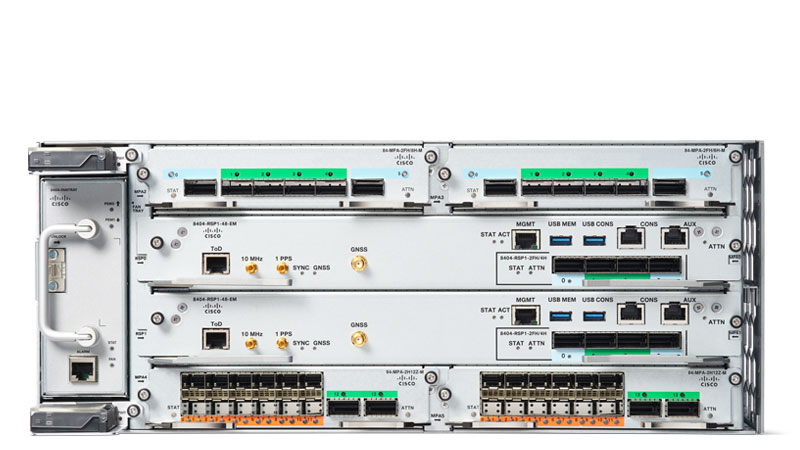
The Cisco 3945 Integrated Services Router (PID CISCO3945/K9) was the flagship of the ISR G2 3900 family, the largest 3900 chassis, built for high-density branches that needed to host routing, security, voice gateway, and on-box application services in a single 3RU box. If you still have 3945s carrying production traffic, you are now operating well past every Cisco support milestone, and the gap between "it still works" and "it is supportable" has become a real audit and security liability. This guide explains exactly where the 3945 stands, why the Cisco-designated replacement is the ISR 4451-X (PID ISR4451-X/K9), what concretely improves when you move, and how to run the refresh cleanly for a government or enterprise environment.
Where the Cisco 3945 stands today
The 3945 has crossed all three end-of-life gates. End of Sale was December 9, 2017; End of Software Maintenance was December 9, 2020; and the Last Day of Support (LDoS) was December 31, 2022. In practical terms, the platform is fully retired, there is no remaining path to patched software, a replacement chassis under contract, or a TAC engineer who will open a case on it. Every month it stays in service is a month of accumulating, unmitigatable risk.
What each milestone actually means
- End of Sale (Dec 2017): Cisco stopped selling new CISCO3945/K9 chassis. Anything sourced after this date is used, refurbished, or gray-market, and only TAA-compliant, partner-sourced units belong in a federal environment.
- End of Software Maintenance (Dec 2020): the last maintenance IOS 15.x rebuilds shipped. No bug fixes and, critically, no security fixes have been produced for the platform since.
- Last Day of Support / LDoS (Dec 2022): the contractual end. No TAC, no RMA, no entitlement. SmartNet cannot be purchased or renewed against the PID.
The replacement: Cisco ISR 4451-X
Cisco's migration bulletin maps the 3945 directly to the ISR 4451-X/K9, and the jump in architecture is significant. The 3945 is a single-CPU ISR G2 running monolithic IOS 15.x, rated at roughly 150 Mbps of throughput with services enabled. The 4451-X is built on a multicore x86 architecture running modular IOS XE, with a hard separation of control plane, data plane, and a dedicated services plane. That separation is the headline benefit: enabling deep services (NBAR2, AVC, IPsec, firewall) no longer starves the routing engine the way it could on the G2.
- Throughput: up to 1 Gbps of default system/IPsec performance, upgradeable to 2 Gbps with the performance (boost) license, roughly a 6x to 13x lift over the 3945's ~150 Mbps services-on ceiling.
- Interfaces and slots: four onboard Gigabit Ethernet ports, three NIM (Network Interface Module) slots, two SM-X service-module slots, and an internal services-card (ISC) slot, replacing the 3945's mix of 4 EHWIC, 2 SM, and 1 ISM slot with denser, higher-bandwidth modules.
- Resources: default 4 GB control-plane DRAM plus 2 GB data-plane DRAM and 8 GB flash, versus the 3945's default 1 GB DRAM / 256 MB compact flash, headroom for IOS XE, telemetry, and on-box containers.
- Software model: native Cisco Catalyst SD-WAN support on IOS XE, so the same chassis can run traditional routing today and be onboarded to SD-WAN fabric later without a forklift.
The licensing change you must plan for
This is the part teams underestimate. The 3945 used PAK-based and right-to-use feature licensing tied to the IOS universal image (IP Base, SEC, UC, Data feature sets unlocked per device). The 4451-X uses Cisco Smart Licensing with DNA-based subscriptions, DNA Essentials or DNA Advantage, managed centrally through your Smart Account and Smart Software Manager (CSSM or on-prem satellite). There is no like-for-like PAK transfer: you are moving from a perpetual, per-box feature-set model to a subscription tied to a Smart Account. Budget the subscription term and assign the licenses to your Virtual Account before the cutover so the 4451-X boots with the entitlements you actually need.
Worth noting for long-term planning: the 4451-X itself has since been superseded by the Cisco Catalyst 8300 Series, which is effectively a hardware refresh of the ISR 4400 line. If your refresh horizon is multi-year and SD-WAN-first, ask your partner to price both, the 4451-X is the Cisco-blessed direct replacement, while the Catalyst 8300 is the current-generation successor with the longest runway ahead of it.
A practical migration plan
1. Assessment and inventory
Pull the running config, IOS version, installed feature sets, and every populated slot from each 3945 (EHWIC, SM, ISM, PVDM). Document T1/E1 or serial WICs, on-box voice DSP usage, and any SRE/application module. This inventory drives both the 4451-X module bill of materials (NIM/SM-X equivalents) and the DNA license tier you need.
2. License transition
Stand up or confirm your Cisco Smart Account and Virtual Account, then provision DNA Essentials or Advantage to match the feature parity your 3945 config requires (security, voice gateway, advanced routing). Do this before hardware arrives so registration is a non-event on cutover night.
3. Config and feature parity
IOS 15.x configs do not paste cleanly into IOS XE. Most routing, NAT, ACL, and crypto syntax carries over, but voice gateway, zone-based firewall, and QoS sections need review against IOS XE conventions. Build the 4451-X config in a lab or staging unit, validate IPsec/IKEv2 against your peers, and confirm DSP/voice translation if the 3945 was an SRST or PSTN gateway.
4. Physical: rack, power, optics, modules
The 4451-X is a 2RU chassis (the 3945 is 3RU), so you gain rack space. Confirm power: the 4451-X uses internal AC or DC supplies with optional redundancy, verify your PDU and circuit before install. Re-source SFP optics for the onboard GE/SFP ports, and order the NIM/SM-X modules that replace your EHWIC/SM cards (legacy EHWICs are not slot-compatible). The 3945 has no integrated PoE switching, so PoE-attached endpoints stay on their access switches, no change there.
5. Phased cutover
Pre-stage and burn-in the 4451-X, then cut over per-site in a maintenance window: pre-load config, swap WAN handoff and LAN uplinks, verify routing adjacencies and IPsec tunnels come up, and run a smoke test before declaring success. Keep the 3945 racked and cabled for a defined rollback window before you decommission.
6. Secure decommission
Once stable, wipe the 3945: erase startup/running config and any stored keys (write erase, delete /force flash and NVRAM), and for sensitive sites follow your sanitization standard (NIST SP 800-88) before the chassis leaves the building. Track the asset disposal for audit. See the full milestone detail on the CISCO3945/K9 EoL page, or browse the broader end-of-life hub to schedule the rest of your G2 fleet.
Procurement notes for government and enterprise buyers
- TAA compliance: for federal and DoD, the ISR4451-X/K9 must be sourced through an authorized partner that can document country-of-origin and Trade Agreements Act compliance, gray-market 4451-X chassis fail this test.
- Payment options: Government Purchase Card (GPC) is accepted for in-threshold orders; larger refreshes can be structured as Simplified Acquisition or FAR-based purchase orders. We do not currently hold a GSA Schedule or SEWP contract.
- Lead times: plan ahead, 4451-X chassis, NIM/SM-X modules, and DNA subscriptions can carry multi-week lead times, and you want hardware staged before the 3945 fails on its own schedule.
- Authorized sourcing: buying from an authorized Cisco partner secures genuine hardware, valid Smart Licensing entitlement, and SmartNet/Success Tracks eligibility from day one.
The 3945 served well, but it is past LDoS and out of runway. Moving to the ISR 4451-X recovers your support entitlement, closes the security-patch gap, and gives you a multicore IOS XE platform ready for SD-WAN. Get a refresh quote or browse the ISR 4451-X in our catalog to start.
Frequently asked questions
Is the Cisco 3945 (CISCO3945/K9) still supported by Cisco?
No. The 3945 reached End of Sale on December 9, 2017, End of Software Maintenance on December 9, 2020, and its Last Day of Support (LDoS) on December 31, 2022. After LDoS there are no new IOS security patches, no TAC cases, and no hardware RMA, the platform is fully retired.
What is the recommended replacement for the Cisco 3945?
Cisco's migration bulletin maps the 3945 to the ISR 4451-X (PID ISR4451-X/K9), a multicore IOS XE router with up to 2 Gbps throughput, four onboard GE ports, three NIM and two SM-X slots, and 8 GB flash. The current-generation successor is the Catalyst 8300, which is worth pricing for SD-WAN-first, multi-year refreshes.
How much faster is the ISR 4451-X than the 3945?
The 3945 tops out around 150 Mbps with services enabled. The 4451-X delivers up to 1 Gbps of default system and IPsec throughput, upgradeable to 2 Gbps with the performance license, roughly a 6x to 13x increase, and its control/data/services plane separation keeps routing stable even with heavy services enabled.
Do my 3945 licenses transfer to the ISR 4451-X?
No. The 3945 used PAK and right-to-use feature-set licensing tied to the IOS universal image. The 4451-X uses Cisco Smart Licensing with DNA Essentials or DNA Advantage subscriptions managed through your Smart Account. Provision the matching DNA tier in your Virtual Account before cutover; there is no direct PAK transfer.
Will my existing 3945 modules and config work in the ISR 4451-X?
Not directly. EHWIC, SM, and ISM cards from the 3945 are not slot-compatible with the 4451-X's NIM and SM-X slots, so you re-source equivalent modules. IOS 15.x configs also need conversion to IOS XE, most routing, NAT, and crypto carries over, but voice gateway, zone-based firewall, and QoS sections require review.
Uniqcli Team
The Uniqcli Team is an authorized Cisco partner specializing in Catalyst wireless, switching, datacenter fabric, licensing, and managed services for U.S. federal, state, local, and education customers. We scope Cisco bills of materials, validate procurement paths (TAA, FIPS, contract vehicles), and deliver design, deployment, and managed operations.
Ready to scope your Cisco build?
Build a quoteRelated reading
View all → Guides
Cisco 1941W EoL: Migrate to Catalyst 8200 C8200-1N-4T
The Cisco 1941W reached Last Day of Support on December 31, 2021, no patches, no TAC, no RMA. Here is what the EoL milestones mean and how to migrate cleanly to the Catalyst 8200 Edge Platform (C8200-1N-4T), including the licensing and wireless changes that catch teams off guard.
April 22, 2026 · 6 min readGuidesCisco 3925 (CISCO3925/K9) to ISR 4431: EoL Migration Guide
The Cisco 3925 ISR is past Last Day of Support, here is how to migrate cleanly to the ISR 4431 (or Catalyst 8300) without losing feature parity.
December 14, 2025 · 7 min read Guides
WS-C2960XR-24PD-I EoL: Migrate to Catalyst 9200 (C9200-24P)
A senior architect's guide to migrating the end-of-life Cisco Catalyst 2960-XR 24-port PoE switch (WS-C2960XR-24PD-I) to the recommended Catalyst 9200 24-port PoE+ (C9200-24P).
October 24, 2025 · 8 min readGuidesCisco 2951 (CISCO2951/K9) Replacement: ISR 4351 Migration Guide
The Cisco 2951 ISR hit Last Day of Support on December 31, 2022; here is what each end-of-life milestone means and how to plan a clean migration to the ISR 4351.
December 12, 2025 · 8 min readGuidesCisco 2911 (CISCO2911/K9) End of Life: ISR 4331 Refresh Guide
The Cisco 2911 ISR G2 reached last day of support on December 31, 2022; here is a practical, partner-vetted plan to migrate it to the Cisco ISR 4331 (and Catalyst 8300) without breaking your branch.
December 8, 2025 · 7 min read Guides
Catalyst 6509-E EoL: Migrate to the Catalyst 9600
The WS-C6509-E passed Last Day of Support on April 26, 2021. Here is what each milestone means, why an unsupported core is a real risk, and how to migrate cleanly to the Catalyst 9600 (C9606R).
May 22, 2026 · 8 min read