
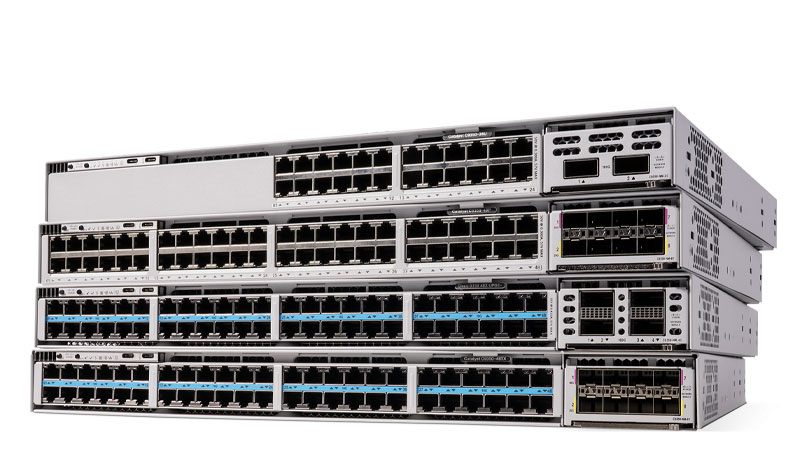
If a Cisco Catalyst 6509-E (PID WS-C6509-E) is still anchoring your campus core or distribution layer, it is now several years past every Cisco lifecycle milestone that matters. End of Sale was October 31, 2017, and Last Day of Support (LDoS) was April 26, 2021. That means there are no more software fixes, no PSIRT security patches, and no TAC support or RMA hardware replacement for this chassis, its Supervisor Engine 2T, or its 67xx line cards. The platform keeps forwarding traffic, which is precisely why so many of these chassis quietly remain in production long after they should have been retired. This guide explains what those dates actually mean for a running network, why the Catalyst 9600 (C9606R) is a genuine generational upgrade rather than a like-for-like swap, and how to plan a low-risk migration.
6509-E lifecycle at a glance: End of Sale: October 31, 2017. Last Day of Support (LDoS): April 26, 2021. Both dates have passed. The full milestone record and replacement mapping live on the EoL detail page for this PID: /cisco-eol/ws-c6509-e.
What the Catalyst 6509-E actually was
The 6509-E is a 9-slot, 15RU modular chassis from the Catalyst 6500-E family, the platform that defined Cisco enterprise core and distribution for nearly two decades. In its last supported configuration it ran the Supervisor Engine 2T (VS-SUP2T-10G), which paired a Policy Feature Card 4 (PFC4) and the EARL8 forwarding ASIC with an 80 Gbps-per-slot crossbar fabric, for up to 2 Tbps of system bandwidth and roughly 720 Mpps of forwarding when fully built out. Around the supervisor sat the 67xx and WS-X69xx line cards: 6748 and 6848 Gigabit cards, 6716/6908 10-Gigabit cards, and a deep bench of service modules (ASA-SM firewall, WiSM2 wireless, NAM). It ran classic Cisco IOS (12.2SX/15.x SY trains), not IOS XE. For its era it was the gold standard. By today's standards it is a power-hungry 1G/10G platform with no native 25G, 40G, 100G, or 400G, no modern Smart Licensing, and an ASIC generation that predates programmable telemetry.
Why acting now matters
The danger of an end-of-life core switch is not that it fails. It is that it keeps working flawlessly while the support floor disappears beneath it. After LDoS, three exposures compound:
- No PSIRT security patches. When a new IOS or Supervisor 2T vulnerability is disclosed, the 6509-E will never receive a fixed image. The code is frozen at the 2021 cutoff, so any CVE that touches that software path on this hardware is permanent and unremediable by patching. For a device sitting at the center of your campus, that is the worst possible place for an open, unfixable vulnerability.
- No TAC or RMA. A failed supervisor, fabric, or line card cannot be opened as a Cisco support case or swapped under contract. Your only recovery path is a cold spare you stockpiled before LDoS or a gray-market board of the same dead-end generation, with no guarantee of authenticity or remaining life.
- Audit and compliance exposure. The frameworks federal, DoD, SLED, and healthcare buyers operate under (FedRAMP, CMMC 2.0, the HIPAA Security Rule, PCI DSS, and CISA directives) all expect supported, patchable infrastructure. An unsupported core that cannot receive security fixes is a finding waiting to happen, and 'the vendor stopped shipping patches' is not a defensible remediation plan to an auditor.
There is also a hard operational ceiling. The 6509-E tops out at 10G. As you adopt Wi-Fi 6/6E access points with multigigabit uplinks, 25G/100G server and storage edges, and 100G+ data-center interconnects, a 10G core becomes the bottleneck the entire campus routes around. You cannot license your way past silicon that physically cannot do the speeds your edge now demands.
What each milestone means in practice
- End of Sale (2017-10-31): the last day Cisco accepted new orders for the WS-C6509-E. Everything since has been consuming the support tail.
- Last Day of Support / LDoS (2021-04-26): the hard wall. No TAC, no RMA, no patches of any kind, no exceptions. From this date the hardware is entirely on its own, and any contract you still pay for it buys nothing enforceable.
The recommended replacement: Catalyst 9600 (C9606R)
The Catalyst 9600 is Cisco's modern modular core and is the named successor for 6500-E-class aggregation. The C9606R is a 6-slot, 8RU chassis (4 line-card slots plus 2 supervisor slots) that is markedly denser and dramatically faster than the 15RU 6509-E it replaces. Critically, it runs Cisco IOS XE, the model-driven OS that brings open NETCONF/RESTCONF/gNMI APIs over YANG, streaming telemetry, and up to 960 GB of SSD for on-box container application hosting, all of which the classic-IOS 6500 simply cannot do.
Concretely better for a campus core
- Throughput in a different league. With the C9600-SUP-1 (three Cisco UADP 3.0 ASICs) the chassis delivers up to 9.6 Tbps switching and 3 Bpps forwarding; with the C9600X-SUP-2 (a single 7nm Cisco Silicon One Q200 with 8 GB on-chip HBM) it reaches up to 25.6 Tbps and 8 Bpps. Either is roughly five to twelve times the ~2 Tbps the Supervisor 2T 6509-E delivered.
- Speeds the 6509-E never had. Up to 224 SFP56 ports at 10/25/50G, up to 128 QSFP28 at 40/100G, and up to 8 native 400G QSFP-DD, plus a 48-port multigigabit copper card (100M/1/2.5/5/10G BASE-T) to land mGig access uplinks directly on the core.
- Far higher control-plane scale. SUP-2 supports up to 256,000 MAC addresses and 2,000,000 IPv4 routes (vs. SUP-1's 128,000 MAC / 256,000 routes), enough headroom for collapsed-core and internet-gateway roles that strained the older PFC4.
- Modern high availability. 1+1 redundant supervisors with SSO, NSF, and full-image ISSU keep forwarding alive during switchovers and upgrades. StackWise Virtual collapses two chassis into one logical switch (the modern answer to VSS on the 6500), and Software Maintenance Upgrade (SMU) hot patching applies critical fixes without a reload, the exact capability the 6509-E lacks.
- Hardware-rooted security. 256-bit AES-GCM MACsec on the line cards, optional WAN MACsec with the HSEC license on SUP-2, plus Cisco Trust Anchor (image signing, Secure Boot, TAM/TPM) for supply-chain integrity, directly relevant to TAA and DoD trust requirements.
Licensing changed: plan for Smart Licensing: The 6500 used perpetual feature-set images. The Catalyst 9600 uses Cisco Smart Licensing through Smart Accounts and Cisco Smart Software Manager. Each switch ships with base Network Advantage and requires an add-on subscription (Cisco DNA Advantage or the newer Catalyst subscription) in 3-, 5-, or 7-year terms, optionally consolidated under an Enterprise Agreement. Budget for the subscription, not just the hardware, and set up the Smart Account before you rack anything.
A practical migration plan
1. Assessment and inventory
Start with show inventory, show module, and show version on every 6509-E to capture the exact supervisor, fabric, line cards, and IOS train in play. Pull the running configuration and document what the chassis really does: VSS or standalone, the L2/L3 boundary, SVIs and HSRP/VRRP groups, OSPF/EIGRP/BGP processes, VRFs, QoS policies, and any service modules (ASA-SM, WiSM2) that need a separate landing spot, since the 9600 is a pure switching platform and does not host those blades.
2. Feature and config parity
This is the step teams underestimate: the 6509-E runs classic IOS and the 9600 runs IOS XE, so configurations do not port verbatim. Most routing and switching constructs translate cleanly, but syntax, QoS (MQC remains, but hardware queuing models differ), MACsec, and any TCAM-template tuning must be re-validated. Build the new configs in a lab or on a bench C9606R, confirm protocol convergence and feature parity, and treat the migration as a rewrite-and-verify, not a copy-paste.
3. Physical: rack, power, optics, uplinks
- Space and power: the 9600 is 8RU vs. 15RU and far more power-efficient per Gbps. Plan PSUs (3000W/2000W AC or 2000W DC, up to four bays in Combined or N+1 mode) and confirm PDU and cooling before install.
- Optics: 6500 used X2, XENPAK, and SFP/SFP+. The 9600 uses SFP56, QSFP28, and QSFP-DD. Budget a fresh optics BOM; old transceivers do not carry over.
- Uplinks and cabling: map every 10G uplink to its 25G/100G/400G equivalent and plan breakout cabling (QSFP-4SFP) where you are landing many 10/25G links on a high-speed line card.
4. Phased cutover
Avoid a forklift. Rack the C9606R alongside the live 6509-E, bring up routing adjacencies in parallel, and migrate VLANs/SVIs and uplinks in maintenance windows, ideally moving the HSRP/VRRP active or StackWise Virtual primary role last. Validate end-to-end reachability, multicast, and QoS at each step so you always have a rollback to the 6500 until the new core is proven.
5. Secure decommission
Once traffic is fully cut over, wipe configurations and credentials, then dispose through a process that meets your data-handling and chain-of-custody requirements. For federal and healthcare environments, document destruction or certified return so the retired asset is accounted for in your audit trail.
Procurement notes for regulated buyers
Modular core hardware carries real lead times, so start the C9606R order, supervisor selection (SUP-1 vs. SUP-2), line cards, optics, and the Smart Licensing subscription well ahead of your target cutover. For US federal, DoD, and SLED contracts, confirm TAA compliance and align purchasing to your GPC, GSA, or contract vehicle, and order through an authorized Cisco partner so warranties, Smart Account entitlement, and supply-chain trust are intact. Browse current Catalyst switching options in our catalog, review the full milestone history on the Cisco EoL hub, and when you are ready to scope a refresh, get a quote and we will build a parity-checked C9606R bill of materials with optics and licensing for your environment.
Ready to replace your 6509-E?: uniqcli is an authorized Cisco partner serving federal, DoD, SLED, healthcare, and enterprise buyers. Get a TAA-compliant Catalyst 9600 (C9606R) migration quote with supervisor, line-card, optics, and Smart Licensing scoped to your core. Start at /get-a-quote.
Frequently asked questions
Is the Cisco Catalyst 6509-E still supported?
No. The WS-C6509-E reached End of Sale on October 31, 2017 and Last Day of Support (LDoS) on April 26, 2021. Since LDoS there have been no software updates, no PSIRT security patches, and no TAC support or RMA hardware replacement for the chassis, Supervisor Engine 2T, or its line cards. Any 6509-E in production today is unsupported and unpatchable.
What replaces the Catalyst 6509-E?
Cisco's recommended modern replacement for 6500-E-class campus core and distribution is the Catalyst 9600, specifically the C9606R chassis. It runs IOS XE, delivers up to 25.6 Tbps with the Silicon One Q200 supervisor, supports 25G/100G/400G interfaces and mGig copper, and adds StackWise Virtual, ISSU, MACsec, and Smart Licensing, in 8RU instead of the 6509-E's 15RU.
Can I reuse my 6500 line cards and optics in a Catalyst 9600?
No. The Catalyst 9600 is a new platform with its own UADP 3.0 or Silicon One supervisors and line cards, and it uses SFP56, QSFP28, and QSFP-DD optics rather than the 6500's X2, XENPAK, and SFP/SFP+ modules. Plan a fresh line-card and optics bill of materials. Service modules like the ASA-SM and WiSM2 also have no slot in the 9600 and need separate replacements.
How is licensing different on the Catalyst 9600 versus the 6500?
The 6500 used perpetual feature-set IOS images. The Catalyst 9600 uses Cisco Smart Licensing managed through a Smart Account and Cisco Smart Software Manager. Each switch ships with base Network Advantage and requires an add-on subscription (Cisco DNA Advantage or the newer Catalyst subscription) in 3-, 5-, or 7-year terms, which can be consolidated under an Enterprise Agreement. Budget for the recurring subscription, not just the hardware.
Do I have to do a forklift replacement, or can I migrate gradually?
You can and should migrate gradually. Rack the C9606R next to the live 6509-E, bring up routing adjacencies in parallel, and move VLANs, SVIs, and uplinks during maintenance windows, transferring the HSRP/VRRP active or StackWise Virtual primary role last. Because IOS and IOS XE configurations are not byte-for-byte compatible, validate feature parity in a lab first and keep the 6500 as rollback until the new core is proven.
Uniqcli Team
The Uniqcli Team is an authorized Cisco partner specializing in Catalyst wireless, switching, datacenter fabric, licensing, and managed services for U.S. federal, state, local, and education customers. We scope Cisco bills of materials, validate procurement paths (TAA, FIPS, contract vehicles), and deliver design, deployment, and managed operations.
Ready to scope your Cisco build?
Build a quoteRelated reading
View all → Guides
Cisco Catalyst 4900M EoL: Migrate to Nexus 9300 (93180YC-FX3)
The Catalyst 4900M (WS-C4900M) passed Last Day of Support on October 5, 2021. Here's why it has to leave the rack and how to migrate cleanly to the Nexus 9300 N9K-C93180YC-FX3 top-of-rack switch.
May 5, 2026 · 8 min read Guides
WS-C3650-48PD-S End of Life: Migrate to Catalyst 9300L
A practical refresh guide for moving the Catalyst 3650 48-port PoE switch (WS-C3650-48PD-S) to the Catalyst 9300L before the October 31, 2026 last day of support.
November 5, 2025 · 7 min readGuidesWS-C2960XR-48FPD-I End of Life: Migrate to Catalyst 9200
The Catalyst 2960-XR 48-port PoE+ switch is past end of sale with support ending October 31, 2027; here is a concrete plan to refresh it to the Catalyst 9200 C9200-48P.
October 25, 2025 · 8 min readGuidesWS-C2960XR-24PD-I EoL: Migrate to Catalyst 9200 (C9200-24P)
A senior architect's guide to migrating the end-of-life Cisco Catalyst 2960-XR 24-port PoE switch (WS-C2960XR-24PD-I) to the recommended Catalyst 9200 24-port PoE+ (C9200-24P).
October 24, 2025 · 8 min readGuidesCisco 2960-24TC-L EoL: Migrate to Catalyst 9200L Guide
The original Catalyst 2960-24TC-L (WS-C2960-24TC-L) passed Last Day of Support on October 31, 2019. Here's why this Fast Ethernet LAN Base switch must come out, and how to refresh cleanly to the Gigabit, PoE+ Catalyst 9200L-24P-4X.
June 7, 2026 · 7 min readGuidesCisco Nexus 5548P EoL: Migrate to Nexus 9300 (93180YC-FX3)
The Nexus 5548P passed Last Day of Support on September 30, 2020, no patches, no TAC, no RMA. Here is why it must come out of the rack and how to migrate cleanly to the Nexus 9300 (N9K-C93180YC-FX3).
May 27, 2026 · 8 min read