
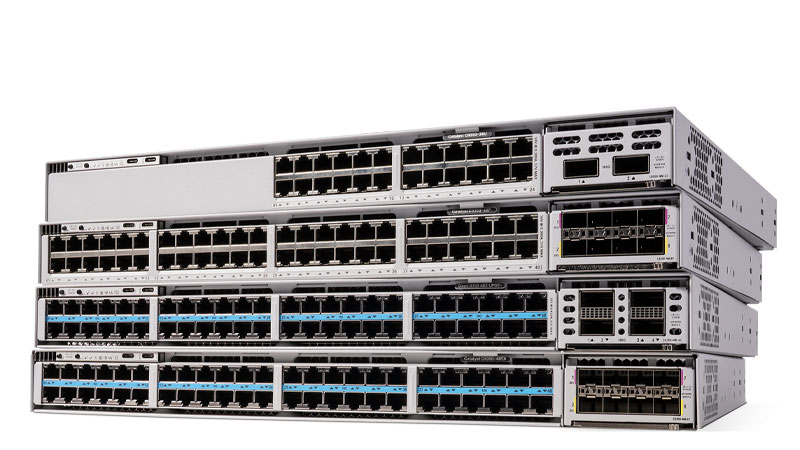
The Cisco Catalyst 2960-XR 24 GigE PoE switch with 10G uplinks and IP Lite (PID WS-C2960XR-24PD-I) has reached the end of its lifecycle. Cisco stopped selling it on October 31, 2022, and its final milestone, Last Day of Support, arrives on October 31, 2027. If this switch is still carrying production access traffic in your wiring closets, you are now operating inside a fixed and shrinking support window. This guide explains exactly what each milestone means for a 2960-XR fleet, why the recommended Catalyst 9200 24-port PoE+ (C9200-24P) is a genuine generational upgrade rather than a like-for-like swap, and how to plan a low-risk migration that holds up to federal, DoD, SLED, and healthcare audit scrutiny.
Why the WS-C2960XR-24PD-I end-of-life matters now
The 2960-XR is a solid Layer 2/Layer 3-lite access switch: 24 ports of 10/100/1000, two 10G SFP+ uplinks, a 370W PoE+ (802.3at) budget, and the IP Lite feature set that adds static routing, RIP, and EIGRP-stub on top of the LAN Base capabilities. It runs classic Cisco IOS and stacks via FlexStack-Plus. None of that changes the fact that it is now a legacy platform with a hard support clock running against it.
The risk is not that the hardware suddenly stops forwarding packets on a milestone date. The risk is everything that disappears around it. Cisco PSIRT stopped releasing software maintenance and security fixes for this platform after October 31, 2023. That means any IOS vulnerability disclosed against the 2960-XR code train after that date has no vendor patch coming. For organizations that map findings to CISA Known Exploited Vulnerabilities, NIST 800-53, CMMC, or HIPAA technical safeguards, an unpatchable production switch is a documented, recurring audit finding that you cannot remediate by patching, only by replacing. Acting before LDoS lets you retire the platform on your schedule instead of an auditor's or an incident responder's.
What each milestone date actually means
End of Sale: October 31, 2022
You can no longer buy the WS-C2960XR-24PD-I new through Cisco. New units in the channel are remaining inventory, gray-market, or refurbished. For TAA-regulated buyers this is a sourcing problem in itself, because provenance and country-of-origin documentation get harder to guarantee on a discontinued SKU.
End of Software Maintenance: October 31, 2023 (already passed)
This is the milestone most people underestimate. As of this date Cisco no longer publishes maintenance releases, bug fixes, or security patches for the 2960-XR. Every PSIRT advisory that touches its IOS train from here forward is, for your switch, permanently open. TAC can still help you operate it under contract, but they cannot hand you a fixed image.
Last Day of Support (LDoS): October 31, 2027
After this date the platform is fully retired. No Cisco TAC cases, no RMA hardware replacement, no contract renewals. A failed power supply or a dead unit becomes a scavenge-for-spares exercise. Any SmartNet you hold lapses with the platform. Plan to have the last 2960-XR de-racked before this date, not on it.
The replacement: Catalyst 9200 24-port PoE+ (C9200-24P)
Cisco positions the Catalyst 9200 24-port PoE+ Base Switch (C9200-24P) as the direct successor, and for this product type it is a real step up rather than a parts swap. The most important architectural change is the move from classic IOS to IOS-XE on a UADP-based ASIC. IOS-XE brings a Linux-based, modular control plane with model-driven programmability (NETCONF/RESTCONF, YANG), patchable subpackages, and far better telemetry than the monolithic IOS on the 2960-XR.
Concrete hardware and capability gains
- Stacking: the C9200 uses StackWise-160 (160 Gbps stack bandwidth, up to 8 members), versus FlexStack-Plus on the 2960-XR. Note the distinction within the family: the higher-volume C9200L variant uses StackWise-80, so if back-panel stack bandwidth matters, the true C9200 (not 9200L) is the one you want.
- Uplinks: the C9200 takes modular network modules, so you can choose 4x 1G, 4x 10G SFP+, or 4x multigigabit (mGig) uplinks. That replaces the 2960-XR's fixed 2x 10G SFP+ and gives you a clean path to 25G-capable aggregation later.
- PoE budget: the C9200-24P delivers a substantially larger PoE+ budget (roughly 740W with the appropriate power supply) versus the 2960-XR's 370W, so it powers more 802.3at endpoints, or pairs with UPOE-capable models in the family for 60W devices the 2960-XR could never feed.
- Throughput and tables: UADP silicon gives larger TCAM, deeper buffers, and meaningfully higher switching capacity than the 2960-XR's fixed-function ASIC, plus hardware support for VXLAN and SD-Access fabric edge roles the 2960-XR cannot do.
- Resilience: field-replaceable, redundant power supplies and fans (FRU PSUs) on the C9200 versus the 2960-XR's design, reducing the blast radius of a hardware failure.
- Trustworthy hardware: Secure Boot, image signing, and Trust Anchor anti-counterfeit silicon, which directly support supply-chain and integrity controls that the 2960-XR predates.
The licensing model changes: from perpetual feature sets to Smart Licensing + DNA
This is the single biggest operational difference and the one that surprises buyers. The 2960-XR used perpetual, per-image feature licensing (LAN Base, IP Lite, IP Services). The Catalyst 9200 uses Smart Licensing with a two-tier model: a perpetual base tier (Network Essentials or Network Advantage) plus a term-based Cisco DNA subscription (DNA Essentials or DNA Advantage), typically sold in 3-, 5-, or 7-year terms and managed through your Smart Account on Cisco's Smart Software Manager. Your existing IP Lite functionality maps comfortably to Network Essentials with DNA Essentials. Budget for the DNA subscription as a recurring line item, and stand up a Smart Account before procurement so license assignment at deployment is not a blocker.
A practical migration plan
1. Assessment and inventory
Pull the running config, show version, show inventory, and show power inline from each 2960-XR. Capture the per-switch PoE draw, the IP Lite features actually in use (static routes, RIP, SVIs, VLAN count), VLAN/VTP topology, port-security and 802.1X posture, and uplink optics. This inventory is what right-sizes the order and de-risks the cutover.
2. License transition
Create or confirm your Cisco Smart Account, choose Network Essentials/Advantage to match your feature needs, and select a DNA term that aligns with your refresh horizon. There is no transfer of the old perpetual IP Lite license; the 9200 licensing is net-new and must be ordered with the hardware.
3. Config and feature parity
IOS-XE syntax is close to IOS but not identical. Most interface, VLAN, and security config ports over with light editing, but validate AAA/802.1X, QoS (the 9200 uses MQC consistently), and any IP Lite routing in a lab or a single pilot switch first. Confirm your management tooling, SNMP, NetFlow/Flexible NetFlow, and any DNA Center integration before you scale.
4. Physical: rack, power, PoE, uplinks, optics, stacking
The C9200-24P is 1RU like the 2960-XR. Confirm closet power and cooling for the larger PoE budget, order StackWise-160 stack cables and the correct network module (1G/10G/mGig) per closet, and reuse 10G SFP+ optics where they are Cisco-coded and compatible. If you stack today with FlexStack-Plus, plan the StackWise migration as a fresh stack build rather than an in-place cable swap.
5. Phased cutover
Migrate closet by closet during maintenance windows. Pre-stage the 9200 stack with the ported config, validate uplinks and PoE on a few test ports, then move patch cords in batches with rollback ready. Keep the outgoing 2960-XR powered and on-site until the new switch has run clean through a full business cycle.
6. Secure decommission
Wipe configs (write erase, delete VLAN database, clear crypto keys/certs), record serial numbers against your asset register, and dispose through a process that meets your data-handling and chain-of-custody requirements. For federal and DoD environments, document destruction or certified disposal to close the audit loop.
Procurement notes for government and enterprise buyers
- TAA compliance: source the C9200-24P new from an authorized Cisco partner so country-of-origin and Trade Agreements Act documentation are clean. Buying a discontinued 2960-XR on the gray market to extend its life undercuts both compliance and support.
- GPC and contract vehicles: uniqcli accepts the Government Purchase Card (GPC) and supports standard public-sector purchasing, which keeps small-dollar refreshes moving without a full procurement cycle.
- Lead times: Catalyst 9200 lead times move with demand and with the DNA license attach. Order hardware and the matching Smart Licensing/DNA subscription together to avoid a switch that arrives unlicensed.
- Authorized sourcing: an authorized partner registers the deal, confirms the right Network tier and DNA term, and ties SmartNet/solution support to the new platform from day one.
You can review the full lifecycle detail for this product on its WS-C2960XR-24PD-I end-of-life page, browse the Catalyst 9200 replacement in our catalog, or check other affected models on the Cisco EoL hub.
Frequently asked questions
Is the Cisco WS-C2960XR-24PD-I still supported in 2026?
Hardware support continues only until the Last Day of Support on October 31, 2027, after which Cisco TAC cases and RMA replacements end. However, software maintenance and security patches already ended on October 31, 2023, so the switch is effectively unpatchable today even though TAC can still assist under an active contract until LDoS.
What is the recommended replacement for the Catalyst 2960-XR 24-port PoE switch?
Cisco recommends the Catalyst 9200 24-port PoE+ Base Switch (C9200-24P). It runs IOS-XE on UADP silicon, offers StackWise-160 stacking, modular 1G/10G/mGig uplinks, a larger ~740W PoE+ budget, and Trustworthy hardware features, replacing the 2960-XR's fixed 2x 10G uplinks, 370W PoE budget, and classic IOS.
Do my IP Lite licenses transfer from the 2960-XR to the Catalyst 9200?
No. The 2960-XR used perpetual per-image feature licenses (IP Lite). The Catalyst 9200 uses Smart Licensing with a perpetual Network tier (Essentials or Advantage) plus a term-based Cisco DNA subscription. IP Lite functionality maps to Network Essentials with DNA Essentials, but the licenses are net-new and must be ordered with the hardware and assigned in your Smart Account.
Will my existing 10G SFP+ optics and config work on the C9200-24P?
Cisco-coded 10G SFP+ optics generally carry over to a compatible C9200 10G network module. Configuration ports over with light editing because IOS-XE syntax is close to IOS, but you should validate AAA/802.1X, QoS, and any routing in a lab or pilot switch before scaling. Note the C9200 uses StackWise-160 cabling rather than the 2960-XR's FlexStack-Plus, so stacks are rebuilt rather than re-cabled in place.
Why should government buyers avoid extending the 2960-XR's life with gray-market units?
The WS-C2960XR-24PD-I went End of Sale on October 31, 2022, so new units are remaining or gray-market stock with uncertain provenance, which undermines Trade Agreements Act (TAA) compliance and supply-chain integrity controls. Sourcing the C9200-24P new from an authorized Cisco partner keeps country-of-origin documentation clean and ties support to a currently maintained platform.
Uniqcli Team
The Uniqcli Team is an authorized Cisco partner specializing in Catalyst wireless, switching, datacenter fabric, licensing, and managed services for U.S. federal, state, local, and education customers. We scope Cisco bills of materials, validate procurement paths (TAA, FIPS, contract vehicles), and deliver design, deployment, and managed operations.
Ready to scope your Cisco build?
Build a quoteRelated reading
View all →GuidesWS-C2960XR-48FPD-I End of Life: Migrate to Catalyst 9200
The Catalyst 2960-XR 48-port PoE+ switch is past end of sale with support ending October 31, 2027; here is a concrete plan to refresh it to the Catalyst 9200 C9200-48P.
October 25, 2025 · 8 min read Guides
Cisco 2960-24TC-L EoL: Migrate to Catalyst 9200L Guide
The original Catalyst 2960-24TC-L (WS-C2960-24TC-L) passed Last Day of Support on October 31, 2019. Here's why this Fast Ethernet LAN Base switch must come out, and how to refresh cleanly to the Gigabit, PoE+ Catalyst 9200L-24P-4X.
June 7, 2026 · 7 min readGuidesWS-C2960X-24PS-L EoL: Migrate to Catalyst 9200L Guide
A practical, partner-built plan for replacing the end-of-sale Catalyst 2960-X 24-port PoE switch (WS-C2960X-24PS-L) with the Catalyst 9200L-24P-4G before the October 2027 last day of support.
October 20, 2025 · 7 min readGuidesCisco WS-C2960X-48FPD-L EoL: Migrating to Catalyst 9200L
The Cisco Catalyst 2960-X 48-port full-PoE switch (WS-C2960X-48FPD-L) is end-of-sale with support ending October 31, 2027, here is a concrete plan to migrate to the Catalyst 9200L (C9200L-48P-4X).
October 22, 2025 · 9 min readGuidesCisco 2960-48TC-L EoL: Migrate to Catalyst 9200L 48-Port
The Catalyst 2960-48TC-L (WS-C2960-48TC-L) passed Last Day of Support on October 31, 2019. Here is why this Fast Ethernet LAN Base switch has to come out of the wiring closet, and how to refresh cleanly to the Catalyst 9200L 48-port C9200L-48T-4X-A.
June 9, 2026 · 8 min readGuidesCatalyst 6509-E EoL: Migrate to the Catalyst 9600
The WS-C6509-E passed Last Day of Support on April 26, 2021. Here is what each milestone means, why an unsupported core is a real risk, and how to migrate cleanly to the Catalyst 9600 (C9606R).
May 22, 2026 · 8 min read