
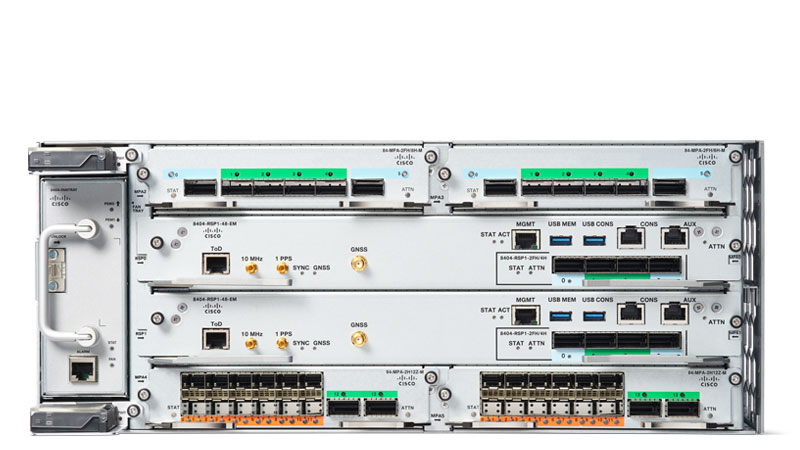
The Cisco 2951 Integrated Services Router (PID CISCO2951/K9) was the flagship of the ISR G2 2900 line: a 2RU-class branch router with three onboard Gigabit Ethernet ports, four enhanced high-speed WAN interface card (EHWIC) slots, and, critically, two service-module (SM) slots that let a single chassis carry high-density branch services like Cisco Unified Communications, UCS-E compute blades, or wired-switching modules. That two-slot density is exactly why the 2951 ended up in so many regional offices, hospital wiring closets, and base communications rooms. If you still run one, the clock has already run out: Cisco placed it on a full end-of-life track, and the last protection date has passed.
Where the Cisco 2951 stands in its lifecycle
Cisco published the EoL bulletin for the 2951 with a hard sequence of milestones. The End-of-Sale date was December 9, 2017, the End of Software Maintenance Releases was December 9, 2020, and the Last Day of Support (LDoS) was December 31, 2022. Every one of those dates is now behind us, which means the platform is not approaching obsolescence; it is fully obsolete and unsupported.
What each milestone actually means in practice
- End of Sale (Dec 9, 2017): Cisco stopped selling the 2951 through normal channels. Anything sold after this date is end-of-life inventory or secondary-market gear, not a current product.
- End of Software Maintenance (Dec 9, 2020): Cisco stopped producing new maintenance and bug-fix releases of IOS 15.x for the platform. From this point forward, no new code, including security fixes, was built for the box.
- Last Day of Support / LDoS (Dec 31, 2022): The final day Cisco TAC would take a case, honor a SmartNet contract, or process an RMA. After this date there is no vendor support, no replacement hardware path, and no PSIRT remediation for the platform.
Why acting now is not optional
The most common mistake is treating a working router as a safe router. The 2951 still forwards packets, so it is easy to leave in place. But three exposures are accumulating quietly. First, security: IOS 15.x vulnerabilities in IKEv1/IKEv2, SNMP, SSH, and web management surfaces keep appearing in Cisco PSIRT advisories, and a past-LDoS platform receives no fixed release, so a single unauthenticated remote-code-execution bug on your WAN edge becomes a permanent open door. Second, operational risk: with no TAC and no RMA, a chassis or power-supply failure means scavenging eBay units of unknown provenance and hoping the config restores. Third, compliance: FedRAMP, CMMC, HIPAA, and PCI all expect supported, patchable infrastructure, and auditors increasingly flag past-LDoS devices as a finding on their own, independent of whether a specific CVE is present. You can review the full milestone breakdown on the Cisco 2951 EoL detail page or browse the wider end-of-life hub to scope a fleet-wide refresh.
The recommended replacement: Cisco ISR 4351
Cisco's EoL bulletin maps the 2951 to the Integrated Services Router 4351 (PID ISR4351/K9), and it is a deliberate one-for-one density match. The 4351 keeps the architecture that made the 2951 useful in the branch: three onboard Gigabit Ethernet ports, three network interface module (NIM) slots, and two service-module (SM) slots, plus an integrated services-card slot. It ships standard with 4 GB of Flash and 4 GB of DRAM (both upgradeable) and the IP Base feature set. The two SM slots mean you can carry the same UCS-E branch-compute or Layer 2/3 switching modules you ran in the 2951, so this is a refresh, not a re-architecture of your branch services footprint.
What you concretely gain over the 2951
- Throughput: The 2951 was rated for roughly 75 Mbps to 350 Mbps of forwarding with services on. The ISR 4351 is a numbered-performance platform with a default aggregate throughput around 200 Mbps that is software-upgradeable up to roughly 400 Mbps via a performance license, with full crypto offload, so it scales with your circuit instead of capping it.
- Software platform: The 2951 runs classic IOS 15.x. The 4351 runs IOS XE, a modern Linux-based control plane with a separated data plane (QFP-based forwarding), programmability via NETCONF/YANG and RESTCONF, native guest-shell containers, and a far cleaner upgrade and patch model.
- SD-WAN ready: The same ISR4351/K9 chassis runs Cisco SD-WAN (Catalyst SD-WAN / vManage-Viptela). The 2951 cannot. This is the single biggest functional gain: you move from a static, CLI-managed branch edge to a centrally orchestrated, application-aware WAN fabric with zero-touch provisioning.
- Crypto and density: Hardware-accelerated IPsec is built in (no separate ISM/AIM crypto module to license and seat), and the NIM ecosystem gives you modern T1/E1, serial, LTE, and Gigabit options the EHWIC catalog never received.
- Licensing: The 2951 used right-to-use and feature-set licensing under classic IOS. The 4351 moves to Cisco Smart Licensing, where entitlements (IP Base, Security/SEC, AppX, and performance/throughput bumps) live in your Smart Account and float across the fleet rather than being locked to a serial number.
A practical migration plan
1. Assess and inventory
Pull the running config and a 'show inventory' / 'show license' from each 2951. Document the EHWICs and SMs in use (T1/E1, switching, UCS-E, voice), the feature set you actually run (IP Base vs. SEC vs. UC), your throughput at peak, and any DSP/voice PVDM resources. This inventory is what determines whether a base ISR4351/K9 with IP Base is enough or whether you need the SEC license and a performance upgrade on day one.
2. Plan the license transition
Set up a Cisco Smart Account and Virtual Account before the hardware lands. The 4351's entitlements (IP Base ships standard; add SEC for full IPsec/VPN feature parity, AppX for application services, and a throughput license if you exceed the default tier) register against that account. There is no direct license carry-over from classic IOS, so treat licensing as a fresh procurement line, not a transfer.
3. Build config and feature parity
Do not paste IOS 15.x configs into IOS XE blindly. Most routing, NAT, ACL, and IPsec syntax carries over, but management-plane items (the 'platform' commands, licensing stanzas, guest-shell, and interface naming like GigabitEthernet0/0/0) differ. Build the XE config in a lab against a known-good IOS XE release, validate crypto interoperability with the remote peers, and confirm QoS and NetFlow behavior, since the QFP data plane handles these differently than the 2951's CPU-based forwarding. If SD-WAN is the goal, build the device template in vManage now rather than CLI-configuring and converting later.
4. Handle the physical layer
The 4351 is a 2RU chassis (the 2951 was effectively 2RU as well), so rack budget is similar, but verify rail kits and PDU outlet type. Confirm you have the right SFPs for the onboard SFP ports and that your NIM/SM modules are 4000-series compatible; many EHWICs do NOT fit the 4351's NIM slots, so re-spec WAN cards as part of the project. Plan power and cabling for the cutover window, and stage optics and modules in the chassis before the maintenance night.
5. Phased cutover
Stage the 4351 alongside the live 2951, pre-load the validated config, and cut over one branch (ideally a low-risk site) first. Keep the 2951 powered but disconnected for a defined rollback window before you decommission. For SD-WAN deployments, zero-touch onboarding lets the device pull its config from vManage once it reaches the controller, which simplifies multi-site rollouts.
6. Secure decommission
Past-LDoS gear should not be resold or stored on a working VLAN. Wipe the config and any stored credentials, certificates, and keys ('write erase' plus removing the startup config and crypto material), then physically retire the unit. For federal and DoD environments, follow your media-sanitization standard (NIST SP 800-88) and document chain of custody for the disposal.
Procurement notes for government and enterprise buyers
Source the ISR4351/K9 through an authorized Cisco partner so the units arrive with valid serials, are eligible for SmartNet/Smart Licensing registration, and carry a clean supply-chain pedigree. For federal buyers, confirm TAA (Trade Agreements Act) compliance and request country-of-origin documentation up front, since secondary-market or gray-market 2951 'replacements' frequently fail TAA and warranty checks. Government Purchase Card (GPC) payment is accepted for in-threshold orders, and we can structure quotes to your micro-purchase or contract vehicle. Plan lead time deliberately: as an EoL-replacement platform itself, the 4351 and its NIM/SM modules can carry multi-week lead times, so order modules and optics together with the chassis. As an authorized partner, uniqcli can validate your bill of materials, confirm licensing tiers, and lock TAA-compliant stock before you commit a maintenance window.
Ready to scope your refresh? Browse the replacement catalog to see the ISR 4351 and compatible modules, then get a quote and we will turn your 2951 inventory into a TAA-compliant, license-correct migration bill of materials with current lead times.
Frequently asked questions
Is the Cisco 2951 (CISCO2951/K9) still supported by Cisco?
No. The 2951 reached its Last Day of Support (LDoS) on December 31, 2022. Cisco TAC will not open cases, SmartNet contracts cannot be renewed, RMAs are not processed, and no new software, including security fixes, is produced for the platform. It is fully end-of-life.
What is the official Cisco replacement for the 2951?
Cisco's EoL bulletin migrates the 2951 to the ISR 4351 (PID ISR4351/K9), which matches the 2951's two service-module slot density while adding IOS XE, SD-WAN support, higher software-upgradeable throughput, and built-in hardware crypto. For the longest support runway, the current-generation Catalyst 8300 is the successor to consider alongside it.
Can I reuse my 2951's EHWIC and service modules in the ISR 4351?
Service-module (SM) modules generally carry forward since both platforms have two SM slots, including UCS-E and switching modules, but many EHWIC WAN cards do NOT fit the 4351's NIM slots. Plan to re-spec your WAN interface cards (NIMs) as part of the migration and verify each module against the 4000-series compatibility matrix.
Does my 2951 IOS license transfer to the ISR 4351?
No. The 2951 used classic IOS feature-set and right-to-use licensing; the 4351 uses Cisco Smart Licensing tied to a Smart Account. Entitlements like IP Base, SEC, AppX, and throughput upgrades are purchased fresh and registered to your Virtual Account, not transferred from the old serial number.
How much faster is the ISR 4351 than the 2951?
Significantly. The 2951 topped out around 350 Mbps with services enabled, while the 4351 defaults to roughly 200 Mbps aggregate and is software-upgradeable to about 400 Mbps via a performance license, with full hardware crypto offload, so it scales with modern circuits instead of becoming the bottleneck.
Uniqcli Team
The Uniqcli Team is an authorized Cisco partner specializing in Catalyst wireless, switching, datacenter fabric, licensing, and managed services for U.S. federal, state, local, and education customers. We scope Cisco bills of materials, validate procurement paths (TAA, FIPS, contract vehicles), and deliver design, deployment, and managed operations.
Ready to scope your Cisco build?
Build a quoteRelated reading
View all →GuidesCisco ISR 4351 (ISR4351/K9) to Catalyst 8300 Migration Guide
A practical, specs-level guide to retiring the end-of-life Cisco ISR 4351 and refreshing to the Catalyst C8300-2N2S-6T Edge Platform.
November 29, 2025 · 7 min readGuidesCisco 2911 (CISCO2911/K9) End of Life: ISR 4331 Refresh Guide
The Cisco 2911 ISR G2 reached last day of support on December 31, 2022; here is a practical, partner-vetted plan to migrate it to the Cisco ISR 4331 (and Catalyst 8300) without breaking your branch.
December 8, 2025 · 7 min readGuidesCisco 3945 (CISCO3945/K9) Replacement: ISR 4451-X Migration
The Cisco 3945 (CISCO3945/K9) is past Last Day of Support, here is why the ISR 4451-X is the right replacement and how to migrate cleanly.
December 16, 2025 · 7 min readGuidesCisco 2921 (CISCO2921/K9) End of Life: ISR 4331 Migration Guide
The Cisco 2921 ISR G2 is past its last day of support, here is what each EoL milestone means and how to migrate cleanly to the IOS XE-based ISR 4331.
December 10, 2025 · 8 min read Guides
Cisco C819HG-4G-G-K9 EoL: Migrate to the Catalyst IR1101
The 819 Hardened ISR (C819HG-4G-G-K9) passed Last Day of Support on December 31, 2021, no patches, no TAC, no RMA, and a cellular modem on bands carriers are sunsetting. Here's how to migrate cleanly to the Catalyst IR1101.
April 24, 2026 · 8 min readGuidesCisco 1941W EoL: Migrate to Catalyst 8200 C8200-1N-4T
The Cisco 1941W reached Last Day of Support on December 31, 2021, no patches, no TAC, no RMA. Here is what the EoL milestones mean and how to migrate cleanly to the Catalyst 8200 Edge Platform (C8200-1N-4T), including the licensing and wireless changes that catch teams off guard.
April 22, 2026 · 6 min read