
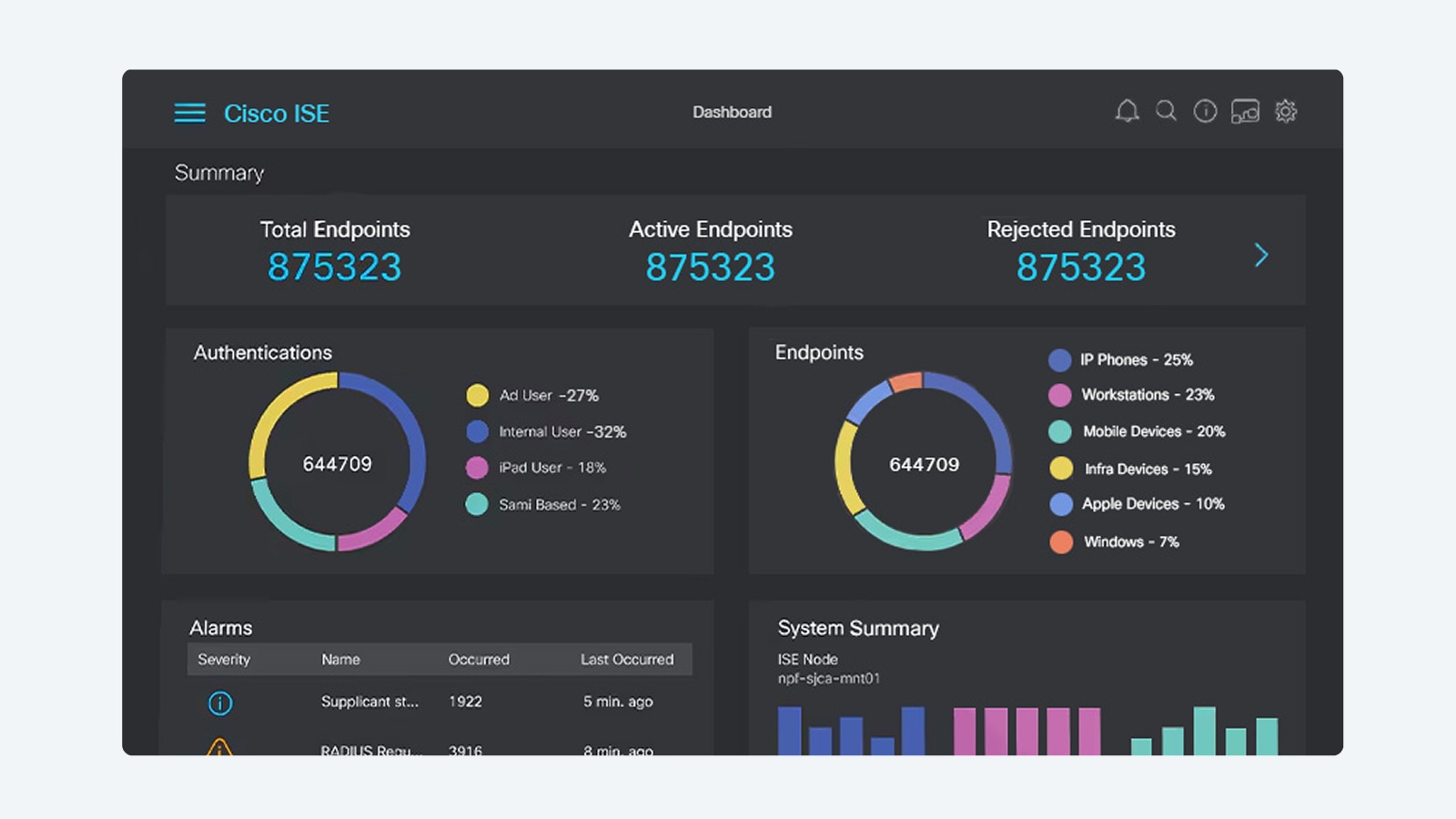
PacketFence is free and open-source, and for the right team that's a completely legitimate way to run network access control. It handles 802.1X, MAB, captive portal guest access, and VLAN enforcement across a wide range of switch vendors, with an active community and an optional paid support tier. The tradeoff is that PacketFence hands you the software and expects you to bring the engineering, deployment, high-availability design, patching, and troubleshooting are on your team unless you buy commercial support. Cisco ISE costs real licensing money but converts that engineering burden into a vendor-supported product with Cisco TAC behind it. The right choice depends less on feature checklists, PacketFence covers more ground than most people expect, and more on whether your team wants to own that operational burden or pay to hand it off.
At a glance
Both platforms cover the same core NAC use cases. Where they diverge is who owns the operational risk once the software is actually running in production.
| Factor | Cisco ISE | PacketFence |
|---|---|---|
| License cost | Endpoint-count subscription tiers | Free (open-source); optional paid support tier |
| Deployment effort | Vendor-guided install, professional services available | Self-managed install; requires in-house Linux and networking expertise |
| Core NAC features | 802.1X, MAB, profiling, posture, guest, BYOD, TrustSec segmentation | 802.1X, MAB, captive portal guest access, VLAN enforcement |
| Switch vendor support | Deepest on Cisco; standard RADIUS elsewhere | Broad multi-vendor support via community-maintained integrations |
| High availability | Built-in multi-node PSN/MnT architecture | Achievable but self-designed and self-maintained |
| Patching & upgrades | Cisco-issued releases and advisories | Community or commercial-support-tier releases; you own the upgrade cycle without a contract |
| Formal support/SLA | Cisco TAC via subscription entitlement | None on the free tier; available through paid commercial support |
| Audit/compliance trail | Structured licensing and vendor documentation for procurement | Depends entirely on your own documentation discipline |
What PacketFence genuinely gets right
This deserves to be said plainly: PacketFence is a capable platform, not a toy. It covers 802.1X, MAB, portal-based guest onboarding, and VLAN enforcement, works across a real range of switch vendors through community-maintained integrations, ships security patches on a regular cadence, and has an active community behind it. For labs, MSPs comfortable running Linux infrastructure, universities with in-house networking teams, and cost-constrained shops, it's a legitimate way to get real NAC functionality without a license line item. A commercial support tier exists if you want a vendor safety net without paying for a fully licensed platform.
The engineering cost hiding behind 'free'
No license fee doesn't mean no cost. Deployment, HA architecture, patch management, and troubleshooting all become your team's job, and when something breaks at 2am there's no TAC case to open unless you've already bought the commercial support tier, at which point a chunk of the apparent savings narrows. Profiling depth, BYOD onboarding, and posture workflows are also less turnkey than ISE's built-in equivalents; they're closer to something you configure and extend yourself than a polished out-of-box workflow. None of that makes PacketFence a bad choice, but it changes what you're actually comparing: a license fee against a smaller license fee plus a real amount of engineering time that has to come from somewhere.
Where ISE's licensing spend buys something concrete
Cisco ISE's cost buys Cisco TAC entitlement, tight native integration with a Cisco access layer through TrustSec Security Group Tags and SD-Access, a structured upgrade path on Cisco's own release cadence, and licensing that maps cleanly onto a standard procurement cycle. That last point matters specifically for regulated and federal buyers who need a documented, auditable purchase, GPC, a FAR-based purchase order, or simplified acquisition, rather than a self-supported open-source deployment with no formal vendor relationship behind it. For organizations already investing in a broader network access control strategy tied to compliance requirements, that documentation trail is often as valuable as any specific feature.
Fit by organization type
PacketFence fits teams that already run Linux infrastructure comfortably, have networking staff who can own an HA deployment end to end, and either don't need or don't yet need formal vendor TAC entitlement and audit documentation. Cisco ISE fits organizations that want, or are required to have, vendor-backed support, Cisco-native segmentation, and licensing that fits cleanly into standard procurement. Neither fit is about company size alone, a well-staffed networking team at a mid-size company can run PacketFence successfully, while a smaller regulated organization may need ISE's vendor relationship regardless of headcount.
What a fair total-cost comparison actually includes
A license-price-only comparison understates PacketFence's real cost and overstates ISE's. The honest PacketFence total includes engineering time for initial deployment, ongoing patch management, HA design and testing, and whatever internal or commercial support you line up for incident response, none of which appears on a software invoice but all of which shows up in staff time or downtime. The honest ISE total includes the subscription license plus whatever professional services or internal ramp-up time it takes your team to operate a Cisco platform they may not have run before. Neither number is small, and the right comparison weighs both against what your team already knows how to run and what a compliance program actually requires you to document.
Migrating between the two
Moving from PacketFence to ISE, or the other direction, is more of a policy-rebuild than a data migration, since neither platform imports the other's configuration format directly. The practical approach is the same either way: document the existing authentication and authorization policy in plain terms, who gets access to what, and under what conditions, then rebuild that logic natively in the target platform, validate it against a pilot group of switches, and cut over site by site rather than all at once. Because both speak standard RADIUS, the switches themselves generally only need a RADIUS server target change once the new policy is validated, which keeps the cutover itself low-risk even though the policy design work behind it is real.
Which should you choose?
- Choose PacketFence if your team is comfortable owning Linux infrastructure and you don't need a formal vendor SLA.
- Choose PacketFence if budget is the primary constraint and your switch environment is well-supported by its community integrations.
- Choose Cisco ISE if you need Cisco TAC-backed support and a documented, auditable procurement path.
- Choose Cisco ISE if TrustSec segmentation or SD-Access fabric integration is part of your architecture.
- Choose Cisco ISE if a compliance framework requires vendor-supported, documented NAC rather than a self-managed open-source deployment.
Frequently asked questions
Is PacketFence really free to use in production?
The core software is free and open-source, and plenty of organizations run it in production without a support contract. What isn't free is the engineering time to deploy, harden, maintain high availability, and troubleshoot it, that cost is real even though no license invoice captures it. A paid commercial support tier exists if you want a vendor safety net without going fully self-managed.
Does PacketFence support 802.1X the same way Cisco ISE does?
Yes, PacketFence implements standard 802.1X and MAB against RADIUS, the same protocol-level mechanism ISE uses. The difference isn't the protocol, it's the surrounding platform: profiling depth, guest and BYOD workflow polish, posture assessment, and native Cisco fabric integration are more built-in and turnkey on ISE.
Can PacketFence manage Cisco switches?
Yes, Cisco switches are among the widely supported platforms in PacketFence's switch integration library, using standard RADIUS and SNMP. What it won't do is propagate Cisco TrustSec Security Group Tags, since that's a Cisco-proprietary mechanism tied to ISE and Cisco's fabric.
Is PacketFence a good fit for a federal or regulated organization?
It can be, but the burden of proof and documentation shifts to your team. Regulated and federal buyers often need a vendor-backed, auditable support relationship as part of their compliance posture, which is where a commercially licensed platform like Cisco ISE, with Cisco TAC entitlement and a standard procurement path, tends to be the more straightforward fit.
How much networking expertise does PacketFence require to run well?
Enough that most organizations running it successfully have dedicated Linux and networking staff comfortable with the underlying stack, not just NAC policy design. If that expertise doesn't already exist in-house, the commercial PacketFence support tier or a vendor-supported platform like ISE will generally cost less in outages and troubleshooting time than it first appears to save.
Uniqcli Team
The Uniqcli Team is an authorized Cisco partner specializing in Catalyst wireless, switching, datacenter fabric, licensing, and managed services for U.S. federal, state, local, and education customers. We scope Cisco bills of materials, validate procurement paths (TAA, FIPS, contract vehicles), and deliver design, deployment, and managed operations.
Ready to scope your Cisco build?
Build a quoteRelated reading
View all →GuidesCisco ISE vs FortiNAC: Enterprise NAC Head-to-Head
Cisco ISE vs FortiNAC both tie network access control to a broader vendor security fabric. The decision comes down to whether your firewall and switching stack is already Cisco or Fortinet.
July 11, 2026 · 5 min readGuidesCisco ISE vs Microsoft NPS: 802.1X on a Budget vs Full NAC
Cisco ISE vs Microsoft NPS is a budget-vs-capability question: NPS ships free with Windows Server for basic 802.1X, while ISE adds profiling, guest, posture, and segmentation NPS lacks.
July 11, 2026 · 5 min readGuidesCisco ISE vs Forescout: NAC and Device Visibility Compared
Forescout vs Cisco ISE is a contest between two philosophies: 802.1X-first policy versus agentless-first visibility. Which fits depends on how much of your fleet can run a supplicant.
July 11, 2026 · 5 min readGuidesISE vs ClearPass vs Forescout: The Three-Way NAC Shootout
Cisco ISE vs Aruba ClearPass vs Forescout is really two questions, ecosystem fit and authentication-first vs visibility-first, not one three-way bake-off. Here's how to tell which applies.
July 11, 2026 · 5 min readGuidesCisco ISE vs Aruba ClearPass: Which NAC Fits Your Network?
Cisco ISE vs Aruba ClearPass rarely comes down to missing features, both are mature NAC platforms. The real question is whether your access layer is Cisco-standardized or genuinely mixed-vendor.
July 11, 2026 · 5 min read Guides
NAC for BYOD, Guest, and IoT: Securing Every Device That Touches the Network
A NAC solution turns BYOD, guest, IoT, and posture into four policies on one platform. Here is how Cisco ISE delivers each scenario, mapped to license tiers and zero-trust outcomes.
June 3, 2026 · 10 min read