
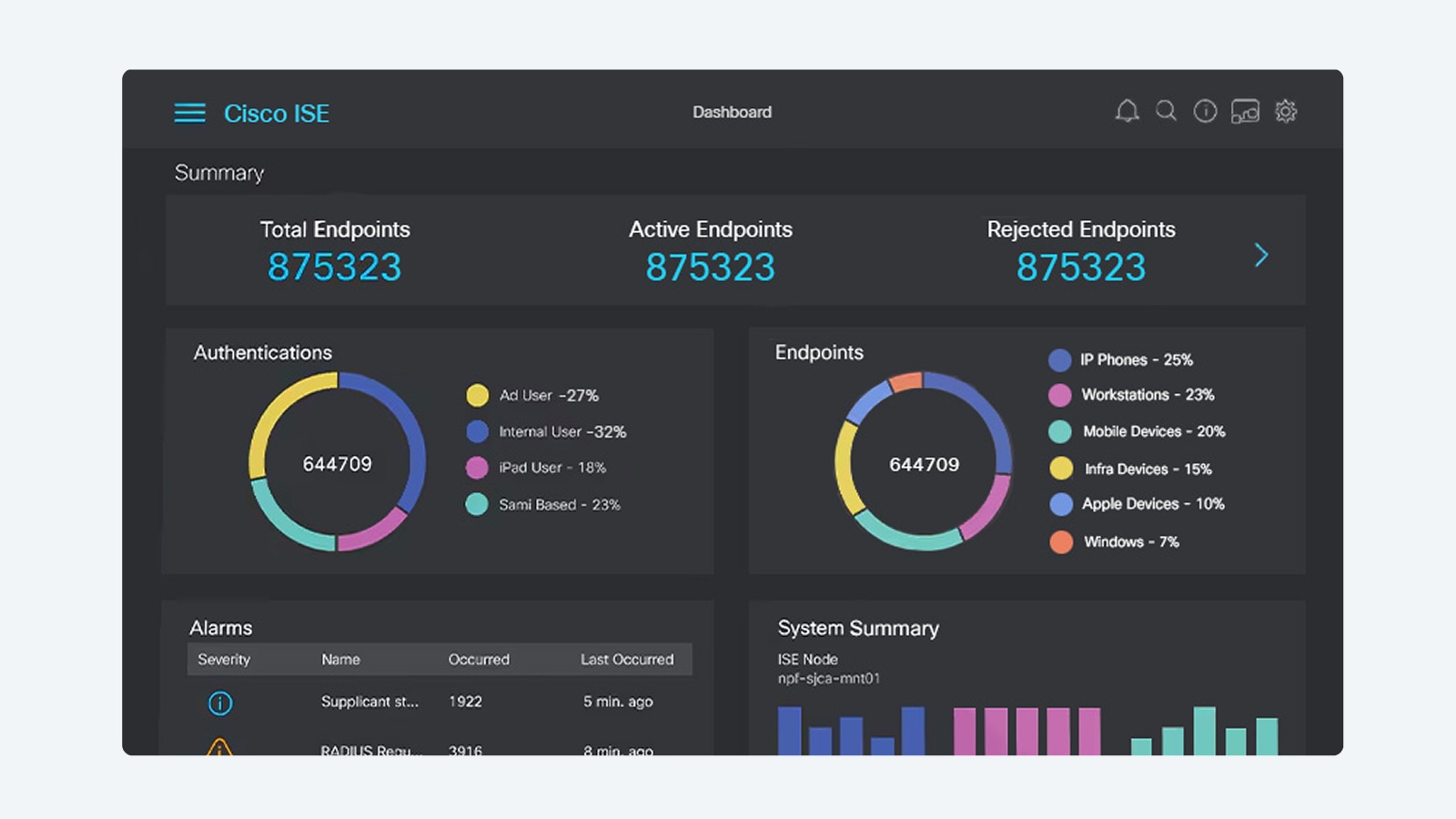
Cisco ISE and Microsoft NPS both speak RADIUS, and that's roughly where the similarity ends. NPS is a free server role bundled with Windows Server, it authenticates and authorizes against Active Directory and does very little else. ISE is a full network access control platform, profiling, posture, guest onboarding, BYOD, TrustSec segmentation, and vendor-backed support, built for organizations that need to prove who and what is on the network, not just authenticate a login. If you need basic 802.1X for domain-joined Windows devices on a small, simple network and you already run Windows Server, NPS costs nothing extra and does the job. If you have BYOD, guest traffic, IoT, compliance requirements, or more than a handful of sites to keep consistent, NPS runs out of road fast and ISE is the tool built for what comes next.
At a glance
The comparison isn't close on features, because NPS was never designed to compete with a NAC platform, it's a RADIUS server, full stop. The table below shows exactly where the gap is.
| Factor | Cisco ISE | Microsoft NPS |
|---|---|---|
| What it is | Purpose-built NAC/policy platform | Free RADIUS/AAA role built into Windows Server |
| Device profiling | Built-in profiling probes and device sensors | None, NPS has no device fingerprinting |
| Guest & BYOD onboarding | Native sponsor/self-service portals and onboarding flows | None built in, requires custom scripting or a separate tool |
| Posture assessment | Native posture checks against endpoint compliance | None |
| Segmentation | TrustSec Security Group Tags, SD-Access integration | None beyond static VLAN assignment via policy |
| Multi-site policy management | Centralized policy across distributed PSNs | Per-server configuration; no built-in multi-site console |
| Licensing cost | Endpoint-count subscription tiers | Included with Windows Server licensing |
| Support path | Cisco TAC via subscription entitlement | Standard Microsoft support channels, general-purpose, not NAC-specific |
What NPS actually does, and doesn't
NPS is the Windows Server implementation of RADIUS under the Network Policy and Access Services role. It authenticates 802.1X and VPN requests against Active Directory, applies condition-based policies (group membership, time of day, connection type), and returns an accept or reject. That's the entire feature set, and it's been essentially that for years, because NPS is a supporting role for Windows Server rather than a maintained security product with its own roadmap. There's no device profiling, no fingerprinting of what's actually connecting beyond the AD credential presented, no guest self-registration workflow, and no posture or compliance check before granting access. FreeRADIUS is the open-source equivalent of the same idea, more configuration flexibility through text-based config files, popular with teams that want to script custom authentication logic, but it shares the same absence of a GUI, profiling engine, or vendor support line.
The gap that shows up first: profiling, guest, and BYOD
In practice, the NPS gap shows up fastest in three places. Anything that can't do clean 802.1X, a printer, a badge reader, an IoT sensor, has to be hand-maintained as a MAC address exception or dropped into a static group, because NPS has no profiling engine to recognize and classify it automatically. Guest Wi-Fi becomes an unmanaged shared-PSK network or a bolt-on captive portal that sits entirely outside the RADIUS policy, since NPS has no native guest workflow. BYOD onboarding is a manual help-desk process rather than a self-service flow, because there's no certificate enrollment or device registration built in. None of this is exotic, it's exactly the workflow Cisco ISE was built to handle natively, with a sponsor portal, profiling library, and onboarding flow that ships as part of the platform instead of being assembled by hand.
Where compliance and scale force the decision
Regulated buyers increasingly need to show device posture and segmentation evidence, not just a login event, for frameworks tied to CMMC, HIPAA, PCI, or FAR-driven federal and DoD requirements. NPS produces none of that evidence trail on its own. Once policy has to be managed across more than a couple of sites, or a change-control audit history and vendor TAC entitlement become part of an incident response plan, NPS's lack of a central management plane becomes an operational cost of its own, separate from, and often larger than, the license cost of the network access control platform it would take to replace it. The engineering time spent working around what NPS doesn't do rarely shows up on a budget line, but it's real.
Where NPS is genuinely the right call
Credit where it's due: for a small, single-site, Windows-only shop with no meaningful guest, BYOD, or IoT population and no compliance mandate requiring posture or segmentation evidence, NPS does the actual job needed at zero incremental license cost. Recommending ISE to a forty-person single-site office with no compliance driver and an all-managed-device fleet would be over-engineering the problem. The honest advice in that scenario is that NPS is fine, and the right trigger to revisit the decision is a specific one, a new compliance requirement, the first real guest or BYOD population, or growth past a handful of sites, rather than a general sense that a mature company should have a mature NAC.
The TACACS+ gap most NPS comparisons miss
NPS is a RADIUS server only, it has no TACACS+ capability, which means it can't handle command-level authorization and accounting for administrators logging into routers and switches. Organizations running NPS for endpoint authentication typically fall back to local device accounts, a shared admin credential, or a separate third-party tool for network device administration, none of which give you per-command audit logging on your own infrastructure. ISE bundles both RADIUS-based NAC and TACACS+ device administration in one platform, so the same system authenticating endpoints can also control and log exactly which commands an administrator ran on a given switch. For any organization that already has to answer "who changed this device configuration and when," that gap in NPS is often a bigger operational problem than the missing profiling and guest features.
Which should you choose?
- Choose Microsoft NPS if you're a small, single-site, Windows-only shop with no guest, BYOD, IoT, or compliance-driven segmentation requirement.
- Choose Microsoft NPS or FreeRADIUS if the only requirement is basic 802.1X authentication against Active Directory and budget is the primary constraint.
- Choose Cisco ISE once you need device profiling, guest self-service, or BYOD onboarding as a managed workflow instead of manual exceptions.
- Choose Cisco ISE if you need to produce posture or segmentation evidence for a compliance framework.
- Choose Cisco ISE if you also need TACACS+ device administration and command-level audit logging for network admins.
- Choose Cisco ISE once you're managing policy across multiple sites and need one console instead of per-server configuration.
Frequently asked questions
Is Microsoft NPS really free?
NPS itself has no separate license fee, it's a server role included with Windows Server, which you're presumably already licensing for Active Directory. The real cost is what it doesn't include: profiling, guest onboarding, posture, and segmentation all have to be built manually or done without, and that engineering time is a cost even though no invoice says so.
Can NPS do 802.1X for wireless as well as wired?
Yes. NPS handles RADIUS authentication for both wired 802.1X and wireless WPA2/WPA3-Enterprise the same way, since both are standard RADIUS exchanges. What it can't do on either medium is profile the connecting device or run a posture check before granting access.
What's the difference between Microsoft NPS and FreeRADIUS?
Both are free RADIUS implementations with no built-in profiling, guest portal, or GUI-driven policy management. NPS is tied to Windows Server and Active Directory and configured through Windows tools; FreeRADIUS is open-source, runs on Linux, and is configured through text files, which gives it more flexibility for custom authentication logic at the cost of a steeper setup curve. Neither is a substitute for a full NAC platform like Cisco ISE.
At what point should a company move from NPS to Cisco ISE?
The usual triggers are a growing guest or BYOD population that NPS can't onboard cleanly, IoT or unmanaged devices that need profiling instead of manual MAC exceptions, a compliance framework that requires posture or segmentation evidence, or enough sites that per-server RADIUS configuration becomes unmanageable. Any one of those is a reasonable signal to evaluate ISE.
Can I run Cisco ISE and Microsoft NPS side by side during a migration?
Yes. A common pattern is to point new or pilot switches and WLCs at ISE while NPS continues serving the rest of the fleet, then migrate segments in phases as policy is validated. Both are standard RADIUS servers, so cutover on any given switch is a configuration change, not a redesign.
Uniqcli Team
The Uniqcli Team is an authorized Cisco partner specializing in Catalyst wireless, switching, datacenter fabric, licensing, and managed services for U.S. federal, state, local, and education customers. We scope Cisco bills of materials, validate procurement paths (TAA, FIPS, contract vehicles), and deliver design, deployment, and managed operations.
Ready to scope your Cisco build?
Build a quoteRelated reading
View all → Guides
How 802.1X Network Access Control Works: Supplicants, Authenticators, and RADIUS
A practical walkthrough of 802.1x authentication: the handshake, the three roles that make it work, and how Cisco ISE turns port-level access into enforceable zero trust.
June 4, 2026 · 12 min read Guides
Cisco ISE Deployment Checklist: Planning, Personas, 802.1X, Posture, and TrustSec
A field-tested planning sequence for Cisco Identity Services Engine, node personas, 802.1X rollout, posture, and TrustSec segmentation, built for federal, SLED, and healthcare teams who cannot afford a noisy cutover.
June 1, 2026 · 11 min read Guides
Zero Trust with Cisco ISE: identity-based access, explained
Zero trust falls apart when the network still trusts a switch port. Cisco Identity Services Engine moves the trust decision to who and what is connecting, then carries that decision across wired, wireless, and the firewall as enforceable policy.
May 18, 2026 · 11 min read Guides
Wi-Fi 7 power: UPOE and PoE requirements
Wi-Fi 7 access points draw more power than any generation before them. Here is what UPOE, 802.3bt, and switch budgeting actually mean for a Cisco Catalyst deployment, and how to avoid the throttling traps.
April 25, 2026 · 11 min read Guides
Multigigabit switching for Wi-Fi 7: cabling and PoE
Wi-Fi 7 access points can outrun a 1G access port and outdraw legacy PoE. Here is how to plan multigigabit switching, structured cabling, and PoE budget so the wired side is ready before the radios light up.
April 14, 2026 · 11 min readGuidesCisco ISE vs PacketFence: Open-Source NAC vs Enterprise NAC
Cisco ISE vs PacketFence is a buy-vs-build decision: PacketFence is a genuinely capable free NAC, but it shifts deployment, HA, and patching work onto your own team instead of a vendor.
July 11, 2026 · 5 min read