
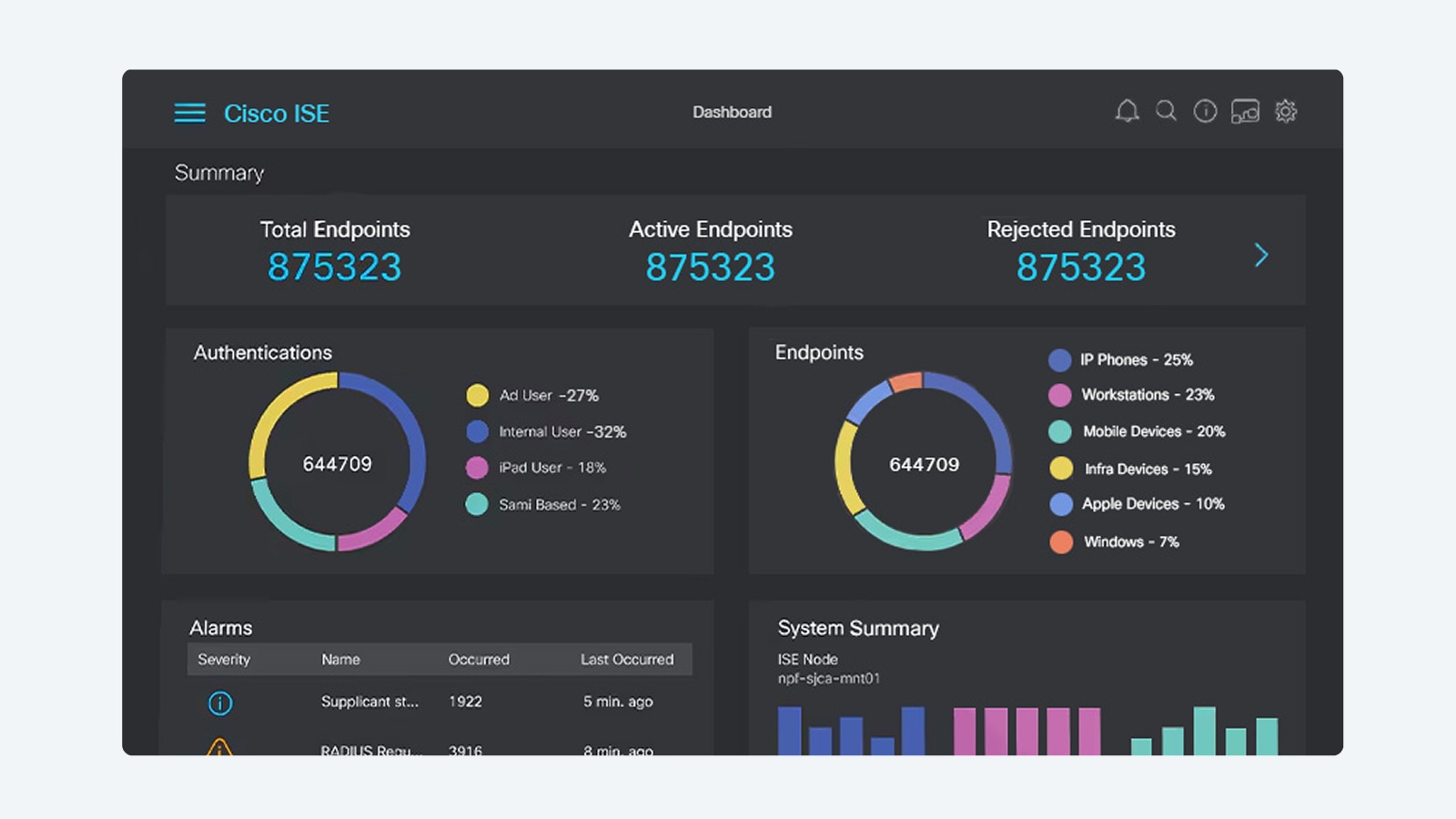
Cisco ISE and Aruba ClearPass both do the same core job, authenticate, profile, and authorize every device before it touches the network, and both are mature, enterprise-grade platforms with more capability than most buyers will ever fully use. The decision usually isn't about missing features; it's about which network you're actually running. ISE is the stronger pick when your access layer is Cisco end to end and you want TrustSec segmentation, SD-Access integration, and pxGrid context flowing into the rest of the Cisco Secure stack. ClearPass earns its reputation in mixed-vendor estates, Cisco switches next to Aruba, Juniper, or other wireless, where a policy engine that treats every vendor as a first-class citizen matters more than deep fabric integration with any single one of them. Neither platform is a clear technical upgrade over the other; it's an ecosystem-fit decision, and getting it wrong mostly costs you administrative friction, not missing capability.
At a glance
The table below lines up the factors that actually separate these two platforms in production, not the marketing feature lists that read almost identically for both vendors.
| Factor | Cisco ISE | Aruba ClearPass |
|---|---|---|
| Architecture | Policy engine (PAN/PSN/MnT nodes); on-prem appliance or VM, with cloud-delivered options on recent releases | Policy Manager cluster; on-prem appliance or VM, with cloud-delivered options on recent releases |
| Enforcement model | 802.1X, MAB, TrustSec Security Group Tags, deep tie-in with Cisco switches, WLCs, and SD-Access fabric | 802.1X, MAB, role-based access via dynamic VLAN and downloadable ACLs across mixed-vendor infrastructure |
| Profiling & BYOD | Built-in profiling probes plus device sensors on Cisco switches; native BYOD onboarding | OnGuard (posture) and OnBoard (BYOD) modules; vendor-neutral profiling collectors |
| Guest access | Sponsor and self-service guest portals, customizable workflows | ClearPass Guest module with comparable sponsor and self-service workflows |
| Ecosystem integration | pxGrid shares identity and context with Cisco Secure Firewall, XDR, and SIEM tools | ClearPass Exchange shares context with a broad set of third-party security and ITSM tools |
| Licensing model | Endpoint-count subscription tiers (Essentials/Advantage/Premier) | Subscription or perpetual tiers by Client Access License (CAL) count |
| Best-fit network | Cisco-standardized switching and wireless | Mixed-vendor switching and wireless |
| Support path | Cisco TAC via subscription entitlement | Aruba/HPE support via contract entitlement |
How deep the Cisco integration actually goes
TrustSec Security Group Tags are the practical difference once you're on Cisco gear. Cisco ISE is the policy decision point for an SD-Access fabric, and enforcement follows the SGT tag assigned at authentication rather than a VLAN or IP address, which means access policy survives a device moving between wired and wireless, or between subnets, without a redesign. That inline tagging is Cisco-proprietary end to end, and it's what lets a segmentation policy defined once propagate consistently across campus, branch, and data center without re-cabling or re-addressing anything. ClearPass can manage Cisco switches perfectly well for standard RADIUS, MAB, and CoA, but it cannot propagate an SGT through Cisco's fabric, so segmentation on Cisco hardware falls back to conventional VLAN and ACL mechanics, which still works, just with less flexibility as the policy matrix grows.
Where ClearPass genuinely wins: multi-vendor reality
ClearPass was built vendor-neutral from day one, and it shows in environments where the access layer isn't going to standardize on one manufacturer, higher education, healthcare systems that grew through acquisition, retail chains with inherited store hardware. Admins get one consistent policy console regardless of what's underneath, without treating any single vendor's switches as the reference platform and everything else as an afterthought. That matters in practice because RADIUS vendor-specific attributes (VSAs) differ by switch manufacturer, and a policy engine built to normalize across them saves real administrative time compared to hand-tuning ISE authorization profiles for every non-Cisco device type you support. If your environment is genuinely mixed and staying that way, ClearPass administration is often simpler in practice than pushing ISE toward feature parity on non-Cisco infrastructure.
Profiling, posture, and guest, mostly a wash
Both platforms handle profiling, posture assessment, guest access, and BYOD onboarding at a comparable level for the majority of use cases. Both maintain their own device fingerprint libraries, both support agent-based and agentless posture checks, and both let you build sponsor-approved or self-registering guest flows with essentially the same building blocks, time-limited access, AUP acceptance, and device-limit enforcement per guest account. The differences that show up are workflow and UI preference, plus depth of specific third-party connectors (MDM platforms, EDR tools), rather than raw capability gaps. Don't pick a NAC platform on this axis alone, both clear the bar comfortably, and the deciding factors live elsewhere.
Licensing shape and scale
Both vendors sell tiered subscriptions rather than a flat per-seat price. ISE ties cost to endpoint count and license tier; ClearPass ties cost to Client Access License (CAL) count across its own entry, mid, and top tiers. Both scale into very large endpoint counts at the top of their respective ranges, and both offer term-length flexibility that affects effective annual cost. Because list pricing rarely reflects a real deal for either platform, and because tier boundaries and included features shift between releases, confirm exact tier structure and endpoint pricing in a validated quote before comparing the two on cost.
Deployment footprint and multi-site scale
Both platforms are built to run distributed rather than as a single box. ISE splits roles across Policy Administration, Policy Service, and Monitoring nodes (PAN/PSN/MnT), so a multi-site design typically means local PSNs for authentication latency with centralized policy administration and logging. ClearPass follows a similar cluster model, with a publisher node holding the master configuration and subscriber nodes handling local authentication load. In practice, sizing either deployment for a multi-site, high-availability design takes real planning, node count, WAN latency to remote sites, and failover behavior during a WAN outage all factor in, and that planning effort is comparable between the two rather than a differentiator either way. Where they diverge again is what each node needs to reach: an ISE PSN behind a Cisco access layer keeps SGT enforcement local, while a ClearPass node authenticating against non-Cisco switches doesn't lose any capability by being remote, since it was never depending on Cisco-specific signaling in the first place.
Which should you choose?
- Choose Cisco ISE if your switches, wireless, and firewalls are already Cisco and you want TrustSec segmentation and SD-Access to work natively.
- Choose Cisco ISE if you already send identity context into Cisco Secure Firewall, XDR, or a SIEM via pxGrid and want that pipeline to stay native.
- Choose Aruba ClearPass if your access layer is genuinely mixed-vendor and likely to stay that way for the foreseeable future.
- Choose Aruba ClearPass if you're standardized on Aruba wireless and want the tightest administrative fit there instead.
- Choose either platform if you mainly need solid 802.1X, guest, and BYOD, let existing infrastructure and support relationships break the tie.
Frequently asked questions
Can Cisco ISE and Aruba ClearPass be used together?
In theory both can sit on the same network since each speaks standard RADIUS, but running two NAC policy engines in parallel creates duplicate policy logic and conflicting CoA behavior. Most organizations pick one as the system of record for authentication policy, even during a phased migration from one platform to the other.
Does Aruba ClearPass work with Cisco switches?
Yes. ClearPass manages RADIUS authentication, MAB, and CoA against Cisco switches the same way it does against any RADIUS-capable access layer. What it cannot do is propagate Cisco TrustSec Security Group Tags inline, since SGT tagging is a Cisco-proprietary mechanism tied to ISE and Cisco's fabric.
Is Cisco ISE harder to deploy than ClearPass?
Neither platform is a quick install; both require real policy design before rollout. ISE's learning curve is steeper if you're standing up TrustSec and SD-Access at the same time, since that's a fabric architecture project, not just a AAA server. For RADIUS, profiling, and guest access alone, initial deployment effort is comparable.
Which is cheaper, Cisco ISE or Aruba ClearPass?
Pricing depends on endpoint count, license tier, and term length for both platforms, and neither publishes a simple per-seat number that holds across deal sizes. Get a validated quote scoped to your actual endpoint count and required tier for both and compare like-for-like rather than relying on list price.
Can I migrate from ClearPass to Cisco ISE without downtime?
Yes, with planning. A common pattern is to stand up ISE in monitor mode alongside the existing ClearPass policy, mirror the authentication rules, validate against real traffic, then cut switches over to ISE as the RADIUS target in phases. Endpoints already authenticating via 802.1X or MAB don't need reconfiguration.
Uniqcli Team
The Uniqcli Team is an authorized Cisco partner specializing in Catalyst wireless, switching, datacenter fabric, licensing, and managed services for U.S. federal, state, local, and education customers. We scope Cisco bills of materials, validate procurement paths (TAA, FIPS, contract vehicles), and deliver design, deployment, and managed operations.
Ready to scope your Cisco build?
Build a quoteRelated reading
View all →GuidesISE vs ClearPass vs Forescout: The Three-Way NAC Shootout
Cisco ISE vs Aruba ClearPass vs Forescout is really two questions, ecosystem fit and authentication-first vs visibility-first, not one three-way bake-off. Here's how to tell which applies.
July 11, 2026 · 5 min read Insights
Cisco ISE Alternatives Compared: When to Stay, When to Switch, and the NAC Trade-offs
An honest Cisco ISE alternative comparison against Aruba ClearPass, FortiNAC, Forescout, NPS, and cloud-native NAC, plus a clear framework for when to stay on ISE and when to switch.
June 9, 2026 · 10 min readGuidesCisco ISE vs PacketFence: Open-Source NAC vs Enterprise NAC
Cisco ISE vs PacketFence is a buy-vs-build decision: PacketFence is a genuinely capable free NAC, but it shifts deployment, HA, and patching work onto your own team instead of a vendor.
July 11, 2026 · 5 min readGuidesCisco ISE vs Microsoft NPS: 802.1X on a Budget vs Full NAC
Cisco ISE vs Microsoft NPS is a budget-vs-capability question: NPS ships free with Windows Server for basic 802.1X, while ISE adds profiling, guest, posture, and segmentation NPS lacks.
July 11, 2026 · 5 min readGuidesCisco ISE vs FortiNAC: Enterprise NAC Head-to-Head
Cisco ISE vs FortiNAC both tie network access control to a broader vendor security fabric. The decision comes down to whether your firewall and switching stack is already Cisco or Fortinet.
July 11, 2026 · 5 min readGuidesCisco ISE vs Forescout: NAC and Device Visibility Compared
Forescout vs Cisco ISE is a contest between two philosophies: 802.1X-first policy versus agentless-first visibility. Which fits depends on how much of your fleet can run a supplicant.
July 11, 2026 · 5 min read