
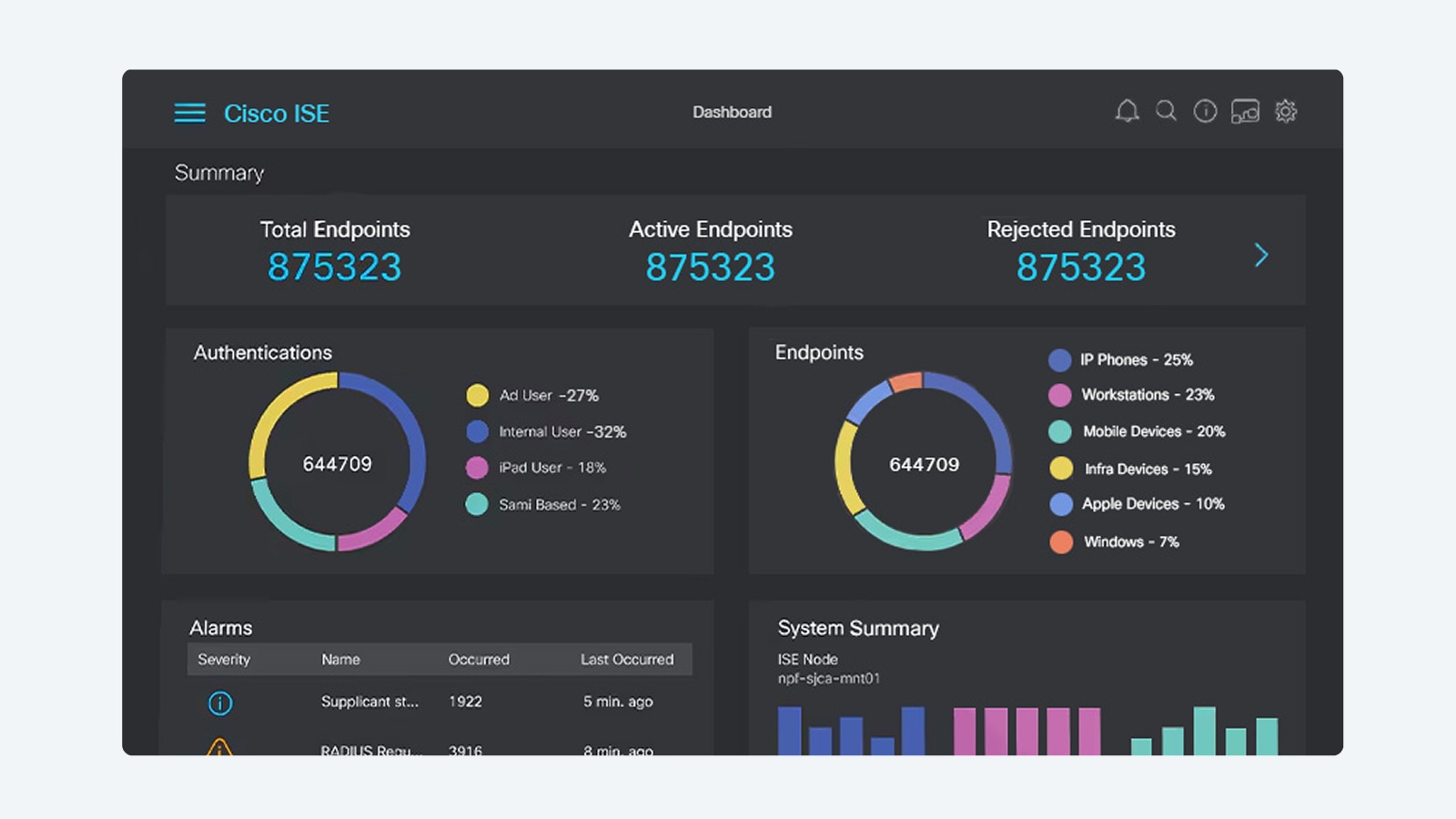
Cisco ISE and FortiNAC both anchor network access control to a broader vendor security fabric, and that's the real decision point: FortiNAC is built to plug into the Fortinet Security Fabric, FortiGate, FortiSwitch, FortiAP, managed through FortiManager and FortiAnalyzer, while ISE is built to anchor Cisco's stack, Catalyst, Meraki, Secure Firewall, and Catalyst Center, sharing context through pxGrid. Neither product is meaningfully weaker at core NAC functions like profiling, guest access, or segmentation policy. The decision comes down to which vendor's firewall and switching you've already standardized on, because that's where each platform's automated response and single-pane management actually pay off, buying either NAC as an island, disconnected from its sibling firewall, gives up most of what makes it worth the premium over a generic RADIUS server.
At a glance
Both platforms are complete NAC solutions on paper. The differences that matter show up in how tightly each one closes the loop with its own vendor's enforcement point.
| Factor | Cisco ISE | FortiNAC |
|---|---|---|
| Ecosystem anchor | Cisco Secure stack: Catalyst, Meraki, Secure Firewall, Catalyst Center | Fortinet Security Fabric: FortiGate, FortiSwitch, FortiAP, FortiManager |
| Discovery method | Profiling probes, device sensors, RADIUS telemetry | L2 polling, SNMP traps, integration with FortiGate for network visibility |
| Automated containment | pxGrid Adaptive Network Control with Cisco Secure Firewall, XDR, and SIEM tools | Direct integration loop with FortiGate for automated quarantine on detected indicators |
| Segmentation | TrustSec Security Group Tags, SD-Access integration | VLAN-based segmentation tied into Fortinet Security Fabric policy |
| Management console | ISE admin console, ties into Catalyst Center for fabric-wide view | FortiNAC Manager, ties into FortiManager/FortiAnalyzer for fabric-wide view |
| Licensing model | Endpoint-count subscription tiers (Essentials/Advantage/Premier) | Per-concurrent-endpoint licensing with FortiCare support tiers |
| Best-fit network | Cisco-standardized switching, wireless, and firewall | Fortinet-standardized switching, wireless, and firewall |
| Support path | Cisco TAC via subscription entitlement | FortiCare support via contract entitlement |
The Security Fabric argument, mirrored
Each vendor's pitch here is structurally identical, and it's worth saying plainly rather than pretending one is obviously better. A NAC becomes far more valuable when it's tightly wired into that same vendor's firewall and switch stack for real-time enforcement and single-pane visibility. If you're a Fortinet shop, FortiNAC's tie-in to FortiGate for automatic quarantine and FortiManager/FortiAnalyzer for reporting is genuinely tighter than trying to bolt Cisco ISE onto Fortinet gear after the fact. The reverse is equally true for Cisco shops, that's not marketing, it's how vendor-integrated security fabrics are built, and there's no honest way to score one categorically above the other outside the context of what you're already running. Buyers who evaluate the two purely on a feature checklist tend to end up disappointed either way, because the checklist looks nearly identical; the experience diverges once you get into how fast policy actually propagates end to end on your specific gear.
Guest, BYOD, and posture, comparable depth
Both platforms ship native guest portals, BYOD self-onboarding, and posture assessment against endpoint compliance state, and both are mature enough here that this axis rarely decides the purchase. FortiNAC's posture checks integrate naturally with FortiClient where it's already deployed; ISE's posture checks integrate with its own agent and with Cisco Secure Endpoint. If your endpoint agent strategy already leans toward one vendor's client software, that alignment is a minor point in favor of the matching NAC, but it's rarely decisive on its own, most organizations running either agent already tolerate a second one for other tools.
Discovery and profiling approach
FortiNAC's discovery leans on Layer 2 polling and SNMP, supplemented by whatever FortiGate already sees passing through it. ISE leans on profiling probes, device sensors on Cisco switches, and RADIUS telemetry from the authentication exchange itself. Both are mature and cover typical enterprise IT plus a reasonable amount of IoT visibility. Neither markets itself as the OT-visibility specialist that a platform like Forescout does, so for genuinely OT-heavy environments, plant floors, medical device fleets, neither ISE nor FortiNAC should be assumed to be the first stop without evaluating a purpose-built agentless tool alongside whichever one you're standardized on.
Automated response: how fast can each contain a threat
The speed and reliability of automated containment depends entirely on how tightly the NAC is integrated with the firewall doing the blocking. FortiNAC-to-FortiGate and ISE-to-Cisco-Secure-Firewall, driven through pxGrid Adaptive Network Control, are each vendor's fastest and most thoroughly tested path from detection to quarantine. Running either NAC against the other vendor's firewall still works through standard mechanisms like RADIUS CoA and open APIs, but it loses the purpose-built automation and the joint testing that vendor engineering puts into the native pairing, expect more integration work and less out-of-the-box reliability in a cross-vendor containment loop. This is worth confirming during a proof of concept rather than taking on faith from either vendor's data sheet: ask to see the actual time from a detected indicator of compromise to a port shutting down or a device dropping into a quarantine VLAN, on your own switch models and firmware, before assuming the automation will behave the way the architecture diagram implies.
Licensing and typical deployment size
FortiNAC is priced per concurrent endpoint with FortiCare support tiers layered on top. ISE is priced by endpoint-count subscription tier, Essentials, Advantage, or Premier. Both scale from a few hundred endpoints up to large enterprise counts, and both bundle support entitlement into the subscription rather than selling it as a fully separate line for most deals. Confirm current tier structure, concurrent-vs-total endpoint counting, and support-tier inclusions in a validated quote for either platform before comparing cost, since the counting methodology differs enough between the two to distort a naive comparison. Term length is another variable worth scoping up front, both vendors offer multi-year subscription terms that improve effective annual cost over a one-year commitment, but only if you're confident in the endpoint count and tier you're locking in, since resizing mid-term is more disruptive than getting the sizing right at quote time.
Which should you choose?
- Choose Cisco ISE if your firewall, switching, and wireless are already Cisco and you want pxGrid-driven automated containment.
- Choose Cisco ISE if TrustSec segmentation and SD-Access fabric are part of your architecture roadmap.
- Choose FortiNAC if you're standardized on the Fortinet Security Fabric and want FortiGate-driven automated quarantine.
- Choose FortiNAC if FortiManager and FortiAnalyzer are already your single pane of glass for security operations.
- Either way, pick the NAC that matches the firewall doing your enforcement, that's where the automation payoff actually lives.
Frequently asked questions
Can FortiNAC manage Cisco switches, or does it require Fortinet gear?
FortiNAC can manage third-party switches, including Cisco, through standard SNMP and RADIUS mechanisms. What it can't replicate on non-Fortinet gear is the tightest automated response loop, which is purpose-built around FortiGate, the same limitation ISE has when paired with non-Cisco firewalls for automated containment.
Does Cisco ISE integrate with FortiGate firewalls?
ISE can share context and drive enforcement through standard mechanisms like RADIUS CoA and APIs, and integrations exist in some configurations. It's workable, but it's not the same purpose-built, jointly tested loop you get running ISE with Cisco Secure Firewall or FortiNAC with FortiGate.
Which is better for IoT and OT visibility, ISE or FortiNAC?
Both offer reasonable profiling for typical enterprise IoT, but neither markets itself as an OT/ICS visibility specialist the way Forescout does. If OT and medical-device visibility is the primary driver rather than a secondary concern, it's worth evaluating a purpose-built agentless platform alongside either NAC.
Is FortiNAC cheaper than Cisco ISE?
Both use per-endpoint pricing with tiered capability, and list comparisons rarely reflect real deal pricing for either vendor. Compare validated quotes scoped to your actual endpoint count, required capabilities, and support tier rather than assuming either platform is categorically cheaper.
Do I need FortiGate to run FortiNAC, or Cisco Secure Firewall to run ISE?
No, neither NAC requires its sibling firewall to function, both work as standalone policy engines using RADIUS, SNMP, and API integrations against whatever's in your network. You just get the deepest automated containment and single-pane reporting when the NAC and firewall are from the same vendor.
Uniqcli Team
The Uniqcli Team is an authorized Cisco partner specializing in Catalyst wireless, switching, datacenter fabric, licensing, and managed services for U.S. federal, state, local, and education customers. We scope Cisco bills of materials, validate procurement paths (TAA, FIPS, contract vehicles), and deliver design, deployment, and managed operations.
Ready to scope your Cisco build?
Build a quoteRelated reading
View all →GuidesCisco ISE vs PacketFence: Open-Source NAC vs Enterprise NAC
Cisco ISE vs PacketFence is a buy-vs-build decision: PacketFence is a genuinely capable free NAC, but it shifts deployment, HA, and patching work onto your own team instead of a vendor.
July 11, 2026 · 5 min read Insights
Cisco ISE Alternatives Compared: When to Stay, When to Switch, and the NAC Trade-offs
An honest Cisco ISE alternative comparison against Aruba ClearPass, FortiNAC, Forescout, NPS, and cloud-native NAC, plus a clear framework for when to stay on ISE and when to switch.
June 9, 2026 · 10 min readGuidesCisco ISE vs Microsoft NPS: 802.1X on a Budget vs Full NAC
Cisco ISE vs Microsoft NPS is a budget-vs-capability question: NPS ships free with Windows Server for basic 802.1X, while ISE adds profiling, guest, posture, and segmentation NPS lacks.
July 11, 2026 · 5 min readGuidesCisco ISE vs Forescout: NAC and Device Visibility Compared
Forescout vs Cisco ISE is a contest between two philosophies: 802.1X-first policy versus agentless-first visibility. Which fits depends on how much of your fleet can run a supplicant.
July 11, 2026 · 5 min readGuidesISE vs ClearPass vs Forescout: The Three-Way NAC Shootout
Cisco ISE vs Aruba ClearPass vs Forescout is really two questions, ecosystem fit and authentication-first vs visibility-first, not one three-way bake-off. Here's how to tell which applies.
July 11, 2026 · 5 min readGuidesCisco ISE vs Aruba ClearPass: Which NAC Fits Your Network?
Cisco ISE vs Aruba ClearPass rarely comes down to missing features, both are mature NAC platforms. The real question is whether your access layer is Cisco-standardized or genuinely mixed-vendor.
July 11, 2026 · 5 min read