
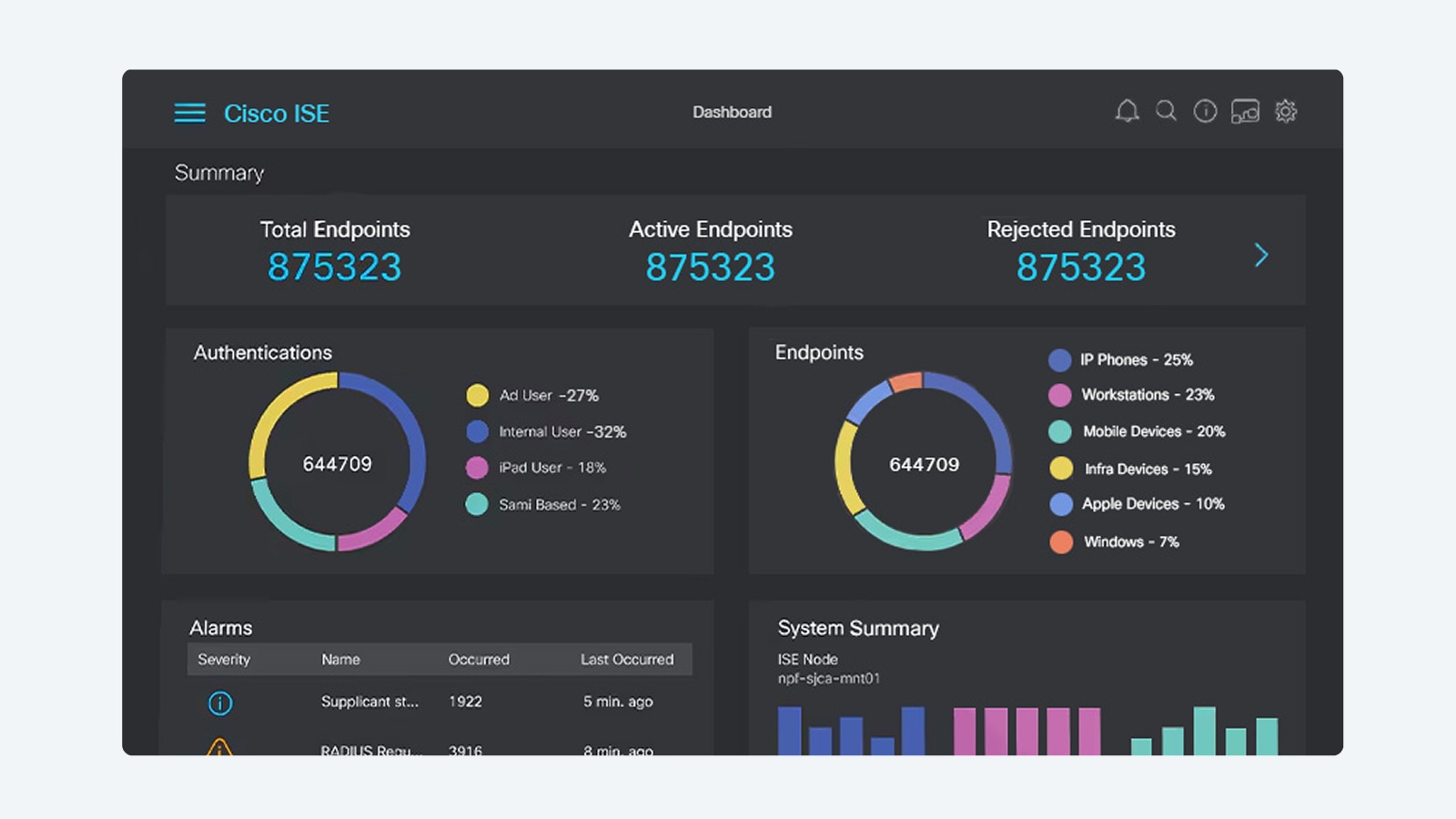
Three different starting philosophies, not three flavors of the same product. Cisco ISE is 802.1X-first and pays off most inside a Cisco-standardized fabric with TrustSec and SD-Access. Aruba ClearPass is vendor-neutral RADIUS-first and pays off in mixed-switch, mixed-AP estates that need one consistent policy layer regardless of the hardware underneath. Forescout is agentless-first and pays off wherever a meaningful share of devices can't or won't run 802.1X, OT floors, hospitals, device-dense campuses. Most enterprise shortlists actually resolve into one of two real decisions: ISE vs. ClearPass, if your fleet can enforce with 802.1X and the question is ecosystem fit, or an 802.1X-rooted platform vs. Forescout, if the real question is authentication-first versus visibility-first. Rarely does a single deployment genuinely need to evaluate all three head to head, but knowing where each one is strongest keeps you from over-scoping a NAC project into a bake-off you don't need.
At a glance
Line these up side by side and the pattern is clear: ISE and ClearPass share an 802.1X-rooted architecture and compete mainly on ecosystem fit, while Forescout competes on a different axis entirely.
| Factor | Cisco ISE | Aruba ClearPass | Forescout |
|---|---|---|---|
| Core model | 802.1X/MAB-first policy engine | Vendor-neutral RADIUS policy engine | Agentless discovery and classification first |
| Best-fit access layer | Cisco-standardized | Mixed-vendor switching/wireless | Any, doesn't require 802.1X to function |
| Segmentation depth | TrustSec SGT + SD-Access fabric | Role-based VLAN/ACL across vendors | VLAN change, ACL push, or virtual firewall segmentation |
| OT/IoT strength | Good, improving via profiling | Good, vendor-neutral profiling | Strongest, purpose-built for agentless visibility |
| Ecosystem integration | pxGrid into Cisco Secure stack | ClearPass Exchange into broad third-party tools | eyeExtend into broad third-party SIEM/EDR/ITSM |
| Licensing model | Endpoint-count subscription tiers | CAL (Client Access License) tiers | Per-device licensing across appliances |
| Support path | Cisco TAC | Aruba/HPE support | Forescout support |
ISE vs. ClearPass: the Cisco-standardized question
When the fleet can run 802.1X broadly, the ISE-vs-ClearPass decision is almost entirely about ecosystem fit rather than capability. Both platforms are mature on profiling, guest access, BYOD onboarding, and posture, that axis is close enough to a wash that it shouldn't decide the purchase. Cisco ISE pulls ahead once the access layer is genuinely Cisco end to end, because TrustSec Security Group Tags and SD-Access fabric integration only work at full depth on Cisco hardware. ClearPass pulls ahead in mixed-vendor estates, where its vendor-neutral RADIUS handling and consistent admin experience across different switch manufacturers avoids the friction of treating one vendor's gear as the reference platform.
ISE/ClearPass vs. Forescout: authentication-first vs. visibility-first
This is the fork that actually matters for a lot of buyers, and it has little to do with which brand's logo is more familiar. If a meaningful chunk of the device population can't run 802.1X, OT equipment, medical devices, legacy printers, badge readers, cameras, an 802.1X-rooted platform like ISE or ClearPass will always be reaching for MAB and static exceptions to cover that population, which is a workable fallback but not a strength. Forescout's passive discovery covers that same population natively, without ever needing a supplicant. Conversely, if the fleet is basically all supplicant-capable IT and BYOD, Forescout's agentless approach doesn't buy you much beyond what ISE or ClearPass already do with profiling, you'd be paying for a visibility specialty you don't need.
Where organizations end up running two of the three
A common, and honest, real-world outcome is running Forescout for visibility and OT/IoT segments alongside ISE or ClearPass for the 802.1X-capable IT segments, rather than picking one platform to cover the entire estate. This only makes sense when the device population genuinely splits that way, a large non-supplicant population alongside a large supplicant-capable one, and it's not a default recommendation to just buy everything. If your device population doesn't actually split like that, adding a second platform adds cost and operational overhead without a matching benefit, so confirm the split is real before budgeting for two tools instead of one.
Licensing shape across all three
All three vendors sell tiered, count-based licensing rather than a flat per-seat price: ISE by endpoint count and tier, ClearPass by Client Access License count, Forescout by device count across its appliances. None of the three publish list pricing that reliably predicts what a real deal costs, and the counting methodology differs enough between vendors, endpoints vs. CALs vs. devices, that a naive side-by-side of sticker prices will mislead you. Get validated quotes scoped to your actual counts for whichever two platforms you're genuinely comparing before drawing any cost conclusions.
Guest, BYOD, and posture: parity across all three
It's worth saying plainly that none of the three lose on the basics. ISE, ClearPass, and Forescout all support sponsor and self-service guest portals, BYOD onboarding flows, and posture or compliance checks against connecting devices, and all three have been doing so for years across large production deployments. Buyers sometimes spend a disproportionate amount of a proof-of-concept comparing guest portal branding options or BYOD click-through flows, when the real differentiation, ecosystem fit for ISE and ClearPass, agentless reach for Forescout, sits elsewhere entirely. Save the bake-off time for the factor that actually applies to your environment rather than re-verifying capability all three already have.
Administrative overhead and learning curve
All three require real policy design work before a production rollout, and none of them is meaningfully faster to stand up than the others for an equivalent scope. Where the effort differs is in what you're designing for: an ISE deployment tied to TrustSec and SD-Access is effectively a fabric architecture project, not just a AAA rollout. A ClearPass deployment across genuinely mixed switch vendors means validating RADIUS behavior and vendor-specific attributes per manufacturer. A Forescout deployment means tuning classification policy against your actual device mix so passive fingerprinting doesn't misclassify anything business-critical. Budget the design and validation phase accordingly regardless of which platform you land on, the license is rarely the long pole in the schedule.
Which should you choose?
- Choose Cisco ISE if you're Cisco-standardized and want TrustSec and SD-Access segmentation.
- Choose Aruba ClearPass if your access layer is mixed-vendor and likely to stay that way.
- Choose Forescout if a large share of your devices can't run 802.1X, OT, medical, legacy IoT.
- Choose ISE or ClearPass alone if your fleet is basically all supplicant-capable IT and BYOD.
- Pair Forescout with ISE or ClearPass if your device population genuinely splits between supplicant-capable and not.
- Don't evaluate all three as a single bake-off, narrow to the real fork, ecosystem fit or authentication vs. visibility-first, before you spend cycles on a lab.
Frequently asked questions
Do I need to evaluate all three, ISE, ClearPass, and Forescout, for every NAC project?
No. Most projects resolve into one real question: either ISE vs. ClearPass, if your fleet can run 802.1X and the decision is ecosystem fit, or an 802.1X platform vs. Forescout, if visibility for non-supplicant devices is the actual problem. A three-way bake-off is worthwhile mainly when you're not yet sure which question you're answering.
Can Forescout replace Cisco ISE entirely?
It can for organizations whose primary need is device visibility and basic enforcement without deep 802.1X-based segmentation. If you need TrustSec-style fabric segmentation or tight integration with a Cisco Secure Firewall or XDR deployment, Forescout doesn't replace what ISE does there, the two are often complementary rather than substitutes.
Which of the three is easiest to deploy in a mixed-vendor network?
Aruba ClearPass is generally the smoothest for mixed-vendor switching and wireless, since it was built vendor-neutral from the start. Forescout is also vendor-agnostic but optimized for visibility rather than fabric-level segmentation. ISE works on mixed-vendor networks via standard RADIUS but reaches full capability only against Cisco infrastructure.
Is Forescout a NAC, or something different?
Forescout markets itself broadly as a device visibility and control platform, and NAC is one of its core use cases alongside asset inventory and OT/IoT security. It performs the same fundamental job, deciding what's allowed on the network, through a different mechanism, agentless discovery, than 802.1X-rooted platforms like ISE and ClearPass.
How do licensing costs compare across all three platforms?
All three use tiered, count-based licensing, ISE by endpoint count and tier, ClearPass by Client Access License count, Forescout by device count across appliances, and none publish list pricing that reliably predicts a real deal. Get validated quotes scoped to your actual counts for whichever two you're actually comparing before drawing cost conclusions.
Uniqcli Team
The Uniqcli Team is an authorized Cisco partner specializing in Catalyst wireless, switching, datacenter fabric, licensing, and managed services for U.S. federal, state, local, and education customers. We scope Cisco bills of materials, validate procurement paths (TAA, FIPS, contract vehicles), and deliver design, deployment, and managed operations.
Ready to scope your Cisco build?
Build a quoteRelated reading
View all →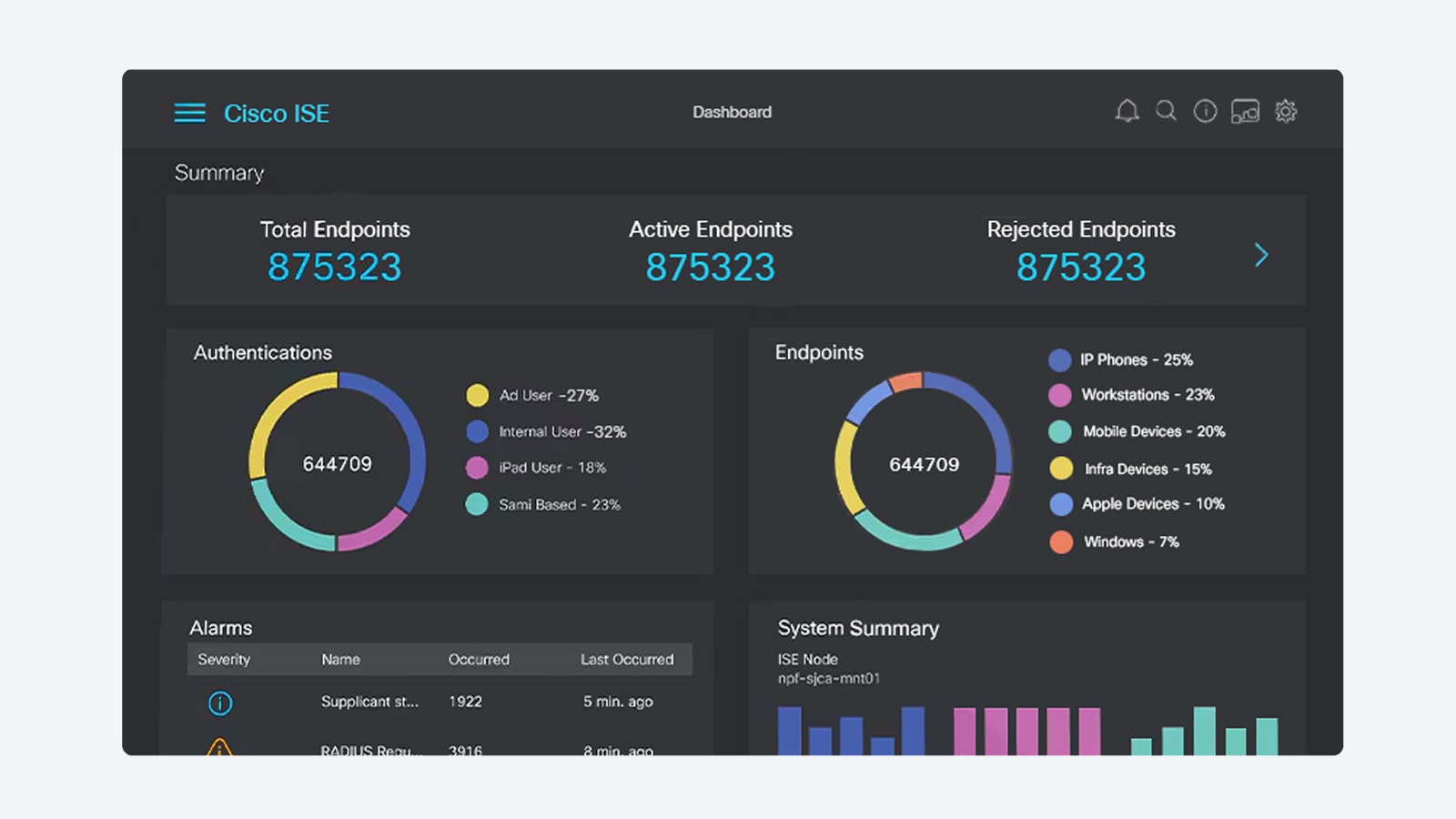 Insights
Cisco ISE Alternatives Compared: When to Stay, When to Switch, and the NAC Trade-offs
An honest Cisco ISE alternative comparison against Aruba ClearPass, FortiNAC, Forescout, NPS, and cloud-native NAC, plus a clear framework for when to stay on ISE and when to switch.
June 9, 2026 · 10 min readGuidesCisco ISE vs Aruba ClearPass: Which NAC Fits Your Network?
Cisco ISE vs Aruba ClearPass rarely comes down to missing features, both are mature NAC platforms. The real question is whether your access layer is Cisco-standardized or genuinely mixed-vendor.
July 11, 2026 · 5 min read Guides
What Is Network Access Control (NAC)? A Plain-English Guide to NAC Solutions
Network access control decides who and what gets on your network, checks whether they are safe, and contains them if they are not. This guide explains what is NAC, how a modern NAC solution works, and how Cisco implements it.
June 6, 2026 · 12 min read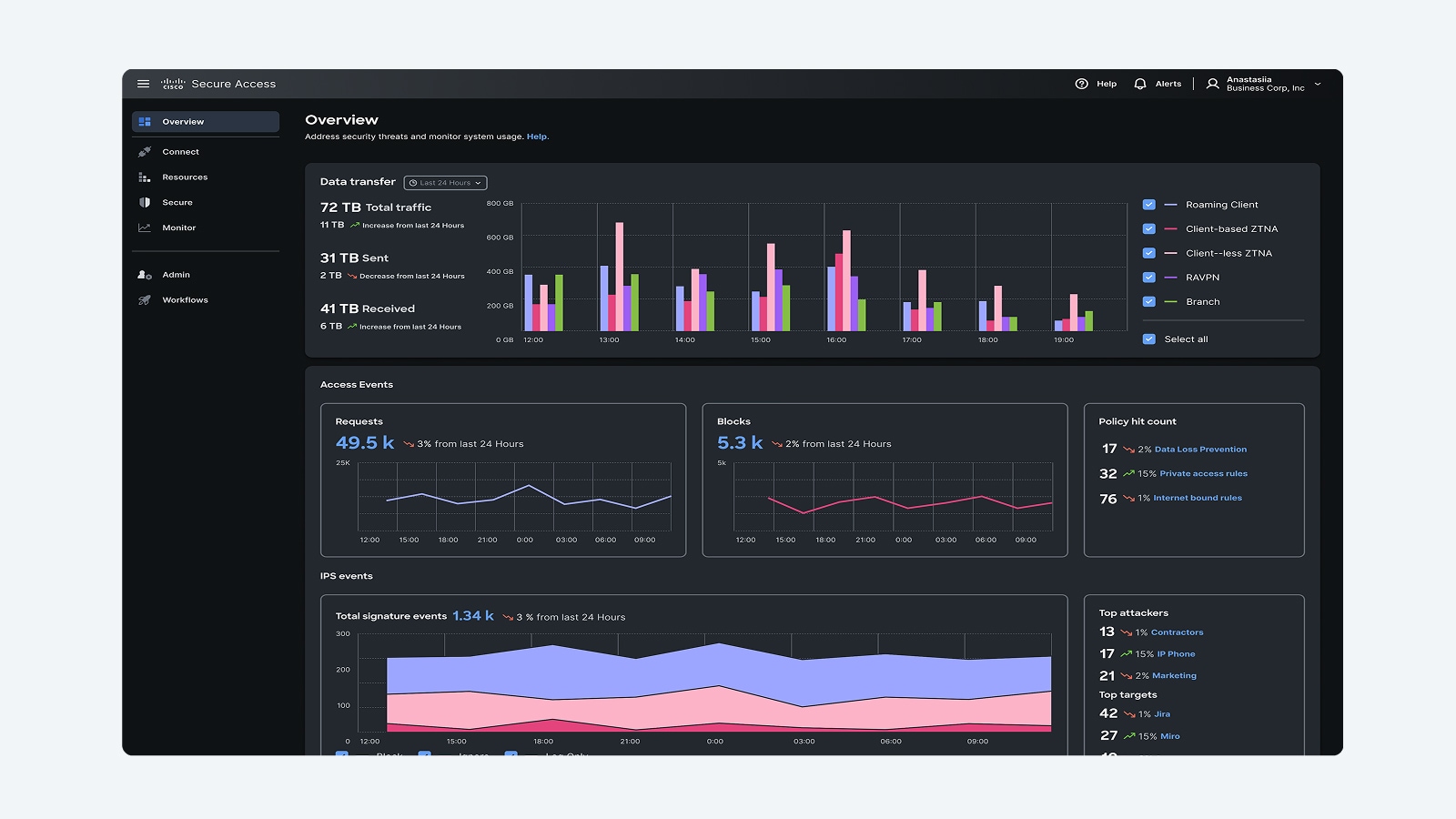 Guides
NAC for BYOD, Guest, and IoT: Securing Every Device That Touches the Network
A NAC solution turns BYOD, guest, IoT, and posture into four policies on one platform. Here is how Cisco ISE delivers each scenario, mapped to license tiers and zero-trust outcomes.
June 3, 2026 · 10 min read Compliance
NAC and Network Segmentation for Federal Zero Trust: Meeting CISA and DoD Mandates
How Cisco NAC, TrustSec segmentation, and XDR deliver network access control compliance against the CISA Zero Trust Maturity Model and DoD Zero Trust Strategy, and what federal and SLED buyers should verify before they purchase.
June 2, 2026 · 12 min read Guides
Webex vs Zoom vs Teams: The Enterprise Three-Way
Webex vs. Zoom vs. Teams compared on devices, calling, bundling, and security, an honest three-way breakdown for enterprise IT buyers choosing a platform.
July 11, 2026 · 5 min read