
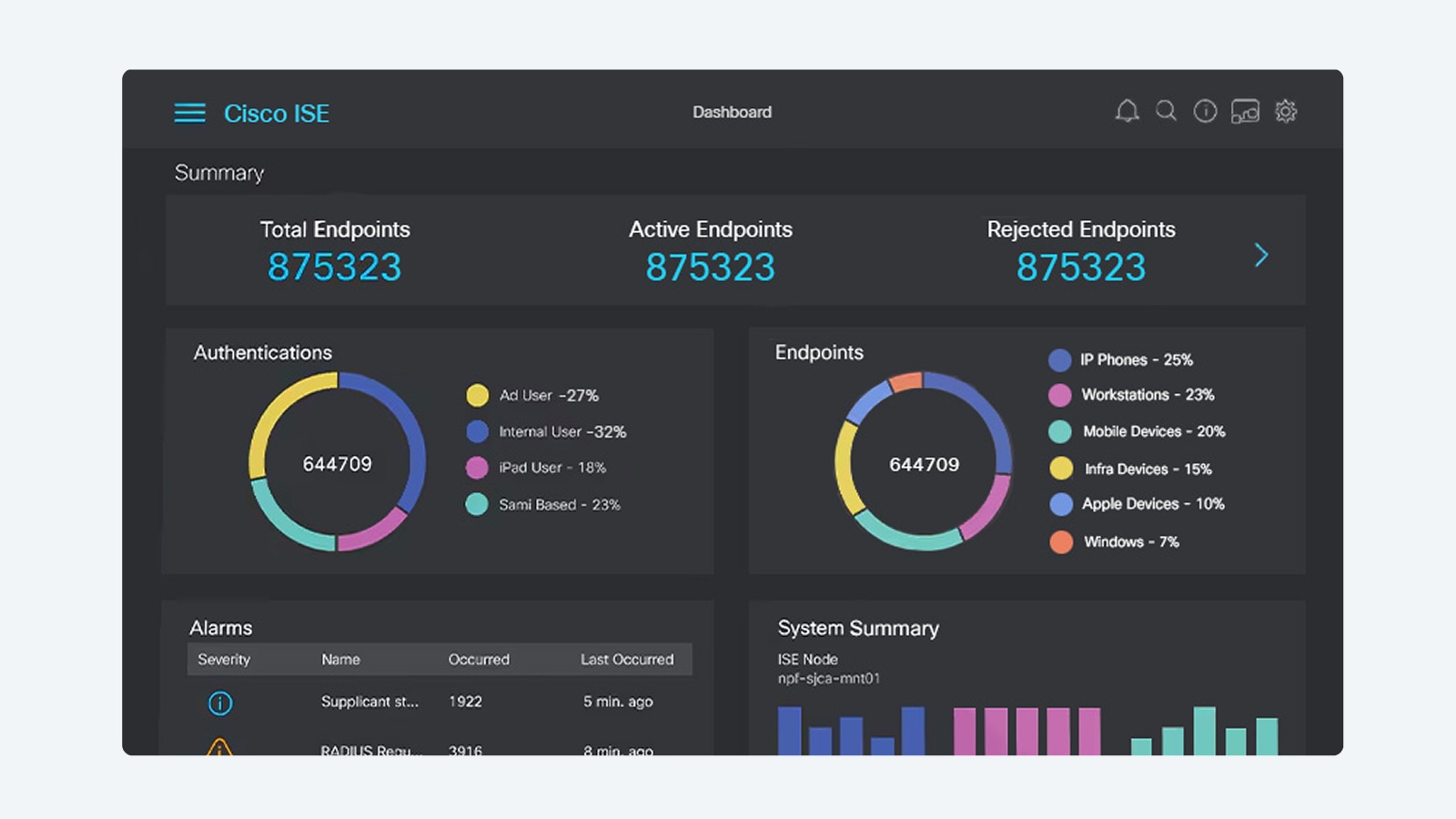
Cisco ISE and Forescout solve access control from different starting points, and that difference matters more than any feature checklist. ISE is an 802.1X-first policy engine: it authenticates and authorizes through the RADIUS exchange, and does its best work when the access layer can run 802.1X or MAB end to end. Forescout is agentless-first: it discovers and classifies devices passively, via SPAN, NetFlow, SNMP, and switch integrations, and can enforce without ever touching 802.1X, which is why it shows up so often in hospitals, plants, and campuses full of devices that can't run a supplicant. If your environment can standardize on 802.1X and you want segmentation keyed to Cisco's own fabric, ISE is the tighter fit. If you're staring down a mixed estate of medical devices, PLCs, cameras, and BYOD that will never speak 802.1X cleanly, Forescout's visibility-first model gets you a usable inventory faster, and enforcement decisions can follow once you actually know what's connected.
At a glance
Both platforms call themselves NAC, but they start from opposite assumptions about how a device proves it belongs on the network. The table below is where that shows up operationally.
| Factor | Cisco ISE | Forescout |
|---|---|---|
| Primary approach | 802.1X/MAB-first policy engine with profiling as a supporting capability | Agentless discovery and classification first, enforcement second |
| Discovery method | RADIUS telemetry, device sensors, profiling probes on Cisco switches | Passive traffic monitoring (SPAN/NetFlow), SNMP, and broad third-party switch/firewall integrations |
| Enforcement options | 802.1X, MAB, TrustSec SGT, CoA-driven VLAN/ACL change | VLAN change, ACL push, virtual firewall segmentation, or integration-driven blocking, with or without 802.1X |
| OT/IoT/unmanaged device fit | Capable via profiling, strongest behind Cisco access switches | Purpose-built strength; widely deployed for OT, medical, and IoT visibility |
| Ecosystem integration | pxGrid into Cisco Secure Firewall, XDR, SIEM | eyeExtend modules into a broad range of third-party SIEM, EDR, vulnerability scanners, and ITSM tools |
| Licensing model | Endpoint-count subscription tiers (Essentials/Advantage/Premier) | Per-device licensing across physical and virtual appliances |
| Best-fit environment | Cisco-standardized access layer, 802.1X achievable fleet-wide | Brownfield, heterogeneous, or device-dense environments where 802.1X isn't universal |
| Support path | Cisco TAC via subscription entitlement | Forescout support via contract entitlement |
Why Forescout leads on agentless visibility
Forescout's passive discovery and fingerprinting library are purpose-built for exactly the devices that break 802.1X-first platforms: infusion pumps, PLCs, badge readers, IP cameras, printers with no supplicant support at all. It doesn't need a device to authenticate to know what it is or to act on it, classification happens from traffic patterns, protocol behavior, and integration data pulled from switches, firewalls, and vulnerability scanners already in place. ISE's profiling has closed a lot of ground with device sensors and expanded probes, and it's sufficient for most enterprise IT estates, but for dense OT, medical-device, or IoT environments specifically, Forescout's passive-first classification is the sharper, more purpose-built tool. That's a genuine tradeoff, not a knock on ISE.
Why ISE goes deeper once you can enforce with 802.1X
Once the access layer is Cisco and 802.1X is achievable broadly, TrustSec segmentation, SD-Access fabric integration, and a tight loop with Catalyst Center become real advantages that Forescout doesn't try to replicate. Segmentation follows an SGT rather than a VLAN redesign, and posture checks tie directly into the same policy that granted network access in the first place, so a device that falls out of compliance mid-session can be re-authorized or quarantined without a separate out-of-band tool. This is where ISE's architecture pays off, but only once 802.1X is actually deployable across the fleet you're protecting, which is a real prerequisite, not a formality.
Integration philosophy: Cisco-native vs. security-tool-agnostic
pxGrid and eyeExtend represent two different bets. ISE's pxGrid runs deepest specifically within the Cisco Secure portfolio, Secure Firewall, XDR, Secure Endpoint, sharing identity and context natively across that stack so a firewall block rule can reference a user or device group instead of an IP. Forescout's eyeExtend module library spans a wider bench of third-party tools by design, because Forescout positions itself as a control point that orchestrates whatever security stack you already run, Cisco or not. Neither approach is wrong; they reflect each vendor's core business, and the right one depends entirely on how consolidated your existing security stack already is. A shop running Cisco firewalls and a Cisco-centric SOC toolchain will get context-sharing value out of pxGrid on day one; a shop running a heterogeneous mix of third-party SIEM, EDR, and vulnerability management tools is more likely to already have a Forescout eyeExtend connector available than a matching pxGrid integration.
Licensing and typical deployment shape
Forescout is priced per device across its appliances, sized to the device count on a given segment or site. ISE is priced by endpoint-count subscription tier, independent of how many physical nodes you deploy for redundancy. Plenty of organizations run both in different roles, Forescout for asset visibility and OT segments, ISE for 802.1X-capable IT segments, rather than treating this as strictly either/or. Confirm exact device and endpoint counts, plus current tier structure, in a validated quote before budgeting either platform, since neither vendor's list pricing translates cleanly to a real deal.
What neither platform fixes for you
Buying either tool does not substitute for basic network hygiene. A flat, undocumented VLAN structure with no segmentation plan will limit what ISE's TrustSec policy or Forescout's enforcement actions can actually accomplish, because both are enforcing against whatever topology already exists rather than redesigning it for you. The organizations that get the most out of either platform go in with at least a rough segmentation plan, which device classes should never talk to which others, and use the NAC tool to enforce that plan consistently, rather than treating the purchase itself as the segmentation strategy. That planning work is the same regardless of which platform you choose, and skipping it is the most common reason either deployment underdelivers against expectations.
Which should you choose?
- Choose Cisco ISE if your fleet can run 802.1X or MAB broadly and your access layer is Cisco.
- Choose Cisco ISE if TrustSec segmentation and SD-Access fabric integration are part of the architecture.
- Choose Forescout if OT, medical, or IoT devices make up a large share of your network and can't run a supplicant.
- Choose Forescout if you need agentless visibility fast, ahead of a longer-term 802.1X rollout.
- Consider running both if your device population genuinely splits, Forescout for visibility and OT, ISE for 802.1X-capable IT.
Frequently asked questions
Can Cisco ISE and Forescout run on the same network?
Yes, and it's a common pairing. Forescout is often deployed for broad visibility and OT/IoT segments while ISE handles 802.1X policy on IT segments that can support a supplicant. Both can share context with a Cisco Secure stack if you run Cisco firewalls or XDR, though integration depth depends on which pxGrid or eyeExtend connectors are licensed.
Does Forescout require 802.1X to work?
No, that's its defining difference from ISE. Forescout can discover, classify, and enforce policy using passive monitoring, SNMP, and switch or firewall integrations without ever requiring a device to authenticate via 802.1X. That's what makes it viable for devices that can't run a supplicant at all.
Is Cisco ISE's device profiling as good as Forescout's?
ISE's profiling is sufficient for most enterprise IT estates and has improved with device sensors and expanded probes. For dense OT, medical-device, or IoT environments specifically, Forescout's passive-first classification library is generally regarded as the deeper, more purpose-built tool, an honest tradeoff, not a gap in ISE overall.
Which is better for a hospital or manufacturing plant network?
Environments with large populations of devices that can't authenticate, infusion pumps, PLCs, badge readers, cameras, tend to get more immediate value from Forescout's agentless discovery. Many of those same environments still run ISE for the IT segments that can support 802.1X, so the two often coexist rather than compete.
Do Cisco ISE and Forescout use the same licensing model?
No. ISE is licensed by endpoint count against a subscription tier (Essentials/Advantage/Premier). Forescout licenses per device across its appliances. The two don't map cleanly to each other, so cost comparisons should be based on validated quotes scoped to your actual device and endpoint counts.
Uniqcli Team
The Uniqcli Team is an authorized Cisco partner specializing in Catalyst wireless, switching, datacenter fabric, licensing, and managed services for U.S. federal, state, local, and education customers. We scope Cisco bills of materials, validate procurement paths (TAA, FIPS, contract vehicles), and deliver design, deployment, and managed operations.
Ready to scope your Cisco build?
Build a quoteRelated reading
View all →GuidesISE vs ClearPass vs Forescout: The Three-Way NAC Shootout
Cisco ISE vs Aruba ClearPass vs Forescout is really two questions, ecosystem fit and authentication-first vs visibility-first, not one three-way bake-off. Here's how to tell which applies.
July 11, 2026 · 5 min read Guides
NAC for BYOD, Guest, and IoT: Securing Every Device That Touches the Network
A NAC solution turns BYOD, guest, IoT, and posture into four policies on one platform. Here is how Cisco ISE delivers each scenario, mapped to license tiers and zero-trust outcomes.
June 3, 2026 · 10 min read Insights
Cisco ISE Alternatives Compared: When to Stay, When to Switch, and the NAC Trade-offs
An honest Cisco ISE alternative comparison against Aruba ClearPass, FortiNAC, Forescout, NPS, and cloud-native NAC, plus a clear framework for when to stay on ISE and when to switch.
June 9, 2026 · 10 min readGuidesCisco ISE vs PacketFence: Open-Source NAC vs Enterprise NAC
Cisco ISE vs PacketFence is a buy-vs-build decision: PacketFence is a genuinely capable free NAC, but it shifts deployment, HA, and patching work onto your own team instead of a vendor.
July 11, 2026 · 5 min readGuidesCisco ISE vs Microsoft NPS: 802.1X on a Budget vs Full NAC
Cisco ISE vs Microsoft NPS is a budget-vs-capability question: NPS ships free with Windows Server for basic 802.1X, while ISE adds profiling, guest, posture, and segmentation NPS lacks.
July 11, 2026 · 5 min readGuidesCisco ISE vs FortiNAC: Enterprise NAC Head-to-Head
Cisco ISE vs FortiNAC both tie network access control to a broader vendor security fabric. The decision comes down to whether your firewall and switching stack is already Cisco or Fortinet.
July 11, 2026 · 5 min read