
Cisco ISE Alternatives Compared: When to Stay, When to Switch, and the NAC Trade-offs
An honest Cisco ISE alternative comparison against Aruba ClearPass, FortiNAC, Forescout, NPS, and cloud-native NAC, plus a clear framework for when to stay on ISE and when to switch.
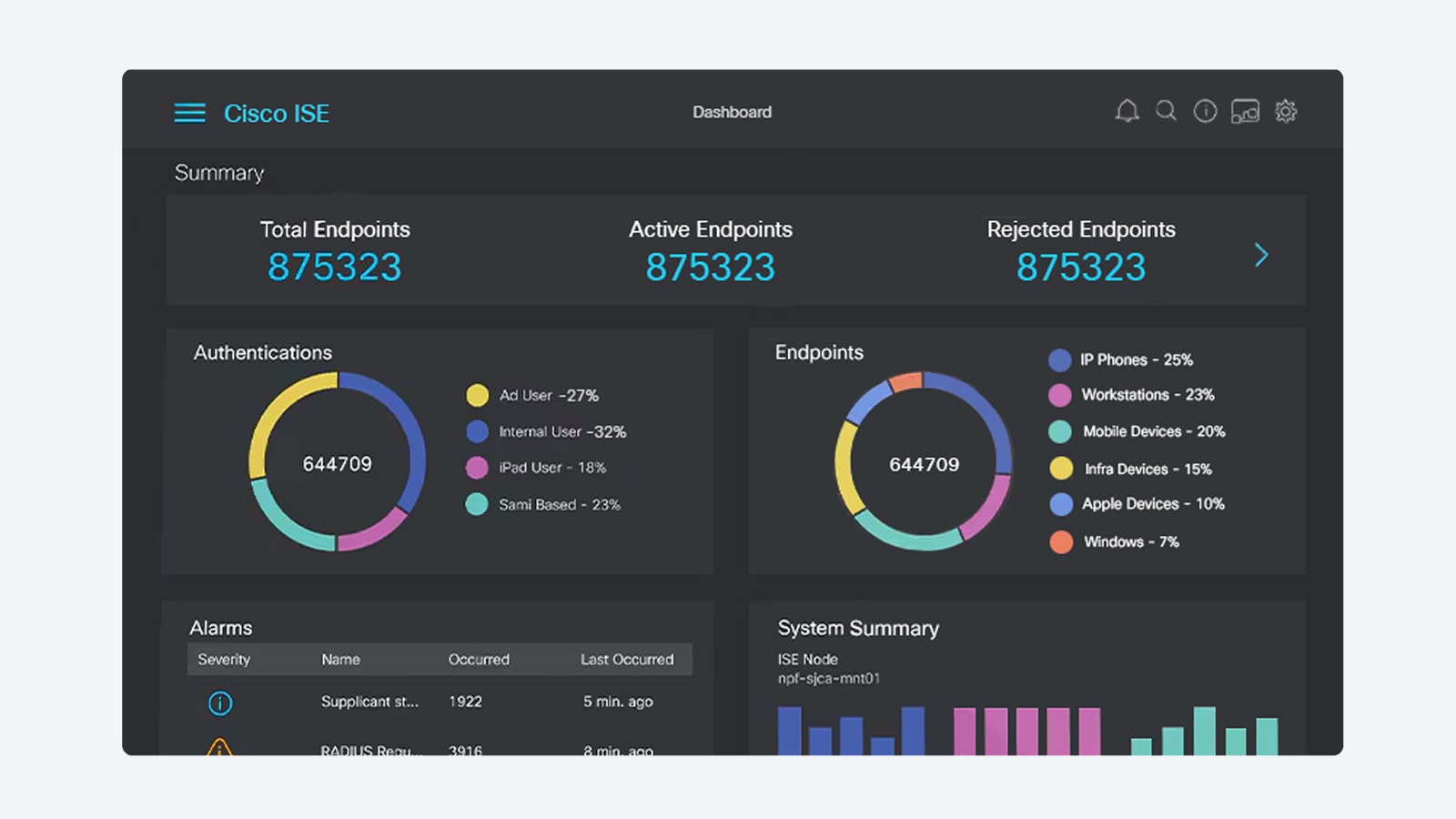
Cisco Identity Services Engine (ISE) is the dominant network access control (NAC) platform in enterprise and government networks, but it is not the only one, and it is not always the right one. If you are evaluating a cisco ise alternative because of licensing complexity, deployment effort, or a desire for a cloud-native experience, you are asking a fair question. The honest answer is that the best NAC depends on your network estate, your compliance obligations, and how much segmentation and posture enforcement you actually need.
This guide compares the serious contenders (Aruba ClearPass, Fortinet FortiNAC, Forescout, Microsoft NPS, and cloud-native NAC such as Portnox) against Cisco ISE, frames the trade-offs without spin, and shows where each option genuinely fits. We sell and deploy Cisco as an authorized partner, so we have a point of view, but the goal here is to help you make a defensible decision rather than to pretend ISE wins every scenario. It does not.
Why teams look for a Cisco ISE alternative in the first place
Most searches for cisco ise alternatives trace back to a handful of recurring frustrations rather than a single dealbreaker. ISE is a deep, capable platform, and that depth is exactly what makes it feel heavy to teams that only need a fraction of it. Before you switch, it is worth naming the actual pain, because some of these are solved by right-sizing the license tier or the deployment model rather than by changing vendors.
- Licensing confusion: the move to nested Essentials, Advantage, and Premier subscription tiers (plus a separate, perpetual Device Administration license for TACACS+) trips up buyers used to the old Base/Plus/Apex model.
- Deployment effort: a distributed cluster of Policy Administration, Monitoring, and Policy Service nodes is more to stand up and operate than a single SaaS tenant.
- On-prem footprint: teams that have moved everything else to the cloud resent maintaining appliances or VMs for NAC.
- Multivendor networks: shops running mostly non-Cisco switching sometimes assume ISE only shines on Cisco gear (it is multivendor, but TrustSec segmentation is richest on Cisco fabric).
- Specialized needs: heavy IoT/OT or agentless-discovery requirements can push teams toward tools built around device visibility first.
Keep these in mind as you read the comparisons. A licensing headache is a procurement problem we can fix at quote time. A genuine architectural mismatch is a reason to look at a different platform. The two are not the same, and conflating them leads to expensive migrations that solve nothing.
Aruba ClearPass vs Cisco ISE: the closest peer
In any honest aruba clearpass vs cisco ise discussion, you start by acknowledging that these are the two most mature, feature-complete, multivendor NAC platforms on the market. Both do 802.1X/RADIUS authentication, MAC Authentication Bypass for devices that cannot run a supplicant, endpoint profiling, posture, guest and BYOD onboarding, and TACACS+ device administration. If your only requirement is identity-based network access control on a mixed-vendor switching estate, either platform will serve you well, and the decision often comes down to which infrastructure vendor you have already standardized on.
Where ClearPass is a reasonable choice
ClearPass is the natural fit for shops running Aruba (HPE) wired and wireless infrastructure, and it is well regarded for its OnGuard posture agent and OnBoard certificate provisioning. Teams that live in the Aruba Central ecosystem get tight integration and a familiar operational model. ClearPass is genuinely multivendor, so it will authenticate Cisco, Juniper, and other switches too. If your network is Aruba-heavy, switching to ISE just to run NAC rarely pays for itself.
Where Cisco ISE pulls ahead
ISE differentiates on software-defined segmentation. Its TrustSec architecture assigns Security Group Tags (SGTs) so policy follows identity instead of IP address, and that group-based policy propagates across switches, routers, wireless, and firewalls to contain lateral movement. Combined with native integration into Cisco Catalyst Center and Software-Defined Access (SD-Access), and Common Policy that carries one identity context from campus to data center to AWS, Azure, and GCP, ISE is the stronger choice when segmentation is a first-class requirement rather than an afterthought. For Cisco-fabric and federal environments, that segmentation depth is usually the deciding factor.
FortiNAC vs Cisco ISE: visibility-first versus policy-first
The fortinac vs cisco ise comparison is really a comparison of philosophies. Fortinet FortiNAC grew out of device visibility and IoT control, and that heritage shows. It is strong at discovering and classifying the unmanaged devices that flood healthcare, manufacturing, and operational technology networks, and it slots cleanly into the Fortinet Security Fabric for organizations already invested in FortiGate firewalls and FortiSwitch.
Cisco ISE approaches the same problem from the policy decision point outward. It also profiles IoT, medical, and OT endpoints, using a cloud-based Multi-Factor Classification machine-learning engine and AI Endpoint Analytics to fingerprint unknown devices by manufacturer, model, OS, and type. Where ISE goes further is enforcement depth: EAP chaining to validate both machine and user credentials in one session via TEAP or EAP-FAST, a broader 100-plus partner pxGrid ecosystem for shared context, deeper identity-store integration, and Threat-Centric NAC that quarantines endpoints automatically based on CVSS and threat scores. If you are a Fortinet shop whose main goal is seeing and segmenting IoT, FortiNAC is coherent. If you need rich identity context and automated containment woven into a broader security stack, ISE is the more complete enforcement engine.
Quick rule of thumb: Choose the NAC that matches your network fabric and your hardest requirement. ClearPass for Aruba estates, FortiNAC for Fortinet/IoT-visibility shops, and Cisco ISE when segmentation, deep identity context, federal certification, or Catalyst/SD-Access integration drive the decision. Standing up NAC on a fabric it was not built for adds friction you will feel every day.
Forescout, Microsoft NPS, and cloud-native NAC
Beyond the two closest peers, three other categories show up on most shortlists of cisco ise competitors, and each occupies a distinct niche rather than competing head-to-head across every capability.
Forescout: agentless visibility at scale
Forescout built its reputation on agentless device discovery and is frequently chosen by organizations with sprawling, heterogeneous OT and IoT environments that want to see everything without deploying supplicants. It is excellent at the visibility and classification problem. Where it differs from ISE is that ISE is primarily the inline policy decision point enforcing access at the 802.1X port, with profiling as one capability among many, whereas Forescout leans on its visibility-and-control model. Some large enterprises actually run both: Forescout for deep visibility, ISE for 802.1X enforcement and TrustSec segmentation.
Microsoft NPS: basic RADIUS, not full NAC
Microsoft Network Policy Server (NPS) is bundled with Windows Server and provides basic RADIUS authentication. It is tempting because it appears free, but it is not a NAC platform. NPS gives you authentication and little else. It has no endpoint profiling, no posture assessment, no guest or BYOD portals, no segmentation, and no automated threat containment. For a small site that only needs to check credentials against Active Directory, NPS can suffice. For any environment that needs to see, classify, and control what connects, treating NPS as a NAC replacement leaves large gaps.
Portnox and cloud-native NAC: SaaS simplicity with limits
Cloud-native NAC vendors such as Portnox deliver NAC purely as SaaS, which is attractive if your driving requirement is to eliminate on-prem appliances and operational overhead. The trade-off is control and reach. ISE offers on-prem appliance, VM, and public-cloud deployment, so regulated, hybrid, and air-gapped environments can keep policy on premises while still getting cloud options where they want them. If your top priority is zero infrastructure and you accept a cloud-only control plane, a SaaS NAC is worth evaluating. If you have data-residency, air-gap, or deep segmentation requirements, the on-prem and hybrid flexibility of ISE matters.
The federal and compliance angle: where ISE is hard to replace
For US federal, DoD, and SLED buyers, the NAC vendor comparison narrows quickly, and this is the scenario where switching away from Cisco ISE is hardest to justify. ISE is widely deployed as the network-level enforcement point for zero trust across public-sector environments, and Cisco engineers it against the certifications agencies require. Per Cisco documentation, ISE is designed to meet FIPS 140 (140-2 or 140-3 depending on release), Common Criteria via the Network Device collaborative Protection Profile (NDcPP), and Unified Capabilities / DoDIN Approved Products List (APL) requirements, with the exact certified release to be confirmed at quote time.
As of release 3.5, ISE adds full single-stack IPv6 support, USGv6 / IPv6 Ready logo certification, and administrator authentication via DoD Common Access Card (CAC) and smart card. It maps directly to the identity and device pillars of the CISA Zero Trust Maturity Model by providing continuous device identification, authentication, posture, and segmentation. Most alternatives cannot match this certification posture, which is why ISE remains the default for agencies with strict 802.1X, segmentation, and continuous-compliance mandates. One caveat to keep honest: ISE itself is not a FedRAMP-authorized cloud service, so confirm current certification and authorization status for any cloud-hosted deployment with your Cisco representative.
Procurement matters as much as the platform: Federal NAC is not just a technology decision, it is a procurement one. As an authorized Cisco partner, Uniqcli sources TAA-compliant Secure Network Server appliances and the correct ISE licensing through GSA and other government purchasing vehicles, confirms the FIPS / Common Criteria / UC APL status of the specific release, and supports Government Purchase Card (GPC) eligible channels. A non-Cisco NAC that cannot clear these gates is a non-starter regardless of its feature list.
A practical decision framework: when to stay, when to switch
Strip away vendor marketing and the choice comes down to fabric alignment, requirement depth, and compliance. Use the following framing to decide quickly. Switching NAC is a multi-quarter project, so the bar to leave a working ISE deployment should be high.
- Stay with (or move to) Cisco ISE if: you run Cisco Catalyst or Meraki infrastructure, need TrustSec/SGT segmentation or SD-Access, have federal/DoD certification requirements (FIPS, Common Criteria, DoDIN APL, CAC login), or want automated Rapid Threat Containment tied into a broader security stack including Cisco XDR.
- Consider Aruba ClearPass if: your wired and wireless estate is Aruba/HPE and you want NAC that mirrors that ecosystem, with no hard segmentation-controller requirement.
- Consider FortiNAC if: you are a Fortinet Security Fabric shop whose primary goal is IoT/OT visibility and control rather than deep identity-based enforcement.
- Consider Forescout if: agentless visibility across a vast heterogeneous OT/IoT estate is your top problem (and consider pairing it with ISE for enforcement).
- Consider cloud-native NAC (Portnox) if: eliminating on-prem infrastructure outweighs deep segmentation, hybrid control, and data-residency needs.
- Stick with Microsoft NPS only if: you genuinely need nothing beyond basic RADIUS authentication for a small, low-risk site.
If your frustration with ISE is licensing or deployment complexity rather than a true capability gap, the cheaper fix is to re-scope the deployment. The right tier (Essentials for core 802.1X, Advantage for profiling and segmentation, Premier for posture and Threat-Centric NAC), the right node topology, and a clean migration plan often resolve the pain without a rip-and-replace. We can model that for you against your endpoint counts and switch estate. Build a rough configuration in our catalog or send your environment details for a tailored proposal.
Make the call with a partner who scopes it honestly
There is no universal best NAC, only the best fit for your fabric, your requirements, and your compliance posture. Cisco ISE wins decisively in Cisco-heavy and federal environments where segmentation and certification matter most, while ClearPass, FortiNAC, Forescout, and cloud-native options each earn their place in the right context. The mistake to avoid is switching for a reason (licensing or deployment friction) that a better-scoped deployment would have solved. To go deeper on capabilities and licensing tiers, see our full Cisco ISE overview and the broader network access control pillar. When you are ready to compare a real configuration against your environment, request a quote and we will scope the compliant, right-sized option, whether that is ISE or an honest recommendation to look elsewhere. Start a quote and we will take it from there.
Frequently asked questions
What is the best Cisco ISE alternative?
There is no single best alternative, only the best fit for your network. Aruba ClearPass is the closest peer for Aruba/HPE estates, FortiNAC suits Fortinet shops focused on IoT visibility, and Forescout excels at agentless discovery across large OT environments. Cisco ISE remains the strongest choice for Cisco-fabric, segmentation-heavy, and federal deployments because of its TrustSec segmentation and FIPS/Common Criteria/DoDIN APL certification posture.
How does Aruba ClearPass compare to Cisco ISE?
Both are mature, multivendor NAC platforms covering 802.1X authentication, profiling, posture, and guest/BYOD. ClearPass is the natural fit for Aruba/HPE infrastructure, while Cisco ISE differentiates with native TrustSec Security Group Tag segmentation and tight integration into Catalyst Center and SD-Access. If your network is Aruba-heavy, ClearPass is reasonable; if segmentation or Cisco-fabric integration matters, ISE leads.
Is FortiNAC better than Cisco ISE for IoT?
FortiNAC is strong at IoT and OT device visibility and fits cleanly into the Fortinet Security Fabric. Cisco ISE also profiles and classifies IoT, medical, and OT devices using AI/ML classification, and adds deeper identity context, EAP chaining, a broad pxGrid ecosystem, and automated Threat-Centric NAC containment. For pure visibility in a Fortinet shop, FortiNAC works; for identity-based enforcement woven into a wider security stack, ISE is more complete.
Can Microsoft NPS replace Cisco ISE?
Only for the most basic needs. Microsoft NPS is a RADIUS server bundled with Windows Server and provides authentication but no profiling, posture, guest/BYOD portals, segmentation, or automated threat containment. It can suffice for a small site that only needs to check credentials, but it is not a full NAC platform and leaves significant gaps for any environment that must see and control what connects.
Should federal agencies switch away from Cisco ISE?
Rarely. ISE is engineered to meet FIPS 140, Common Criteria (NDcPP), and DoDIN/UC APL requirements, supports CAC/smart-card administrator login, and maps to the identity and device pillars of the CISA Zero Trust Maturity Model. Most alternatives cannot match this certification posture. Agencies should confirm the certified release and cloud authorization status at quote time, and procure through TAA-compliant, GPC-eligible channels.
When does it make sense to switch NAC vendors at all?
Switch when you have a genuine architectural mismatch, for example a network fabric a different vendor serves better, or a hard requirement your current platform cannot meet. Do not switch to solve licensing or deployment frustration, which a re-scoped tier and node topology usually fix more cheaply. Migrating NAC is a multi-quarter project, so the bar to leave a working deployment should be high.
Uniqcli Team
The Uniqcli Team is an authorized Cisco partner specializing in Catalyst wireless, switching, datacenter fabric, licensing, and managed services for U.S. federal, state, local, and education customers. We scope Cisco bills of materials, validate procurement paths (TAA, FIPS, contract vehicles), and deliver design, deployment, and managed operations.
Ready to scope your Cisco build?
Build a quoteRelated reading
View all → Guides
ISE vs ClearPass vs Forescout: The Three-Way NAC Shootout
Cisco ISE vs Aruba ClearPass vs Forescout is really two questions, ecosystem fit and authentication-first vs visibility-first, not one three-way bake-off. Here's how to tell which applies.
July 11, 2026 · 5 min readGuidesCisco ISE vs Aruba ClearPass: Which NAC Fits Your Network?
Cisco ISE vs Aruba ClearPass rarely comes down to missing features, both are mature NAC platforms. The real question is whether your access layer is Cisco-standardized or genuinely mixed-vendor.
July 11, 2026 · 5 min read Insights
Cisco Competitors: How Cisco Stacks Up Against Arista, Juniper/HPE, Aruba, Fortinet, and More
No single vendor wins every domain. Here's an honest, domain-by-domain breakdown of where Cisco leads, where Arista, HPE (Juniper), Aruba, Fortinet, Palo Alto, and Ubiquiti are genuinely stronger, and what that means for your buy decision.
July 3, 2026 · 10 min read Guides
Cisco vs Aruba (HPE) Switches: Catalyst vs CX Compared
Cisco vs aruba switches is a genuine campus-value contest: Aruba CX's AOS-CX and Aruba Central often win on simplicity and price, while Catalyst counters with deeper ISE/TrustSec segmentation.
July 11, 2026 · 5 min readGuidesCisco ISE vs FortiNAC: Enterprise NAC Head-to-Head
Cisco ISE vs FortiNAC both tie network access control to a broader vendor security fabric. The decision comes down to whether your firewall and switching stack is already Cisco or Fortinet.
July 11, 2026 · 5 min readGuidesCisco ISE vs Forescout: NAC and Device Visibility Compared
Forescout vs Cisco ISE is a contest between two philosophies: 802.1X-first policy versus agentless-first visibility. Which fits depends on how much of your fleet can run a supplicant.
July 11, 2026 · 5 min read