
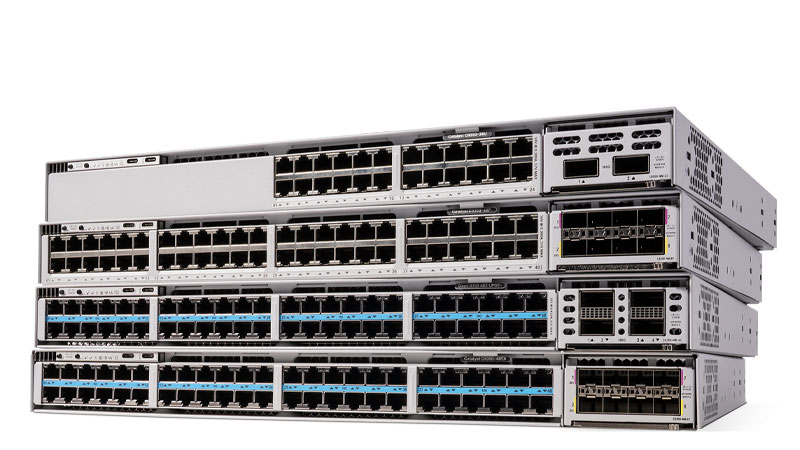
If you still have a Cisco Catalyst 2960-S 24-port PoE switch (PID WS-C2960S-24PS-L) carrying live traffic in a wiring closet, you are running hardware that Cisco stopped selling on November 6, 2015 and stopped supporting in any form on November 30, 2020. That last date, the last day of support, or LDoS, is the one that matters. Past it, the switch is not just old; it is unsupportable. There are no more software fixes, no security patches for newly disclosed vulnerabilities, and no TAC case or RMA you can open when one fails at 2 a.m. This guide walks through what each milestone means in practice, why the WS-C2960X-24PS-L was named as its direct replacement, and how to plan a clean migration, with notes specific to federal, DoD, SLED, and healthcare buyers.
What the WS-C2960S-24PS-L actually is
The 2960-S was Cisco's previous-generation fixed Layer 2 access switch. This specific SKU gives you 24 ports of 10/100/1000 Ethernet with PoE/PoE+, a 370W PoE power budget, and four 1G SFP uplinks, running the LAN Base feature set on IOS. It introduced FlexStack, a 20 Gbps stacking ring over a rear module that let you bond up to four members into a single managed unit. For its era it was a workhorse: 88 Gbps switching capacity, line-rate Gigabit, and enough PoE budget to light up a closet of phones, APs, and cameras. The problem is purely one of lifecycle, not capability. The 370W budget is shared across all 24 ports, which means roughly 15.4W per port if loaded evenly, fine for 802.3af phones, tight for a closet full of 802.3at (PoE+, 30W) devices.
What each end-of-life milestone means in practice
- End of Sale, November 6, 2015: Cisco stopped taking new orders. Anything you buy after this date is secondary-market or new-old-stock. The clock on every later milestone started here.
- End of Software Maintenance, November 5, 2016: The last maintenance IOS release shipped. After this, no bug fixes, no software enhancements, and critically, no new vulnerability remediation. Any CVE disclosed after this date against the 2960-S code base will never be patched.
- Last Day of Support (LDoS), November 30, 2020: The hard wall. Cisco TAC will not open a case, will not honor a SmartNet contract, and will not RMA a failed unit. The hardware is fully obsolete and out of every support program.
The recommended replacement and why it is concretely better
Cisco named the Catalyst 2960-X 24 GigE PoE 370W LAN Base (WS-C2960X-24PS-L) as the direct successor, a like-for-like fit at the SKU level: 24 Gigabit copper ports, 370W PoE+ budget, four 1G SFP uplinks, LAN Base. Same form factor, same uplink optics (you can reuse your existing GLC-T, GLC-SX-MMD, and GLC-LH-SMD SFPs), same rack footprint. The upgrades under the hood are real: switching capacity jumps to 108 Gbps, the stacking architecture moves from FlexStack (20 Gbps) to FlexStack-Plus (80 Gbps) with up to 8 members, and the platform supports up to 1024 VLANs and a deeper buffer than the 2960-S. RJ-45 console plus a dedicated USB console and USB storage port make field provisioning easier.
Be aware of where the lifecycle actually stands today. The 2960-X is itself now retired, so for a forward-looking refresh the current target is the Catalyst 9200L. The decision comes down to budget and timeline: the 2960-X is a true drop-in for an under-pressure closet, while the 9200L is the modern platform you would standardize on. The 9200L runs IOS-XE instead of classic IOS, adds StackWise-160 stacking, brings UADP-based ASICs, and, the big shift, moves licensing to Cisco Smart Licensing with Network Essentials/Advantage tiers managed through Catalyst Center (formerly DNA Center). That is a genuine operational change from the old per-box LAN Base model: licenses become account-level entitlements you manage centrally rather than feature sets baked into the image.
- Throughput: 88 Gbps (2960-S) → 108 Gbps (2960-X) → 56-128 Gbps class with modern ASIC offload (9200L)
- Stacking: FlexStack 20 Gbps / 4 members → FlexStack-Plus 80 Gbps / 8 members → StackWise-160
- Software: classic IOS (frozen) → IOS / IOS-XE → IOS-XE with programmability (NETCONF/RESTCONF, model-driven telemetry)
- Licensing: perpetual LAN Base on the box → same → Smart Licensing + Catalyst Center subscription tiers
- PoE: 370W PoE+ across all three; if you need more headroom for PoE+ cameras and Wi-Fi 6 APs, step up to a 740W-budget SKU
A practical migration plan
1. Assessment and inventory
Pull a real inventory before you buy anything. From each switch, capture 'show version', 'show inventory', 'show power inline', 'show interfaces status', and the stack topology. You want three numbers: actual PoE draw per closet (so you know whether 370W is enough or you need the 740W variant), uplink optic types in use (so you can reuse them), and stack member count (FlexStack-Plus supports up to 8, so consolidation is often possible). Tag every WS-C2960S-24PS-L in your CMDB against its LDoS date so the finding is documented.
2. License transition
Going 2960-S to 2960-X, LAN Base is perpetual and stays on the box, no license server, no portal. Going to the 9200L, set up a Cisco Smart Account and Virtual Account first, decide Network Essentials vs Advantage, and plan whether the switches phone home directly, through a Smart Licensing satellite/CSLU, or in an air-gapped (offline reservation) mode, the last is common in DoD and classified enclaves. Sort this out before delivery so switches register on day one.
3. Config and feature parity
Most LAN Base IOS configuration ports directly: VLANs, trunking, port security, voice VLANs, 802.1X/MAB, QoS markings, and SSH. The 2960-X uses the same IOS CLI, so a sanitized config from the 2960-S transfers with minimal edits, mostly interface ranges and stack renumbering. The 9200L on IOS-XE needs more attention: AAA and 802.1X syntax shifts slightly, QoS uses the MQC model, and you will adopt the new licensing stanza. Build a golden config per closet role and validate it on a bench unit before touching production.
4. Physical: rack, power, PoE, uplinks, optics, stacking
- Rack: 1RU each, identical footprint, no cabinet rework for a like-for-like swap
- Power: confirm the closet's AC feed; if you move from 370W to 740W PoE you may pull more from the PDU
- Optics: 1G SFPs (GLC-T, GLC-SX-MMD, GLC-LH-SMD) carry over; verify on the 9200L compatibility matrix if you upgrade uplinks to SFP+ 10G
- Stacking: FlexStack and FlexStack-Plus modules and cables are NOT compatible, order the correct stack kit for the target platform; do not plan to reuse 2960-S FlexStack hardware
5. Phased cutover
Stage and pre-load the replacement switches off-hours, then cut over one closet (or one stack) per maintenance window. Pre-label patch cables, move uplinks first, verify the management plane and 802.1X authentication, then migrate access ports in batches. Keep the outgoing 2960-S powered and patched in place until the new unit is verified, so rollback is a cable swap, not a re-rack.
6. Secure decommission
Do not let a retired switch leave the building with its config intact. Run 'write erase' plus 'delete /force /recursive flash:' and reload to clear startup config, VLAN database, and any stored credentials or certificates. For federal and healthcare assets, follow NIST SP 800-88 media sanitization and capture a certificate of data destruction for the audit trail. Then dispose through an authorized, environmentally compliant channel.
Procurement notes for government and enterprise
Buy new, in-warranty hardware from an authorized partner, not gray-market 2960-S stock, which has no support path and is a counterfeit risk. For federal buyers, confirm TAA compliance (country of origin) on the exact SKU; we can supply the documentation your contracting officer needs. The 2960-X and 9200L both accept GPC/purchase-card payment for orders under the micro-purchase threshold, and larger refreshes can be quoted as FAR-based purchase orders under Simplified Acquisition Procedures. We do not hold a GSA Schedule or other contract vehicle. Lead times on current-generation Catalyst gear move with Cisco's supply cycles, so place orders early when you are working against a fiscal-year deadline.
See the full lifecycle record on the WS-C2960S-24PS-L end-of-life page, browse the broader Cisco EoL hub to check the rest of your fleet, or compare replacement switches in our catalog.
Frequently asked questions
Is the Cisco WS-C2960S-24PS-L still supported?
No. The Catalyst 2960-S reached its last day of support on November 30, 2020. Cisco no longer provides software updates, security patches, TAC support, or RMA replacement for this switch. Running it in production means any new IOS vulnerability stays unpatched and a hardware failure has no warranty path.
What is the direct replacement for the WS-C2960S-24PS-L?
Cisco named the Catalyst 2960-X 24 GigE PoE 370W LAN Base (WS-C2960X-24PS-L) as the direct successor, same 24-port, 370W PoE+, 4x 1G SFP, LAN Base configuration with higher throughput and FlexStack-Plus stacking. Because the 2960-X is now also retired, the current forward-looking refresh target is the Catalyst 9200L on IOS-XE.
Can I reuse my SFP optics and stack cables when I migrate?
Your 1G SFP uplink optics (GLC-T, GLC-SX-MMD, GLC-LH-SMD) carry over to the 2960-X. Stacking hardware does not: the 2960-S uses FlexStack and the 2960-X uses FlexStack-Plus, and the modules and cables are not interchangeable. Order the correct stack kit for your target platform.
How does licensing change if I move to the Catalyst 9200L instead?
The 2960-S and 2960-X use perpetual LAN Base baked into the IOS image. The 9200L moves to Cisco Smart Licensing with Network Essentials and Network Advantage tiers, managed through your Smart Account and Catalyst Center. You will set up a Smart/Virtual Account and choose an online, satellite, or offline (reservation) registration mode before deployment.
Why does end-of-life matter for compliance audits?
Frameworks like FISMA, FedRAMP, HIPAA, PCI-DSS, and CMMC expect that infrastructure can receive security updates. A switch past its last day of support cannot be patched, so newly disclosed vulnerabilities remain open indefinitely. Assessors flag unsupportable gear as a finding, which weakens your ATO posture and creates remediation obligations.
Uniqcli Team
The Uniqcli Team is an authorized Cisco partner specializing in Catalyst wireless, switching, datacenter fabric, licensing, and managed services for U.S. federal, state, local, and education customers. We scope Cisco bills of materials, validate procurement paths (TAA, FIPS, contract vehicles), and deliver design, deployment, and managed operations.
Ready to scope your Cisco build?
Build a quoteRelated reading
View all →GuidesWS-C2960X-24PS-L EoL: Migrate to Catalyst 9200L Guide
A practical, partner-built plan for replacing the end-of-sale Catalyst 2960-X 24-port PoE switch (WS-C2960X-24PS-L) with the Catalyst 9200L-24P-4G before the October 2027 last day of support.
October 20, 2025 · 7 min readGuidesCisco WS-C2960X-48FPD-L EoL: Migrating to Catalyst 9200L
The Cisco Catalyst 2960-X 48-port full-PoE switch (WS-C2960X-48FPD-L) is end-of-sale with support ending October 31, 2027, here is a concrete plan to migrate to the Catalyst 9200L (C9200L-48P-4X).
October 22, 2025 · 9 min readGuidesWS-C2960S-48TS-L End of Life: Migration Guide to the 2960-X
The Catalyst 2960-S 48-port LAN Base hit Last Day of Support in November 2020, here is exactly why to refresh now and how to migrate cleanly to its successor.
October 18, 2025 · 9 min read Guides
Cisco 2960-24TC-L EoL: Migrate to Catalyst 9200L Guide
The original Catalyst 2960-24TC-L (WS-C2960-24TC-L) passed Last Day of Support on October 31, 2019. Here's why this Fast Ethernet LAN Base switch must come out, and how to refresh cleanly to the Gigabit, PoE+ Catalyst 9200L-24P-4X.
June 7, 2026 · 7 min readGuidesCisco 2960-48TC-L EoL: Migrate to Catalyst 9200L 48-Port
The Catalyst 2960-48TC-L (WS-C2960-48TC-L) passed Last Day of Support on October 31, 2019. Here is why this Fast Ethernet LAN Base switch has to come out of the wiring closet, and how to refresh cleanly to the Catalyst 9200L 48-port C9200L-48T-4X-A.
June 9, 2026 · 8 min readGuidesWS-C2960XR-48FPD-I End of Life: Migrate to Catalyst 9200
The Catalyst 2960-XR 48-port PoE+ switch is past end of sale with support ending October 31, 2027; here is a concrete plan to refresh it to the Catalyst 9200 C9200-48P.
October 25, 2025 · 8 min read