
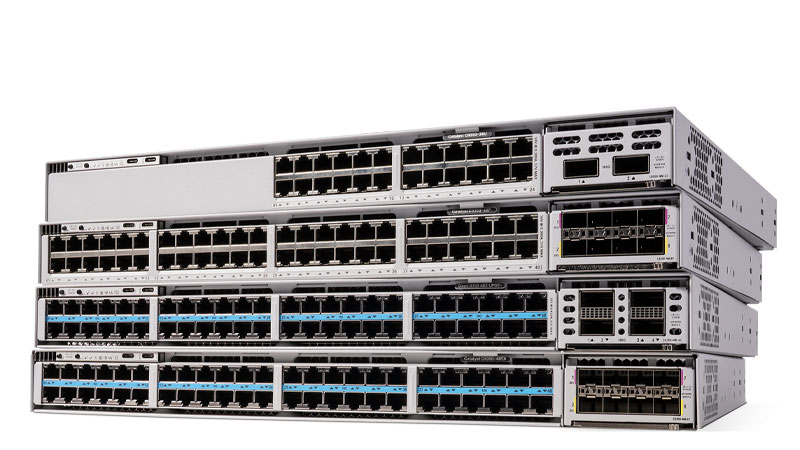
If you still have Cisco Catalyst 2960-S switches carrying production traffic, the WS-C2960S-48TS-L is the model most likely to be hiding in a wiring closet: 48 fixed 10/100/1000 data ports, four 1G SFP uplinks, FlexStack stacking, and the LAN Base feature set. It was a workhorse access switch for the better part of a decade. It is also fully obsolete. Cisco stopped selling it on November 6, 2015, ended software maintenance on November 5, 2016, and reached Last Day of Support (LDoS) on November 30, 2020. As of today every one of those gates is firmly closed, and the switch has been running on borrowed time for more than five years.
This guide explains what each of those milestone dates actually means for an operations team, why an LDoS box is a measurable risk rather than a theoretical one, and how to migrate to the model Cisco named as its direct successor, the Catalyst 2960-X 48-port LAN Base (WS-C2960X-48TS-L), with a real plan for licensing, config parity, the physical swap, and secure decommissioning. You can review the full lifecycle record for this exact PID on our WS-C2960S-48TS-L end-of-life page, and browse the broader Cisco EoL hub for the rest of your fleet.
What the milestone dates actually mean
Cisco's lifecycle vocabulary is precise, and the gaps between dates are where the operational pain lives. Reading them in order tells the whole story of a WS-C2960S-48TS-L still in service.
End of Sale, November 6, 2015
After this date you could no longer order the switch new from Cisco. It is the clock-start for everything that follows: the published five-year support window runs from here, not from when you happened to deploy the unit. A switch you bought in 2015 and one bought in 2012 reached LDoS on the same day.
End of Software Maintenance, November 5, 2016
This is the date most teams underestimate. After end of SW maintenance, Cisco stopped producing maintenance IOS rebuilds for the 2960-S, meaning bug fixes and, critically, security patches. The last shipping train for this platform is IOS 15.0(2)SE; nothing newer was ever released for it. Every vulnerability disclosed by Cisco PSIRT against 2960-S code since late 2016 has no fix you can install. The hardware kept switching packets, but the software underneath it has been frozen for nearly a decade.
Last Day of Support, November 30, 2020
LDoS is the hard wall. Past this date Cisco TAC will not open a case for the platform, there is no RMA path for a failed unit, and no further software of any kind, not even an emergency PSIRT fix for a critical, actively-exploited CVE. A 2960-S that dies on a Friday night is simply gone; there is no advance-replacement spare coming from Cisco. Whatever you can source is end-of-life gray-market hardware running the same frozen, unpatched code.
The recommended replacement: Catalyst 2960-X 48-port LAN Base
Cisco's own EoL bulletin pointed 2960-S buyers at the Catalyst 2960-X, and the WS-C2960X-48TS-L is the like-for-like match: 48 ports of 10/100/1000 data and four 1G SFP uplinks in the same 1RU footprint, same LAN Base positioning. It is a clean drop-in for a data closet, and the differences are exactly the ones that matter for the next refresh cycle.
- Switching capacity: the 2960-X moves to a 216 Gbps switching fabric and roughly 108 Mpps forwarding, versus the 2960-S's smaller fabric, real headroom for line-rate gigabit across all 48 ports plus uplinks.
- Stacking: FlexStack-Plus replaces the original FlexStack, supporting up to 8 members at 80 Gbps of stack bandwidth (versus 4 members at 40 Gbps on the 2960-S), so you can collapse more closet switches into one managed stack with one IP.
- Larger tables and buffers: more MAC entries, larger TCAM, and 4 MB of packet buffer help with denser endpoint counts and bursty traffic that the older platform struggled with.
- Software currency: the 2960-X runs IOS 15.2(7)E trains, an actively-maintained code base that still receives PSIRT security fixes, the single most important difference from the frozen 2960-S.
- Optional uplink/PoE flexibility across the 2960-X line: if requirements have grown since the original deployment, sibling SKUs add 10G SFP+ uplinks or PoE+/UPOE for phones, APs, and cameras, capability the TS data SKU never had.
Licensing is straightforward here and worth calling out, because it is where buyers often expect more friction than exists. The 2960-X uses the same Right-to-Use (RTU) feature-set model as the 2960-S, LAN Base is the base license, and there is no Smart Licensing portal, no subscription, and no DNA tier to manage. The newer cloud/Smart Licensing and DNA subscription model belongs to the Catalyst 9000 generation, not the 2960-X. So a LAN Base-to-LAN Base move is feature-set neutral: what you licensed before is what you get, with nothing new to register or renew.
A practical migration plan
1. Assessment and inventory
Pull an authoritative inventory before you buy anything. Run 'show version', 'show inventory', and 'show switch' across the fleet to capture serial numbers, IOS release, stack membership, and PID per closet. Map which uplinks use which SFP optics (1000BASE-SX, -LX, -T, or DOM-capable modules), the 2960-X uses standard Cisco SFPs, and many existing optics carry over, but verify each one rather than assuming. Note any closet that is stacked so you size FlexStack-Plus cabling and member counts correctly.
2. Config and feature parity
Because both platforms run IOS 15.x and share the LAN Base feature set, configurations port with high fidelity. Export each switch's running-config, then review for the handful of things that legitimately differ: interface naming under a new stack, FlexStack-Plus stack priorities and provisioning, any platform-specific buffer or QoS commands, and SNMP/AAA/syslog targets. Build the target config offline and stage it so cutover is a paste, not a live debugging session. This is also the moment to retire stale ACLs, VLANs, and dot1x policy that accumulated over a decade rather than copying cruft forward.
3. Physical: rack, power, uplinks, optics, stacking
The 2960X-48TS-L is a 1RU fixed switch with an internal AC supply, so rack space and power are a straight swap for most closets, no new PDU planning unless you are moving to a PoE SKU, in which case size the power budget to the PoE+ load (phones, APs, cameras). Reuse compatible SFP optics where verified; order new ones where not. For stacked closets, lay in FlexStack-Plus stacking modules and cables ahead of cutover so the new stack comes up as a single logical switch on first boot.
4. Phased cutover
Do not flash-cut the whole building. Stage the new switch or stack with the validated config, then cut over one closet during a maintenance window: move uplinks first, confirm Layer 2/Layer 3 reachability and spanning-tree convergence, then migrate access ports in batches. Keep the old 2960-S powered and patch-panel-accessible until the new switch has run clean through a full business day, so rollback is a cable move rather than a re-rack. Validate dot1x, voice VLAN, DHCP snooping, and uplink LACP before declaring the closet done.
5. Secure decommission
An LDoS switch leaving the building is a data-handling event, not just e-waste. Before it goes, wipe configuration and credentials: 'write erase', delete vlan.dat, clear any stored keys/certs, and 'reload' to confirm it boots blank. For DoD and federal environments, follow your media sanitization SOP and capture a certificate of data destruction or sanitization for the asset record. Track serial numbers out of your CMDB so the decommissioned unit cannot be confused with live inventory.
Procurement notes for government and enterprise buyers
Sourcing matters as much as the spec sheet when you buy for federal, DoD, SLED, or healthcare. A few points to plan around:
- TAA compliance: federal and many SLED contracts require Trade Agreements Act-compliant hardware. Buy through an authorized channel that can attest to country of origin and provide TAA documentation on the quote, do not assume gray-market stock qualifies.
- Authorized partner sourcing: buying from an authorized Cisco partner protects warranty eligibility, ensures genuine (not counterfeit or relabeled) hardware, and keeps you on a clean serial-number trail for audits and any future support contract.
- GPC and purchasing paths: we accept Government Purchase Card payment for under-threshold buys and can process orders through Simplified Acquisition (FAR Part 13) and FAR-based purchase orders, which removes a common procurement bottleneck on refresh projects.
- Lead times: plan around current channel lead times rather than assuming next-day stock; for fleet-wide refreshes, phasing your purchase orders to match closet-by-closet cutover schedules avoids paying to warehouse switches you cannot install yet.
Every WS-C2960S-48TS-L still in service is past Last Day of Support, unpatched, and out of RMA coverage, the only open question is whether you replace it on your schedule or after a failure on its. Browse the 2960-X and current-generation successors in our catalog, and when you are ready to size the swap, get a refresh quote with TAA documentation and stack/optics carried over correctly from day one.
Frequently asked questions
Is the WS-C2960S-48TS-L still supported by Cisco in 2026?
No. The WS-C2960S-48TS-L reached Last Day of Support (LDoS) on November 30, 2020. Cisco TAC will not open cases for it, there is no RMA or advance-replacement path, and no software of any kind is released for it, including security patches. Software maintenance actually ended earlier, on November 5, 2016, so the platform has been frozen on IOS 15.0(2)SE for years.
What is the direct replacement for the Catalyst 2960-S 48-port LAN Base?
Cisco named the Catalyst 2960-X 48-port LAN Base (WS-C2960X-48TS-L) as the successor. It matches the original 48 x 1G data ports and 4 x 1G SFP uplinks in the same 1RU form factor and the same LAN Base feature set, while adding a 216 Gbps fabric, FlexStack-Plus (up to 8 members at 80 Gbps), larger tables and buffers, and, most importantly, an actively-patched IOS 15.2(7)E code base.
Will my existing configuration and SFP optics carry over to the 2960-X?
Largely yes. Both platforms run IOS 15.x with the LAN Base feature set, so running-configs port with high fidelity, review mainly stack provisioning, interface naming, and platform-specific QoS/buffer commands. The 2960-X uses standard Cisco SFPs, so many existing 1G optics (SX, LX, -T) carry over, but verify each module rather than assuming compatibility.
Does migrating to the 2960-X require Smart Licensing or a DNA subscription?
No. The 2960-X uses the same Right-to-Use (RTU) feature-set licensing as the 2960-S, LAN Base is the base license with no subscription, no Smart Licensing registration, and no DNA tier. Smart Licensing and DNA subscriptions belong to the Catalyst 9000 generation. A LAN Base-to-LAN Base move is licensing-neutral.
Should I move to the 2960-X or skip straight to the Catalyst 9200L?
For most fixed-config gigabit closets the 2960-X is still a sound, cost-effective drop-in today. However, the 2960-X is itself end-of-sale with its own LDoS approaching, so if you capitalize hardware for 7-plus years, common in federal and healthcare, it is worth pricing the Catalyst 9200L (mGig options, UADP ASIC, IOS-XE, StackWise-160) as a longer-horizon alternative. We can quote both side by side.
What are the compliance risks of keeping a 2960-S running past LDoS?
Because no security patches exist for the platform, an in-service 2960-S cannot satisfy the patch-management controls required by CMMC, FedRAMP, HIPAA, PCI-DSS, and most cyber-insurance questionnaires. It reads as an open audit finding on its face, and any disclosed PSIRT vulnerability against its frozen IOS is permanently unfixable. That regulatory and contractual exposure is usually the deciding factor for refresh, alongside the lack of any RMA path.
Uniqcli Team
The Uniqcli Team is an authorized Cisco partner specializing in Catalyst wireless, switching, datacenter fabric, licensing, and managed services for U.S. federal, state, local, and education customers. We scope Cisco bills of materials, validate procurement paths (TAA, FIPS, contract vehicles), and deliver design, deployment, and managed operations.
Ready to scope your Cisco build?
Build a quoteRelated reading
View all → Guides
Cisco 2960-48TC-L EoL: Migrate to Catalyst 9200L 48-Port
The Catalyst 2960-48TC-L (WS-C2960-48TC-L) passed Last Day of Support on October 31, 2019. Here is why this Fast Ethernet LAN Base switch has to come out of the wiring closet, and how to refresh cleanly to the Catalyst 9200L 48-port C9200L-48T-4X-A.
June 9, 2026 · 8 min readGuidesWS-C2960X-24PS-L EoL: Migrate to Catalyst 9200L Guide
A practical, partner-built plan for replacing the end-of-sale Catalyst 2960-X 24-port PoE switch (WS-C2960X-24PS-L) with the Catalyst 9200L-24P-4G before the October 2027 last day of support.
October 20, 2025 · 7 min readGuidesWS-C2960L-24PS-LL to Catalyst 1000 Migration Guide
Cisco WS-C2960L-24PS-LL hits Last Day of Support on Oct 31, 2026, here is a concrete plan to migrate to the Catalyst 1000 C1000-24P-4G-L before the patch and RMA window closes.
October 14, 2025 · 7 min readGuidesWS-C3750X-48P-S End of Life: Migration to Catalyst 3850
A practical refresh guide for replacing the fully end-of-support Cisco Catalyst 3750-X 48-port PoE switch (WS-C3750X-48P-S) with the Catalyst 3850, including specs, licensing, and a phased cutover plan.
November 11, 2025 · 7 min readGuidesWS-C2960S-24PS-L End of Life: Migration to the 2960-X
The Catalyst 2960-S 24-port PoE switch (WS-C2960S-24PS-L) hit last-day-of-support in November 2020, here is exactly what that means and how to migrate cleanly to its successor.
October 16, 2025 · 8 min read Guides
Cisco Meraki MR26 EoL: Migrate to Catalyst CW9164I
The Meraki MR26 passed Last Day of Support on May 9, 2023, it gets no PSIRT fixes, no firmware, and no RMA. Here is what that means for an 802.11n fleet still in your ceilings and how to refresh cleanly to the Wi-Fi 6E Catalyst CW9164I on the Meraki dashboard.
March 30, 2026 · 9 min read