
Nexus N9K-X9464TX EoL: Migrate to the N9K-X9716D-GX
The Nexus 9500 48-port 1/10GBASE-T line card (N9K-X9464TX) passed Last Day of Support on July 31, 2022. Here is what each milestone means, why a first-generation copper line card has to come out of a modular core, and how to refresh to a Cloud Scale 400G line card without ripping the whole chassis.
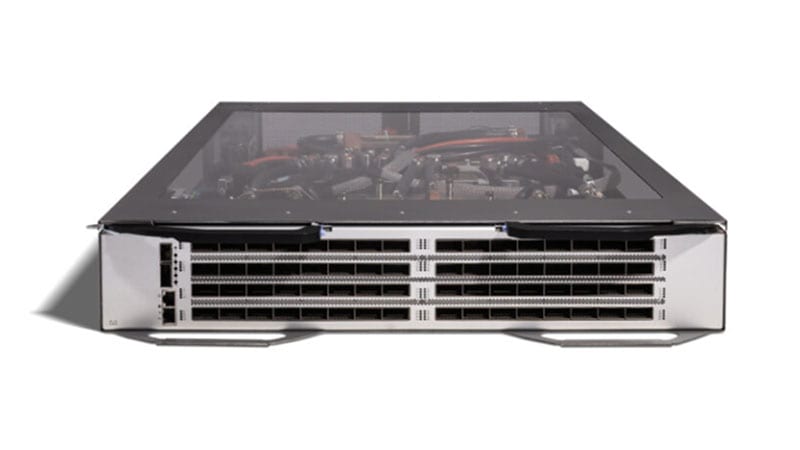
If your Cisco Nexus 9500 chassis still carries an N9K-X9464TX line card in production, that card is now past every Cisco lifecycle date that matters. The N9K-X9464TX reached End of Sale on August 1, 2017 and its Last Day of Support (LDoS) on July 31, 2022. From that LDoS date forward Cisco provides no NX-OS or ACI software fixes scoped to this module, no PSIRT security patches, and no TAC support or RMA replacement for the card itself. A line card has no power button and no LEDs that scream obsolescence; it just keeps forwarding traffic in slot after slot of a Nexus 9504, 9508, or 9516. That silence is exactly why these first-generation copper cards quietly persist in modular cores years after they should have been pulled. This guide explains what the milestone dates mean for a chassis that is otherwise healthy, why the recommended N9K-X9716D-GX is a genuine generational jump rather than a like-for-like swap, and how to plan a controlled refresh that respects the fabric-module and chassis dependencies that line-card migrations always hide.
What the N9K-X9464TX actually was
The N9K-X9464TX is a first-generation Nexus 9500 modular line card: 48 ports of 1/10GBASE-T copper on RJ45, plus 4 uplink ports of 40 Gigabit on QSFP+, for a card delivering roughly 1.28 Tbps of forwarding capacity. The 10GBASE-T copper interfaces were its whole reason to exist. In 2015-2017, a large share of enterprise and government data center servers still terminated on Category 6A copper at 1G or 10G, and this card let architects collapse those copper-attached hosts directly into a modular Nexus 9500 spine or aggregation chassis instead of stranding them on separate top-of-rack switches. It runs in standalone NX-OS mode or as part of an ACI fabric, and it depends on the original first-generation Nexus 9500 fabric modules and supervisor (Supervisor A class) to reach its rated bandwidth.
Its limitations are architectural, not cosmetic. The host ports are fixed at 10GBASE-T with no 25G or 100G path. The uplinks top out at 40G QSFP+ with no native 100G or 400G option. The card predates Cisco's Cloud Scale ASIC family, so it lacks the deep buffering, line-rate hardware streaming telemetry, and the per-port MACsec encryption that modern fabrics and federal encryption-in-transit mandates now assume. And 10GBASE-T copper carries a real power and latency penalty versus SFP/QSFP optics, roughly 2-4 watts per port and additional serialization latency, which matters at 48 ports per slot across a fully loaded chassis. For a copper-heavy server estate in 2016 it was the right tool. For 25G/100G NICs, 400G spines, and encrypted east-west traffic, it is a hard ceiling bolted into the middle of an otherwise capable chassis.
Why acting now matters
The danger of an end-of-life data center component is never that it stops working. It is that it keeps working while the support floor disappears beneath it. After LDoS, three exposures compound on an N9K-X9464TX, and they compound faster on a line card than on a standalone switch because the card is sharing a chassis with everything else you care about.
- No PSIRT security patches. When a new NX-OS or ACI vulnerability touches the forwarding path or a feature this card participates in, there is no fixed, supported image qualified for the X9464TX. Its software story is frozen at the last release that covered first-generation Nexus 9500 hardware. A modular chassis usually sits in the data center core, in the east-west and often the management path, so an unpatchable card there is not a low-value target.
- No TAC or RMA. A failed line card cannot be opened as a TAC case or swapped under a SmartNet/Cisco service contract. Recovery depends entirely on a cold spare you bought before LDoS or a secondary-market card of the same dead-end generation, with no Cisco backstop on either. In a chassis that may host dozens of production VLANs or EPGs, a single failed slot becomes an unscheduled outage with no support path.
- Audit and compliance exposure. The frameworks federal, DoD, SLED, and healthcare buyers live under (FedRAMP, CMMC 2.0, NIST 800-53, the HIPAA Security Rule, PCI DSS, and CISA BOD directives) all expect supported, patchable infrastructure. An unsupported line card that cannot receive fixes is an audit finding waiting to surface, and 'the vendor stopped shipping patches in 2022' is not a defensible remediation in an assessment.
There is also a quiet capacity argument. Every slot occupied by an X9464TX is a slot not delivering 100G or 400G density, so the card is both a risk and an opportunity cost in the same chassis.
The recommended replacement: N9K-X9716D-GX
Cisco's recommended migration for modern modular fabrics is the Cloud Scale GX-series, and specifically the Nexus 9500 16-port 400G line card, PID N9K-X9716D-GX. This is not an incremental refresh of a copper card; it is a different era of silicon. The X9716D-GX provides 16 ports of 400 Gigabit on QSFP-DD, delivering 6.4 Tbps of forwarding per slot, built on Cisco's Cloud Scale ASIC. Compared to the X9464TX's roughly 1.28 Tbps and 40G uplink ceiling, that is about a 5x jump in per-slot bandwidth and a 10x jump in maximum port speed.
What is concretely better
- Speed and flexibility. Each 400G QSFP-DD port breaks out to 4x100G, and depending on optics down to 40G, 25G, or 10G, so a single X9716D-GX can serve as 16x400G, 64x100G, or a mix. That breakout flexibility is the practical replacement for the X9464TX's role: copper-attached 10G/25G hosts move onto top-of-rack leaves that uplink at 100G/400G into these GX line cards, instead of terminating copper directly into the modular chassis.
- Cloud Scale buffering and telemetry. The GX ASIC brings intelligent deep buffers and line-rate hardware streaming telemetry (Cisco Nexus Dashboard / NX-OS streaming), giving real per-flow visibility the first-gen card cannot produce. For congestion-sensitive workloads, AI/ML east-west traffic, and storage, this is the difference between guessing and measuring.
- MACsec encryption in hardware. The GX line cards support line-rate MACsec (IEEE 802.1AE) on the ports, which the X9464TX could not do. For encryption-in-transit mandates (NIST 800-53 SC-8, DoD data-in-transit requirements), this moves encryption off a bolt-on appliance and into the fabric itself.
- Power and density. Replacing 48 copper 10GBASE-T ports of bolt-on PHY power with optics-based 400G ports changes the watts-per-bit math dramatically in your favor, and frees slots for far higher aggregate bandwidth.
- Smart Licensing. The GX-series uses NX-OS Smart Licensing Using Policy with tiered entitlements (Essentials / Advantage, plus optional ACI tiers) managed through Cisco Smart Software Manager, rather than the older per-feature PAK licensing era the X9464TX lived in.
A practical migration plan
1. Assess and inventory
Start at the chassis, not the card. Run show inventory and show module to enumerate every X9464TX, its slot, the installed fabric modules, supervisors, and power supplies. Run show interface status and your NetFlow/telemetry exports to learn what is actually attached to each 10GBASE-T port and how heavily it is used; copper ports that have been dark for a year do not need a 400G replacement plan. Capture the NX-OS or ACI version, the VLAN/VRF/EPG footprint riding the card, and the optics inventory. The output of this step is a per-slot map: what the card does today, and where that workload lands tomorrow.
2. Resolve the platform path
Decide whether the existing chassis can host GX line cards. If the chassis is a Cloud Scale-capable Nexus 9504/9508/9516 that can take -G fabric modules and a supported supervisor, the migration is a fabric-module + line-card upgrade in place. If the chassis itself is first-generation and cannot host the -G fabric modules, the honest answer is a chassis refresh, and the migration becomes a parallel-build rather than an in-slot swap. Either way, settle the supervisor, fabric module, NX-OS release, and power-budget questions now.
3. License transition
Stand up a Cisco Smart Account and Virtual Account, then choose your Smart Licensing Using Policy connectivity model: direct, on-prem Smart Software Manager (satellite), or offline reservation. For air-gapped, classified, or strict federal environments, use offline reservation so no device needs to reach Cisco. Map the features you use today (Layer 3, VXLAN/EVPN, ACI, telemetry) to the Essentials/Advantage tiers so you do not under-license at cutover.
4. Config and feature parity
Build the new line-card configuration deliberately rather than copy-pasting. The X9464TX's 10GBASE-T copper ports do not map one-to-one onto 400G QSFP-DD; the parity exercise is usually 'these copper hosts move to a 25G/100G ToR leaf that uplinks into the GX card.' Recreate VLANs, VRFs, port-channels, QoS policy, and (for ACI) EPGs and contracts. Where you can, turn on MACsec and streaming telemetry now, since those are capabilities the old card never had and are easy to forget to enable.
5. Physical: optics, breakout, power, cabling
This is where a copper-to-optics migration is most physical. Every 10GBASE-T RJ45 connection that used to land on the X9464TX becomes a fiber or DAC connection somewhere. Order the right QSFP-DD optics or breakout cables for each GX port (400G native, or breakout to 4x100G / 25G / 10G as the design dictates), confirm fiber type and structured cabling, and re-check the chassis power budget with GX line cards and new fabric modules installed. Stage and label optics per slot before the maintenance window.
6. Phased cutover
Do not flash-cut a core chassis. In an in-place upgrade, stage fabric modules and supervisor to a supported NX-OS first, then bring up GX line cards slot by slot and migrate workloads in waves with rollback checkpoints. In a parallel build, stand up the new chassis or new GX slots, validate with non-production traffic, then move VLANs/EPGs in maintenance windows. Validate east-west and north-south reachability, MACsec sessions, and telemetry export at each wave before proceeding.
7. Secure decommission
A retired line card and chassis still hold configuration, keys, and topology detail. Wipe NX-OS configuration and any stored credentials, follow your data-sanitization standard (NIST 800-88 media handling where applicable), and document chain of custody. For federal and DoD environments, sanitize and dispose through an approved process and retain the records for audit.
Procurement notes for regulated buyers
For federal, DoD, and SLED buyers, the replacement hardware should be TAA-compliant and sourced through an authorized Cisco partner so warranty, SmartNet, and software entitlement transfer cleanly. GX-series line cards, -G fabric modules, supervisors, and 400G QSFP-DD optics carry real lead times, and a line-card refresh that also needs fabric modules has more long-pole parts than a single switch swap, so plan procurement well ahead of any compliance deadline. Government Purchase Card (GPC) orders, contract-vehicle pricing, and bundle quoting that pairs the line card with the correct fabric modules and optics are all things we handle directly. Browse modular Nexus options on our catalog, review the dependency map on the N9K-X9464TX EoL page, or see other affected platforms in the Cisco EoL library.
Frequently asked questions
Is the Cisco N9K-X9464TX still supported?
No. The N9K-X9464TX reached End of Sale on August 1, 2017 and Last Day of Support on July 31, 2022. After LDoS, Cisco provides no PSIRT security patches, no NX-OS/ACI software fixes scoped to this card, and no TAC support or RMA replacement. It still forwards traffic, but it is unsupported and unpatchable, which is an audit and security exposure in any regulated environment.
Can I just drop an N9K-X9716D-GX into my existing Nexus 9500 chassis?
Not necessarily. The Cloud Scale 400G GX line card requires Cloud Scale-capable -G/GX fabric modules, a supported supervisor, adequate power, and a current NX-OS release. If your chassis still runs first-generation fabric modules, you must upgrade those (and possibly the supervisor) first, or refresh the chassis. Always confirm chassis variant, fabric module generation, supervisor, power budget, and NX-OS train before ordering line cards.
How do I replace 10GBASE-T copper ports with a 400G line card?
You do not connect copper hosts directly to the GX card. The migration pattern is to move 10G/25G copper-attached servers onto top-of-rack leaf switches and uplink those leaves at 100G or 400G into the X9716D-GX. Each 400G QSFP-DD port breaks out to 4x100G (and down to 25G/10G with the right optics), so one GX line card aggregates far more host bandwidth than the 48 copper ports it replaces.
What is concretely better about the N9K-X9716D-GX?
It delivers 16x400G QSFP-DD ports and 6.4 Tbps per slot on Cisco's Cloud Scale ASIC, versus roughly 1.28 Tbps and a 40G uplink ceiling on the X9464TX. It adds line-rate hardware MACsec encryption, deep intelligent buffers, line-rate streaming telemetry, flexible breakout, and modern NX-OS Smart Licensing Using Policy, capabilities the first-generation copper card never had.
How does licensing change when moving to the GX-series?
The GX line cards use NX-OS Smart Licensing Using Policy with tiered entitlements (Essentials/Advantage plus optional ACI tiers) managed in Cisco Smart Software Manager, replacing the older per-feature PAK model. Set up a Smart Account and Virtual Account, pick a connectivity mode, and use offline license reservation for air-gapped, classified, or strict federal deployments.
Uniqcli Team
The Uniqcli Team is an authorized Cisco partner specializing in Catalyst wireless, switching, datacenter fabric, licensing, and managed services for U.S. federal, state, local, and education customers. We scope Cisco bills of materials, validate procurement paths (TAA, FIPS, contract vehicles), and deliver design, deployment, and managed operations.
Ready to scope your Cisco build?
Build a quoteRelated reading
View all →GuidesCisco Nexus 93120TX EoL: Migrating to the Nexus 93216TC-FX2
The Nexus 93120TX passed Last Day of Support on February 28, 2025, no patches, no TAC, no RMA. Here's why it must come out and how to migrate cleanly to the Nexus 93216TC-FX2.
February 10, 2026 · 8 min readGuidesCisco Nexus 6001-64T EoL: Migrate to Nexus 93180YC-FX3
The Nexus 6001-64T (N6K-C6001-64T) passed Last Day of Support on April 30, 2022. Here is what each milestone means, why the 10GBASE-T top-of-rack switch has to come out, and how to refresh cleanly to the Cloud Scale Nexus 93180YC-FX3.
April 19, 2026 · 7 min readGuidesCisco Nexus 9396TX EoL: Migrate to the 93180YC-FX3
The Nexus 9396TX (N9K-C9396TX) passed its Last Day of Support on April 30, 2023. Here is a practical, spec-driven plan to refresh this 10GBASE-T leaf onto the Nexus 93180YC-FX3, covering the milestone dates, what is concretely better, and a phased migration that keeps your fabric supported and audit-clean.
April 1, 2026 · 8 min readGuidesCisco Nexus 56128P EoL: Migrate to Nexus 9300 93360YC-FX2
The Nexus 56128P (N5K-C56128P) hit Last Day of Support on September 30, 2025. Here's what each lifecycle date means and how to refresh cleanly to the Nexus 9300 93360YC-FX2 with 25G/100G and MACsec.
February 3, 2026 · 8 min read Guides
Cisco Meraki MX400 EoL: Migrate to the MX250
The Meraki MX400 (MX400-HW) hit Last Day of Support on May 20, 2025, no more firmware, PSIRT fixes, or RMA. Here's why it must come out and how to migrate cleanly to the fixed-config, higher-throughput MX250.
March 8, 2026 · 9 min read Guides
Cisco Nexus 5548P EoL: Migrate to Nexus 9300 (93180YC-FX3)
The Nexus 5548P passed Last Day of Support on September 30, 2020, no patches, no TAC, no RMA. Here is why it must come out of the rack and how to migrate cleanly to the Nexus 9300 (N9K-C93180YC-FX3).
May 27, 2026 · 8 min read