
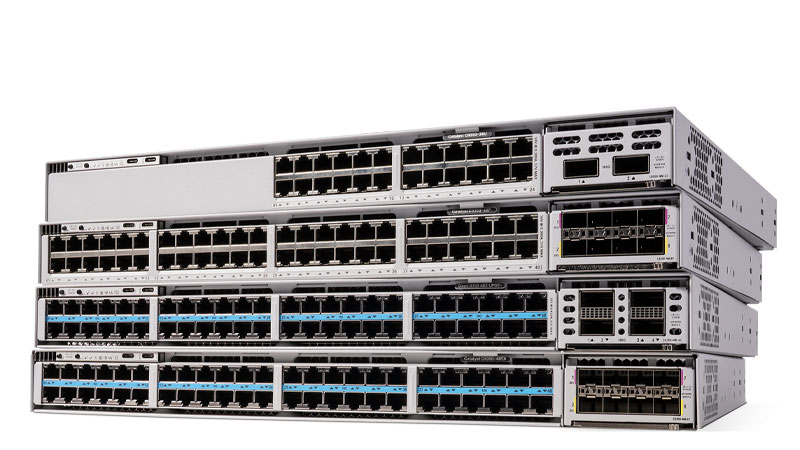
If you still have Cisco Meraki MS220-48LP switches (PID MS220-48LP-HW) humming away in wiring closets, they are now past every Meraki lifecycle milestone that matters. The MS220-48LP reached its Last Day of Support on July 29, 2024. From that date forward Cisco/Meraki provides no firmware fixes, no security patches, and no advance-replacement RMA for this model. The switch keeps forwarding frames and keeps powering phones and access points, which is exactly why these units quietly persist long after they should have been retired. This guide explains what the end-of-life dates actually mean for a live access layer, why the recommended MS225-48LP is a genuine upgrade rather than a like-for-like swap, and how to plan a low-risk refresh.
What the MS220-48LP actually was
The MS220-48LP is a 48-port Gigabit, Layer 2, cloud-managed access switch. The "LP" denotes Low Power, partial PoE: it carries 802.3at PoE+ capability across the ports but with a single 370W power budget, so it can power a subset of ports at full PoE+ rather than all 48 simultaneously. Uplinks are 4x 1G SFP. Switching capacity tops out around 100 Gbps with a non-blocking 1G access layer, and it is managed entirely from the Meraki dashboard with no CLI. Stacking on the MS220 line is virtual only (dashboard grouping), not a physical data-plane stack. For 2014-era access closets feeding phones, badge readers, and a handful of 802.11n/ac access points, it was a clean, low-touch switch. Against today's PoE loads and 10G aggregation expectations, it is a bottleneck with no support floor.
Why acting now matters
The hazard of an EoL switch is not that it stops working. It is that it keeps working while the support floor disappears beneath it. Three concrete exposures stack up after LDoS:
- No PSIRT security patches. When a new switching or Meraki firmware vulnerability is disclosed, the MS220-48LP will not receive a fixed build. Its firmware train is frozen. Any CVE affecting that code path on this hardware is permanent, and because the device phones home to the Meraki cloud, an unpatchable management agent is a real attack surface, not a theoretical one.
- No TAC support or RMA. A dead unit cannot be advance-replaced under contract, and you cannot open a supported case to troubleshoot it. Your only recovery is a spare you stockpiled before LDoS or a gray-market unit of the same dead-end model.
- Audit and compliance exposure. The frameworks federal, DoD, SLED, and healthcare buyers live under (FedRAMP, CMMC, HIPAA Security Rule, PCI DSS, and CISA directives) expect supported, patchable infrastructure. An unsupported switch that cannot be patched is a finding waiting to happen, and "the vendor no longer ships fixes" is not a defensible remediation plan.
There is also a licensing trap unique to Meraki. The hardware is inseparable from a dashboard subscription. When an MS220 license lapses on an EoL device, you cannot renew it indefinitely on a platform Meraki has retired, so the clock on the cloud entitlement and the clock on hardware support converge. The switch and its license age out together.
What each milestone means in practice
- End of Sale (2017-07-29): the last day Meraki accepted new orders for the MS220-48LP. Everything after this date has been consuming the support tail.
- Last Day of Support / LDoS (2024-07-29): the final day of any firmware fixes, security patches, and hardware replacement. After this date the device is unsupported in every sense, regardless of whether it is still passing traffic.
The recommended replacement: Meraki MS225-48LP
The direct successor is the Cisco Meraki MS225-48LP (PID MS225-48LP-HW), a 48-port Gigabit, Layer 2, stackable cloud-managed switch. It deliberately preserves the things that made the MS220 easy (same 48x GbE access density, same 802.3at PoE+ with a 370W budget, same single-pane Meraki dashboard, same lifetime hardware warranty) while fixing the two structural limits of the older platform: uplinks and stacking.
Concretely what is better
- Uplinks jump from 4x 1G SFP to 4x 10G SFP+. That is a 10x increase in northbound capacity to your distribution or core, which is the difference between an access closet that can feed Wi-Fi 6/6E access points and one that throttles them at the wire.
- True physical stacking. The MS225 supports dedicated data-plane stacking at up to 80 Gbps, so multiple switches act as one logical unit with a single management point, cross-stack link aggregation, and resilient uplinks. The MS220's "stacking" was virtual dashboard grouping only.
- Higher switching capacity. The MS225 roughly doubles forwarding capacity versus the MS220 generation, giving real non-blocking headroom across 48 ports plus 10G uplinks.
- A current, TAA-compliant SKU. A TAA-compliant MS225-48LP option is available, which matters for federal and DoD builds where country-of-origin documentation is mandatory. The MS220 has no clean compliant path because it is end-of-life.
If your closet only needs simple non-stacked access and budget is tight, the MS120-48LP is the lighter-weight alternative; it matches port count and 370W PoE but keeps 1G uplinks and drops physical stacking. For most refreshes, the MS225-48LP is the right floor because the 10G uplinks and stacking are what carry the design forward into a Wi-Fi 6/6E and multi-gig client world. You can compare current Meraki access-layer pricing in our catalog before you settle the BOM.
A practical migration plan
1. Assessment and inventory
Pull a switch-port report from the Meraki dashboard for every MS220-48LP: port count in use, PoE draw per port and per switch (confirm you are inside the 370W budget today and after refresh), VLAN assignments, native and tagged VLANs on uplinks, link aggregation groups, and any access policies or sticky-MAC settings. Note the firmware version and the license expiry date for each unit. This inventory becomes your config-parity checklist.
2. License transition
Meraki licensing is per-device and tied to your dashboard organization, sold as an Enterprise or Advanced subscription term per switch. When you claim MS225-48LP serials into the org, plan the subscription term up front and confirm co-termination so all licenses share one renewal date rather than drifting. Do not let MS220 licenses auto-renew on hardware you are retiring; align the new MS225 term to your fiscal calendar instead.
3. Config and feature parity
Because both platforms are Layer 2 and both run from the same dashboard, parity is straightforward. Recreate VLANs, access policies, port profiles, link aggregation, and any QoS or storm-control settings. Validate that PoE-dependent endpoints (IP phones, cameras, APs) negotiate the expected class. If you adopt the new 10G uplinks, build the link aggregation and spanning-tree relationships on the MS225 before cutover and diff them against the MS220 config so nothing silently drops.
4. Physical: rack, power, PoE, uplinks, optics, stacking
Both switches are 1RU. Confirm rack power and closet thermals, then plan optics deliberately: the MS225's 10G SFP+ uplinks need SFP+ transceivers and, ideally, fiber or Cat6A to the distribution layer, where the MS220 likely ran 1G SFP. If you are stacking, order the stacking cables and lay out the stack ring before the maintenance window. Verify your PoE budget covers the in-use ports at their negotiated class; the 370W ceiling is unchanged, so a closet that was already maxed on the MS220 will be maxed on the MS225 too.
5. Phased cutover
Stage the MS225 in the dashboard, push the validated config, and cut over one closet at a time during a window. Move uplinks first, confirm dashboard connectivity and stack health, then migrate access ports in batches, validating PoE and client reachability as you go. Keep an MS220 on hand as a temporary fallback until the new switch has run clean for a maintenance cycle.
6. Secure decommission
Remove retired MS220 units from the dashboard org, wipe local configuration, and dispose through a documented chain of custody. For federal, DoD, and healthcare environments, follow your media-sanitization standard and retain the disposal record; an unsupported switch left racked "just in case" reintroduces the exact audit exposure you just closed.
Procurement notes
Source MS225-48LP units through an authorized Cisco partner. For US federal, DoD, and SLED buyers, confirm TAA compliance and country-of-origin documentation up front, validate genuine Meraki serials with clean dashboard entitlement, and plan for current lead times rather than assuming stock. Government Purchase Card (GPC) orders and quote-to-PO timelines benefit from engaging the partner early, and if you are buying under your own contract vehicle we will align licensing, TAA paperwork, and delivery with it and your fiscal year. Buying gray-market MS220 units to extend a dead platform only deepens the support and audit problem.
Frequently asked questions
Is the Cisco Meraki MS220-48LP still supported?
No. The MS220-48LP reached its Last Day of Support on July 29, 2024. Meraki no longer provides firmware updates, security patches, TAC support, or RMA replacement for this model. The switch still passes traffic, but it is unpatchable and unsupported, which creates real audit and compliance exposure.
What is the recommended replacement for the MS220-48LP?
The Cisco Meraki MS225-48LP (MS225-48LP-HW). It keeps the same 48 Gigabit ports, 802.3at PoE+ with a 370W budget, the Meraki dashboard, and a lifetime warranty, while upgrading the uplinks from 4x 1G SFP to 4x 10G SFP+, adding true physical stacking up to 80 Gbps, and offering a TAA-compliant SKU. The MS120-48LP is a lighter, non-stacking alternative.
What does the MS225-48LP add over the MS220-48LP?
The two biggest gains are 10G SFP+ uplinks (a 10x jump from the MS220's 1G SFP) and dedicated physical stacking at up to 80 Gbps, so a stack of switches acts as one logical unit. Switching capacity is also roughly doubled. Port count, PoE+ standard, and the 370W power budget are unchanged.
Will my Meraki licenses transfer to the new MS225 switches?
Meraki licensing is per-device and tied to your dashboard organization, not transferable from retired hardware. You purchase new Enterprise or Advanced subscription terms for the MS225 serials. Plan the term up front and co-terminate licenses so they share one renewal date, and avoid renewing MS220 licenses on hardware you are retiring.
Is a TAA-compliant version of the MS225-48LP available for federal buyers?
Yes. A TAA-compliant MS225-48LP SKU is available, with country-of-origin documentation suitable for federal, DoD, and SLED procurement. The end-of-life MS220-48LP has no clean compliant path. An authorized Cisco partner can confirm the compliant SKU, GPC and contract-vehicle eligibility, and current lead times.
Uniqcli Team
The Uniqcli Team is an authorized Cisco partner specializing in Catalyst wireless, switching, datacenter fabric, licensing, and managed services for U.S. federal, state, local, and education customers. We scope Cisco bills of materials, validate procurement paths (TAA, FIPS, contract vehicles), and deliver design, deployment, and managed operations.
Ready to scope your Cisco build?
Build a quoteRelated reading
View all →GuidesCisco MS220-24P End-of-Life: Migrate to MS225-24P Guide
The Meraki MS220-24P hit Last Date of Support on July 29, 2024. Here is what each milestone means, why the stackable MS225-24P is the right refresh, and a practical migration plan for federal, healthcare, and enterprise wiring closets.
January 1, 2026 · 8 min readGuidesCisco Meraki MS220-48FP EoL: Migrate to MS225-48FP
The Meraki MS220-48FP reached Last Day of Support on July 29, 2024. Here is what each milestone means, why running it now is a compliance and security liability, and exactly how to refresh to the MS225-48FP with physical stacking and 10G uplinks.
March 15, 2026 · 9 min readGuidesMeraki MS220-8P EoL: Migrate to the MS120-8LP Switch
The compact Meraki MS220-8P PoE switch reached Last Day of Support on September 21, 2025. Here is exactly what that means and how to refresh to the functionally equivalent MS120-8LP without disrupting your edge.
January 5, 2026 · 10 min readGuidesCisco Meraki MS42 EoL: Migration to the MS125-48
The Meraki MS42 passed Last Day of Support on April 26, 2021, here's why it must come out and how to migrate cleanly to the MS125-48 with 10G uplinks and stacking.
January 8, 2026 · 8 min read Guides
Cisco Meraki MR72 EoL: Migrating Outdoor Wi-Fi to the MR76
The Meraki MR72 passed Last Day of Support on April 30, 2024. Here's exactly what that means for your outdoor network and how to migrate cleanly to the Wi-Fi 6 Meraki MR76 without leaving the dashboard.
March 19, 2026 · 7 min read Guides
Cisco UCS C22 M3 EoL: Migrate to UCS C220 M7 Refresh Guide
The Cisco UCS C22 M3 (UCSC-C22-M3S) hit Last Day of Support on April 30, 2020, no patches, no TAC, no RMA. Here is a practical, spec-driven plan to migrate this entry-level 1RU server to the current-generation UCS C220 M7.
June 2, 2026 · 7 min read