
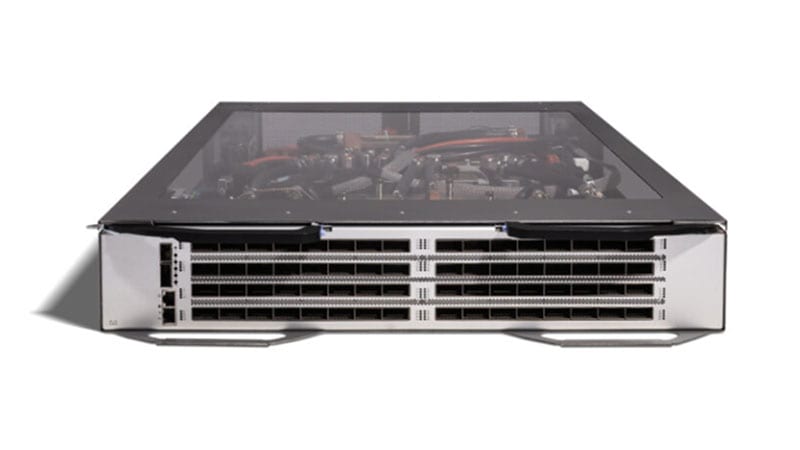
If you still have a Cisco MDS 9513 Multilayer Director (PID DS-C9513) anchoring a Fibre Channel SAN, it is now past every Cisco lifecycle milestone that matters. The 9513 reached End of Sale on October 31, 2016 and crossed its Last Day of Support on April 30, 2022. From that date forward there are no software or security fixes, no TAC cases, and no RMA replacement for the chassis or any of its modules. The director still moves frames between hosts and arrays, which is precisely why so many of these chassis are still humming in core racks years after they should have been retired. This guide explains what those dates actually mean for a SAN that production depends on, why the MDS 9718 is a generational leap rather than a like-for-like swap, and how to plan a clean cutover.
What the MDS 9513 actually was
The MDS 9513 was the flagship of the MDS 9500 family, the largest-chassis Fibre Channel director Cisco built in that generation. It is a 14U, 13-slot chassis: two slots for redundant Supervisor-2 or Supervisor-2A modules and eleven slots for Fibre Channel line cards. Switching is handled by separate crossbar fabric modules (Fabric 1, Fabric 2, and later Fabric 3) mounted behind the line cards. Fully populated, it supported up to 528 autosensing 1/2/4/8-Gbps Fibre Channel ports in a single chassis (and up to 1,584 ports per rack across three chassis), with roughly 8.4 Tbps of aggregate system bandwidth. It ran Cisco MDS NX-OS (and earlier SAN-OS), with VSANs, IVR, zoning, FCIP, and port-channels, the feature set that made it a workhorse SAN core for a decade.
The defining limitation today is the speed ceiling. The 9513 tops out at 8-Gbps Fibre Channel per port. There is no 16G, 32G, or 64G path on this chassis, the backplane, supervisor, and fabric generation simply do not go there. Even with the Fabric 3 module driving the 8-Gbps Advanced line cards at full 256-Gbps per-slot bandwidth, a single port never exceeds 8G. Modern all-flash and NVMe arrays and 32G/64G host bus adapters are throttled the moment they touch this fabric.
Why acting now matters
The danger of an end-of-life SAN director is not that it stops working, it is that it keeps working while the support floor disappears beneath it. For a Fibre Channel core, which by design sits under every database, VM datastore, and backup target in the building, that exposure is amplified. Three concrete risks stack up after LDoS:
- No PSIRT security patches. When a new NX-OS or Fibre Channel vulnerability is disclosed, the 9513 and its Supervisor-2/2A modules will not receive a fixed image. The software train is frozen. Any CVE touching that code path on this hardware is permanent and unremediable.
- No TAC or RMA. A failed supervisor, fabric module, line card, or power supply cannot be opened as a support case or swapped under contract. Your only recovery is a cold spare you bought before LDoS or a gray-market part of the same dead-end generation, and on a 14U director, a single failed module can degrade the entire core.
- Audit and compliance exposure. Federal, DoD, SLED, and healthcare buyers operate under FedRAMP, CMMC, the HIPAA Security Rule, PCI DSS, and CISA directives that expect supported, patchable infrastructure. An unpatchable storage director carrying production data is a finding waiting to happen, and 'the vendor no longer ships fixes' is not a defensible remediation plan.
What each milestone means in practice
- End of Sale (2016-10-31): the last day Cisco accepted new orders for the chassis. Everything after this is consuming the support tail.
- End of Software Maintenance: no separate maintenance-only window was published for this PID, the relevant hard date is LDoS, after which no images of any kind ship.
- Last Day of Support / LDoS (2022-04-30): the hard wall. No TAC, no RMA, no patches. The director, its supervisors, and its line cards are entirely on their own from this date.
The recommended replacement: MDS 9718 Multilayer Director
Cisco's replacement for the 9513 is the MDS 9718 Multilayer Director (DS-C9718), the 18-slot flagship of the MDS 9700 family and the highest-density FC director Cisco ships. This is a full generational jump in fabric architecture, not a slot-for-slot refresh. Where it leaves the 9513 behind:
- 64-Gbps Fibre Channel line rate. The 9718 supports up to 768 line-rate 64-Gbps FC ports in a single chassis (up to 1,152 ports per rack), an 8x per-port speed increase over the 9513's 8G ceiling. Ports auto-negotiate down to 2/4/8/10/16/32G, so existing 8G and 16G hosts attach natively while you stage the move to 32G/64G arrays.
- Massive switching capacity. Six Fabric-3 crossbar switching modules deliver up to 3 Tbps of FC throughput per direction to each payload slot, for up to 48 Tbps of front-panel Fibre Channel bandwidth, versus roughly 8.4 Tbps of system bandwidth on the 9513. The fabric is no longer the bottleneck.
- More usable slots and density. The 18-slot 9718 carries two supervisors plus up to 16 I/O modules (the 9513 offered eleven line-card slots), so you both increase port count and consolidate multiple 9513s into one chassis.
- NVMe/FC and SAN Analytics. The 9700 platform runs NVMe over Fibre Channel alongside traditional SCSI FC, and Cisco SAN Analytics provides per-flow, line-rate latency and IOPS telemetry, visibility the SAN-OS-era 9513 never had.
- Modern NX-OS and Smart Licensing. The 9718 runs the current MDS NX-OS train with ongoing PSIRT coverage and uses Smart Software Licensing (Smart Licensing Using Policy) for feature entitlements, replacing the legacy per-feature license keys of the 9500 era.
A practical migration plan
1. Assessment and inventory
Start with a full picture of the existing fabric. Capture per-port speed and utilization, the line-card mix across all eleven slots, VSAN and zoneset configuration, IVR topology, port-channel/ISL layout, FCIP tunnels, and every host and storage WWPN. Identify which devices are genuinely 8G-limited versus which are 16G/32G HBAs and arrays that have been running degraded against the 9513. That data sizes the 9718 module count and the optic mix, and tells you where the speed upgrade pays back first.
2. License and feature transition
The 9513's per-feature license keys (Enterprise, IVR, FCIP, etc.) do not carry to the 9700 platform. Map each feature you use today to the equivalent 9700 Smart License entitlement and provision the new licenses against your Smart Account before cutover so features are unlocked the moment the chassis powers up. This is also the moment to retire features you no longer use rather than recreating dead configuration.
3. Configuration and feature parity
NX-OS concepts carry forward, but do not copy-paste. Rebuild VSANs, zoning (prefer enhanced zoning and device-aliases), IVR, and port-channels on the 9718 to match production intent, validated against the inventory rather than the old running-config. Confirm domain IDs and principal-switch roles so the new director joins or replaces the existing fabric without a disruptive domain reconfiguration.
4. Physical: rack, power, optics, and cabling
Plan rack space, weight, and power early, a fully loaded director draws serious current and the 9718 uses up to sixteen 3-kW power supplies across dual feeds, so confirm PDU capacity and redundant circuits before delivery. Order the correct 32G/64G SFPs (and any 16G optics for legacy hosts) and length-rated OM4/OM5 fiber. If you are running both directors in parallel during cutover, you need power and rack headroom for both at once.
5. Phased cutover
For a production SAN, the safe pattern is parallel-run, not big-bang. Stand the 9718 up beside the 9513, build the matching fabric, and migrate hosts and arrays VSAN-by-VSAN or initiator-by-initiator, leaning on multipathing (MPIO) so each server keeps a live path while the second path moves. Validate zoning and I/O on the new fabric before draining the old path. Migrate non-critical workloads first, prove the pattern, then move the database and datastore traffic. Multipath redundancy is what turns a director refresh into a zero-downtime event.
6. Secure decommission
Once traffic is drained and a soak period has passed, wipe the 9513 configuration (erase startup-config and any stored credentials, SNMP strings, and certificates), remove it from monitoring and CMDB, and dispose through a process that meets your data-handling and chain-of-custody requirements. For federal and healthcare environments, document the sanitization and retire the asset against the audit record.
Procurement notes
Director-class hardware is configure-to-order, so chassis, supervisors, 64G line cards, and optics carry meaningful lead times, order well ahead of any fiscal-year close or audit deadline. For federal, DoD, and SLED buyers, specify TAA-compliant configurations and confirm eligibility on your contract vehicle or GPC threshold up front. Buying through an authorized Cisco partner is what guarantees genuine hardware, a valid Smart Licensing entitlement tied to your Smart Account, and a clean SmartNet support start, not a refurbished chassis with no support path. As an authorized partner serving regulated buyers, uniqcli can size the 9718 against your current fabric, validate the optic and license bill of materials, and quote TAA-compliant builds. Browse current director and module options in the catalog, review the full milestone record at /cisco-eol/ds-c9513 and other end-of-life Cisco hardware on the EoL index.
Frequently asked questions
Is the Cisco MDS 9513 still supported?
No. The MDS 9513 (DS-C9513) reached End of Sale on October 31, 2016 and its Last Day of Support (LDoS) on April 30, 2022. Since that date Cisco provides no software or PSIRT security fixes, no TAC case support, and no RMA hardware replacement for the chassis, its Supervisor-2/2A modules, or its 8-Gbps line cards. Any unit still in production is running entirely without a vendor support floor.
What replaces the MDS 9513 director?
The current successor is the Cisco MDS 9718 Multilayer Director (DS-C9718), the 18-slot member of the MDS 9700 family. It is the highest-density FC director Cisco ships: up to 768 line-rate 64-Gbps Fibre Channel ports in a single chassis, driven by Fabric-3 crossbar modules delivering up to 48 Tbps of front-panel FC bandwidth, versus the 8-Gbps ceiling and 8.4 Tbps system bandwidth of the 9513.
Can I keep my MDS 9513 line cards or optics in the MDS 9718?
No. The MDS 9700 chassis uses a different backplane, supervisor, crossbar fabric, and I/O module generation than the MDS 9500. Supervisor-2/2A modules, Fabric 1/2/3 modules, and the 8-Gbps Advanced switching modules are not transferable. SFP+ optics also differ: 8G SW/LW SFP+ are not reused on 32G/64G ports. Plan the 9718 as a forklift refresh with new modules and new SFPs sized to your host and array port speeds.
Why migrate now if the 9513 still passes traffic?
Because the risk is operational and compliance-driven, not functional. A post-LDoS director means an unpatchable known vulnerability stays unpatched forever, a failed supervisor or fabric module cannot be RMA'd, and frameworks like FedRAMP, CMMC, HIPAA, and PCI DSS expect supported, patchable infrastructure. For a SAN core that sits under every database and VM datastore, an outage with no TAC path is an unacceptable single point of failure.
How long are lead times for the MDS 9718, and is it TAA-compliant?
Director-class chassis, supervisors, and 64G line cards are configure-to-order and typically carry multi-week lead times, so order ahead of any fiscal or audit deadline. TAA-compliant configurations are available for federal, DoD, and SLED buyers. Buying through an authorized Cisco partner ensures genuine hardware, valid smart-licensing entitlement, clean GPC-payable purchasing, and a proper warranty and SmartNet support start.
Uniqcli Team
The Uniqcli Team is an authorized Cisco partner specializing in Catalyst wireless, switching, datacenter fabric, licensing, and managed services for U.S. federal, state, local, and education customers. We scope Cisco bills of materials, validate procurement paths (TAA, FIPS, contract vehicles), and deliver design, deployment, and managed operations.
Ready to scope your Cisco build?
Build a quoteRelated reading
View all →GuidesCisco MDS 9506 EoL: Migrating Your SAN Core to the MDS 9706
The MDS 9506 director passed Last Day of Support on April 30, 2022, here is why it must come out of your SAN core and how to migrate cleanly to the 16/32/64-Gbps MDS 9706.
April 15, 2026 · 9 min read Guides
Cisco MDS 9124 End of Life: Migrating to the MDS 9148T 32G
The Cisco MDS 9124 (DS-C9124-K9) hit Last Day of Support in 2019, no TAC, RMA, or security patches. Here is what its lifecycle dates mean and how to migrate your Fibre Channel fabric to the 32G MDS 9148T with zero downtime.
June 15, 2026 · 6 min readGuidesCisco MDS 9222i (DS-C9222I-K9) to MDS 9250i Migration Guide
The MDS 9222i is years past last day of support. Here is why an unsupported FCIP switch is a real risk and how to refresh cleanly to the MDS 9250i Multiservice Fabric Switch.
May 29, 2026 · 9 min readGuidesCisco MDS 9148 (DS-C9148-K9) Replacement & Migration Guide
The MDS 9148 8G fabric switch is past last day of support, here is why moving to the 16G MDS 9148S now protects your SAN, your TAC coverage, and your audit posture.
December 17, 2025 · 8 min read Guides
Catalyst 6509-E EoL: Migrate to the Catalyst 9600
The WS-C6509-E passed Last Day of Support on April 26, 2021. Here is what each milestone means, why an unsupported core is a real risk, and how to migrate cleanly to the Catalyst 9600 (C9606R).
May 22, 2026 · 8 min read Guides
Meraki MR24 (MR24-HW) End of Life: Migrate to Catalyst CW9164I
The Meraki MR24 reached Last Day of Support in May 2021, which means no PSIRT patches, firmware, or TAC. Here is what the milestone dates mean and a practical plan to refresh to the Wi-Fi 6E Catalyst CW9164I (CW9164I-MR) under the same Meraki dashboard.
May 18, 2026 · 7 min read