
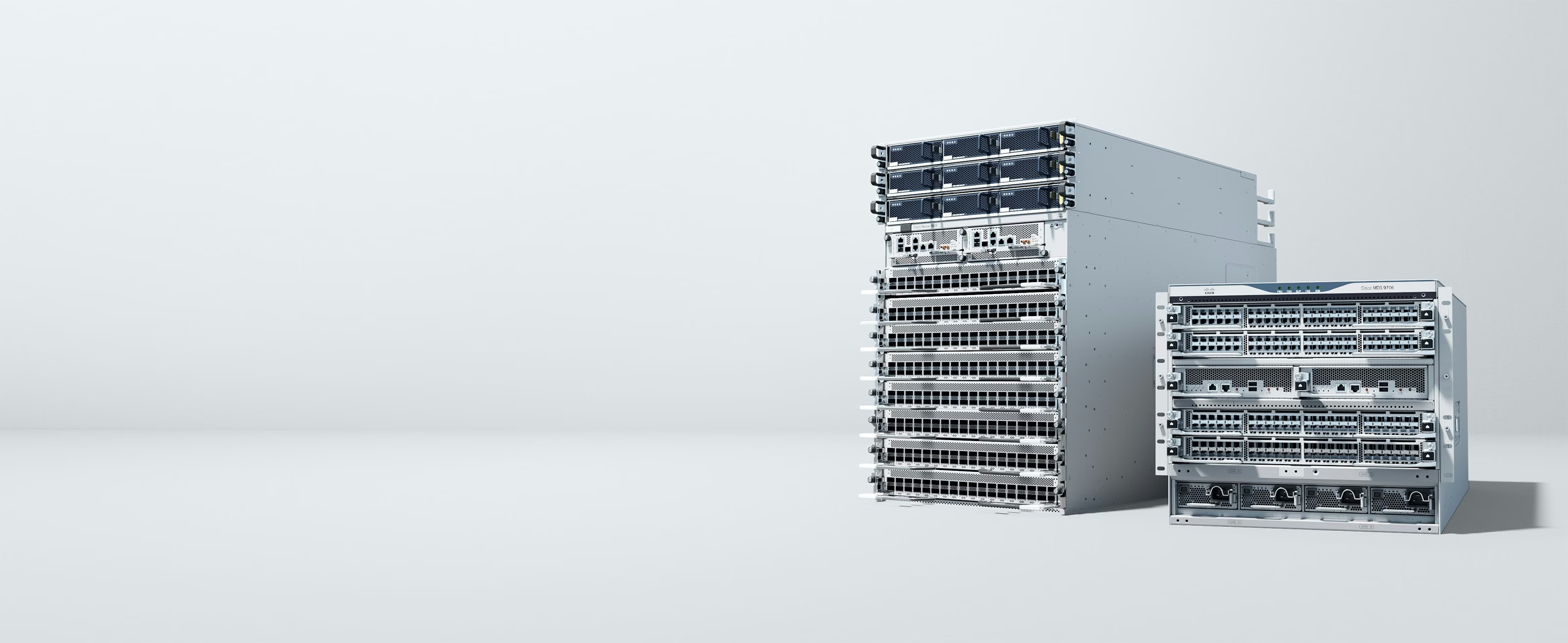
Nexus and Catalyst answer different questions, and the cisco catalyst vs nexus search usually means someone is about to size the wrong platform for the room. Nexus is Cisco's data center switching family, built for spine-leaf fabrics, server and storage racks, and heavy East-West traffic under NX-OS, with an optional ACI fabric mode. Catalyst is Cisco's campus and branch family, built for wiring closets, PoE endpoints, and wireless under IOS XE, managed through Catalyst Center. Almost no enterprise network runs one instead of the other; the real decision is where the boundary sits and how the two management planes hand off policy between them. If you're trying to pick one switch for a mixed campus-and-server-room build, the room decides the platform, not the other way around. A typical mid-sized enterprise or public-sector network runs Catalyst from the wiring closet through the campus core, then hands off to a Nexus pair or fabric the moment traffic becomes primarily server-to-server rather than user-to-server.
At a glance
Both lines run on Cisco silicon and both speak Ethernet, but the software, licensing, and operational model diverge sharply. This lines up the core differences before the decision factors that actually drive a purchase.
| Dimension | Cisco Nexus | Cisco Catalyst |
|---|---|---|
| Platform positioning | Data center fabric, spine-leaf, server/storage racks, DC interconnect | Campus and branch, access, distribution, and collapsed core |
| Operating system | NX-OS, with an optional ACI fabric mode via APIC controllers | IOS XE across the current Catalyst 9000 family |
| Management | Nexus Dashboard (and APIC in ACI mode) for fabric-wide visibility | Catalyst Center (formerly DNA Center), or Meraki cloud/hybrid mode on supported models |
| Licensing | Cisco Smart Licensing, NX-OS Essentials/Advantage tiers plus add-ons | Cisco Smart Licensing, Network Essentials/Advantage subscription tiers |
| Stacking / upgrade path | vPC dual-homing and VXLAN/EVPN fabric scale-out, not chassis stacking | StackWise-160/480/Virtual stacking, plus SD-Access fabric |
| Typical role | Server and storage connectivity, spine-leaf fabric, DC interconnect | Wiring-closet PoE endpoints, wireless, campus core/distribution |
NX-OS vs IOS XE: why the software split isn't cosmetic
The two operating systems exist because the problems are different. NX-OS is built around VXLAN/EVPN fabric scale, FCoE and storage-network convergence, very large MAC and routing tables, and the option to run in ACI mode under an APIC controller for intent-based, fabric-wide policy. None of that is relevant to a wiring closet. IOS XE is built around 802.1X and MAB authentication, PoE/PoE+/UPOE power management, wireless controller integration, and SD-Access for identity-based segmentation at the access edge, none of that is what a spine switch needs to do. Pieces of the tooling already overlap (both platforms use Smart Licensing and expose NETCONF/RESTCONF telemetry), but the feature sets stay purpose-built to the layer they run. Buying a switch for its port count instead of the software it runs is the most common mistake we see in a rushed refresh.
Where the lines blur: collapsed core and small server rooms
The gray area is real. A high-end fixed Catalyst 9500 or the newer 400G-capable C9500X can serve as a collapsed core or a modest server-room aggregation switch, and plenty of mid-sized organizations run exactly that instead of standing up a separate Nexus fabric. That works when the room is really a large closet: a handful of racks, modest East-West traffic, no requirement for a VXLAN/EVPN overlay or storage convergence. It stops working once you need true leaf-spine scale-out, multi-tenant fabric segmentation, or FCoE-class storage traffic, at which point Nexus is the only Cisco platform built for the job. If you're not sure which side of that line your server room sits on, size the actual East-West traffic and growth plan before choosing hardware, not after. Uplink speed is a useful proxy: if your servers are still on 1G/10G with a handful of 25G hosts, a Catalyst aggregation layer is often plenty; once you're standardizing racks on 25G/100G server NICs with 400G spine uplinks, you're describing a Nexus fabric whether you call it one yet or not.
PoE and endpoint density vs storage-grade throughput
Catalyst switches carry PoE, PoE+, and UPOE power budgets because campus access ports feed phones, access points, cameras, and a growing count of IoT sensors, a job Nexus was never designed for and doesn't power at all. Nexus instead optimizes for consistent, low-latency forwarding across large numbers of 25G/100G/400G server and storage links, with buffering and queuing tuned for East-West microburst traffic rather than mixed voice, video, and data at the edge. Trying to make one platform do both jobs is where refresh budgets go sideways: an oversized Catalyst core wastes money on PoE silicon and licensing it will never use in a server room, and an undersized Nexus deployment in a wiring closet gives you none of the endpoint security or wireless integration IOS XE provides.
Licensing and management planes stay separate
Both families now run on Cisco Smart Licensing, which is the one place the buying experience has converged, both tie entitlement to your Smart Account and both offer Essentials and Advantage-class tiers. Everything downstream of that stays separate. Nexus licensing and any ACI/APIC entitlement is tracked and monitored through Nexus Dashboard; Catalyst's Network Essentials/Advantage subscription is managed through Catalyst Center, or through the Meraki dashboard if you onboard supported Catalyst hardware into cloud or hybrid management. Most enterprises run both management planes side by side rather than picking one, because they answer different operational questions: fabric health and East-West telemetry on one side, endpoint assurance and wireless RF on the other. Budget for both tools as part of a refresh, not as an either/or line item, and plan the subscription terms to expire close together so renewal cycles don't fragment across your Smart Account.
Which should you choose?
Match the platform to the room, not the brand name on the quote:
- Building or refreshing a data center leaf-spine fabric, server/storage racks, or anything needing VXLAN/EVPN or FCoE, Nexus 9000, in standalone NX-OS or ACI mode.
- Wiring closets, PoE endpoints, campus wireless, or an SD-Access rollout, Catalyst 9200, 9300, or 9500 on IOS XE.
- A modest server room with a handful of racks and no fabric-scale ambitions, a high-end Catalyst 9500 or C9500X can often serve as a collapsed core; validate the traffic pattern first.
- Most enterprise and public-sector networks, plan for both platforms and a defined policy handoff between Catalyst Center and Nexus Dashboard, rather than stretching one line to cover the whole network.
Frequently asked questions
Can a Catalyst switch replace a Nexus switch in a data center?
Sometimes, at a small scale. A high-end Catalyst 9500 or C9500X can serve as a collapsed core or light server-room aggregation switch when East-West traffic is modest and you don't need VXLAN/EVPN fabric scale-out or FCoE storage convergence. Once you need true leaf-spine scale, multi-tenant fabric segmentation, or storage-network convergence, Nexus is the platform built for it.
Is Cisco Nexus more expensive than Catalyst?
It depends entirely on the specific model, port speed, and licensing tier on each line, a fixed-configuration Nexus access switch and a high-end Catalyst core switch can land close together, while a modular Nexus chassis for a large fabric costs considerably more than an access-layer Catalyst. Get a validated quote for your exact configuration rather than assuming one family is categorically cheaper.
Do Nexus and Catalyst share the same command-line syntax?
They look similar on the surface, both are Cisco CLIs with familiar show and config-terminal conventions, but NX-OS and IOS XE are different operating systems with different feature sets, licensing stanzas, and automation APIs. Engineers fluent in one pick up the other quickly, but configurations don't port directly between them.
What is ACI mode, and do I need it on Nexus?
ACI (Application Centric Infrastructure) is an optional Nexus operating mode, managed by APIC controllers, that applies intent-based policy across the whole data center fabric instead of configuring each switch independently. It's valuable for large, dynamic, multi-tenant fabrics; a smaller, stable data center often runs standalone NX-OS without APIC and does fine. Scope it against your automation and multi-tenancy needs rather than adding it by default.
Can Catalyst Center and Nexus Dashboard share policy?
They're built for different layers and don't merge into a single console, but Cisco's broader architecture is designed so identity and segmentation created at the campus edge, via ISE and SD-Access, can extend into the data center fabric. Treat them as two coordinated management planes with a defined handoff rather than one unified tool.
Can I stack Nexus switches the way I stack Catalyst switches?
No. Catalyst uses physical StackWise stacking, or StackWise Virtual, to run multiple switches as one logical unit. Nexus scales out with vPC dual-homing and a VXLAN/EVPN fabric topology instead of chassis stacking, the scale-out model is architectural, not a stacking cable.
Uniqcli Team
The Uniqcli Team is an authorized Cisco partner specializing in Catalyst wireless, switching, datacenter fabric, licensing, and managed services for U.S. federal, state, local, and education customers. We scope Cisco bills of materials, validate procurement paths (TAA, FIPS, contract vehicles), and deliver design, deployment, and managed operations.
Ready to scope your Cisco build?
Build a quoteRelated reading
View all → Guides
Cisco Nexus 9300 vs 9500 for Data Center Fabric
A practical, no-nonsense breakdown of where the fixed Nexus 9300 fits as a leaf and where the modular Nexus 9500 earns its place as a spine, so you size your data center fabric for the next decade instead of the next quarter.
June 2, 2026 · 11 min read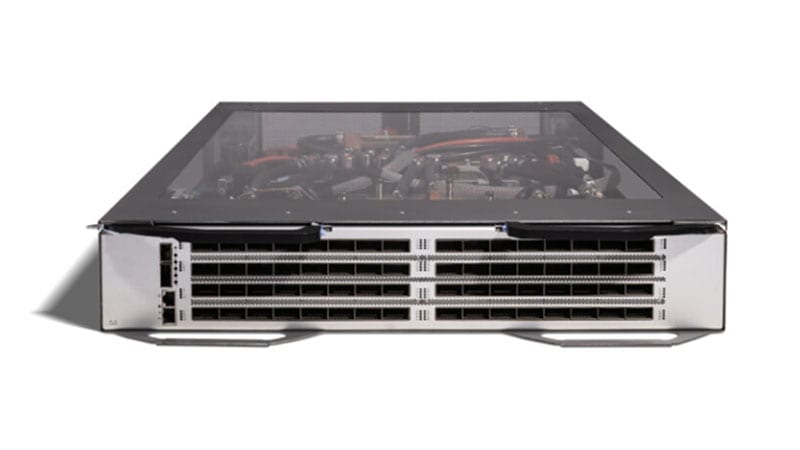 Guides
Cisco Catalyst 4900M EoL: Migrate to Nexus 9300 (93180YC-FX3)
The Catalyst 4900M (WS-C4900M) passed Last Day of Support on October 5, 2021. Here's why it has to leave the rack and how to migrate cleanly to the Nexus 9300 N9K-C93180YC-FX3 top-of-rack switch.
May 5, 2026 · 8 min readGuidesCisco vs Juniper Switches: Catalyst/Nexus vs EX/QFX
Cisco vs juniper switches comes down to Junos's one-OS consistency and service-provider roots versus Catalyst and Nexus's campus-to-data-center breadth, complicated by Juniper's 2025 move under HPE.
July 11, 2026 · 5 min readGuidesCisco ACE Module EoL: Migrating Off ACE10-6500-K9
The ACE Application Control Engine Module (ACE10-6500-K9) passed Last Day of Support on January 31, 2019. Here is what that means, why it is now a compliance liability, and how to move data center application delivery onto the Catalyst 8500 edge platform and modern load-balancing tiers.
June 13, 2026 · 8 min read Guides
How to size a campus wireless deployment: APs, switching and licensing
Sizing a campus wireless refresh is three problems wearing one trench coat: enough APs for the RF, enough switch ports and PoE to feed them, and the right licensing to run it all. Here is how to scope each layer so the bill of materials lands once.
June 6, 2026 · 12 min read Guides
AI-ready data centers for government: sizing the GPU network with Cisco Silicon One and Nexus
Standing up a GPU cluster for a federal mission is a network-sizing problem before it is a compute problem. Here is how to size the AI back-end fabric with Cisco Silicon One and Nexus 9000, keep it lossless, and buy it through a purchase path that clears review.
May 30, 2026 · 11 min read