
Cisco IP Phone Buyer's Guide (2026): 9800 vs 8800 vs 7800
A practical buyer's guide to the current Cisco desk phone lineup, which series is active, which is winding down, MPP vs Enterprise firmware, PoE requirements, and the license gotchas that trip up fleet rollouts.
The current Cisco desk phone lineup is the Desk Phone 9800 Series (9811, 9841, 9851, 9861, 9871), which is the active flagship line for Webex Calling, CUCM, and third-party SIP. The 8800 Series is still shipping in Multiplatform (MPP) firmware but its video models (8845, 8865) are end-of-sale, and two of the four 6800 Series MPP phones (6841, 6861) stopped ordering in June 2026 and the rest follow in October. Buy 9800 for new deployments; only choose 8800 MPP for exact fleet-matching on an existing install base.
What's actually current in the Cisco phones lineup right now
Cisco's desk phone naming has shifted twice in the past few years, from "Unified IP Phone" to "IP Phone" to the current "Desk Phone" branding for the 9800 Series, and a lot of resale listings and even some Cisco documentation still lag behind. If you're speccing a fleet in 2026, treat the 9800 Series as the default and everything below it as either a cost-down option or a legacy holdover you're phasing out.
The 9800 Series is a five-model line: the 9811 is the entry point (grayscale, no NFC, requires UCM 14+), the 9841 steps up to a larger 3.5-inch grayscale display, adds NFC, and supports UCM 12.5+, the 9851 adds color, and the 9861/9871 add Wi-Fi, Bluetooth, and, on the 9871, a color touchscreen. All five run on the same PhoneOS platform with TLS 1.3, the 9841 and up add TPM 2.0 hardware security and AI-based noise removal (the 9811 skips both), and all support Webex Calling, Cisco Unified Communications Manager (CUCM), Webex Dedicated Instance, Cisco BroadWorks, and Asterisk out of the box, no firmware swap required to move between them.
The 8800 Series is the outgoing flagship. The base voice-only models (8811, 8841, 8851, 8861) are still orderable in Multiplatform firmware and Cisco continues to ship firmware updates for them, but Cisco has already discontinued the 8845 video model (last order date passed in 2024) and the 8865 video model (last order date mid-2025). If you need a video-capable desk phone today, the 9800 Series doesn't have a direct video model either, Cisco has moved video-at-the-desk workflows to Webex Room devices and soft clients instead, so plan around that gap rather than hunting for a replacement video deskphone.
The 7800 Series and 6800 Series are the legacy, budget tier, and both are actively being sunset in favor of 9800. Cisco has published last-day-to-order dates for individual models rather than the whole family at once: the 7811 and 7821 stop ordering October 28, 2026, with Cisco's own EoL bulletins naming the 9811 and 9841 as their direct successors. On the 6800 side, the 6841 and 6861 MPP models already passed their last-order date of June 1, 2026, while the 6821 and 6851 run through October 28, 2026, with Cisco naming the 9811 and 9841 as their successors. If a distributor is still quoting 6841/6861 stock, confirm whether you're getting new-in-box units from remaining channel inventory or Cisco Refresh remanufactured units, which is the channel Cisco's own bulletins point to once the last-order date has passed.
| Series | Status | Firmware | Best for | Notable gotcha |
|---|---|---|---|---|
| 9800 (9811/9841/9851/9861/9871) | Current, active | PhoneOS (multi-platform) | New deployments, Webex Calling, CUCM 12.5+/14+ | 9811 needs UCM 14+, not 12.5 |
| 8800 voice (8811/8841/8851/8861) | Shipping, mature | MPP or Enterprise (SCCP/SIP) | Matching an existing 8800 fleet | Enterprise firmware needs manual conversion to MPP for Webex Calling |
| 8800 video (8845/8865) | End-of-sale | MPP or Enterprise | Do not spec for new buys | 8845 EoS 2024, 8865 EoS 2025, TAC support only |
| 7800 (7811/7821/7841/7861) | Winding down | MPP or Enterprise | Budget single-line to 4-line desks | 7811/7821 last order Oct 28, 2026 |
| 6800 (6821/6841/6851/6861) | Mostly end-of-sale | MPP only | Basic-needs desks, cost-sensitive rollouts | 6841/6861 last order passed (Jun 1, 2026); 6821/6851 last order Oct 28, 2026 |
MPP vs Enterprise firmware, which one do you actually need
Cisco desk phones below the 9800 Series ship in one of two firmware flavors, and picking the wrong one is the single most common ordering mistake we see. Enterprise firmware (sometimes called SCCP or CUCM firmware) only talks to Cisco Unified Communications Manager. MPP firmware, Multiplatform Phone, also called 3rd-party call control or 3PCC, is Cisco's open SIP stack that talks to Webex Calling, CUCM (via SIP), Cisco BroadWorks, Asterisk, and other standards-based SIP platforms.
If your call control is Webex Calling and you're not buying 9800 Series (which ships MPP-equivalent by default), you need the MPP-firmware SKU or PID suffix, not the Enterprise one, check the part number carefully, because both firmware variants of the 7800/8800 series often share the same base model number with a different suffix or ordering PID. Cisco does publish a conversion path between Enterprise and MPP firmware on 7800/8800 hardware, and for Webex Calling the migration can now be run from Control Hub with the license generated automatically, but it only covers certain hardware versions (7821 V03+, 7841 V04+, 7861 V03+) and is still a project you don't want to run after 500 phones have already shipped to 40 branch offices. Confirm firmware at time of order, not after unboxing.
Webex Calling vs CUCM vs third-party SIP, what each needs from the phone
Webex Calling (Cisco's cloud call control) is the default recommendation for most new buyers because it eliminates on-prem CUCM servers entirely. It works natively with the 9800 Series and with MPP-firmware 8800/7800/6800 phones, provisioned and monitored through Webex Control Hub. Onboarding at scale uses Cisco's Device Activation Code (DAC) or EDOS/GDS zero-touch provisioning, so IT doesn't have to touch each handset.
CUCM (Cisco Unified Communications Manager) is still the right call for organizations with heavy on-prem requirements, existing UC infrastructure, air-gapped or classified environments, or deep integration with contact center platforms like Webex Contact Center Enterprise or third-party CCaaS. CUCM 12.5 and later supports MPP-mode phones registering over SIP, and CUCM 14+ is required for the 9811 specifically, check your CUCM version before speccing the entry-level 9800 model.
Third-party SIP / BroadWorks / Asterisk deployments, common with regional carriers and some government telephony contracts, need MPP firmware and a hosted or on-prem SIP registrar that supports standards-based provisioning. The 9800 and MPP-flavored 8800/7800/6800 all register the same way here; verify your specific SIP provider's Cisco interop notes for supported codecs and any provisioning template quirks before a mass rollout.
PoE classes and power, what your switch needs to deliver
Power draw scales with display size and Wi-Fi/Bluetooth radios, and it determines what your access switch has to supply per port. The 9811 and 9841 (grayscale, no radios) run on 802.3af PoE Class 2, drawing under 7W. The 9851, 9861, and 9871 step up to 802.3af PoE Class 3 (up to 12.95W at the device) because of the color display. Key Expansion Modules (KEMs) change the math: the 9811 and 9841 take none, the 9851 takes one, and the 9861 and 9871 run a single KEM on switch PoE but need the Cisco Power Adapter 3 to drive up to three.
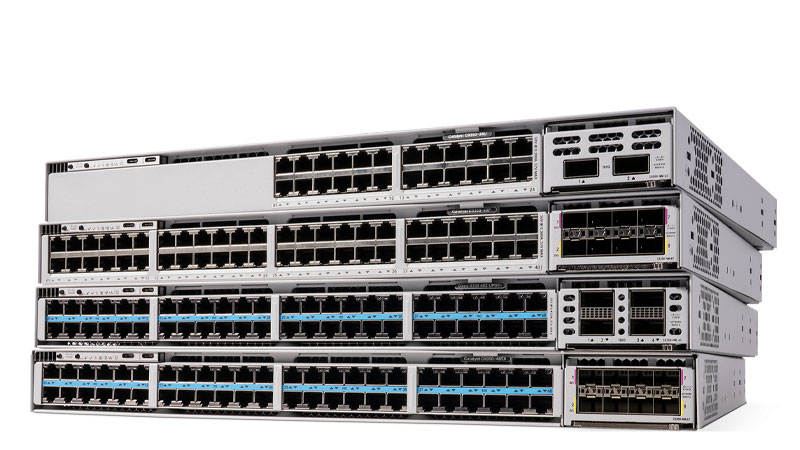
For fleet planning: audit your access-layer switch PoE budget before ordering color/touchscreen models at scale. A wiring closet sized for Class 2 desk phones running mostly-idle can get oversubscribed fast when you swap in a stack of color 9861s with KEMs attached, especially alongside PoE+ access points and PTZ cameras on the same switch stack. If you're refreshing switches as part of the same project, our catalog carries Catalyst access switches with PoE+ and UPOE budgets sized for mixed voice/video/AP deployments.
Video and conference room devices at a glance
With 8845/8865 video deskphones discontinued and no 9800 video successor, Cisco has consolidated video collaboration into the Webex Room device family instead of the desk phone line. For a huddle space or small conference room, the Room Bar or Room Bar Pro (all-in-one camera, codec, mic, and speaker bar that pairs with any display) covers most needs; Room Kit EQ scales up to larger rooms with an external Quad Camera and touch controller for up to three displays. None of these register as "phones" in the traditional sense, they're Webex-native endpoints, licensed and managed through Control Hub alongside your Webex Calling users, and they're a separate line item from desk phone procurement, not a swap-in replacement for a video-capable handset.
Buying gotchas that trip up fleet rollouts
- Country SKUs matter. Cisco phones ship with a country-specific power adapter/plug and, on some models, region-locked regulatory firmware. A US-market PID dropped into a Canadian or EU office can hit compliance or power-adapter issues, always order the region-correct PID, not just the base model number.
- Licenses are never bundled. Webex Calling user licenses and CUCM CUWL/UCL entitlements are purchased and provisioned separately from the hardware PID, tied to your Smart Account. Confirm license availability and Smart Account structure before hardware lands.
- Firmware suffix determines call control compatibility. The same base model number (say, 8841) can be ordered in Enterprise or MPP firmware, verify the exact PID for your call control platform, since converting after delivery is a manual, non-trivial process at scale.
- KEMs and power adapters aren't automatically included. Key Expansion Modules for receptionist/attendant consoles are separate PIDs, and heavily-populated KEM setups may require the standalone Cisco Power Adapter rather than PoE alone.
- Government and TAA-restricted buyers need to confirm compliance at the PID level, not the series level, TAA-compliant variants exist for specific models, some under ++ part numbers and others simply flagged as TAA-eligible in Cisco's ordering tool, so confirm the exact PID before you commit.
- EoS models can still be quoted by distributors carrying old stock. Cross-check any 8845/8865/6841/6861 quote against Cisco's own EoL bulletin before committing budget to a phone that's already off the active price list, and expect the 6821, 6851, 7811, and 7821 to join that list after October 28, 2026.
If your organization runs CUCM on-premises and you're trying to figure out sizing, licensing tiers, or whether it's time to move to Webex Calling instead, our Cisco Unified Communications Manager buying guide walks through call control platform selection in more depth. For hardware, the full current desk phone lineup, 9800, 8800 MPP, and remaining 7800/6800 stock, is searchable in our catalog, with PIDs, specs, and datasheet access for each model.
Frequently asked questions
What is the current Cisco IP phone series in 2026?
The Cisco Desk Phone 9800 Series (models 9811, 9841, 9851, 9861, 9871) is the current, actively sold flagship line. It replaces the aging 7800/6800 series and supersedes the 8800 Series as Cisco's primary desk phone for new deployments, supporting Webex Calling, CUCM, BroadWorks, and Asterisk on unified PhoneOS firmware.
What's the difference between MPP and Enterprise firmware on Cisco phones?
Enterprise (SCCP/CUCM) firmware only registers to Cisco Unified Communications Manager. MPP (Multiplatform) firmware uses standard SIP and works with Webex Calling, CUCM via SIP, BroadWorks, Asterisk, and other third-party call control platforms. The 9800 Series ships as a unified platform that supports all of these without a firmware swap; on 7800/8800 hardware you must order the correct firmware variant up front.
Are Cisco 8800 series phones being discontinued?
Partially. The 8800 Series video models (8845, 8865) are already end-of-sale as of 2024–2025. The voice-only 8811, 8841, 8851, and 8861 in Multiplatform firmware are still orderable and receiving firmware updates, but Cisco is steering new deployments toward the 9800 Series, so treat 8800 as a fleet-matching option rather than a first choice for new buys.
Do Cisco IP phones come with a Webex Calling or CUCM license included?
No. Phone hardware and firmware are ordered separately from call control licensing. Webex Calling requires a per-user or per-workspace license provisioned in Control Hub; CUCM requires CUWL or User Connect License entitlements tied to a Cisco Smart Account. Both must be budgeted and provisioned independently of the phone PID.
What PoE class do Cisco desk phones need?
Grayscale, radio-free models like the 9811 and 9841 run on 802.3af PoE Class 2 (under 7W). Color-display and Wi-Fi/Bluetooth-equipped models like the 9851, 9861, and 9871 need 802.3af PoE Class 3 (up to 12.95W), and a 9861 or 9871 with more than one Key Expansion Module needs the Cisco Power Adapter 3 instead of switch PoE.
What replaced the Cisco 7800 and 6800 series phones?
Cisco's own end-of-life bulletins name the 9800 Series as the successor line, for example, the 7811 is superseded by the 9811 and the 7821 by the 9841. Last-order dates are staggered by model: 6841/6861 MPP already passed (June 1, 2026), while 7811/7821/6821/6851 run through October 28, 2026.
Uniqcli Team
The Uniqcli Team is an authorized Cisco partner specializing in Catalyst wireless, switching, datacenter fabric, licensing, and managed services for U.S. federal, state, local, and education customers. We scope Cisco bills of materials, validate procurement paths (TAA, FIPS, contract vehicles), and deliver design, deployment, and managed operations.
Ready to scope your Cisco build?
Build a quoteRelated reading
View all → Guides
Webex Calling vs Teams Phone: Cloud PBX Compared
Webex Calling vs. Teams Phone compared on PSTN connectivity, CUCM migration paths, and desk phone compatibility, a practical cloud PBX guide for IT buyers.
July 11, 2026 · 5 min readGuidesWebex vs Microsoft Teams: Meetings, Calling, Devices
Webex vs. Teams compared on Microsoft 365 bundling, cloud calling, room hardware, and security, an honest breakdown to help IT buyers choose the right platform.
July 11, 2026 · 5 min readGuidesCisco Unified Communications Manager (CUCM) Buying Guide
What CUCM actually is today, how it's licensed now that perpetual UCL is gone, where it runs (on-prem UCS vs. Webex Calling Dedicated Instance), and how partners actually structure a purchase.
July 3, 2026 · 8 min read Guides
How to size a campus wireless deployment: APs, switching and licensing
Sizing a campus wireless refresh is three problems wearing one trench coat: enough APs for the RF, enough switch ports and PoE to feed them, and the right licensing to run it all. Here is how to scope each layer so the bill of materials lands once.
June 6, 2026 · 12 min read Guides
Stadium Wi-Fi capacity planning: sizing for a packed house
A sold-out crowd is the most hostile RF environment your wireless will ever face. Here is how to size Cisco Wi-Fi for a packed house, from device density math to antenna geometry to controller headroom.
June 6, 2026 · 12 min read Guides
Designing high-density Wi-Fi for stadiums and arenas
A packed stadium is the hardest Wi-Fi environment on earth: tens of thousands of clients in one RF space, all live at the same second. Here is how to design Cisco high-density wireless that holds up at kickoff, not just on a quiet weekday walk-through.
June 6, 2026 · 13 min read