
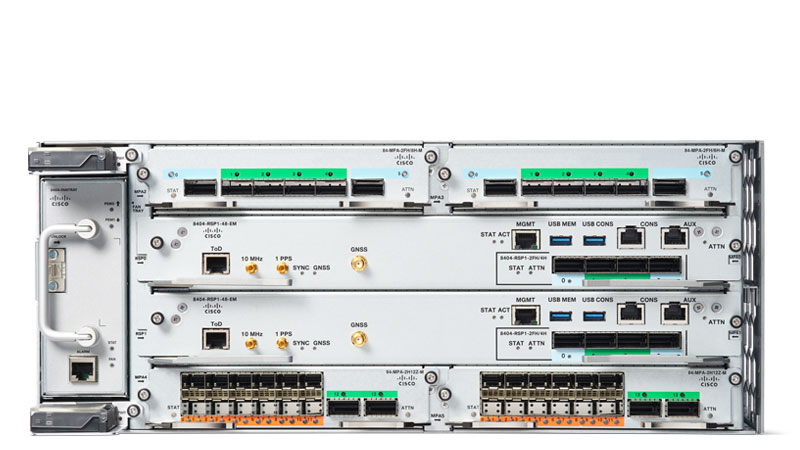
The Cisco ASR 1001-X (PID ASR1001-X) was the workhorse of the fixed ASR 1000 line: a 1RU edge router built around the QuantumFlow Processor, with six built-in Gigabit Ethernet ports, an Embedded Services Processor that scaled from 5 Gbps up to roughly 20 Gbps with software licenses, an SPA bay for additional WAN interfaces, and hardware crypto for high-throughput IPsec. It anchored WAN aggregation, internet edge, and early Cisco SD-WAN (Viptela/IWAN) deployments in thousands of agency and enterprise racks. That platform is now on the clock. If you still run one in production, the question is no longer whether to refresh but how to do it cleanly before support lapses.
Why acting now matters, not in 2027
The most common mistake is treating LDoS as the deadline. It is the cliff, not the planning horizon. The more consequential milestone already passed: End of Software Maintenance on August 1, 2023. Since that date, Cisco no longer produces maintenance rebuilds of IOS XE for this platform. The last supported train is 17.9; you will not get a 17.12 or 17.15 image for an ASR1001-X. In practice that means new CVEs disclosed by Cisco PSIRT against IOS XE features your router runs may simply have no fixed image for this box. You can track which advisories touch your platform on our live security advisory hub, but a known-affected, no-patch-available device is exactly the finding an auditor flags.
After July 31, 2027 the exposure compounds: no TAC case can be opened, no RMA can be processed, and no software access of any kind remains. A failed power supply or ESP becomes a unit you cannot replace through Cisco. For FedRAMP, FISMA, CMMC, StateRAMP, HIPAA, and PCI environments, running hardware past LDoS is a documented control gap. The defensible position is to have the refresh planned and budgeted now, while you still have a supported runway and while replacement hardware lead times are predictable.
What each milestone means in practice
- End of Sale (Aug 1, 2022): You can no longer buy new ASR1001-X from Cisco. Authorized partners may still hold genuine, TAA-eligible stock for spares, but it is a finite pool, not a long-term sourcing plan.
- End of SW Maintenance (Aug 1, 2023): No new IOS XE rebuilds. 17.9 is the terminal train. Security fixes for newly disclosed vulnerabilities generally will not arrive for this platform.
- Last Day of Support (Jul 31, 2027): No TAC, no RMA, no contract renewals, no software downloads. The asset is fully unsupported and, for most compliance frameworks, no longer deployable in scope.
The recommended replacement: Catalyst 8500L (C8500L-8S4X)
Cisco's migration target is the Catalyst 8500L, specifically the C8500L-8S4X. This is the modern aggregation router for the same role the ASR1001-X filled, WAN edge, SD-WAN headend, and internet aggregation, but built on current silicon and the Catalyst 8000 software stack. The C8500L-8S4X ships with a fixed interface complement of four 10GE SFP+ ports plus eight 1GE SFP ports, a meaningful uplink upgrade over the ASR1001-X's six 1GE ports and SPA-dependent expansion.
The throughput story is the headline. Where the ASR1001-X topped out near 20 Gbps of forwarding with the right ESP license, the C8500L delivers substantially higher aggregate forwarding and crypto performance on a newer multi-core x86 data plane, with hardware-accelerated IPsec that scales SD-WAN tunnel counts and encrypted throughput well beyond the older QuantumFlow design. For tunnel-heavy SD-WAN headends, this is the single biggest operational gain, more encrypted sessions and higher per-tunnel throughput without adding chassis.
The licensing model changes, plan for it
This is where teams get surprised. The ASR1001-X used Right-to-Use / PAK-style and early Smart Licensing for throughput and feature tiers. The Catalyst 8500L runs Cisco IOS XE 17.x under Cisco DNA / Catalyst SD-WAN subscription licensing via Smart Licensing Using Policy (SLUP). You select a Network tier (Network Essentials or Network Advantage) and a DNA/subscription term, and entitlements are managed through Cisco Smart Software Manager (CSSM) rather than node-locked PAK files. Crucially, ASR1001-X licenses do not transfer to the 8500L, budget for fresh subscription licensing, and decide up front whether the device will be managed by Catalyst SD-WAN Manager (vManage) or run as an autonomous IOS XE router.
A practical migration plan
1. Assessment and inventory
Pull `show version`, `show license`, `show inventory`, and the running config from each ASR1001-X. Record the IOS XE train, ESP throughput license, installed SPAs, crypto usage, and SD-WAN role (autonomous vs controller-managed). Map physical circuits: which of the six 1GE ports and any SPA interfaces are live, and at what speeds. This inventory drives both the license SKUs and the optics order for the 8500L.
2. License transition
Stand up or confirm your CSSM Smart Account and Virtual Account. Order Network Advantage or Essentials plus the DNA/Catalyst SD-WAN subscription matching your feature set and term. If you are moving to controller-managed SD-WAN, align the 8500L onboarding (PnP or bootstrap) with your existing or new vManage/SD-WAN Manager fabric.
3. Config and feature parity
Most IOS XE config migrates with light editing, but do not copy-paste blindly. Re-map interface names (the 8500L's TenGig and Gig SFP ports differ from the ASR's port layout and any SPA slots), re-check crypto maps/IKEv2 proposals against current defaults, and confirm any feature that was license-gated on the ASR is entitled under your new tier. Build the candidate config in a lab or on the spare unit and diff behavior before cutover.
4. Physical: rack, power, uplinks, optics
- Rack: both are 1RU, so rack space is a wash, but confirm cable management for the denser 12-port (4x10GE + 8x1GE) faceplate.
- Power: verify PSU type and redundancy; the 8500L draws differently than the ASR, confirm circuit and PDU headroom.
- Optics: this is a real cost line. The 8500L uses SFP+ for 10GE uplinks; reuse Cisco-coded SFPs where compatible, but plan to buy SFP+ (SR/LR) for the new 10GE ports.
- No SPA bay: any SPA-based WAN interface on the ASR must be re-homed to a native port or a separate device.
5. Phased cutover
Avoid a forklift. Rack the 8500L alongside the ASR, bring up routing adjacencies in parallel (or pre-stage the SD-WAN tunnel), and shift traffic per circuit or per site during a maintenance window with a tested rollback. For SD-WAN headends, onboard the 8500L to the fabric and migrate edge sites in waves. Keep the ASR live and reachable until the new device has carried production traffic clean through at least one full business cycle.
6. Secure decommission
After cutover, zeroize the ASR: erase the startup config, remove crypto keys and certificates, wipe the bootflash, and de-register the device from CSSM and any SD-WAN controller. For federal and regulated environments, follow NIST SP 800-88 media sanitization and document chain of custody. Decide whether to retain a sanitized unit as a cold spare for any remaining ASRs, or to dispose/return it through a compliant ITAD process.
Procurement notes for government and enterprise
For federal, DoD, and SLED buyers, source the C8500L-8S4X and its optics as TAA-compliant, genuine Cisco through an authorized partner, provenance and Smart Account registration both matter for audit and warranty. Catalyst 8000 hardware lead times fluctuate, so place orders ahead of your maintenance window rather than against the LDoS date. Micro-purchase and card transactions via GPC are supported for qualifying line items, and bundling hardware, optics, and the DNA/SD-WAN subscription on a single quote simplifies the funding action. You can review your platform's specifics on the ASR 1001-X EoL detail page, browse the broader EoL hub for sibling ASR 1000 units, and see the replacement on our router catalog. When you are ready, get a refresh quote and we will build the line item with TAA-compliant hardware, the right license tier, and a migration timeline that lands well before July 31, 2027.
Frequently asked questions
When does the Cisco ASR1001-X reach end of life?
The ASR 1001-X went End of Sale on August 1, 2022 and End of Software Maintenance on August 1, 2023, meaning no new IOS XE rebuilds, 17.9 is the terminal train. Last Day of Support (LDoS) is July 31, 2027, after which there is no TAC, RMA, or software access. Plan the refresh now, not against the 2027 date.
What is the recommended replacement for the ASR1001-X?
Cisco's migration target is the Catalyst 8500L, specifically the C8500L-8S4X, which provides four 10GE SFP+ uplinks plus eight 1GE SFP ports, an upgrade over the ASR's six 1GE ports, with substantially higher forwarding and IPsec throughput for WAN aggregation and SD-WAN headend roles.
Do my ASR1001-X licenses transfer to the Catalyst 8500L?
No. The ASR1001-X used PAK/RTU and early Smart Licensing for throughput tiers; the C8500L runs IOS XE 17.x under Cisco DNA / Catalyst SD-WAN subscription licensing via Smart Licensing Using Policy (SLUP) and Smart Software Manager. Budget for fresh Network Essentials or Advantage plus a DNA/subscription term, old entitlements do not carry over.
Is the ASR1001-X a security risk if I keep running it?
Increasingly, yes. Since End of Software Maintenance in August 2023, Cisco no longer issues IOS XE security fixes for this platform. New PSIRT advisories that affect features it runs may have no patched image, which auditors flag as an unremediated, no-fix-available finding for FISMA, CMMC, HIPAA, and PCI scopes.
How hard is the ASR1001-X to Catalyst 8500L migration?
Most IOS XE config migrates with light editing, re-map interface names (the 8500L is fixed-port with no SPA bay), re-validate crypto and any license-gated features, and onboard to Smart Licensing. Run a phased, per-circuit cutover with the new unit racked alongside the old one and a tested rollback, then securely zeroize the ASR per NIST SP 800-88.
Uniqcli Team
The Uniqcli Team is an authorized Cisco partner specializing in Catalyst wireless, switching, datacenter fabric, licensing, and managed services for U.S. federal, state, local, and education customers. We scope Cisco bills of materials, validate procurement paths (TAA, FIPS, contract vehicles), and deliver design, deployment, and managed operations.
Ready to scope your Cisco build?
Build a quoteRelated reading
View all →GuidesCisco ASR 1001 End-of-Life: Migration to ASR1001-X
The Cisco ASR1001 hit Last Day of Support on April 30, 2021, so here is a practical, specs-driven plan to refresh to the ASR1001-X and modern Smart Licensing.
October 5, 2025 · 8 min readGuidesASR 1002-X End of Life: Catalyst 8500-12X Migration Guide
The ASR1002-X reaches Last Day of Support on July 31, 2027, here is exactly what to migrate to the Catalyst 8500-12X and how to do it cleanly.
October 11, 2025 · 8 min readGuidesCisco ASR 1002 End-of-Life: Migration to the ASR1002-X (and What Comes Next)
The ASR 1002 reached Last Day of Support on April 30, 2021; here is how to migrate to the ASR1002-X and plan for its Catalyst 8500 successor without breaking aggregation services or compliance.
October 9, 2025 · 8 min read Guides
Cisco 7606-S EoL: Migrating to the Catalyst 8500 (C8500-12X)
The Cisco 7606-S (CISCO7606-S) passed Last Day of Support on July 31, 2021. Here is why the chassis must come out and how to migrate its WAN-edge roles cleanly to the IOS XE-based Catalyst 8500 (C8500-12X).
May 7, 2026 · 7 min readGuidesCisco 1941W EoL: Migrate to Catalyst 8200 C8200-1N-4T
The Cisco 1941W reached Last Day of Support on December 31, 2021, no patches, no TAC, no RMA. Here is what the EoL milestones mean and how to migrate cleanly to the Catalyst 8200 Edge Platform (C8200-1N-4T), including the licensing and wireless changes that catch teams off guard.
April 22, 2026 · 6 min readGuidesCisco C819HG-4G-G-K9 EoL: Migrate to the Catalyst IR1101
The 819 Hardened ISR (C819HG-4G-G-K9) passed Last Day of Support on December 31, 2021, no patches, no TAC, no RMA, and a cellular modem on bands carriers are sunsetting. Here's how to migrate cleanly to the Catalyst IR1101.
April 24, 2026 · 8 min read