
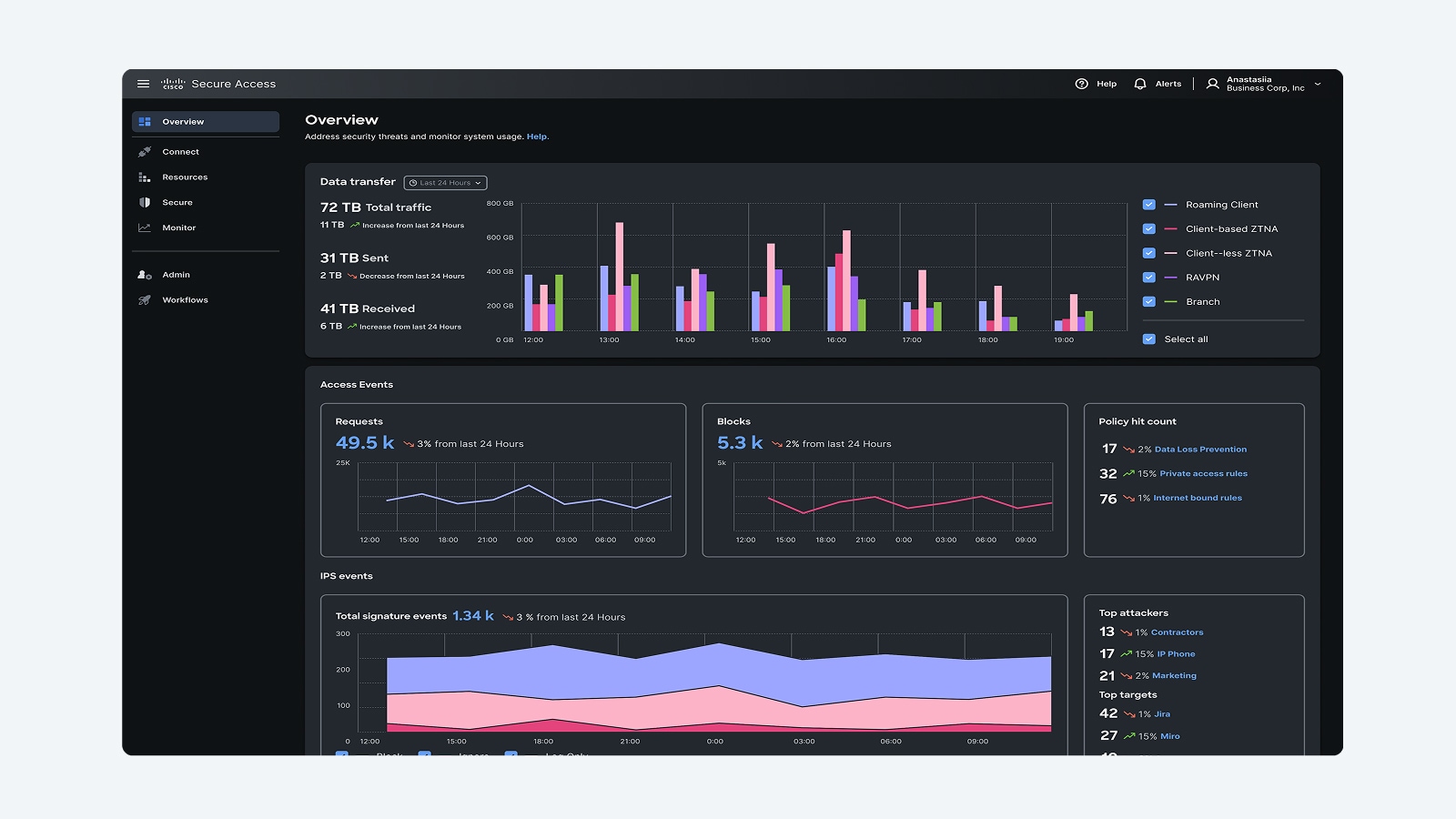
Zscaler vs Cisco Secure Access is really a question about where you are starting from. Zscaler is the dedicated, proxy-first SSE pure-play: Zscaler Internet Access (ZIA), Zscaler Private Access (ZPA), and Zscaler Digital Experience (ZDX) built from the ground up as a standalone cloud with no legacy network product to carry forward. Cisco Secure Access is Cisco's converged, cloud-delivered SSE platform, ZTNA, secure web gateway, CASB, and firewall-as-a-service unified in one service, built on the Umbrella cloud and Duo identity foundation, positioned as the natural next step for organizations still running Cisco AnyConnect VPN.
Short version: Zscaler's proxy-first architecture is the most mature, purpose-built inline inspection cloud in the category, and that maturity is real. Cisco Secure Access will not out-mature it on raw proxy pedigree. What Secure Access offers instead is a converged migration path for organizations already running Cisco SD-WAN, Umbrella, Duo, or AnyConnect that want to move to zero trust without a parallel rebuild of their network security stack.
At a glance
Both deliver ZTNA, secure web gateway, and CASB as cloud services. The difference is what each is built on top of.
| Dimension | Zscaler | Cisco Secure Access |
|---|---|---|
| Architecture | Proxy-first, dual ZIA/ZPA architecture, cloud-native from day one, no legacy VPN lineage | Converged SSE (ZTNA, SWG, CASB, FWaaS, DNS security) unified in one service, built on Umbrella and Duo |
| Deployment | App Connectors and Client Connector; vendor-neutral rollout independent of network hardware | Cisco Secure Client, the successor agent to AnyConnect, giving existing Cisco VPN shops a direct migration path |
| Identity & integration | Integrates with any IdP, Okta, Entra ID, Ping, vendor-neutral by design | Native Duo device trust and MFA, native Cisco ISE integration, deepest inside the Cisco identity stack |
| Licensing model | Modular ZIA/ZPA/ZDX bundles priced by capability | Unified SSE license tiers bundling ZTNA, SWG, CASB, and FWaaS |
| Ecosystem | Independent SSE pure-play, the Zero Trust Exchange is a standalone dedicated cloud | Part of Cisco Security Cloud, SD-WAN SASE on-ramp, Cisco XDR, Talos intelligence |
| Ops overhead | Requires standing up a dedicated SSE operating model from scratch | Lower overhead for orgs already running Cisco SD-WAN, Umbrella, or Duo, extends existing consoles and policy |
Proxy-first maturity vs a converged Cisco platform
Give Zscaler its due: it is the category's proxy-first pioneer, and years of running one of the largest dedicated inline-inspection clouds in the world shows in its performance at scale, its SSL/TLS inspection depth, and the maturity of its policy engine. Cisco Secure Access takes a different path by design, it converges capability that used to live in separate Cisco products (Umbrella's DNS and SWG layer, Duo's identity and device trust, and ZTNA) into one licensed platform, rather than building a single-purpose proxy cloud from a blank slate. That convergence is the point of Secure Access, not an attempt to out-build Zscaler's core proxy engineering.
Migrating off legacy VPN and AnyConnect
This is the search a lot of Cisco shops are actually running, and it deserves a direct answer: Cisco AnyConnect has not disappeared, it has evolved. Cisco Secure Client is the current unified agent, and it still supports traditional AnyConnect VPN mode while adding the ZTNA and SSE capability Secure Access delivers. For an organization with AnyConnect deployed fleet-wide, Secure Access is the path that keeps the existing agent and client relationship in place while layering in zero trust, rather than removing AnyConnect and standing up a completely separate Zscaler Client Connector deployment. That continuity is a real operational advantage if your VPN estate is already Cisco, not just a licensing convenience.
SASE on-ramp and SD-WAN integration
Cisco's networking tie-in is where Secure Access separates most clearly from a pure-play competitor. Catalyst SD-WAN uses Secure Access and Umbrella as a built-in SASE on-ramp, so branch and remote-user traffic gets cloud-delivered protection without backhauling to a data center, configured from the same SD-WAN management plane that already runs your branch network. Zscaler integrates with Cisco SD-WAN too, and plenty of organizations run that combination successfully, but it is an integration between two vendors rather than a single platform's native on-ramp. If your WAN is already Catalyst SD-WAN, that difference shows up in how many consoles your network team touches on a normal day.
Vendor-neutral vs single-vendor trade-offs
Zoom out and this is the same trade-off that shows up across most Cisco-versus-pure-play comparisons. Zscaler's vendor-neutral posture is a genuine strength for a multi-vendor network: it does not care whether your edge is Cisco, Palo Alto, or Fortinet, or whether your identity provider is Okta or Entra ID. Cisco Secure Access's strength is the inverse: the less vendor diversity you have to manage because your network, identity, and access stack are already Cisco, the more Secure Access pays back in shared consoles, shared identity through Duo and ISE, and one support relationship instead of two. Neither posture is universally correct; it maps directly to how consolidated or how heterogeneous your infrastructure already is.
A phased migration is normal, not a red flag
Very few organizations retire a VPN estate and cut over to a new SSE platform in a single weekend, and neither vendor expects you to. A common, sensible pattern looks like this: pilot ZTNA against a handful of applications and a defined user group, run it alongside the existing AnyConnect or third-party VPN for the rest of the organization, expand coverage application by application as policy and access mapping get validated, and only retire the legacy VPN once ZTNA coverage is proven at scale. The mistake is not running both during the transition; it is leaving the migration open-ended with no target date and no owner for reconciling policy between the old and new paths.
Which should you choose?
Anchor the decision to your existing VPN, network, and identity stack, not just feature checklists.
Choose Zscaler if
- You want the most mature, dedicated proxy-first SSE cloud, evaluated independent of any network vendor
- Your network is multi-vendor and you do not want SSE tied to any single hardware or identity ecosystem
- You are running a green-field zero-trust program with no legacy Cisco VPN estate to migrate
- You are prepared to stand up and staff a fully separate SSE operating model
Choose Cisco Secure Access if
- You are running Cisco AnyConnect today and want a direct migration path through Cisco Secure Client rather than a parallel agent rollout
- Your WAN already runs Catalyst SD-WAN and you want SSE as a native SASE on-ramp, not a bolted-on integration
- You already use Duo and Umbrella and want ZTNA to extend that identity and DNS investment instead of duplicating it
- Reducing the number of separate security vendors and consoles is an active priority
Frequently asked questions
Is Cisco Secure Access a replacement for AnyConnect?
It is the evolution of that path rather than a hard cutover. Cisco Secure Client is the current unified agent and successor to the standalone AnyConnect client, and it still supports traditional AnyConnect VPN mode while adding the ZTNA and broader SSE capability that Secure Access delivers.
Is Zscaler better than Cisco Secure Access?
It depends on your starting infrastructure. Zscaler's proxy-first architecture is the more mature, dedicated SSE cloud on its own merits. Cisco Secure Access is strongest for organizations already running Cisco SD-WAN, Umbrella, Duo, or AnyConnect, where convergence and native integration outweigh Zscaler's standalone proxy depth.
Does Cisco Secure Access include ZTNA?
Yes. Zero trust network access is a core capability of Cisco Secure Access, delivered alongside secure web gateway, CASB, and firewall-as-a-service in one converged, cloud-delivered platform.
Can I run Zscaler on a Cisco network?
Yes. Zscaler is vendor-neutral and integrates with Cisco SD-WAN and other Cisco network hardware. You keep Zscaler's proxy-first SSE capability, but you do not get the native SASE on-ramp integration that Cisco Secure Access has with Catalyst SD-WAN.
What is the difference between Cisco Umbrella and Cisco Secure Access?
Cisco Secure Access is the newer, unified SSE platform built on the Umbrella cloud, adding Duo identity and device trust, ZTNA, and converged licensing across capabilities that used to be scoped separately. Umbrella remains available as DNS-layer security and a Secure Internet Gateway (SIG) on its own for organizations that do not need the full Secure Access bundle.
Uniqcli Team
The Uniqcli Team is an authorized Cisco partner specializing in Catalyst wireless, switching, datacenter fabric, licensing, and managed services for U.S. federal, state, local, and education customers. We scope Cisco bills of materials, validate procurement paths (TAA, FIPS, contract vehicles), and deliver design, deployment, and managed operations.
Ready to scope your Cisco build?
Build a quoteRelated reading
View all →GuidesZscaler vs Cisco AnyConnect: ZTNA vs VPN, Explained
Zscaler vs Cisco AnyConnect is really a ZTNA-vs-VPN question. Here's the architectural difference, where classic VPN still wins, and how Cisco's own ZTNA answer changes the migration decision.
July 12, 2026 · 6 min readGuidesCisco Umbrella vs Zscaler: DNS and SSE Security Compared
Cisco Umbrella vs Zscaler comes down to architecture: DNS-layer security that grows into a full SSE stack, versus a proxy-first cloud built for inline inspection at scale. Here is how to choose.
July 11, 2026 · 5 min read Insights
Cisco Secure Firewall and SASE: how to scope branch and remote security
The old hub-and-spoke security model breaks once your users and apps leave the building. Here is a practical way to scope Cisco Secure Firewall and SASE together, sized to where your people actually work.
May 26, 2026 · 11 min read Compliance
Zero Trust for federal agencies: Hypershield, ISE, and Secure Access explained
Federal mandates pushed Zero Trust from buzzword to deadline. Here is how Cisco Hypershield, Identity Services Engine, and Secure Access fit a real agency architecture, and where each one earns its place.
May 22, 2026 · 11 min readGuidesUmbrella SIG vs Zscaler ZIA: Secure Internet Gateways
Umbrella SIG vs Zscaler ZIA is an architecture question: a DNS-first layer with a proxy behind it, versus a single proxy that inspects everything, every time. Here is what actually differs.
July 11, 2026 · 5 min read Guides
Cisco NCS 540 vs ASR 920: Access Routing Compared
NCS 540 vs ASR 920: both are active Cisco access routers, but one runs IOS XR and one runs IOS XE. The real decision is which operating model your network is standardizing on.
July 11, 2026 · 7 min read