
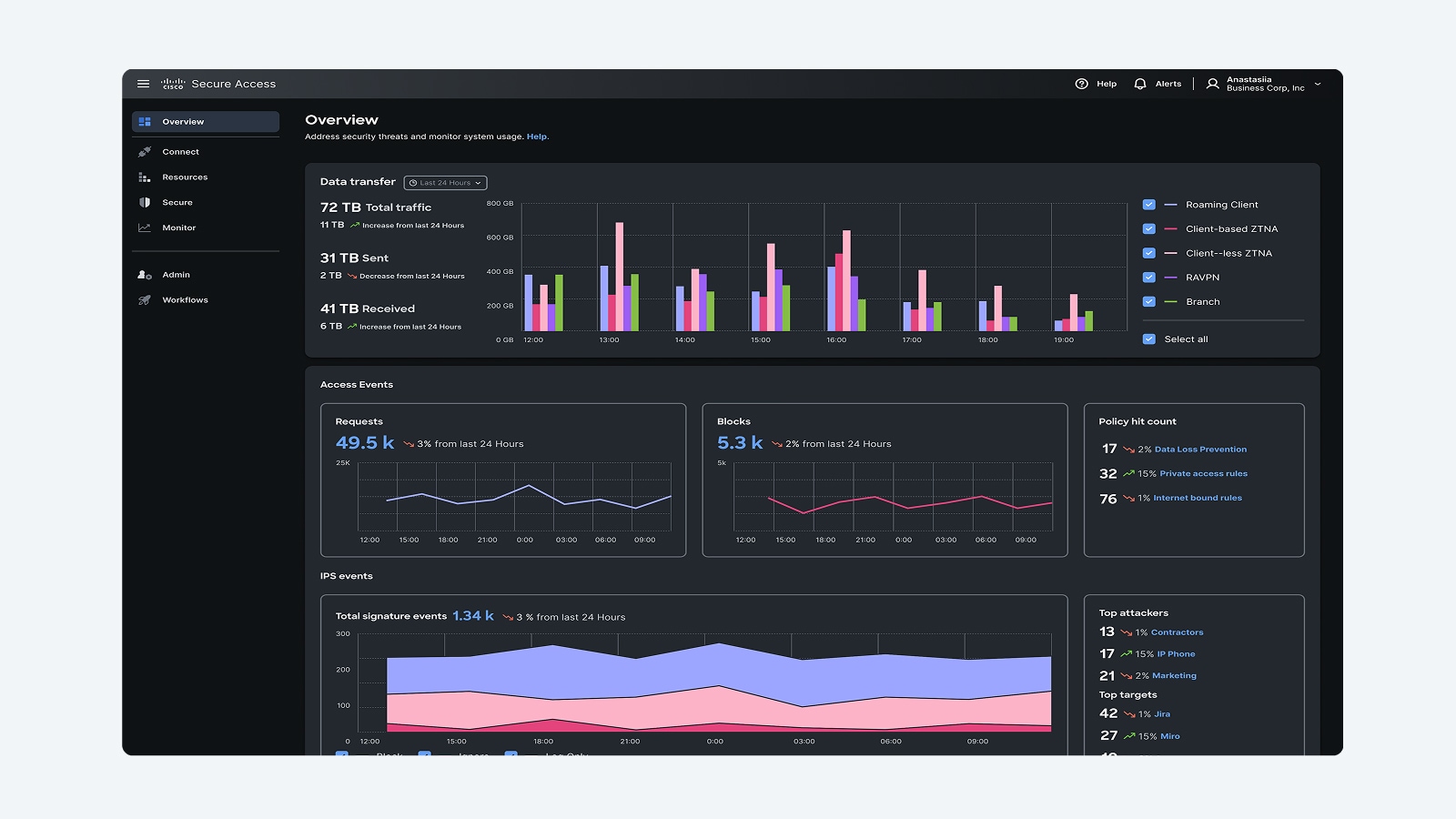
The short version: the Zscaler vs Cisco AnyConnect question is really a ZTNA-vs-VPN question, because Zscaler Private Access and Cisco AnyConnect (now shipped as part of Cisco Secure Client) are not the same category of product, even though both get called on to solve "remote access." Zscaler is a Zero Trust Network Access (ZTNA) broker that connects one authenticated user to one specific application without ever putting that user on your network; Cisco AnyConnect is a remote-access VPN that extends the network itself to wherever the client sits. If your workforce is cloud-first, browser- and SaaS-heavy, and you want to shrink the attack surface a VPN concentrator represents, ZTNA is the better default. If a site needs full-tunnel network reach, has to talk to OT, ICS, or other non-web protocols, or has to keep working when the path to a cloud broker is flaky, classic VPN still does a job ZTNA wasn't built for. The honest answer for most Cisco shops in 2026 is both, running side by side, and Cisco's own ZTNA module inside Secure Client exists specifically so that transition doesn't require ripping out AnyConnect first.
At a glance: Zscaler vs Cisco AnyConnect
| Factor | Zscaler Private Access | Cisco AnyConnect / Secure Client |
|---|---|---|
| Category | ZTNA broker, identity-brokered application access | Remote-access VPN, network-level tunnel |
| Connection direction | Outbound-only app connector; no inbound listener | Inbound VPN gateway (ASA/FTD/ISR) clients connect into |
| Access granularity | Per-user, per-application policy | Network or subnet-level once the tunnel is up |
| Internet-facing footprint | No publicly listening VPN port to attack | VPN head-end is a reachable, scannable target |
| Protocol coverage | Strongest for web and TCP-based apps | Any IP protocol, including OT/ICS and legacy apps |
| Offline or low-connectivity sites | Depends on a reachable path to the cloud broker | Works over any private WAN, MPLS, or direct link |
| Cisco-native ZTNA option | Not applicable, Zscaler is the ZTNA vendor here | Available via Cisco Secure Access and the Secure Client ZTNA module |
| Typical buyer today | Distributed, cloud-first workforce, heavy SaaS use | Sites needing full-tunnel access, OT protocols, or offline resilience |
The real difference: inbound listener vs identity-brokered access
Classic remote-access VPN, including Cisco AnyConnect, works by giving the client a virtual presence on the corporate network. The client authenticates to a head-end device, gets an internal IP address, and from that point the network's own routing and firewall rules decide what it can reach, which is powerful, but it also means the head-end has to listen for inbound connections from anywhere on the internet, and a compromised endpoint effectively sits inside the perimeter. Zscaler Private Access flips the model: a lightweight connector sits next to each application and makes an outbound-only connection to Zscaler's cloud, the user's client makes its own outbound connection to the same cloud, and the two are stitched together only after identity and policy checks pass. There is no listening port to scan, no network-level reachability, and no lateral path from one allowed app to another, the user never touches a subnet, only the specific app they were granted. That's the core of the ZTNA-vs-VPN debate: one model extends the network outward, the other brokers access to individual applications and nothing else.
Where classic VPN still wins
ZTNA's app-by-app model runs into real limits in a few common environments. Full-tunnel requirements, where a remote user genuinely needs broad network reach, not just a handful of published apps, are still a VPN job. Operational technology and industrial protocols, legacy client-server applications that were never built with a web-friendly connector in mind, and file-share or print protocols that assume network-level presence all tend to work more predictably over a VPN tunnel than through an application-aware broker. Offline or intermittently connected sites are the other sticking point: a ZTNA broker depends on a working path out to a cloud control plane, so a remote site with unreliable internet, an air-gapped segment, or a disaster-recovery link that has to keep functioning without cloud dependency is often better served by a VPN tunnel over a private WAN or direct circuit. None of this makes ZTNA the wrong architecture for the workforce at large, it just means the OT closet, the site with no reliable broadband, and the legacy app that speaks a protocol no connector understands are still VPN's to keep.
Cisco's own ZTNA answer isn't frozen in 2019
A common misconception in this comparison is that Cisco's only answer is AnyConnect, full stop. That was fair a few years ago; it isn't now. Cisco Secure Access is Cisco's cloud-delivered security service edge (SSE) platform, and it includes a ZTNA capability that's delivered through the same Secure Client software that used to be "just AnyConnect." In practice that means a Cisco shop can run VPN and ZTNA from one client, one policy console, and one vendor relationship, rather than standing up a second agent and a second management plane purely to get application-level access control. It's a meaningfully different starting point than choosing between AnyConnect and Zscaler as if they were the only two options: the real decision for a Cisco-standardized network is whether to build ZTNA on Cisco Secure Access or bring in Zscaler as the SSE layer, with AnyConnect either retired, kept for the workloads above, or run in parallel during migration. For the broader SSE-suite comparison, SWG, CASB, and DNS security included, not just the access piece, see our breakdown of the full security service edge stacks, not just the access layer.
Replacing AnyConnect: what actually has to change
"AnyConnect replacement" projects usually stall on the same three questions, regardless of which ZTNA vendor wins. First, application inventory: ZTNA policy is written per application, so someone has to enumerate what remote users actually reach today, which a wide-open VPN tunnel never forced anyone to do. Second, identity integration: both Zscaler and Cisco's ZTNA module lean on your existing identity provider for authentication and posture, so the migration is as much an identity-and-access project as a networking one. Third, the tail of exceptions, the OT segment, the one legacy app, the site with no reliable internet, has to get an explicit decision rather than being left on VPN by default and forgotten. None of that is a reason to avoid the move; it's the reason most migrations run VPN and ZTNA in parallel for a stretch rather than as a single cutover weekend.
Licensing: what you're actually buying
On the Cisco side, AnyConnect/Secure Client licensing comes in tiers, a base VPN-and-posture tier and a higher tier that layers in endpoint compliance and advanced posture, sold as user-count subscriptions rather than perpetual licenses; the newer ZTNA capability is licensed through Cisco Secure Access rather than bundled into the AnyConnect tier itself. Cisco Secure Access and Umbrella's Secure Internet Gateway licensing follow the same shape: an essentials tier covering DNS-layer security and web filtering, and an advantage tier that adds the fuller cloud firewall, CASB, and private access capabilities. Zscaler's own tiers are broadly comparable in structure, essentials-and-up packaging by capability, but priced and packaged under its own program, which is out of scope for a Cisco reseller quote. Confirm current tier contents and user-count breakpoints in a validated quote before budgeting a renewal or a migration, since Cisco periodically adjusts what each tier includes. If the DNS-layer and web-filtering piece of this decision matters as much as the access-broker piece, our side-by-side look at Umbrella's DNS security tiers against Zscaler's covers that ground separately.
Which should you choose?
- Choose Zscaler Private Access if the workforce is cloud-first and SaaS-heavy and you want to eliminate the VPN head-end as an internet-facing attack surface.
- Keep Cisco AnyConnect / Secure Client VPN where a site needs full-tunnel access, talks to OT/ICS or other non-web protocols, or has to function without a reliable path to a cloud broker.
- If the network is already Cisco-standardized, evaluate Cisco Secure Access and the Secure Client ZTNA module before assuming a second vendor and a second agent are required.
- Running a phased AnyConnect replacement? Keep VPN live for the legacy-app and OT tail while ZTNA policy is built out app by app, don't force a single cutover date.
- Either path, license by real user counts and confirm current tier inclusions in a validated quote, SSE and ZTNA packaging changes more often than hardware licensing does.
One planning note that applies regardless of vendor: don't treat this as an all-or-nothing rip-and-replace. The organizations that migrate cleanly tend to move application by application, starting with the SaaS and web apps that are the easiest ZTNA win, while leaving VPN in place for the OT segment, the offline site, and the one legacy app nobody's gotten around to modernizing. Loop in our security practice for a session-by-session comparison before committing budget to either path.
Frequently asked questions
Is Zscaler Private Access a direct replacement for Cisco AnyConnect?
Not a one-to-one replacement, Zscaler Private Access is a ZTNA broker that grants per-application access, while Cisco AnyConnect is a network-level VPN, so most organizations end up running both during a migration rather than swapping one for the other overnight. The applications that are web-based and well-inventoried tend to move to ZTNA first, while OT, legacy, and offline-site traffic often stays on VPN.
What is the core difference between ZTNA and VPN?
A VPN like Cisco AnyConnect gives an authenticated client a presence on the network itself, after which network routing and firewall rules govern access; ZTNA like Zscaler Private Access instead brokers a direct, per-application connection between an identity-verified user and one resource, with no broader network reachability granted. That difference is why ZTNA is described as reducing attack surface, there's no VPN head-end listening for inbound connections and no lateral path between applications.
Does Cisco have its own ZTNA product, or is AnyConnect the only option?
Cisco offers ZTNA through Cisco Secure Access, its cloud-delivered security service edge platform, delivered via the same Secure Client software historically known just for AnyConnect VPN. That means a Cisco-standardized environment can evaluate a Cisco-native ZTNA path before assuming Zscaler or another third party is required for zero trust access.
Can AnyConnect and a ZTNA broker like Zscaler run at the same time?
Yes, and in practice most migrations run them in parallel for a period, VPN stays in place for OT protocols, legacy apps, and offline or low-connectivity sites while ZTNA policy is built out application by application for the rest of the workforce. This phased approach is generally safer than a single cutover because it forces an explicit decision on every exception rather than leaving them stranded.
Why would a site keep VPN instead of moving to ZTNA?
Sites with OT or industrial control protocols, legacy client-server applications that predate web-friendly connectors, or unreliable internet paths to a cloud broker are the common reasons to keep classic VPN. ZTNA depends on a working connection to a cloud control plane and works best for web and TCP-based applications, so environments outside that profile are usually left on VPN by design, not oversight.
How is Cisco AnyConnect/Secure Client and Cisco Secure Access licensing typically structured?
Cisco AnyConnect/Secure Client is sold in tiers, a base VPN-and-posture tier and a higher tier adding endpoint compliance and advanced posture, priced as user-count subscriptions, while the newer ZTNA capability is licensed through Cisco Secure Access rather than the AnyConnect tier itself. Cisco Secure Access and Umbrella's Secure Internet Gateway licensing follow a similar essentials-versus-advantage tier structure; confirm exact current inclusions in a validated quote since Cisco periodically updates what each tier covers.
Uniqcli Team
The Uniqcli Team is an authorized Cisco partner specializing in Catalyst wireless, switching, datacenter fabric, licensing, and managed services for U.S. federal, state, local, and education customers. We scope Cisco bills of materials, validate procurement paths (TAA, FIPS, contract vehicles), and deliver design, deployment, and managed operations.
Ready to scope your Cisco build?
Build a quoteRelated reading
View all →GuidesZscaler vs Cisco Secure Access: SSE Platforms Compared
Zscaler vs Cisco Secure Access weighs proxy-first SSE maturity against a converged platform built on Umbrella and Duo for teams migrating off traditional VPN and AnyConnect.
July 11, 2026 · 5 min read News
NewsCheck Point VPN Flaw Tied to Qilin Ransomware: The Case for Zero Trust Over Legacy VPN
A critical Check Point gateway authentication flaw is being exploited in the wild and has already been linked to a Qilin ransomware affiliate. Here is what happened, who is exposed, and how to move remote access toward identity-based Zero Trust before the next campaign finds you.
June 9, 2026 · 7 min read Guides
Cisco RV042 (RV042-G5) End-of-Life: Migrate to the RV340
The RV042 Dual WAN VPN Router passed its Last Day of Support on June 30, 2019. Here is a practical, partner-vetted plan to refresh to the gigabit RV340 without breaking your dual-WAN VPN branch.
June 11, 2026 · 6 min read Guides
CBRS and private 5G explained for enterprises
CBRS opened up private cellular for ordinary enterprises. Here is how the shared 3.5 GHz band, private 5G, and Wi-Fi 7 actually fit together, and where each one earns its keep on a real network.
June 6, 2026 · 11 min read Guides
Private 5G vs Wi-Fi: when to use which in industrial environments
Private 5G and Wi-Fi 7 are not rivals so much as tools for different jobs. Here is how to decide which radio belongs where on a factory floor, a port, a mine, or a hospital campus, and how the two coexist under one Cisco-managed network.
June 6, 2026 · 11 min read Guides
Stadium Wi-Fi capacity planning: sizing for a packed house
A sold-out crowd is the most hostile RF environment your wireless will ever face. Here is how to size Cisco Wi-Fi for a packed house, from device density math to antenna geometry to controller headroom.
June 6, 2026 · 12 min read