
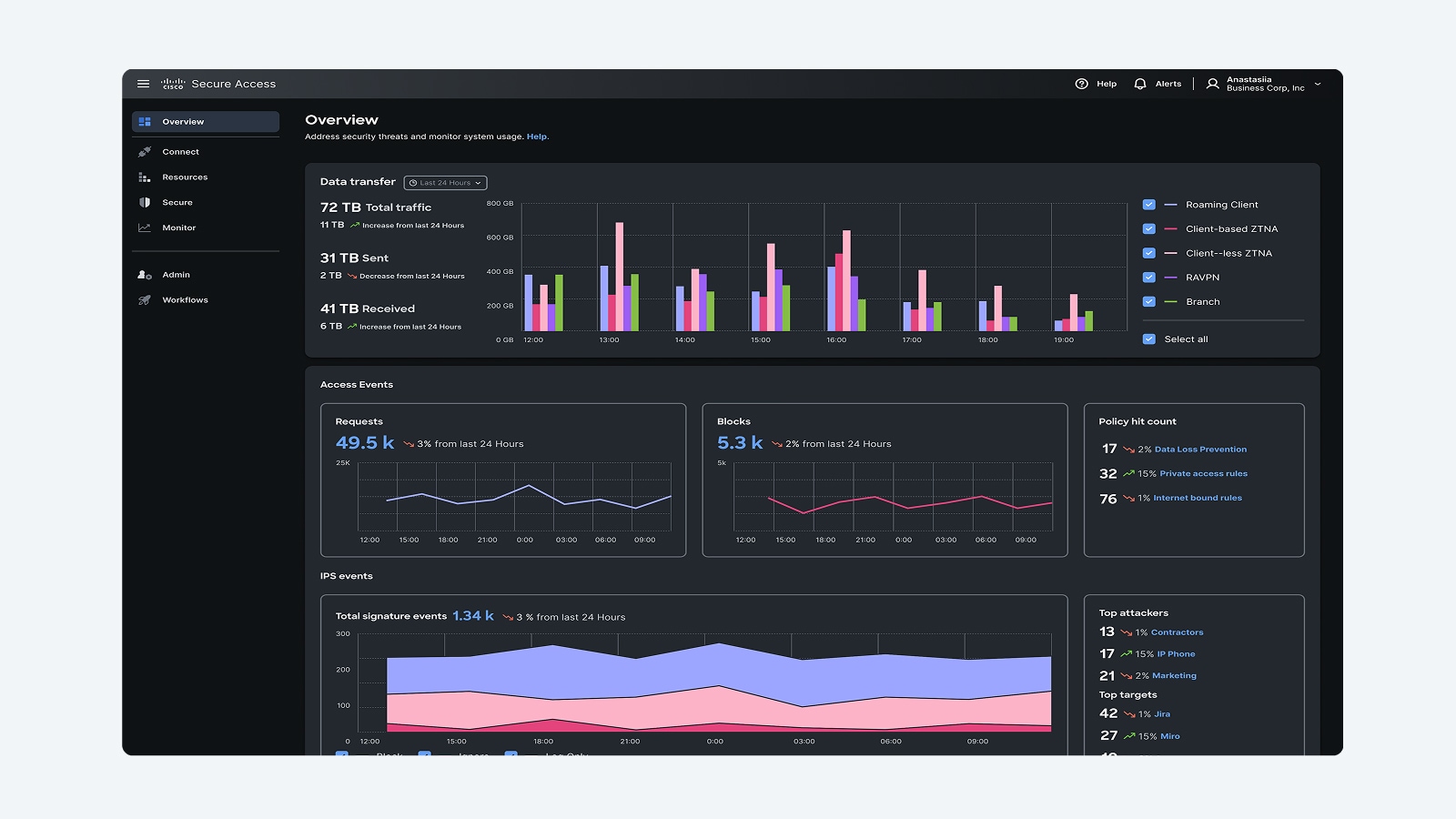
Umbrella SIG vs Zscaler ZIA is a narrower, more technical question than the broader Cisco-versus-Zscaler debate: both are secure internet gateways, but they get there through genuinely different traffic paths. Cisco Umbrella's Secure Internet Gateway (SIG) is a layered design, DNS-layer security handles the first pass, then a secure web gateway (SWG) proxy adds full HTTP/S inspection, CASB, and DLP for the traffic that needs it. Zscaler Internet Access (ZIA) is proxy-first end to end: every request is decrypted, inspected, and re-encrypted through Zscaler's cloud, with no DNS-only shortcut in the path.
Short version: SIG's DNS-first layer means a large share of threats never reach a proxy at all, which keeps latency low and infrastructure lean, especially on Cisco SD-WAN and Meraki branch gear that already forward DNS natively. ZIA's single-proxy model inspects everything uniformly by design, which is more consistent and is the reason organizations with heavy SSL inspection and DLP requirements at scale often default to it. Neither is a lesser architecture; they optimize for different things.
At a glance
Both are secure internet gateways in the SSE sense. The traffic path to get there is where they actually differ.
| Dimension | Umbrella SIG | Zscaler ZIA |
|---|---|---|
| Architecture | Layered: DNS-layer security first, secure web gateway proxy added for full HTTP/S, CASB, and DLP inspection | Single proxy-first architecture, every request routes through Zscaler's inline inspection cloud |
| Deployment | DNS forwarding from routers, Meraki APs, or a roaming client, with IPSec tunnels to the proxy layer as needed | GRE/IPSec tunnels or Client Connector redirect all traffic through the proxy; no DNS-only tier |
| Identity & integration | Native to Cisco SD-WAN, Meraki, ISE, and Duo for identity-aware policy at the branch and endpoint | Vendor-neutral, integrates with any IdP and any network hardware |
| Licensing model | SIG Essentials and Advantage tiers, bundling DNS and SWG capability together | Modular ZIA bundles priced by capability, advanced threat protection, DLP, and sandboxing scale separately |
| Ecosystem | Part of Cisco Security Cloud, Talos intelligence, SD-WAN SASE on-ramp | Part of the Zscaler Zero Trust Exchange, alongside ZPA and ZDX |
| Ops overhead | DNS-first layer reduces proxy load and is quick to stand up on existing Cisco network gear | One consistent proxy model simplifies policy, but requires redirecting all traffic through it |
DNS-layer-first vs proxy-first: what actually inspects your traffic
This is the core architectural fork. SIG's DNS layer resolves a lookup and checks it against threat intelligence before any connection to the destination is even made, a request to a known-malicious domain simply never gets an IP address back, and it never touches the proxy layer at all. Only the traffic that clears DNS and needs deeper inspection (unknown categories, file downloads, cloud app control, DLP scanning) gets routed through the SWG proxy. ZIA skips that first filter entirely: every request, regardless of destination reputation, is decrypted and inspected inline before Zscaler decides whether to allow it. That is the trade-off in one sentence, SIG front-loads a fast, cheap filter to shrink what the proxy has to handle; ZIA treats every request as equally worth full inspection from the start.
Where Zscaler's proxy depth leads
Give this one to Zscaler directly: a single, always-on proxy architecture is a more thorough default than a layered one, because nothing that clears the DNS check gets a pass on deeper inspection it might have actually needed. Zscaler has built one of the largest dedicated inline-inspection clouds in the industry around exactly that model, and its SSL/TLS inspection, sandboxing, and DLP maturity reflect years of engineering focus on a single architecture rather than a layered one. For organizations whose compliance posture demands full inspection of every request as a matter of policy, not just for flagged traffic, ZIA's proxy-first purity is a legitimate, earned advantage over a DNS-first design.
Where Umbrella SIG's layered model wins
SIG's advantage shows up hardest at the branch. Because DNS-layer security requires no tunnel and no client for basic protection, a branch router or Meraki access point can start blocking threats the moment it forwards DNS, before any IPSec tunnel to the proxy layer is even built. Catalyst SD-WAN treats Umbrella as a native SASE on-ramp, so branch traffic gets DNS-layer protection automatically as part of the WAN fabric, with the SWG proxy layered in for sites or users that need deeper inspection. Combined with identity context from Duo and Cisco ISE, that means policy can be identity-aware without every packet first making a round trip through a proxy, which keeps the architecture lighter for organizations that do not need full inline inspection on 100 percent of traffic to meet their compliance bar.
Licensing tiers and how each scales
SIG is sold in Essentials and Advantage tiers, with DNS-layer security and SWG capability bundled together rather than licensed as separate line items, which simplifies budgeting once you know your user count. ZIA's bundles are more modular, letting you license specific capability (advanced threat protection, DLP, sandboxing) independently as needs grow, which gives more granular control at the cost of more moving parts to track. Neither Cisco nor Zscaler publishes flat list pricing for these tiers, and both scale primarily by user or seat count and which modules you enable, so the only reliable number is one scoped to your actual traffic profile and site count rather than a figure pulled from a comparison article.
Which should you choose?
The decision hinges on how much of your protection can happen before the proxy, and how much of your network is already Cisco.
Choose Zscaler ZIA if
- You want a single proxy-first architecture as the source of truth for every request, with no DNS-only tier
- Compliance requires full inline inspection of all traffic, not just what clears an earlier filter
- You run a multi-vendor network and want an SSE gateway that is not tied to Cisco hardware or identity products
- Granular, modular licensing by capability matters more than a bundled DNS-plus-SWG tier structure
Choose Umbrella SIG if
- You run Cisco SD-WAN or Meraki branch infrastructure and want DNS-layer protection as a native part of the WAN fabric
- You want a lighter architecture where a large share of threats never reach a proxy at all
- You already use Duo or Cisco ISE and want identity-aware policy without redirecting all traffic through a new cloud
- You want DNS and SWG bundled into one licensed tier rather than tracked as separate modules
Frequently asked questions
What does SIG stand for?
SIG stands for Secure Internet Gateway, Cisco Umbrella's tier that bundles DNS-layer security with a secure web gateway (SWG) proxy for full HTTP/S inspection, CASB, and DLP.
What does ZIA stand for?
ZIA stands for Zscaler Internet Access, the proxy-first secure web gateway component of Zscaler's SSE platform, which also includes Zscaler Private Access (ZPA) for zero-trust application access and Zscaler Digital Experience (ZDX) for monitoring.
Is Umbrella SIG the same as Umbrella DNS security?
No. Umbrella DNS security covers the DNS-layer blocking on its own. SIG bundles that DNS-layer security with a full secure web gateway proxy layer, adding deeper HTTP/S inspection, CASB, and DLP. Confirm exact tier boundaries and what is included at each level in a validated quote.
Does Zscaler ZIA inspect encrypted traffic?
Yes. SSL/TLS inspection is core to ZIA's proxy-first model, traffic is decrypted, inspected, and re-encrypted inline as part of how the platform evaluates every request, not an optional add-on.
Can I run Umbrella SIG alongside Cisco SD-WAN?
Yes. Catalyst SD-WAN uses Cisco Secure Access and Umbrella as a native SASE on-ramp, so branch and remote-user traffic gets DNS-layer and SIG protection as part of the WAN fabric rather than as a separately managed overlay.
Uniqcli Team
The Uniqcli Team is an authorized Cisco partner specializing in Catalyst wireless, switching, datacenter fabric, licensing, and managed services for U.S. federal, state, local, and education customers. We scope Cisco bills of materials, validate procurement paths (TAA, FIPS, contract vehicles), and deliver design, deployment, and managed operations.
Ready to scope your Cisco build?
Build a quoteRelated reading
View all →GuidesCisco Umbrella Packages Explained: DNS vs SIG, Essentials vs Advantage
Cisco Umbrella still ships as four packages, DNS Security Essentials, DNS Security Advantage, SIG Essentials, and SIG Advantage, even as new capability lands in Cisco Secure Access. Here's what each tier actually includes and how to license it.
July 3, 2026 · 7 min readGuidesZscaler vs Cisco Secure Access: SSE Platforms Compared
Zscaler vs Cisco Secure Access weighs proxy-first SSE maturity against a converged platform built on Umbrella and Duo for teams migrating off traditional VPN and AnyConnect.
July 11, 2026 · 5 min readGuidesCisco Umbrella vs Zscaler: DNS and SSE Security Compared
Cisco Umbrella vs Zscaler comes down to architecture: DNS-layer security that grows into a full SSE stack, versus a proxy-first cloud built for inline inspection at scale. Here is how to choose.
July 11, 2026 · 5 min readGuidesZscaler vs Cisco AnyConnect: ZTNA vs VPN, Explained
Zscaler vs Cisco AnyConnect is really a ZTNA-vs-VPN question. Here's the architectural difference, where classic VPN still wins, and how Cisco's own ZTNA answer changes the migration decision.
July 12, 2026 · 6 min read Guides
Cisco UTM Appliances Compared: Meraki MX vs Secure Firewall
A UTM appliance comparison for Cisco buyers: what UTM vs NGFW naming really means, then how Meraki MX and Secure Firewall stack up as Cisco's two UTM-style paths.
July 11, 2026 · 6 min readGuidesCisco Secure Firewall vs Check Point: Enterprise NGFW Comparison
Cisco Secure Firewall vs Check Point, compared on management, ecosystem integration, and licensing, with the real-world scenarios where each enterprise NGFW platform wins.
July 11, 2026 · 6 min read