
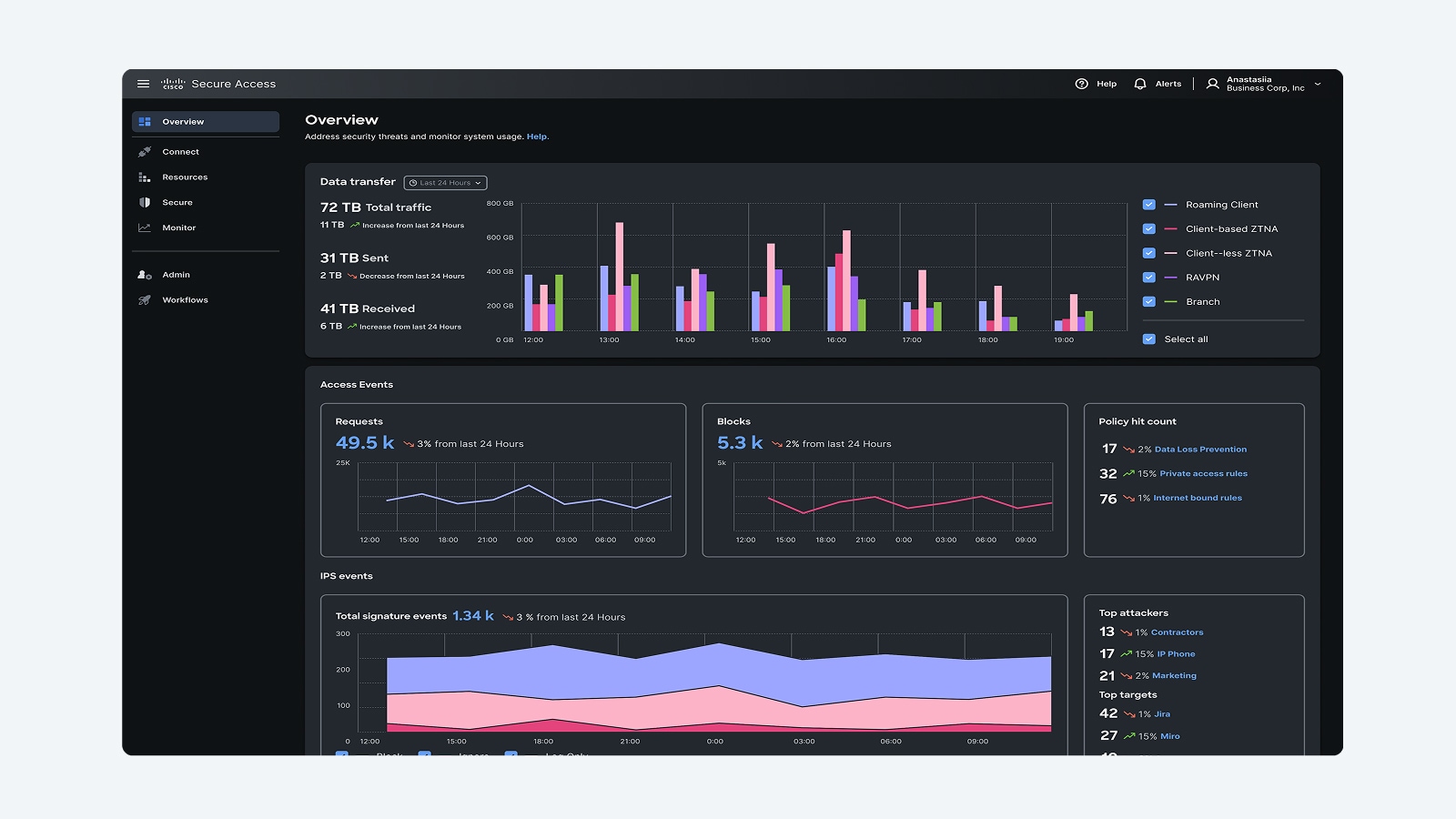
Cisco Umbrella vs Zscaler is really a question about where you want traffic inspected and how much of your existing network you want to lean on. Umbrella started as DNS-layer security and has grown into a full secure internet gateway (SIG); Zscaler was built proxy-first from day one and remains the deepest dedicated inline-inspection cloud in the category. Neither is the wrong answer, the fit depends on what you already run.
Short version: if you operate a Cisco-heavy network (SD-WAN, Meraki, ISE, Duo) and want DNS-layer blocking plus proxy depth without standing up a second security operating model, Umbrella is the lower-friction path. If full inline inspection of every request is a hard requirement and you run a multi-vendor network, Zscaler's dedicated SSE cloud is difficult to match. The architecture, licensing, and decision breakdown follow.
At a glance
Both platforms now cover the core of secure service edge (SSE): web filtering, cloud app control, and threat inspection. The difference is in how each gets there.
| Dimension | Cisco Umbrella | Zscaler |
|---|---|---|
| Architecture | DNS-layer security first, with a Secure Internet Gateway (SIG) proxy layer added for full SWG/CASB/DLP inspection | Proxy-first from the ground up, every request routes through Zscaler's inline inspection cloud (ZIA) |
| Deployment | DNS forwarding from routers, Meraki APs, or a roaming client, with IPSec tunnels to the SIG proxy when deeper inspection is needed | GRE/IPSec tunnels or Client Connector route all traffic through Zscaler's cloud; no DNS-first shortcut |
| Identity & integration | Native ties to Cisco SD-WAN, Meraki, ISE, and Duo for identity-aware policy | Vendor-neutral, integrates with any IdP (Okta, Entra ID, Ping) and any network vendor |
| Licensing model | DNS and SIG Essentials/Advantage tiers, often layered onto an existing Cisco agreement | Modular ZIA/ZPA/ZDX bundles priced by capability |
| Ecosystem | Part of Cisco Security Cloud, Talos intelligence, Cisco XDR, SD-WAN SASE on-ramp | Independent SSE pure-play, Zero Trust Exchange spans ZIA, ZPA, and ZDX |
| Ops overhead | Lower incremental overhead for Cisco shops, fewer new consoles, shared identity via Duo/ISE | A dedicated SSE operating model, purpose-built around full-traffic inspection |
DNS-layer speed vs proxy-first depth
Umbrella's DNS layer blocks a request before a connection is even established: malicious domains, command-and-control callbacks, and phishing infrastructure get dropped at resolution, adding essentially no latency and never touching a proxy. Zscaler takes a different, more uniform approach, every request is decrypted, inspected, and re-encrypted through its proxy cloud regardless of whether it turns out to be a threat. That consistency is real depth, and it is exactly why large enterprises with heavy compliance and data-loss requirements gravitate toward Zscaler's model: full inspection, every time, by design, not as a second layer bolted onto DNS.
How each fits your existing network
This is where the two philosophies diverge hardest. Umbrella is built to extend a Cisco network you already operate: branch routers and Meraki access points forward DNS natively, Catalyst SD-WAN uses Umbrella as a built-in SASE on-ramp, and identity context from Cisco ISE and Duo flows straight into policy. If your WAN, switching, and access control are already Cisco, Umbrella is additive rather than a parallel project. Our security overview covers where it sits alongside the rest of the stack.
Zscaler was built to be vendor-neutral, and it shows. It integrates cleanly with any network hardware and any identity provider, which matters for organizations running a mixed estate, a different vendor at the edge, a different vendor for identity, a different cloud for infrastructure. You are not fighting Zscaler's architecture to make it fit a non-Cisco network; that flexibility is the product.
Licensing and total cost pattern
Cisco does not publish a flat list price for Umbrella, and Zscaler's bundles are similarly scoped to your traffic, user count, and which modules (DLP, CASB, sandboxing) you turn on. Rather than compare list prices that rarely reflect what either vendor actually charges, the honest comparison is structural: Umbrella's DNS and SIG tiers frequently layer onto an existing Cisco enterprise agreement, which can lower the marginal cost of adoption if you already hold Cisco licensing. Zscaler's modular pricing stands alone, which is straightforward for a green-field SSE buy but does not benefit from an existing Cisco relationship. Either way, treat any number you see online as a starting point and get a validated quote against your actual user count and traffic profile before budgeting.
Where Zscaler leads, where Cisco wins
Being direct about the trade-offs: Zscaler is the category's proxy-first pioneer, and its inline-inspection depth, global cloud scale, and SSE-specific engineering focus are genuinely ahead for organizations whose primary requirement is full-traffic inspection at scale. Cisco's advantage is not out-inspecting Zscaler request-for-request; it is that Umbrella does not require a second security stack. Talos threat intelligence, one of the industry's largest telemetry networks, feeds Umbrella's blocklists, and Umbrella's DNS and web events flow natively into Cisco XDR alongside endpoint, network, and identity signals, so a DNS-layer block becomes part of the same incident timeline instead of a separate console you have to check.
What a migration or coexistence period actually looks like
Few organizations flip a switch from one platform to the other. It is common to see both running side by side for months during a merger, an acquisition, or a phased SASE rollout, and that is fine as long as policy ownership is explicit. A frequent pattern: Umbrella stays in place for DNS-layer coverage and Cisco-connected branches while Zscaler is piloted for a specific business unit or a recently acquired entity with a non-Cisco network, with a defined date to consolidate onto one platform once the evaluation is done. The failure mode is not running two tools temporarily; it is leaving both in production indefinitely with nobody owning policy conflicts between them.
Which should you choose?
Match the platform to the network you already operate and the depth of inspection your risk profile actually requires.
Choose Cisco Umbrella if
- You already run Cisco SD-WAN, Meraki, ISE, or Duo and want DNS-layer security to extend that estate, not duplicate it
- Your priority is fast, low-latency blocking of the majority of threats before they ever reach a proxy
- You want DNS and web security correlated into the same incident view as endpoint and network telemetry through Cisco XDR
- You would rather layer security spend onto an existing Cisco agreement than stand up a parallel vendor relationship
Choose Zscaler if
- Full inline inspection of every request, every time, is a hard requirement, not a nice-to-have
- You run a multi-vendor network and want an SSE layer that does not favor any one network or identity vendor
- Your compliance and DLP requirements call for the deepest, most mature proxy architecture in the category
- You are building a green-field SSE program rather than extending existing Cisco licensing
Frequently asked questions
Is Cisco Umbrella the same as Zscaler?
No. Both cover secure internet access, but the architecture differs: Umbrella starts with DNS-layer security and adds a Secure Internet Gateway (SIG) proxy for deeper inspection, while Zscaler is proxy-first from the ground up, routing every request through its inline inspection cloud (ZIA). Umbrella integrates natively with Cisco's network and identity stack; Zscaler is built to be vendor-neutral.
Does Cisco Umbrella provide full SSE like Zscaler?
Yes, through the Secure Internet Gateway (SIG) tier, which layers secure web gateway, CASB, and DLP capability on top of Umbrella's DNS-layer security. It covers the same core SSE ground as Zscaler ZIA, delivered through a DNS-first architecture rather than a pure proxy model.
Which is better for a Cisco-heavy network?
Umbrella generally has the lower-friction fit, because it extends capability already built into Cisco SD-WAN, Meraki, ISE, and Duo rather than introducing a fully separate operating model. Zscaler works fine alongside Cisco hardware too, but without the same native SASE on-ramp integration.
Is Zscaler more secure than Cisco Umbrella?
Neither claim holds up as a blanket statement. Zscaler's proxy-first architecture inspects every request uniformly, which is a genuine strength for heavy compliance and DLP needs. Umbrella's DNS layer blocks a large share of threats before a connection is even made, then adds proxy-level inspection through SIG. The right fit depends on your traffic profile and existing network, not a single security score.
How is Cisco Umbrella licensed?
Cisco does not publish flat list pricing for Umbrella. Licensing is scoped by tier (DNS security or SIG, Essentials or Advantage), user or seat count, and term. As an authorized Cisco partner, Uniqcli can return a validated, TAA-compliant quote sized to your environment.
Uniqcli Team
The Uniqcli Team is an authorized Cisco partner specializing in Catalyst wireless, switching, datacenter fabric, licensing, and managed services for U.S. federal, state, local, and education customers. We scope Cisco bills of materials, validate procurement paths (TAA, FIPS, contract vehicles), and deliver design, deployment, and managed operations.
Ready to scope your Cisco build?
Build a quoteRelated reading
View all →GuidesZscaler vs Cisco Secure Access: SSE Platforms Compared
Zscaler vs Cisco Secure Access weighs proxy-first SSE maturity against a converged platform built on Umbrella and Duo for teams migrating off traditional VPN and AnyConnect.
July 11, 2026 · 5 min readGuidesCisco Umbrella Packages Explained: DNS vs SIG, Essentials vs Advantage
Cisco Umbrella still ships as four packages, DNS Security Essentials, DNS Security Advantage, SIG Essentials, and SIG Advantage, even as new capability lands in Cisco Secure Access. Here's what each tier actually includes and how to license it.
July 3, 2026 · 7 min readGuidesUmbrella SIG vs Zscaler ZIA: Secure Internet Gateways
Umbrella SIG vs Zscaler ZIA is an architecture question: a DNS-first layer with a proxy behind it, versus a single proxy that inspects everything, every time. Here is what actually differs.
July 11, 2026 · 5 min read Guides
Meraki MX vs FortiGate: SD-WAN Security Appliances Compared
Meraki MX vs FortiGate weighs Meraki's cloud-managed, zero-touch simplicity for distributed branches against FortiGate's deep FortiOS control and respected, ASIC-accelerated SD-WAN.
July 11, 2026 · 5 min readGuidesCisco vs SonicWall: SMB and Branch Security Compared
Cisco vs SonicWall for SMB and branch security weighs SonicWall's low entry price and mature SMB channel against Meraki MX and Firepower's threat intel, ecosystem fit, and patch record.
July 11, 2026 · 5 min read Guides
Cisco vs Fortinet SD-WAN: Security-First WAN Compared
Cisco SD-WAN vs Fortinet SD-WAN: Fortinet runs SD-WAN natively inside FortiOS for one-box security consolidation; Cisco separates routing and security for deeper WAN scale.
July 11, 2026 · 7 min read