
WS-C4500X-16SFP+ End of Life: Migrate to Catalyst 9500-16X
With Cisco's last day of support for the Catalyst 4500-X 16-port 10G switch arriving October 31, 2025, here is a practical, partner-vetted plan to refresh onto the Catalyst 9500-16X (C9500-16X).
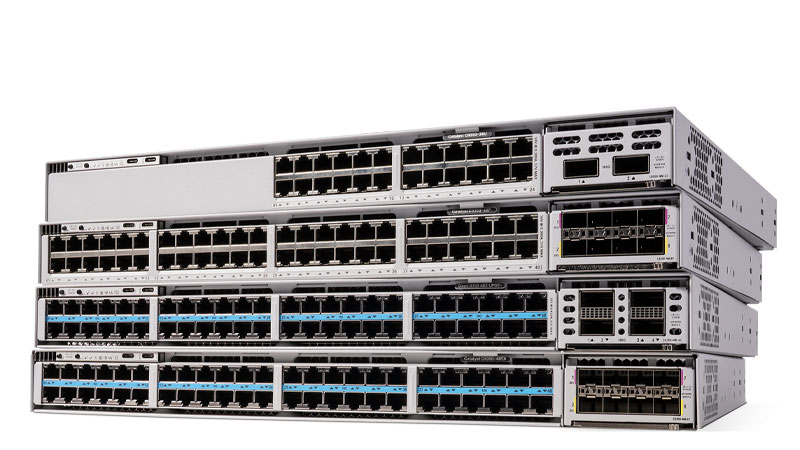
The Cisco Catalyst 4500-X 16-Port 10G IP Base switch (PID WS-C4500X-16SFP+) was, for the better part of a decade, the workhorse of mid-size collapsed cores and data-center aggregation closets: a compact 1RU box with 16 line-rate 10 Gigabit SFP+ ports, optional expansion to 24 via the eight-port uplink module, front-to-back airflow for hot-aisle racks, and VSS for chassis-pair resilience. That run is over. Cisco has moved this SKU through its full end-of-life sequence, and the final milestone, Last Day of Support, has now passed. If this switch is still carrying production traffic in your core, it is operating without a safety net.
The EoL timeline for the WS-C4500X-16SFP+, and why each date matters
Cisco end-of-life is a staged process, not a single cliff. For this product the three dates that govern your risk are clear, and each one removes a specific protection you may still be relying on:
- End of Sale, October 30, 2020: Cisco stopped selling the WS-C4500X-16SFP+. From this point the only sources are secondary-market or remaining channel stock, and warranty/support entitlement gets harder to establish.
- End of SW Maintenance Releases, October 30, 2021: Cisco stopped producing maintenance and bug-fix software for the platform. Critically, this is when routine PSIRT security remediation effectively ended, new vulnerabilities discovered after this point generally do not get a fixed release for this chassis.
- Last Day of Support (LDoS), October 31, 2025: The hard cutoff. No TAC cases, no RMA hardware replacement, and no further software of any kind. A failed power supply or supervisor cannot be replaced under contract, and any new CVE is permanent.
The recommended replacement: Catalyst 9500-16X (C9500-16X)
Cisco's bulletin maps the 16-port 4500-X directly to the Catalyst 9500-16X. It is the right call, and not a like-for-like swap so much as a generational upgrade in the same form factor. Both are fixed 1RU switches built around 16 native SFP+ ports, so the C9500-16X drops into the same aggregation or collapsed-core role with the same fiber footprint. What you gain underneath is substantial.
What is concretely better
- Forwarding and ASIC: The 9500-16X runs Cisco's programmable UADP 2.0 XL ASIC with deep, flexible TCAM and an x86 control-plane CPU with multiple gigabytes of DRAM, versus the fixed-function silicon and constrained control plane of the 4500-X. This is what enables in-place feature additions (VXLAN/EVPN, SD-Access fabric, model-driven telemetry) without a hardware change.
- Uplinks and density: Native 16x 1/10G SFP+ plus a modular uplink slot for an additional 8x 10G or 2x 40G QSFP+, giving you 40G aggregation uplinks the 4500-X never offered.
- Resilience: StackWise Virtual (SVL) replaces VSS, delivering the same dual-chassis single-logical-switch design with sub-second failover and multichassis EtherChannel to the access layer.
- Security: Line-rate MACsec-256 encryption, Cisco TrustSec/SGT segmentation, and an ongoing PSIRT remediation stream on supported IOS-XE 17.x, the patch lifecycle the 4500-X lost in 2021.
- Operations: Full IOS-XE programmability, NETCONF/RESTCONF, YANG models, streaming telemetry, on-box Python, and native integration with Catalyst Center (formerly DNA Center) for assurance and automation.
One honest note on airflow: your existing 4500-X is the front-to-back (port-side exhaust) variant. Order the C9500-16X with matching front-to-back airflow and the correct PSU orientation so it fits your hot-aisle/cold-aisle layout without re-cabling power or reversing the rack.
The licensing shift you must plan for
This is the change teams most often underestimate. The 4500-X used perpetual IOS feature sets, you bought IP Base outright and owned it. The Catalyst 9500 uses Cisco Smart Licensing with term-based subscriptions. You choose a device tier (Network Essentials or Network Advantage) and optionally layer a Cisco DNA / Catalyst Center subscription on top, sold in 3-, 5-, or 7-year terms. For a former IP Base routing/aggregation switch, Network Advantage is the practical match, it covers the full routing stack, VXLAN, and StackWise Virtual. Register every unit to your organization's Smart Account at deployment; budget the recurring subscription, not just the hardware, in your refresh business case.
A practical migration plan
1. Assessment and inventory
Capture the running state of each 4500-X before you touch anything. Pull show version, show inventory, show running-config, show module, and show switch virtual (if VSS). Document the feature set, optic inventory per port, uplink topology, VLAN/SVI map, routing protocols, and any QoS, ACL, or NetFlow policies. Confirm exactly which units are standalone versus VSS pairs, that determines how many 9500-16X units you need and whether you are building SVL pairs. The per-product detail page for this switch summarizes the EoL specifics at WS-C4500X-16SFP+ end-of-life detail, and the full retirement schedule lives on the Cisco EoL hub.
2. License transition
Create or confirm a Cisco Smart Account and Virtual Account, decide Network Essentials versus Advantage per role, and size the DNA term to your hardware refresh horizon. Order licenses with the hardware so devices come up registered. Plan for Smart Licensing Using Policy (SLUP) connectivity in air-gapped or restricted enclaves, offline/CSLU or on-prem Smart Software Manager modes are supported and common in DoD environments.
3. Config and feature parity
IOS-XE on the 9500 is close to the 4500-X CLI but not identical, convert rather than paste. Watch for VSS-to-StackWise-Virtual syntax, licensing and boot-mode statements, and any platform-specific QoS or TCAM templates (sdm prefer). Build the target config offline, validate it in a lab or against a single staged unit, and confirm routing adjacencies, MEC/port-channels, and security policy (ACLs, MACsec, TrustSec) behave as expected before it sees production traffic.
4. Physical: rack, power, optics, uplinks, stacking
Both switches are 1RU, so rack space is rarely the constraint. Confirm PSU input (the 9500-16X commonly ships with dual AC PSUs; verify your PDU phase and receptacles), match front-to-back airflow, and reuse Cisco-coded 10G SFP+ optics and DAC cables after checking the 9500 compatibility matrix. If you are introducing 40G uplinks, procure QSFP+ optics. For redundant cores, cable the two 9500-16X units as a StackWise Virtual pair using the SVL and dual-active-detection links before connecting downstream.
5. Phased cutover
Avoid a flag-day swap on a core device. Pre-stage and pre-cable the 9500 (or SVL pair) alongside the live 4500-X, bring up routing in a non-forwarding or higher-cost state, then migrate downstream EtherChannel members or SVIs in batches during maintenance windows, validating reachability and MAC/ARP convergence at each step. Keep the 4500-X powered and reversible until the new core has soaked under real load.
6. Secure decommission
Once the 9500 owns production, decommission the 4500-X properly: wipe the configuration and any stored credentials or keys, remove it from monitoring and Smart Account/CMDB records, and follow your data-sanitization policy. For federal and healthcare environments, document the chassis serials for chain-of-custody and asset-disposal records before the units leave the rack.
Procurement notes for government and enterprise buyers
For TAA-covered contracts, confirm country-of-origin and order C9500-16X units through an authorized channel so you receive genuine, warranty-entitled, TAA-compliant hardware with valid Smart Licensing, gray-market 9500s frequently arrive without transferable licensing or support entitlement. Government Purchase Card (GPC) orders and DNA term bundling are things an authorized partner can structure for you; uniqcli holds no GSA MAS, SEWP, or NASPO contract vehicle, so purchases run through GPC, Simplified Acquisition, or a FAR-based purchase order. Plan lead time deliberately: current-generation Catalyst 9500 supply has improved, but optics and specific airflow/PSU SKUs can still lag, so order early rather than against an LDoS that has already passed.
You can browse the Catalyst 9500-16X and matching optics in our catalog, and when you are ready to scope the swap, request a refresh quote at our get-a-quote page, send us your show inventory output and we will return a like-for-like 9500-16X bill of materials, a licensing recommendation, and a lead-time commitment from an authorized Cisco partner.
Frequently asked questions
When did the WS-C4500X-16SFP+ reach end of life, and what changed on each date?
End of Sale was October 30, 2020, so the SKU can no longer be ordered new from Cisco. End of SW Maintenance Releases was October 30, 2021, after which Cisco stopped publishing maintenance and most bug-fix releases for the platform, including routine PSIRT remediation. The Last Day of Support (LDoS) is October 31, 2025, after that date there is no TAC support, no RMA hardware replacement, and no further security fixes for this chassis. Operating it past LDoS means running an unsupported, unpatchable core switch.
Is the Catalyst 9500-16X a true one-for-one replacement for the 16-port 4500-X?
Yes, Cisco's own EoS/EoL bulletin maps the WS-C4500X-16SFP+ directly to the C9500-16X. Both are fixed 1RU switches with 16 native SFP+ ports for 10G aggregation or collapsed-core duty. The 9500-16X adds a modular uplink slot (up to 8x 10G or 2x 40G QSFP+), the programmable UADP 2.0 XL ASIC, an x86 control-plane CPU, IOS-XE 17.x, MACsec-256, and StackWise Virtual. It is a generational jump in forwarding, programmability, and security, not just a refresh.
How does licensing change moving from IP Base to the Catalyst 9500?
The 4500-X used the perpetual IOS feature-set model (IP Base, with Enterprise Services as an upgrade). The Catalyst 9500 uses Cisco Smart Licensing with term-based subscription tiers: Network Essentials or Network Advantage for the device software, plus an optional Cisco DNA (now Catalyst Center) subscription layered on top. Network Advantage roughly corresponds to and exceeds your old IP Base/routing capabilities (full OSPF/EIGRP/BGP, VXLAN, StackWise Virtual). Budget for a 3-, 5-, or 7-year DNA term and register the device to a Smart Account at deployment.
Can I keep my existing 10G optics and fiber when I migrate?
In most cases, yes. The C9500-16X uses standard SFP+ cages, so Cisco-coded 10G SFP+ transceivers (SFP-10G-SR, -LR, -ER) and SFP+ DAC/AOC cables that ran in the 4500-X are supported, and your existing fiber plant is unchanged. Validate each optic against the 9500 transceiver compatibility matrix before cutover, since a few legacy or third-party-coded modules may need replacement. If you plan to use the 40G QSFP+ uplink module, you will need new QSFP+ optics.
Does the 9500-16X replace VSS, and how do I move a 4500-X VSS pair?
Yes. The 4500-X supported Virtual Switching System (VSS) to bond two chassis into one logical switch; the Catalyst 9500 replaces that with StackWise Virtual (SVL), which delivers the same single-control-plane, single-management-IP, dual-active behavior with MEC/port-channel uplinks to downstream devices. Migrate a VSS pair by building a new SVL pair of 9500-16X switches, pre-staging the converted config, then cutting downstream MEC links over during a maintenance window so the access layer never sees more than one logical core.
Uniqcli Team
The Uniqcli Team is an authorized Cisco partner specializing in Catalyst wireless, switching, datacenter fabric, licensing, and managed services for U.S. federal, state, local, and education customers. We scope Cisco bills of materials, validate procurement paths (TAA, FIPS, contract vehicles), and deliver design, deployment, and managed operations.
Ready to scope your Cisco build?
Build a quoteRelated reading
View all →GuidesWS-C4500X-32SFP+ EOL & Catalyst 9500-48Y4C Migration
The Catalyst 4500-X 32-Port 10G (WS-C4500X-32SFP+) hit Last Day of Support on October 31, 2025, here is a concrete plan to migrate to the higher-density, 25G/100G Catalyst 9500-48Y4C.
November 20, 2025 · 8 min readGuidesCatalyst 4500E Sup 7L-E EoL: Migrate to C9400-SUP-1
The Catalyst 4500E Supervisor Engine 7L-E (WS-X45-SUP7L-E) passed Last Day of Support on October 31, 2023. Here is why it has to come out and how to migrate cleanly to the Catalyst 9400 with the C9400-SUP-1.
March 22, 2026 · 9 min readGuidesWS-C2960X-24PS-L EoL: Migrate to Catalyst 9200L Guide
A practical, partner-built plan for replacing the end-of-sale Catalyst 2960-X 24-port PoE switch (WS-C2960X-24PS-L) with the Catalyst 9200L-24P-4G before the October 2027 last day of support.
October 20, 2025 · 7 min readGuidesCisco WS-C3850-48P-S EoL: Migrate to Catalyst 9300 (C9300-48P-A)
The Catalyst 3850 48-port PoE IP Base reached last day of support on October 31, 2025, here is a concrete plan to refresh to the Catalyst 9300 C9300-48P-A.
November 14, 2025 · 8 min readGuidesWS-C2960XR-24PD-I EoL: Migrate to Catalyst 9200 (C9200-24P)
A senior architect's guide to migrating the end-of-life Cisco Catalyst 2960-XR 24-port PoE switch (WS-C2960XR-24PD-I) to the recommended Catalyst 9200 24-port PoE+ (C9200-24P).
October 24, 2025 · 8 min readGuidesCisco WS-C2960X-48FPD-L EoL: Migrating to Catalyst 9200L
The Cisco Catalyst 2960-X 48-port full-PoE switch (WS-C2960X-48FPD-L) is end-of-sale with support ending October 31, 2027, here is a concrete plan to migrate to the Catalyst 9200L (C9200L-48P-4X).
October 22, 2025 · 9 min read