
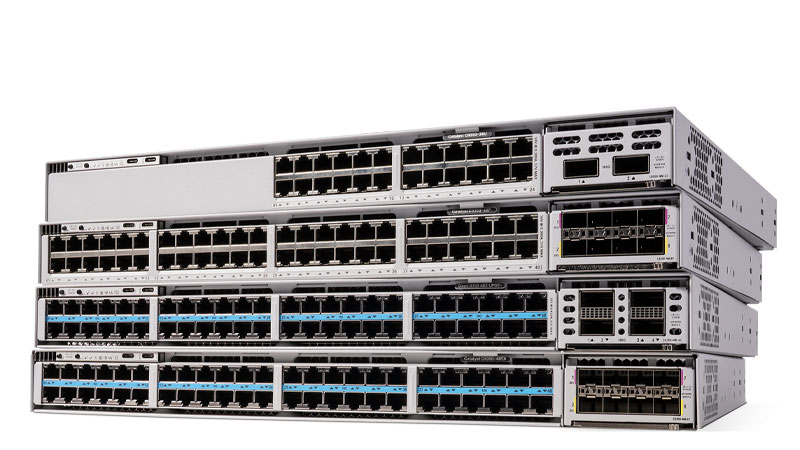
If you still have Catalyst 3850 24-port PoE switches carrying access-layer traffic, the clock has already run out. The WS-C3850-24P-S, the IP Base, 24-port PoE+ member of the 3850 stackable line, passed its Last Day of Support (LDoS) on October 31, 2025. From that date forward Cisco provides no software fixes, no security patches, and no hardware replacement under contract. This guide lays out exactly what each milestone means, why the Catalyst 9300 24-port PoE+ (C9300-24P-A) is the engineered replacement, and how to execute a low-risk refresh.
Where the WS-C3850-24P-S stands today
The 3850 was Cisco's flagship stackable access switch in the mid-2010s, built on the UADP 1.0 ASIC and running IOS-XE on a 4-core CPU. The 24P-S variant pairs 24 ports of 10/100/1000 PoE+ (up to 30W per port, 435W system PoE budget on the standard supply) with StackWise-480 backplane stacking and StackPower for shared power resiliency. The '-S' suffix denotes the IP Base feature set, Layer 3 routing limited to static and RIP plus a subset of EIGRP/OSPF stub, with full dynamic routing requiring an IP Services license. That feature gating is itself a reason to move: the licensing model is a generation behind.
What each milestone date actually means
End of Sale, October 30, 2020
Cisco stopped selling the WS-C3850-24P-S new through normal channels. Any unit acquired after this date is either remaining channel inventory or secondary-market hardware. This is the date that started the support countdown.
End of SW Maintenance, October 30, 2021
Routine maintenance rebuilds of IOS-XE for this platform ended. Past this point you only received severity-critical and security fixes, feature and bug-fix trains were frozen. Your 3850s have effectively been on a static code base for years.
Last Day of Support (LDoS), October 31, 2025
The terminal milestone, now in the past. All Cisco engineering and TAC support, including security patching and hardware RMA, has ceased regardless of any active SmartNet contract. Every WS-C3850-24P-S in production is now operating without a safety net.
The recommended replacement: Catalyst 9300 24-port PoE+ (C9300-24P-A)
Cisco's named successor is the Catalyst 9300 series, and the direct one-for-one for the 24P-S is the C9300-24P-A, 24 ports of 1G PoE+ with the Network Advantage license. It is not a re-badge; it is a generational jump in silicon, stacking, and the operating model.
- ASIC and CPU: The 9300 runs the UADP 2.0/3.0 family with an x86 multi-core CPU and far more memory headroom than the 3850's UADP 1.0. That capacity is what enables on-box analytics, encrypted-traffic visibility, and application telemetry the 3850 cannot run.
- Stacking throughput: StackWise-480 (480 Gbps) on the 3850 is replaced by StackWise-480 / StackWise-1T on the 9300, scaling stack bandwidth and supporting up to 8 members. StackPower carries forward for shared, redundant power across the stack.
- PoE budget: The C9300-24P delivers full 802.3at PoE+ (30W/port) and supports Cisco UPOE on UPOE-capable SKUs; with dual power supplies you get a substantially larger and more flexible PoE budget than the 3850's single-supply baseline, important for dense AP, camera, and IP-phone deployments.
- Uplink flexibility: Modular network modules give you 4x10G, 8x10G, 2x25G, or 2x40G uplink options, versus the more limited 3850 uplink modules, directly relevant if you are also moving the distribution layer to 25G/40G.
- mGig path: While the C9300-24P-A is fixed 1G on the downlinks, the broader 9300 line (e.g., C9300-24UX / -48UX) offers Multigigabit 100M–10G ports. If you are deploying Wi-Fi 6/6E access points that exceed 1G, evaluate an mGig 9300 SKU instead of the straight 24P during design.
The licensing change you must plan for
This is the biggest operational difference. The 3850 used perpetual right-to-use licenses (IP Base / IP Services / LAN Base). The 9300 uses Cisco Smart Licensing with term-based DNA subscriptions layered on a perpetual Network Essentials or Network Advantage base. The '-A' in C9300-24P-A means the switch ships with the Network Advantage tier (full dynamic routing, SD-Access fabric edge, flexible NetFlow, advanced QoS), a superset of the 3850 IP Base/IP Services capability. You pair it with a Cisco DNA Advantage subscription (typically 3, 5, or 7-year terms) and manage entitlements through Smart Software Manager (CSSM) or an on-prem Smart Software Manager satellite for air-gapped/DoD environments. Budget for the subscription renewal as an ongoing line item, it is not a one-time perpetual buy like the 3850 was.
A practical migration plan
1. Assessment and inventory
Pull a real inventory: serial numbers, stack member counts, IOS-XE versions, and uplink module types across every 3850-24P-S. Capture per-switch PoE draw (show power inline) and port utilization so you size the 9300 PoE budget and uplinks correctly rather than guessing. Confirm your distribution-layer optics and fiber so 10G/25G uplink modules are spec'd to match. See the full record on the WS-C3850-24P-S EoL detail page.
2. License transition
Create or confirm your Smart Account and Virtual Account in CSSM before hardware lands. Decide on DNA subscription tier and term, and for classified or disconnected networks stand up an on-prem SSM satellite. Map each 3850 IP Base/IP Services entitlement to the equivalent Network Advantage feature so nothing is lost in cutover.
3. Config and feature parity
IOS-XE to IOS-XE migration is largely syntax-compatible, but do not blind-paste. Re-validate QoS policies (the 9300 QoS model and queue structure differ), SVIs, VLAN/VTP config, port-security, 802.1X/MAB, and any IP Services routing that maps to Network Advantage. Build and test the new config in a lab stack first. If you run StackWise stacks, plan member numbering and priority before the physical swap.
4. Physical: rack, power, PoE, uplinks, optics, stacking
Both are 1RU, so rack footprint is unchanged, but confirm power: the 9300 uses different power-supply SKUs and you will likely want dual supplies for full PoE+ and redundancy. Order StackWise-480/1T cables (they are not interchangeable with 3850 StackWise cables on all configs) and the correct uplink network module plus SFP/SFP+/SFP28 optics. Verify TAA-compliant optics if procuring for federal use.
5. Phased cutover
Migrate one stack/closet at a time during a maintenance window. Stage the 9300 stack, load the validated config, then move uplinks and endpoint patches in batches, verifying PoE-up and endpoint reachability after each. Keep the 3850 powered and patch-ready as instant rollback until the new stack proves out for a full business cycle.
6. Secure decommission
Erase configs and credentials (write erase, delete certs/keys, factory reset). For DoD/federal, follow NIST SP 800-88 media-sanitization guidance and document chain of custody for each serial. Authorized partners can also handle certified destruction or trade-in credit toward the refresh.
Procurement notes for government and enterprise buyers
- TAA compliance: Confirm country-of-origin and TAA status on every C9300-24P-A, power supply, network module, and optic for GSA Schedule, DoD, and SLED contracts.
- GPC / purchase-card friendly: For sub-threshold buys, a single 9300 with optics and a DNA term can be structured for Government Purchase Card payment through an authorized partner.
- Lead times: 9300 lead times fluctuate; place orders early, especially for specific uplink modules and 25G optics, and ask about buffer stock.
- Source from an authorized partner: Buy from a Cisco-authorized partner so warranty, Smart Licensing registration, and DNA entitlements bind correctly to your Smart Account, gray-market 9300s frequently arrive with licensing and warranty problems.
Browse the Catalyst 9300 replacement options in our catalog or review the broader Cisco end-of-life hub to plan adjacent refreshes. When you are ready to scope hardware, optics, and DNA terms for your exact closet count, request a refresh quote and we will build a TAA-compliant bill of materials and migration timeline for your environment.
Frequently asked questions
Is the WS-C3850-24P-S still supported by Cisco?
No. The WS-C3850-24P-S reached Last Day of Support (LDoS) on October 31, 2025. Cisco no longer provides software updates, security patches (PSIRT), TAC support, or hardware RMA for it, regardless of any active SmartNet contract. Running it in production is now an unsupported and audit-flaggable configuration.
What is the direct replacement for the WS-C3850-24P-S?
Cisco's named successor is the Catalyst 9300 24-port PoE+ with Network Advantage, PID C9300-24P-A. It matches the 24-port 1G PoE+ form factor while upgrading the ASIC, CPU, stacking bandwidth, PoE flexibility, and uplink options, and moves you onto the current IOS-XE and Smart Licensing model.
How does licensing change moving from the 3850 to the C9300-24P-A?
The 3850 used perpetual IP Base/IP Services right-to-use licenses. The C9300-24P-A ships with a perpetual Network Advantage base plus a term-based Cisco DNA Advantage subscription managed through Smart Software Manager (CSSM), or an on-prem SSM satellite for air-gapped networks. Network Advantage is a superset of 3850 IP Base/IP Services, but the DNA subscription is a recurring renewal you must budget for.
Will my existing 3850 configuration work on the Catalyst 9300?
Mostly, since both run IOS-XE, but do not blind-paste. QoS structures, uplink modules, and StackWise cabling differ, and IP Services routing must be mapped to Network Advantage. Validate the migrated config in a lab stack, re-check QoS, 802.1X/MAB, SVIs, and routing, before any production cutover.
Can I buy the C9300-24P-A on a Government Purchase Card and is it TAA compliant?
GPC payment is supported: for sub-threshold purchases, an authorized partner can structure a C9300-24P-A with optics and a DNA term for GPC payment. TAA status is per part number and lot, so confirm country-of-origin on the switch, power supplies, network modules, and optics for GSA, DoD, and SLED requirements, and buy through an authorized partner so Smart Licensing and warranty register correctly to your Smart Account.
Uniqcli Team
The Uniqcli Team is an authorized Cisco partner specializing in Catalyst wireless, switching, datacenter fabric, licensing, and managed services for U.S. federal, state, local, and education customers. We scope Cisco bills of materials, validate procurement paths (TAA, FIPS, contract vehicles), and deliver design, deployment, and managed operations.
Ready to scope your Cisco build?
Build a quoteRelated reading
View all →GuidesWS-C3750X-12S-S End of Life: Catalyst 3850 12S Migration
The Catalyst 3750-X 12-port SFP (WS-C3750X-12S-S) is years past last day of support, here is how to migrate cleanly to the Catalyst 3850 12S and what changes in licensing, stacking, and security.
November 7, 2025 · 8 min readGuidesWS-C3850-12X48U-S Replacement: Catalyst 9300 Migration
A practical, partner-built guide to retiring the EoL Catalyst 3850 mGig UPOE switch (WS-C3850-12X48U-S) and refreshing to the Catalyst 9300-48UXM with Network Advantage.
November 16, 2025 · 8 min readGuidesCisco WS-C3850-48P-S EoL: Migrate to Catalyst 9300 (C9300-48P-A)
The Catalyst 3850 48-port PoE IP Base reached last day of support on October 31, 2025, here is a concrete plan to refresh to the Catalyst 9300 C9300-48P-A.
November 14, 2025 · 8 min read Guides
WS-C3750V2-48PS-S to Catalyst 9300 Migration Guide
The Catalyst 3750V2-48PS-S hit Last Day of Support in 2021. Here is a practical, architect-level plan to refresh it to the stackable Catalyst 9300 (C9300-48P-A) with no security, compliance, or operational gaps.
May 14, 2026 · 6 min readGuidesWS-C3750X-24P-S Replacement: Migrate to Catalyst 3850
A practical refresh guide for the end-of-life Catalyst 3750-X 24-port PoE switch, with a concrete migration path to the WS-C3850-24P-S successor.
November 9, 2025 · 7 min readGuidesWS-C3750X-48P-S End of Life: Migration to Catalyst 3850
A practical refresh guide for replacing the fully end-of-support Cisco Catalyst 3750-X 48-port PoE switch (WS-C3750X-48P-S) with the Catalyst 3850, including specs, licensing, and a phased cutover plan.
November 11, 2025 · 7 min read