
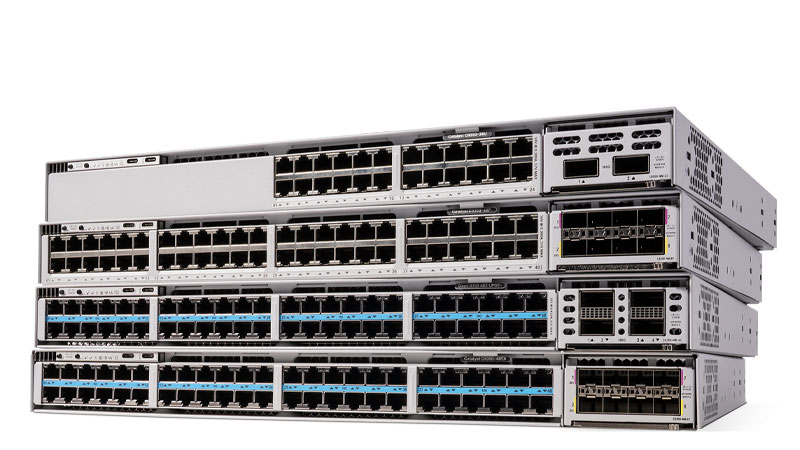
If you still have a Cisco Catalyst 3750-X 24-port PoE switch (PID WS-C3750X-24P-S) carrying production traffic, it is running well past every Cisco support boundary. End-of-Sale was October 30, 2016; software maintenance ended October 30, 2017; and the Last Date of Support (LDoS) passed on October 31, 2021. That last date is the one that matters most: as of today the platform has had no security patches for years and is entirely outside Cisco's TAC and RMA umbrella. This guide explains what those milestones mean operationally and lays out a concrete, low-risk migration to the named successor, the Catalyst 3850 24-port PoE IP Base (WS-C3850-24P-S).
Why a 3750-X past LDoS is a liability, not just an old switch
A switch that still forwards packets can feel like a switch that is still fine. It is not. After LDoS, Cisco's PSIRT no longer issues fixed software for the 3750-X, so any new vulnerability disclosed in its IOS train, including ones that affect the broader IOS code base, will never be patched on this hardware. There is no engineering escalation path through TAC and no advance hardware replacement, so a failed power supply or a dead supervisor becomes a scavenge-the-spares-shelf problem rather than a next-business-day RMA.
What each milestone date actually means
- End-of-Sale (2016-10-30): Cisco stopped selling the WS-C3750X-24P-S new. Any unit acquired after this is used, refurbished, or gray-market. The lifecycle clock started here.
- End of SW Maintenance (2017-10-30): the last date Cisco released maintenance and bug-fix software. After this, only severe security fixes were considered, and only until LDoS.
- Last Date of Support (2021-10-31): the hard stop. No TAC, no RMA, no PSIRT fixes, regardless of any SmartNet contract you may still be paying for. Support contracts cannot be renewed past this date.
The replacement: WS-C3850-24P-S and what it buys you
Cisco's own bulletin named the Catalyst 3850 24-port (WS-C3850-24P-S) as the direct successor, and it is a meaningful generational jump rather than a sidegrade. Both switches present the same physical edge: 24 ports of 10/100/1000 with 802.3at PoE+ at up to 30W per port. What changes is everything behind the ports.
- Stacking bandwidth: StackWise Plus on the 3750-X is a 32 Gbps ring. The 3850 uses StackWise-480, a 480 Gbps backplane, a 15x increase that removes the stack interconnect as a bottleneck and supports up to nine members.
- Operating system: the 3750-X runs classic IOS; the 3850 runs IOS-XE, a Linux-based, modular OS with patchability, model-driven telemetry (NETCONF/YANG), and a clean path toward programmability and ISSU-style updates.
- Wired-plus-wireless convergence: the 3850 has an integrated wireless LAN controller that can terminate up to 50 access points and 2000 clients directly on the switch, something the 3750-X simply cannot do.
- Uplinks: the 3850 network modules add 10G SFP+ and 40G QSFP+ options, versus the 3750-X's C3KX-NM ceiling of 2x10G, giving you real headroom for aggregation.
- PoE headroom: the 3850-24P delivers a 435W PoE+ budget on one supply, expandable with a second power supply, comfortably covering a modern edge of Wi-Fi 6 APs, IP phones, and cameras.
The licensing shift you must plan for
The 3750-X used the old per-image IP Base / IP Services model with right-to-use licensing baked into the software train. The 3850 moves to the IOS-XE world: IP Base and IP Services as on-box licenses, and later releases adopting Cisco Smart Licensing and the Cisco DNA subscription tiers. The practical implication is that you no longer treat the license as a static attribute of the box. You will register the 3850 to a Smart Account (or a Smart Software Manager On-Prem satellite for air-gapped environments), and DNA Essentials or Advantage entitlements ride alongside the hardware. Build the Smart Account and entitlement mapping into the project up front so switches do not land in a non-compliant licensing state on day one.
A practical migration plan
1. Assess and inventory
Catalog every 3750-X stack: member count, IP Base vs IP Services, uplink module type, PoE draw, and the running config size. Pull show version, show inventory, and show power inline from each stack so you size the 3850 supplies and uplinks correctly. Use our Cisco EoL hub to cross-check any co-located gear that is also aging out, since refreshing the access layer is the natural moment to retire end-of-life uplinks and aggregation switches in the same window.
2. Establish licensing and config parity
Stand up the Smart Account and map each 3750-X feature set to the equivalent 3850 license tier (IP Base to Network Essentials-class, IP Services to Advantage-class for routing-heavy stacks). Then translate the configuration: most IOS CLI carries directly to IOS-XE, but validate the differences, including interface naming under the new platform, the QoS model (the 3850 uses MQC throughout), and any embedded event manager or netflow that needs reworking. Build the target config in a lab or on a single 3850 before touching production.
3. Plan the physical layer
Both are 1RU, but the cabling and power are not drop-in. The 3750-X's StackWise Plus cables and StackPower cables do not fit the 3850; you will use StackWise-480 and the 3850's own redundant power supplies. Confirm rack PDU capacity for the higher PoE budget, reuse compatible 1G/10G optics where the compatibility matrix allows, and order the correct 3850 network module for your uplinks rather than assuming the old C3KX-NM transfers.
4. Phased cutover and secure decommission
Migrate one closet or stack at a time during a maintenance window. Pre-stage the 3850 with the validated config, move uplinks first to verify the upstream path, then shift access ports in batches, watching PoE negotiation and spanning-tree convergence as you go. Keep the old stack powered but isolated until the new one is proven, then decommission it securely: wipe the configuration and VLAN database, remove from monitoring and the asset register, and dispose through a process that meets NIST SP 800-88 media-sanitization requirements for any unit that held sensitive config or keys.
Procurement notes for government and enterprise buyers
Source the replacement from an authorized partner so you get TAA-compliant, traceable hardware with valid Cisco licensing rather than gray-market stock that can fail an audit or arrive unlicensed. As an authorized Cisco partner, uniqcli supplies TAA-compliant 3850 (and current-generation Catalyst 9300) units and accepts the Government Purchase Card (GPC) for in-threshold orders. Note that the 3850 itself is now end-of-sale with an LDoS of October 30, 2025, so for new purchases we will also quote the Catalyst 9300 successor so you can weigh budget against lifecycle. Lead times on refresh hardware move with demand, so it is worth locking quantities early.
You can review the full lifecycle detail for this exact unit on our WS-C3750X-24P-S end-of-life page, browse the replacement in our catalog, and when you are ready to scope the refresh, get a quote and we will size the 3850 or 9300 path, licensing, optics, and cutover plan for your environment.
Frequently asked questions
Is the Cisco WS-C3750X-24P-S still supported?
No. The Catalyst 3750-X 24-port PoE IP Base reached its Last Date of Support (LDoS) on October 31, 2021. After that date Cisco provides no TAC engineering, no RMA hardware replacement, and no PSIRT security fixes, even if the unit is covered by a SmartNet contract. Software maintenance ended even earlier, on October 30, 2017. Any 3750-X in production today is running unsupported code with no path to remediation.
Can I stack a WS-C3750X-24P-S with a WS-C3850-24P-S?
No. The 3750-X uses StackWise Plus (a 32 Gbps ring) and the 3850 uses StackWise-480 (480 Gbps); the stack cables, connectors, and protocols are not interoperable. The two platforms also run different operating systems (IOS on the 3750-X, IOS-XE on the 3850), so they cannot form a mixed stack or share a single control plane. Plan to retire each 3750-X stack as a complete unit rather than mixing generations.
Will my 3750-X uplink modules and SFPs move to the 3850?
The C3KX-NM network modules from the 3750-X do not fit the 3850, which uses its own network-module family with 1G, 10G SFP+, and 40G QSFP+ options. Most standard Cisco 1G SFP and 10G SFP+ optics carry forward, but validate each part number against the 3850 compatibility matrix before reuse. The C3KX-PWR power supplies and the RPS 2300 redundant power system are also not compatible with the 3850's internal redundant supply design.
What is the difference in PoE budget between the two switches?
Both the WS-C3750X-24P-S and the WS-C3850-24P-S deliver 802.3at PoE+ at up to 30W per port across all 24 ports. The 3850-24P ships with a 435W PoE budget on a single supply, expandable to roughly 1100W with a second power supply, comfortably powering a full edge of phones, APs, and cameras. If you need 60W UPOE per port, step up to the WS-C3850-24U instead of the -24P.
Should I buy the 3850 or skip straight to the Catalyst 9300?
The 3850 is itself now end-of-sale (LDoS October 30, 2025), so for a brand-new purchase the Catalyst 9300 (for example C9300-24P) is the current-generation, fully supported successor and the better long-term buy. The 3850 remains a valid like-for-like replacement when matching an existing 3850 estate or sourcing certified-refurbished TAA stock on a tight budget. We will quote both paths so you can weigh lifecycle against cost.
Uniqcli Team
The Uniqcli Team is an authorized Cisco partner specializing in Catalyst wireless, switching, datacenter fabric, licensing, and managed services for U.S. federal, state, local, and education customers. We scope Cisco bills of materials, validate procurement paths (TAA, FIPS, contract vehicles), and deliver design, deployment, and managed operations.
Ready to scope your Cisco build?
Build a quoteRelated reading
View all →GuidesWS-C3750X-48P-S End of Life: Migration to Catalyst 3850
A practical refresh guide for replacing the fully end-of-support Cisco Catalyst 3750-X 48-port PoE switch (WS-C3750X-48P-S) with the Catalyst 3850, including specs, licensing, and a phased cutover plan.
November 11, 2025 · 7 min readGuidesWS-C3750X-12S-S End of Life: Catalyst 3850 12S Migration
The Catalyst 3750-X 12-port SFP (WS-C3750X-12S-S) is years past last day of support, here is how to migrate cleanly to the Catalyst 3850 12S and what changes in licensing, stacking, and security.
November 7, 2025 · 8 min readGuidesWS-C2960X-24PS-L EoL: Migrate to Catalyst 9200L Guide
A practical, partner-built plan for replacing the end-of-sale Catalyst 2960-X 24-port PoE switch (WS-C2960X-24PS-L) with the Catalyst 9200L-24P-4G before the October 2027 last day of support.
October 20, 2025 · 7 min readGuidesCisco WS-C3850-24P-S Migration Guide: Upgrade to C9300-24P-A
The Catalyst 3850 24-Port PoE IP Base (WS-C3850-24P-S) reached Last Day of Support on October 31, 2025, here is how to plan a clean refresh to the Catalyst 9300 24-port PoE+ (C9300-24P-A).
November 13, 2025 · 7 min read Guides
Cisco 2960-48TC-L EoL: Migrate to Catalyst 9200L 48-Port
The Catalyst 2960-48TC-L (WS-C2960-48TC-L) passed Last Day of Support on October 31, 2019. Here is why this Fast Ethernet LAN Base switch has to come out of the wiring closet, and how to refresh cleanly to the Catalyst 9200L 48-port C9200L-48T-4X-A.
June 9, 2026 · 8 min readGuidesCisco MS220-24P End-of-Life: Migrate to MS225-24P Guide
The Meraki MS220-24P hit Last Date of Support on July 29, 2024. Here is what each milestone means, why the stackable MS225-24P is the right refresh, and a practical migration plan for federal, healthcare, and enterprise wiring closets.
January 1, 2026 · 8 min read