
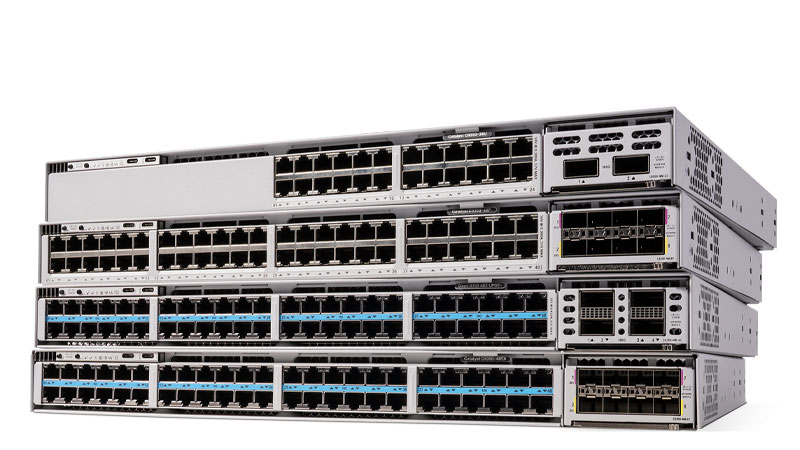
If you still have Cisco Catalyst 3750-X 12-port GE SFP switches (PID WS-C3750X-12S-S) aggregating fiber in a wiring closet or distribution rack, you are now running infrastructure that Cisco no longer supports in any form. This is the all-fiber member of the 3750-X family: twelve SFP ports for 1G fiber uplinks and aggregation, FlexStack-Plus stacking, a 715W/1100W modular power supply bay, and the IP Base feature set running classic IOS 15.x. It was a workhorse for fiber risers and small distribution layers. It is also fully past its support lifecycle, and the gap between "still powered on" and "still defensible" is exactly what this guide is about.
Where WS-C3750X-12S-S sits in its lifecycle
Cisco published the end-of-life milestones for this PID years ago, and every one of them is now behind us. Understanding what each date actually changes in operational terms matters more than the calendar itself.
- End of Sale: October 30, 2016, Cisco stopped selling the switch new. Anything you buy now is secondary-market or new-old-stock, with no factory warranty path.
- End of Software Maintenance: October 30, 2017, the last day Cisco released maintenance and bug-fix IOS images for the platform. Whatever 15.2 image you are running is, functionally, the final one you will ever get.
- Last Day of Support (LDoS): October 31, 2021, the hard stop. After this date there are no Cisco-delivered software fixes of any kind, including security fixes, and no TAC support or RMA hardware replacement, even with an active contract.
Why acting now actually matters
The most concrete exposure is security. Cisco's PSIRT continues to disclose vulnerabilities affecting IOS and IOS-based Catalyst platforms, and a switch frozen on a 2017 image accumulates unpatched CVEs with each disclosure cycle. There is no "first fixed release" to upgrade to, the fix train ended. For a distribution or aggregation switch that often sits in the path of management traffic, voice VLANs, and inter-VLAN routing, an unpatchable control plane is not a theoretical concern.
The second exposure is operational. With no RMA, a failed power supply or a dead unit in a FlexStack stack becomes an outage you resolve by scavenging spares off eBay. The third is compliance. Federal and DoD environments under RMF/STIG, healthcare under HIPAA, and SLED under state frameworks all expect supported, patchable hardware. An auditor who finds a switch four-plus years past LDoS will flag it, and "the vendor no longer supports it" is the finding, not the defense. If this is on your books, start with the WS-C3750X-12S-S end-of-life detail page and the broader Cisco EoL hub to map your full exposure.
The recommended replacement: Catalyst 3850 12-port SFP (WS-C3850-12S-S)
Cisco's own migration bulletin mapped the 3750-X 12S directly to the Catalyst 3850 12-port GE SFP IP Base, PID WS-C3850-12S-S, the like-for-like fiber aggregation successor. It preserves the form factor you know (twelve 1G SFP ports, IP Base licensing) while moving you onto a fundamentally stronger platform.
What concretely improves
- Operating system: the 3850 runs IOS-XE, not classic IOS. That means a Linux-based control plane, true ISSU on a stack, patch-style updates, model-driven telemetry, and a far more modern programmability story (NETCONF/RESTCONF, guest shell).
- Stacking and bandwidth: StackWise-480 replaces FlexStack-Plus, jumping from 40 Gbps of stack bandwidth on the 3750-X FlexStack to 480 Gbps on the 3850, a 12x increase, with up to nine members and StackPower for shared, redundant power across the stack.
- Switching capacity: the 3850 fixed platforms carry a substantially larger switching fabric and higher forwarding rate than the 3750-X, with deeper buffers and a unified access data plane (the same ASIC family used to terminate wireless CAPWAP traditionally).
- Uplink flexibility: the 3850 supports a modular network module slot for 1G/10G/40G uplinks, so the same chassis that aggregates 1G fiber today can carry 10G or 40G uplinks tomorrow, a path the fixed 3750-X simply did not have.
A note on the current shipping equivalent
Be aware that the 3850 itself has since gone end-of-sale. If you are buying new today rather than sourcing a 3850 from inventory, the current-generation fiber aggregation equivalent is the SFP-based Catalyst 9300 (for example the 9300-24S/48S families) running IOS-XE 17.x with DNA/Cisco Networking subscription licensing, mGig and UPOE+ options on the copper variants, and StackWise-1T. For a pure 1G-fiber aggregation refresh the 3850-12S is the closest one-to-one swap; for a longer capital horizon, the Catalyst 9300 is worth pricing in the same conversation. You can compare both against your current footprint in the catalog.
A practical migration plan
1. Assess and inventory
Pull show version, show inventory, and show running-config from every 3750-X 12S in scope. Record stack membership and FlexStack cabling, the exact SFP types in each port (1000BASE-SX/LX/ZX, BX, or 1G copper SFP), power supply ratings, and uplink topology. Note any features in use: routed SVIs, EtherChannel, OSPF/EIGRP stubs, QoS policies, ACLs, and 802.1X. This inventory is the source of truth for both the new BOM and the parity check.
2. Transition licensing
Confirm IP Base feature parity is sufficient (it is, for the 12S role) and provision the equivalent entitlement in your Smart Account. On the 3850, IP Base covers the static and basic dynamic routing you likely run on the 3750-X; only step up to IP Services if you need full routing scale or advanced features. Register the new switches to Smart Licensing during staging, not at cutover.
3. Establish config and feature parity
Do not paste IOS 15.x config blindly into IOS-XE. Most interface, VLAN, and routing syntax carries over, but rebuild and verify: QoS (IOS-XE uses MQC consistently), SPAN, control-plane policing, and any legacy macro/auto-smartport constructs. Validate licensing-gated features boot correctly. Stage the full config on the bench and diff behavior before it goes near production.
4. Handle the physical layer
- Optics: 1G SFPs are reusable in the 3850 SFP ports, so plan to migrate your existing transceivers, but verify each is on the 3850 compatibility matrix and budget replacements for anything marginal or Cisco-coded for the old platform.
- Power: the 3850-12S draws from the same modular PSU concept; confirm circuit and PDU capacity, and if you adopt StackPower, cable the power stack ring deliberately.
- Stacking: FlexStack-Plus cables are not StackWise-480 cables. Order the correct StackWise-480 stacking cables and adapters, this is the single most-forgotten line item in a 3750-X to 3850 refresh.
- Rack/uplinks: the 3850-12S is 1RU like the 3750-X 12S, so rack space is a wash; if you populate a 10G/40G network module, plan the uplink optics and fiber to your core accordingly.
5. Phased cutover
Migrate stack-by-stack or closet-by-closet during a maintenance window, never the whole site at once. Pre-stage the 3850 stack fully configured, move uplinks first to validate L3 reachability, then cut access/aggregation ports in batches with rollback cabling staged. Confirm routing adjacencies, spanning-tree topology, and license status come up clean before declaring the window successful.
6. Secure decommission
Once a 3750-X is out of production, wipe it before it leaves your custody. Erase the startup-config and any stored credentials, clear the VLAN database, and for federal/DoD assets follow your sanitization standard (NIST 800-88) and document the disposition. A retired switch with intact config is a credential and topology leak waiting to happen.
Procurement notes for government and enterprise buyers
For TAA-covered contracts, confirm country-of-origin compliance on the replacement hardware and optics before you order, an authorized partner can attest to this in writing, a marketplace reseller generally cannot. GPC/purchase-card thresholds and SEWP/contract-vehicle eligibility should be confirmed up front so the order does not stall in approval. Lead times on Catalyst switching, optics, and stacking cables fluctuate, so quote the full BOM, chassis, PSUs, SFPs, StackWise cables, and the support contract, as one package rather than discovering the cable shortage mid-deployment. Sourcing from an authorized Cisco partner also keeps your warranty and Smart Licensing registration clean, which matters when the whole point of this refresh is getting back onto a supported, patchable footing.
The WS-C3750X-12S-S did its job for a decade. Continuing to run it now trades a known capital cost for an open-ended security, availability, and audit liability. Ready to scope the swap? Start your refresh quote and we will build the migration BOM around your exact fiber footprint.
Frequently asked questions
Is the Cisco WS-C3750X-12S-S still supported?
No. The Catalyst 3750-X 12-port SFP reached Last Day of Support on October 31, 2021. Since then there are no Cisco security patches, no TAC support, and no RMA hardware replacement, even on an active contract. Software maintenance actually ended earlier, on October 30, 2017, so the platform has been frozen on its final IOS 15.x image for years.
What is the direct replacement for the WS-C3750X-12S-S?
Cisco's migration bulletin maps it to the Catalyst 3850 12-port GE SFP IP Base, PID WS-C3850-12S-S, the like-for-like fiber aggregation successor with twelve 1G SFP ports and IP Base licensing. Because the 3850 has itself gone end-of-sale, buyers purchasing new today should also evaluate the SFP-based Catalyst 9300, the current shipping equivalent.
Can I reuse my existing 1G SFP transceivers and stacking cables on the 3850?
Your 1G SFP optics are generally reusable in the 3850 SFP ports once verified against its compatibility matrix. The stacking cables are not. The 3750-X uses FlexStack-Plus while the 3850 uses StackWise-480, which requires different cables and adapters, order these explicitly, as they are the most commonly missed line item in this refresh.
How does licensing change moving from the 3750-X to the 3850?
The 3750-X used permanent on-box right-to-use IP Base/IP Services licenses. The 3850 runs IOS-XE and moved to Smart Licensing, where your IP Base entitlement lives in a Cisco Smart Account rather than on the device. Set up or confirm your Smart Account and register the entitlement during staging so the switch is compliant from first boot.
What is the biggest technical upgrade from the 3750-X 12S to the 3850 12S?
Besides moving from classic IOS to IOS-XE, the headline jump is stacking bandwidth: StackWise-480 delivers 480 Gbps versus the 40 Gbps of FlexStack-Plus on the 3750-X, roughly a 12x increase, plus StackPower for shared redundant power, deeper buffers, a larger switching fabric, and a modular uplink slot supporting 10G/40G.
Uniqcli Team
The Uniqcli Team is an authorized Cisco partner specializing in Catalyst wireless, switching, datacenter fabric, licensing, and managed services for U.S. federal, state, local, and education customers. We scope Cisco bills of materials, validate procurement paths (TAA, FIPS, contract vehicles), and deliver design, deployment, and managed operations.
Ready to scope your Cisco build?
Build a quoteRelated reading
View all →GuidesCisco WS-C3850-24P-S Migration Guide: Upgrade to C9300-24P-A
The Catalyst 3850 24-Port PoE IP Base (WS-C3850-24P-S) reached Last Day of Support on October 31, 2025, here is how to plan a clean refresh to the Catalyst 9300 24-port PoE+ (C9300-24P-A).
November 13, 2025 · 7 min readGuidesWS-C3750X-48P-S End of Life: Migration to Catalyst 3850
A practical refresh guide for replacing the fully end-of-support Cisco Catalyst 3750-X 48-port PoE switch (WS-C3750X-48P-S) with the Catalyst 3850, including specs, licensing, and a phased cutover plan.
November 11, 2025 · 7 min readGuidesWS-C3750X-24P-S Replacement: Migrate to Catalyst 3850
A practical refresh guide for the end-of-life Catalyst 3750-X 24-port PoE switch, with a concrete migration path to the WS-C3850-24P-S successor.
November 9, 2025 · 7 min readGuidesWS-C3850-12X48U-S Replacement: Catalyst 9300 Migration
A practical, partner-built guide to retiring the EoL Catalyst 3850 mGig UPOE switch (WS-C3850-12X48U-S) and refreshing to the Catalyst 9300-48UXM with Network Advantage.
November 16, 2025 · 8 min readGuidesCisco WS-C3850-48P-S EoL: Migrate to Catalyst 9300 (C9300-48P-A)
The Catalyst 3850 48-port PoE IP Base reached last day of support on October 31, 2025, here is a concrete plan to refresh to the Catalyst 9300 C9300-48P-A.
November 14, 2025 · 8 min read Guides
WS-C3750V2-48PS-S to Catalyst 9300 Migration Guide
The Catalyst 3750V2-48PS-S hit Last Day of Support in 2021. Here is a practical, architect-level plan to refresh it to the stackable Catalyst 9300 (C9300-48P-A) with no security, compliance, or operational gaps.
May 14, 2026 · 6 min read