
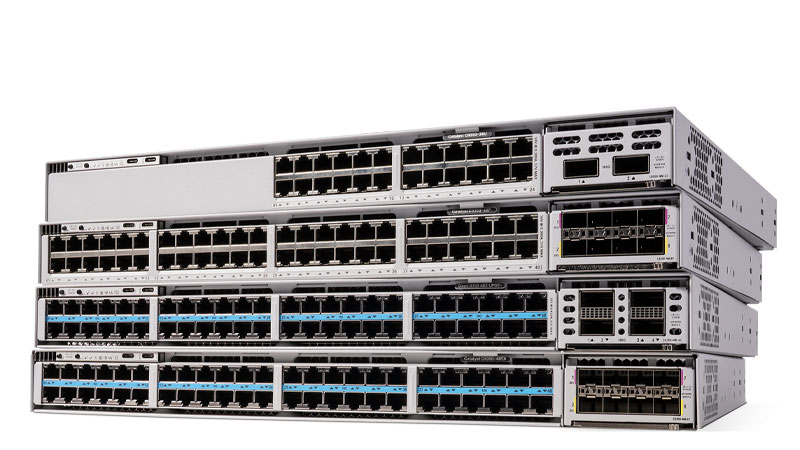
If you have Cisco Catalyst 3560-CX 12-port PoE switches (PID WS-C3560CX-12PC-S) humming away behind displays, under desks, or in conference rooms, the clock on them has already started ticking. Cisco's end-of-life bulletin (EOL15072) moved this model into its sunset phase, and one of the most important milestones is already behind us. This guide explains exactly what each date means, why the recommended Catalyst 9000 Compact replacement is genuinely better for this deployment type rather than just newer, and how to run a clean migration that holds up in a federal or healthcare audit.
Where the WS-C3560CX-12PC-S stands today
The 3560-CX 12-port is a fanless, IP Base compact switch built for the network edge: 12 ports of Gigabit Ethernet with PoE+ (a roughly 124W PoE budget), two 1G SFP uplinks plus two 1G copper uplinks, silent operation, and a shallow chassis that fits where a normal access switch cannot. It runs classic IOS with a perpetual IP Base feature license, basic Layer 3 (static routing and RIP), QoS, and ACLs, but not the full routing stack. For a decade it was the default answer for 'I need a few PoE ports somewhere quiet and out of the way.' Cisco's published successor for that exact role is the Catalyst 9000 Compact, specifically the C9200CX-12P-2X2G-A.
What each milestone means in practice
End of Sale simply closed the new-purchase channel; secondary-market and authorized-partner stock can still exist, but you are buying a discontinued platform. The milestone that should worry you most is End of Software Maintenance, which passed in April 2025. From that point forward the IOS image on your switch is frozen, and any vulnerability Cisco PSIRT discloses against this platform will never receive a patch. You can monitor those disclosures, but for the 3560-CX the only remediation is replacement, because no fix is coming. Last Day of Support in April 2029 is the hard wall: after it, Cisco TAC will not open a case and will not RMA a dead unit, so a hardware failure means scavenging the used market for a part that is itself unsupported.
Why the Catalyst 9200CX Compact is the right replacement
The C9200CX-12P-2X2G-A is not a generic 'newer switch'. It is engineered for the same fanless edge niche the 3560-CX occupied, with meaningful upgrades on every axis that matters for that role.
- PoE budget roughly doubles: about 240W on the 9200CX versus ~124W on the 3560-CX, so the same 12 ports can now power higher-draw 802.3at devices such as multiple PTZ cameras, Wi-Fi 6/6E access points, or video bars without starving the budget.
- Uplinks jump from 1G to 10G: the 2X2G/2X10G uplink set provides two 10G SFP+ ports plus two 1G ports, giving the edge a real 10-Gigabit path back to the distribution layer instead of the 3560-CX's 1G ceiling.
- Modern silicon and IOS-XE: the 9200CX runs IOS-XE with a multicore CPU, programmable APIs (NETCONF/RESTCONF, YANG), patchable software, and model-driven telemetry, none of which the classic-IOS 3560-CX supports.
- Hardware security: line-rate MACsec-256 encryption and Cisco Trustworthy hardware (secure boot, runtime defenses) replace the 3560-CX's far more limited crypto, which matters for DoD and zero-trust segmentation.
- SD-Access ready: the 9200CX can participate in Cisco SD-Access fabric and be managed centrally from Catalyst Center, where the 3560-CX cannot.
The two things that change for you
Be deliberate about two differences. First, licensing: the 3560-CX's perpetual IP Base does not carry over. The 9200CX uses Cisco Smart Licensing, and this SKU ships at the Network Advantage tier, delivered as a term subscription (3/5/7-year) managed in a Smart Account. Budget for that subscription as a line item, not an afterthought. Second, power: a fully loaded 240W PoE switch draws more from the wall than the old unit, so confirm the circuit and UPS behind each location can carry it. Like the 3560-CX, the 9200CX Compact is standalone and does not stack; if you actually need stacking, step up to a full Catalyst 9200/9300 instead.
A practical migration plan
1. Inventory and assess
Pull an accurate count of every WS-C3560CX-12PC-S in service, where each one lives, and what it powers. The compact form factor means these switches hide in odd places, so capture the physical mounting (desk, wall, behind-display bracket), the uplink type in use, and the PoE load per device. The product's EoL detail page is a useful anchor for the milestone dates when you build the business case.
2. Plan the license transition
Stand up or confirm a Cisco Smart Account and Virtual Account before hardware arrives. Decide on subscription term length and size it to comfortably outlast the 2029 LDoS so you are not re-licensing during the same window everyone else is refreshing. If you are heading toward Catalyst Center management, factor that into the tier and term now.
3. Establish config and feature parity
Most IP Base configurations (VLANs, access ports, voice VLAN, basic QoS, ACLs, DHCP snooping, static routes) port cleanly to IOS-XE, but the syntax and some defaults differ, so do not blind-paste a classic-IOS config. Build a tested IOS-XE template per site profile, validate it on one unit, then standardize. Take advantage of the move to enable MACsec or telemetry where it strengthens your security posture.
4. Handle the physical layer
Confirm power and PoE headroom at each location for the higher 240W budget. The uplink change is the big one: the 9200CX wants 10G SFP+ optics where the 3560-CX used 1G, so order TAA-compliant optics that match both ends of the link, and verify the distribution switch has the matching 10G ports. Reuse mounting hardware where the bracket pattern matches, but verify before assuming.
5. Phased cutover and secure decommission
Cut over site-by-site or closet-by-closet during maintenance windows, validating PoE, uplink negotiation, and end-device reachability at each step rather than flash-cutting the whole fleet. When a 3560-CX comes out of service, wipe the configuration (it contains VLAN topology, SNMP strings, and credentials), record the serial for asset disposition, and route the hardware through a sanitized, documented disposal path. For government and healthcare environments that chain of custody is part of the audit trail, not an optional nicety.
Procurement notes for government and enterprise buyers
For US federal, DoD, and SLED buyers, source the C9200CX through an authorized Cisco partner to guarantee TAA compliance and a clean provenance trail, because gray-market compact switches are a common counterfeit target precisely because they are small and high-volume. Government Purchase Card (GPC) orders are supported for in-threshold quantities, and consolidating a multi-site refresh into a single quote keeps pricing and lead times predictable. Order optics and subscriptions alongside the hardware so nothing arrives half-provisioned, and place orders well ahead of the 2029 LDoS, when demand and lead times tighten.
As an authorized Cisco partner, uniqcli can validate your 3560-CX inventory, size the right C9200CX configuration and subscription term, and ship TAA-compliant units with matching optics. Browse the replacement in our catalog, review this model's EoL detail page, or see the full end-of-life hub for other platforms in your fleet. When you are ready, get a refresh quote and we will turn your switch count into a costed migration plan.
Frequently asked questions
When does the WS-C3560CX-12PC-S actually stop working?
It does not stop working on any date; these are support milestones, not kill switches. End of Sale was April 30, 2024, and End of Software Maintenance was April 30, 2025, so the IOS image you have today is the last one it will ever receive. The Last Day of Support is April 30, 2029. After that date there are no more PSIRT security fixes, no TAC cases, and no RMA hardware replacement, so a failed unit becomes a used-market scavenger hunt and an open vulnerability becomes permanent. The switch will keep forwarding packets; the risk is operational and compliance-related, not a sudden outage.
Is the C9200CX-12P-2X2G-A a true drop-in replacement for the 3560-CX 12-port?
Functionally yes, and in most respects it is an upgrade. Both are fanless 12-port GbE PoE+ compact switches sized for desks, conference rooms, and back-of-display mounts. The 9200CX roughly doubles the PoE budget (about 240W versus 124W), moves uplinks from 1G to dual 10G SFP+ plus dual 1G, and runs IOS-XE instead of classic IOS. The two physical differences to plan for are the higher power draw at the wall when PoE is loaded and the move from perpetual IP Base licensing to a Network Advantage subscription tied to Smart Licensing.
What happens to my IP Base license, do I owe Cisco money I did not before?
The perpetual IP Base feature set on the 3560-CX does not transfer; the 9200CX uses subscription licensing. The C9200CX-12P-2X2G-A as ordered is the Network Advantage tier, which is delivered through Cisco Smart Licensing and managed in a Smart Account. Plan for term-based DNA/Catalyst Center subscriptions (typically 3, 5, or 7 years) rather than a one-time purchase. Budget for this up front, as it is the single most common surprise in a 3560-CX refresh, and the term length should be sized to cover you through at least the 2029 LDoS horizon and beyond.
Can I stack the C9200CX like other Catalyst 9200 switches?
No. The 9200CX Compact models are standalone fanless switches with no StackWise-160/StackPower connectors, the same as the 3560-CX, which also did not stack. If you need true stacking for a wiring closet, the right target is a full-depth Catalyst 9200 or 9300, not the Compact. The CX line is purpose-built for the same role the 3560-CX filled: a single quiet switch at the edge, behind a display, or under a desk where a fanless small footprint matters more than stacking.
Why move now when support technically lasts until 2029?
Three reasons. First, software maintenance already ended in April 2025, so any vulnerability disclosed today on this platform will never be patched, and you are accumulating permanent risk every Patch Tuesday. Second, federal, DoD, and healthcare auditors increasingly flag unsupported network gear in STIG, FISMA, and HIPAA security reviews, and a switch past End of SW Maintenance is hard to defend in an audit. Third, lead times and pricing are better the further you are from the 2029 cliff, when demand spikes and TAA-compliant inventory tightens. Refreshing on your schedule is cheaper and calmer than refreshing on Cisco's deadline.
Uniqcli Team
The Uniqcli Team is an authorized Cisco partner specializing in Catalyst wireless, switching, datacenter fabric, licensing, and managed services for U.S. federal, state, local, and education customers. We scope Cisco bills of materials, validate procurement paths (TAA, FIPS, contract vehicles), and deliver design, deployment, and managed operations.
Ready to scope your Cisco build?
Build a quoteRelated reading
View all →GuidesWS-C3560CX-8PC-S Replacement & Migration to Catalyst 9000
The Catalyst 3560-CX 8-port PoE (WS-C3560CX-8PC-S) is End-of-Sale, here is how to migrate to the Catalyst 9000 Compact C9200CX-8P-2X2G-A before support ends.
October 29, 2025 · 7 min read Guides
Cisco 2960-24TC-L EoL: Migrate to Catalyst 9200L Guide
The original Catalyst 2960-24TC-L (WS-C2960-24TC-L) passed Last Day of Support on October 31, 2019. Here's why this Fast Ethernet LAN Base switch must come out, and how to refresh cleanly to the Gigabit, PoE+ Catalyst 9200L-24P-4X.
June 7, 2026 · 7 min readGuidesWS-C2960XR-48FPD-I End of Life: Migrate to Catalyst 9200
The Catalyst 2960-XR 48-port PoE+ switch is past end of sale with support ending October 31, 2027; here is a concrete plan to refresh it to the Catalyst 9200 C9200-48P.
October 25, 2025 · 8 min readGuidesWS-C2960XR-24PD-I EoL: Migrate to Catalyst 9200 (C9200-24P)
A senior architect's guide to migrating the end-of-life Cisco Catalyst 2960-XR 24-port PoE switch (WS-C2960XR-24PD-I) to the recommended Catalyst 9200 24-port PoE+ (C9200-24P).
October 24, 2025 · 8 min readGuidesCisco Catalyst 3560V2 (WS-C3560V2-48PS-S) to Catalyst 9200 Migration Guide
The WS-C3560V2-48PS-S reached Last Day of Support on May 31, 2021, no PSIRT patches, no TAC, no RMA. Here is a practical, specs-driven plan to migrate from the Fast Ethernet 3560V2 to the gigabit, IOS-XE Catalyst 9200 (C9200-48P-A).
May 13, 2026 · 7 min readGuidesWS-C2960L-16PS-LL EoL: Migrate to Catalyst 1000 C1000-16P-2G-L
A practical refresh guide for replacing the end-of-life Catalyst 2960-L 16-port PoE LAN Lite switch (WS-C2960L-16PS-LL) with the Catalyst 1000 C1000-16P-2G-L before support ends 31 October 2026.
October 13, 2025 · 8 min read