
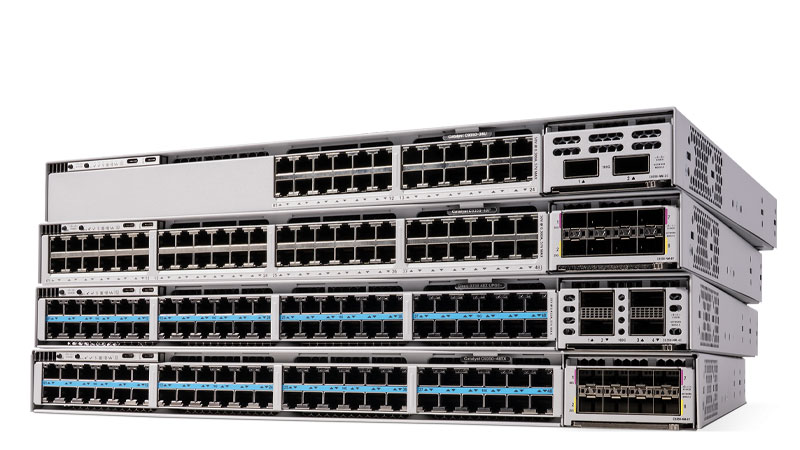
Yes. Third-party SFPs and SFP+/QSFP modules will physically and electrically work in most Cisco Catalyst switches, but Cisco IOS-XE blocks them by default and error-disables the port with a `%PM-4-ERR_DISABLE: gbic-invalid` message. You unlock them with the global command `service unsupported-transceiver` (often paired with `no errdisable detect cause gbic-invalid`). The real question is not whether they light up, it is what you give up. Running non-Cisco optics lets Cisco withhold support under warranty or your SmartNet/Solution Support contract if a fault traces back to that optic, removes Digital Optical Monitoring guarantees, and disqualifies the link from TAA/federal procurement. For lab, edge, and non-critical links, third-party is often a reasonable cost play. For production uplinks, contracted gear, and any federal or DoD environment, genuine Cisco optics are the right call, and an authorized partner can price them far closer to the gray market than most buyers expect.
The short answer: they work, but Cisco fights you by default
Out of the box, a Cisco Catalyst switch running IOS-XE inspects the EEPROM (the small identity chip) on every transceiver you insert. If the serial-number and vendor data do not match a Cisco-coded module, the platform refuses to bring the port up and logs an error like `%PM-4-ERR_DISABLE: gbic-invalid error detected on GigabitEthernet1/0/1` or `%PLATFORM_PM-6-MODULE_ERRDISABLE`. The port lands in err-disabled state and stays down.
This is a software policy, not a physical incompatibility. A quality third-party SFP that meets the MSA (Multi-Source Agreement) standard is electrically and optically interchangeable with the Cisco-branded equivalent, many are even built in the same contract factories. What the EEPROM check enforces is Cisco's commercial preference, not an engineering limit. That distinction matters, because it means will it work and should you run it are two completely different questions.
How the service unsupported-transceiver command works
Cisco provides an official escape hatch. From global configuration mode you enter `service unsupported-transceiver`, acknowledge the on-screen legal warning, and on many platforms also clear the error trigger with `no errdisable detect cause gbic-invalid`. After that, the switch will accept and bring up non-Cisco optics.
The command behaves the same way across the modern lineup, Catalyst 9200, 9300, 9500, and the older 3650/3850 on IOS-XE, and on NX-OS data-center platforms such as the Nexus 9000 series. A few practical notes engineers should know: the command is hidden or undocumented on some releases but is recognized and persists in the running-config, surviving reload once saved; it is global, not per-port, so enabling it tells the whole switch to stop policing optic identity; it does not improve a bad optic, since forcing the port up only masks a marginal laser or out-of-spec DOM data rather than fixing the physics; and when you enter it, IOS-XE prints the explicit warning that Cisco may withhold support if a problem traces to the third-party part. That warning is the whole point of the next section.
Warranty and TAC implications: what you actually give up
Cisco's published policy is consistent and worth reading literally: when a fault or defect can be traced to the use of third-party transceivers, cables, or modules installed by a customer or reseller, Cisco may, at its discretion, withhold support under the warranty or under a Cisco support program such as SmartNet Total Care or Solution Support.
In day-to-day terms, that means two things. First, opening a TAC case on a link that runs a non-Cisco optic invites a fast request: swap in a genuine Cisco module and reproduce the issue before we troubleshoot further. TAC is within its rights to decline deeper work until the third-party part is removed, because they cannot trust the optic's reported data. Second, the hardware warranty on the switch itself is not voided by inserting a third-party SFP, the switch warranty stands, but Cisco can decline to attribute a failure to its product if a foreign optic is in the path. You are effectively self-insuring the optic and the diagnostic time around it.
There is also a quieter operational cost: Digital Optical Monitoring (DOM). Cisco validates the temperature, voltage, TX/RX power, and bias-current telemetry on its own modules. Third-party optics report DOM too, but Cisco does not stand behind those values, so the proactive alarms your monitoring depends on become advisory rather than authoritative.
When third-party optics are fine, and when genuine matters
This is not an all-or-nothing decision. Mature network teams run a tiered policy: cheap optics where the blast radius is small, genuine optics where downtime or compliance is expensive.
Third-party is usually fine for lab, test, and staging environments where you control both ends and downtime costs nothing; low-criticality access-edge links such as a single user drop or a non-redundant IoT segment; and short-lived or transitional builds you expect to rip out within a refresh cycle.
Genuine Cisco optics matter when the link is a production uplink, a data-center spine/leaf path, or any redundant pair that a single failure can degrade; when the switch is under active SmartNet or Solution Support and you need TAC to honor four-hour or next-business-day response without an argument about optics; when you depend on accurate DOM alarming for SLAs or proactive replacement; and when the deployment is federal, DoD, SLED, or any contract with a TAA (Trade Agreements Act) requirement. That last one is the hard line.
The federal/TAA case deserves its own emphasis. Trade-agreement compliance turns on country of origin and an auditable supply chain. Genuine Cisco optics carry that provenance; most gray-market and white-box optics cannot prove it, which can disqualify the entire link, and sometimes the entire order, under FAR/TAA clauses. If you procure through SEWP, GSA, or any vehicle with a Buy American or TAA flag, the safe and defensible choice is genuine, sourced through an authorized partner. We cover the broader rules in our TAA-compliant Cisco procurement guide.
Common genuine Cisco optics and what they replace
If you decide on genuine, here are the real Cisco part numbers that cover the vast majority of Catalyst and Nexus uplinks. Match the optic to the port type (SFP = 1G, SFP+ = 10G, QSFP+ = 40G, QSFP28 = 100G) and the fiber and distance you have in the ground.
These are the parts most buyers are comparing against a third-party equivalent. An authorized partner can quote any of them, confirm switch compatibility, and bundle them onto the same line item as the switches and cabling. Browse the full range in the optics and transceivers catalog.
How an authorized partner prices genuine optics competitively
The reason buyers reach for third-party optics is almost always price, list price on a genuine SFP can look absurd next to a $20 white-box module. But list price is rarely what an authorized partner actually charges. Distribution deal registration, volume tiers, and bundling optics onto the same purchase order as the switches routinely close most of that gap, and on a fully-loaded basis, warranty coverage retained, TAC honored, no compliance risk, no diagnostic finger-pointing, genuine often wins outright.
As an authorized Cisco partner, we quote optics at partner pricing, confirm the exact module your platform expects, and keep the line TAA-compliant when your contract requires it. We can also right-size the order so you are not paying for long-reach single-mode optics on a 300-meter run, or for genuine modules on lab links where third-party is genuinely fine. Pair optics with switches from the Cisco switches catalog, size the budget with our breakdown of how much a Cisco switch costs, and if you are keeping gear under contract, our SmartNet renewal guide explains why genuine optics keep that coverage clean. When you are ready, request a quote with your part list and we will confirm compatibility and price it competitively.
Frequently asked questions
Does using a third-party SFP void my Cisco switch warranty?
Not automatically. Inserting a third-party optic does not void the switch's hardware warranty by itself. What Cisco's policy allows is for Cisco to withhold support under the warranty or a support program (like SmartNet Total Care or Solution Support) if it determines a fault can be traced to the third-party part. The switch warranty stands; the risk is that Cisco can decline to attribute a failure to its product, and TAC may require you to install a genuine optic before troubleshooting further.
What command lets a Cisco Catalyst switch accept a non-Cisco SFP?
From global configuration mode, enter `service unsupported-transceiver` and acknowledge the warning. On many IOS-XE platforms you also add `no errdisable detect cause gbic-invalid` so the port stops auto-disabling. If the port is already err-disabled, recover it with `shutdown` then `no shutdown`. The same `service unsupported-transceiver` command applies on NX-OS Nexus platforms. The setting is global and persists after a reload once saved.
Will Cisco TAC help me if I'm running third-party optics?
TAC will take the case, but for any issue touching a link with a non-Cisco optic they can ask you to swap in a genuine Cisco transceiver and reproduce the problem first. They are within policy to decline deeper troubleshooting until the third-party part is removed, because the optic's reported data (including DOM telemetry) is not Cisco-validated. If TAC response time matters to your SLA, genuine optics avoid that friction entirely.
Are third-party SFPs allowed in federal or TAA-compliant deployments?
Generally no. Trade Agreements Act (TAA) compliance depends on country of origin and an auditable supply chain. Genuine Cisco optics carry that provenance; most gray-market or white-box optics cannot prove it, which can disqualify the link, and sometimes the whole order, under FAR/TAA clauses. For SEWP, GSA, DoD, or any Buy American/TAA-flagged procurement, source genuine Cisco optics through an authorized partner. See our TAA-compliant Cisco procurement guide for the full rules.
Why are genuine Cisco optics so much more expensive than third-party?
List price is the comparison point most buyers see, and it is rarely what an authorized partner actually charges. Deal registration, volume tiers, and bundling optics onto the same PO as the switches close most of the gap. On a fully-loaded basis, warranty retained, TAC honored, DOM validated, TAA compliance intact, genuine optics from an authorized partner are far more competitive than the list-versus-white-box headline suggests. Request a quote and you will usually see the real delta is small.
Uniqcli Team
The Uniqcli Team is an authorized Cisco partner specializing in Catalyst wireless, switching, datacenter fabric, licensing, and managed services for U.S. federal, state, local, and education customers. We scope Cisco bills of materials, validate procurement paths (TAA, FIPS, contract vehicles), and deliver design, deployment, and managed operations.
Ready to scope your Cisco build?
Build a quoteRelated reading
View all →GuidesWhich SFP, SFP+ and QSFP Modules Are Compatible With the Catalyst 9300
Which SFP, SFP+, SFP28 and QSFP optics work with the Cisco Catalyst 9300 and 9300X? Network module mapping, real part numbers, copper vs fiber, and CLI verification.
June 23, 2026 · 4 min readGuidesSFP-10G-SR vs SFP-10G-LR: Which 10G Optic to Choose
SFP-10G-SR vs SFP-10G-LR explained: distance, fiber type, cost, and Cisco platform support. Choose the right 10G transceiver and matching fiber the first time.
June 23, 2026 · 5 min readGuidesGLC-T vs GLC-TE: 1000BASE-T Copper SFP Differences and Replacement
GLC-T vs GLC-TE: the only real difference is temperature range. GLC-T is End-of-Sale; GLC-TE is the drop-in replacement. Specs, supported platforms, and which to buy.
June 23, 2026 · 5 min readGuidesCisco transceiver & optics compatibility guide (SFP, SFP+, QSFP, QSFP-DD)
How Cisco optics compatibility actually works: form factors by speed (1G–400G), platform and IOS-XE/NX-OS support, transceiver coding, and genuine vs third-party SFPs. Part-number mapping from an…
June 23, 2026 · 7 min read Guides
Meraki MS vs Catalyst Switches: Cloud-Managed or IOS XE?
Meraki ms vs catalyst is really a management-philosophy question: full cloud-dashboard simplicity versus on-box IOS XE control, and Cisco now blurs the line by cloud-managing Catalyst hardware.
July 11, 2026 · 5 min readGuidesCisco vs Juniper Switches: Catalyst/Nexus vs EX/QFX
Cisco vs juniper switches comes down to Junos's one-OS consistency and service-provider roots versus Catalyst and Nexus's campus-to-data-center breadth, complicated by Juniper's 2025 move under HPE.
July 11, 2026 · 5 min read