
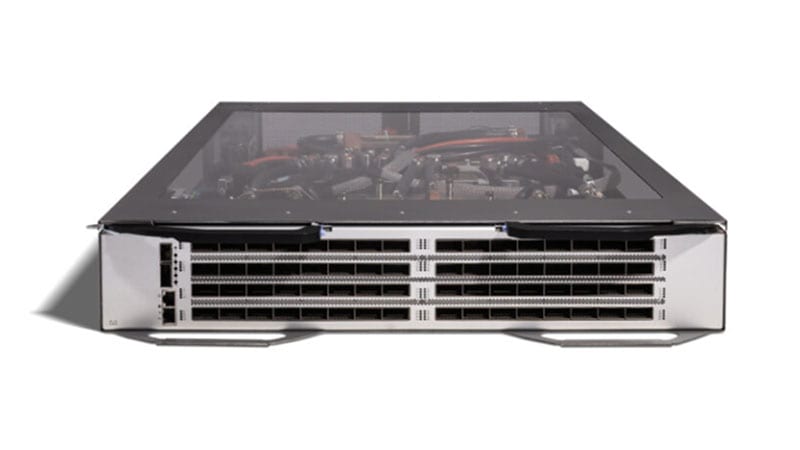
If you still have Cisco Nexus 5696Q switches (PID N5K-C5696Q) anchoring a data center row, the clock has nearly run out. The 5696Q reaches its Last Day of Support (LDoS) on May 31, 2026. After that date Cisco provides no software fixes, no PSIRT security patches, and no TAC support or RMA hardware replacement for this chassis. A 4RU switch that is still forwarding line-rate traffic is exactly the kind of asset that quietly survives multiple refresh cycles, which is precisely the risk. This guide explains what the 5696Q actually was, what each end-of-life milestone means for a production fabric, why the recommended Nexus 93360YC-FX2 is a genuine architectural upgrade rather than a like-for-like swap, and how to plan a clean cutover.
What the Nexus 5696Q actually was
The Nexus 5696Q (N5K-C5696Q) is a modular 4-rack-unit chassis switch from the Nexus 5600 platform, and the modular design is what set it apart from its fixed siblings. It carries eight line-card expansion module (LEM) slots and, fully populated with 40G modules, presents up to 96 ports of 40 Gigabit Ethernet in QSFP+ for 7.68 Tbps of switching bandwidth. Each 40G port can be broken out into four line-rate 10G ports with QSFP breakout cables, so a fully loaded chassis could also serve as a very high-density 10G aggregation point. It supported the N5696-M20UP unified module (20 ports of 1/10G with Fibre Channel and FCoE support) and a 4-port 100G LEM, with six power supplies in N+N redundancy and four fan modules in N+1. It was a capable VXLAN-ready unified-fabric switch for its era, bridging Ethernet and storage in converged designs.
The trouble is generational. The 5696Q tops out at 40G interfaces and 10G server-facing ports. It has no native 25G server connectivity, no 100G fabric uplinks in the way modern spines expect, and no line-rate MACsec encryption. Its buffering and telemetry belong to the merchant-silicon generation before intelligent buffer management and streaming telemetry became table stakes. For 2015-era 10/40G fabrics it was the right tool. For a 2026 data center facing 25G NICs, 100G spines, and zero-trust encryption mandates, it is a ceiling.
Why acting now matters
The danger with an end-of-life data center switch is not that it fails. It is that it keeps forwarding flawlessly while the support floor disappears beneath it. Three exposures stack up after LDoS:
- No PSIRT security patches. When a new NX-OS vulnerability is disclosed, the 5696Q will not receive a fixed image. The codebase froze at the 2022 software-maintenance cutoff, so any CVE touching that code path on this hardware is permanent and unremediated by design.
- No TAC or RMA. A failed supervisor, LEM, fabric, or power supply cannot be opened as a support case or swapped under contract after LDoS. Your only recovery is spares you stockpiled before the wall or gray-market parts of the same dead-end platform.
- Audit and compliance exposure. The frameworks federal, DoD, SLED, and healthcare buyers live under (FedRAMP, CMMC, NIST 800-53, HIPAA Security Rule, PCI DSS, and CISA directives) assume supported, patchable infrastructure. An unpatchable core switch is a finding waiting to be written, and 'the vendor no longer ships fixes' is not a defensible remediation plan.
There is also a software trap. The Nexus 5600 platform runs an older NX-OS train that diverges sharply from the NX-OS 9.x/10.x running on current Nexus 9000 hardware. As you modernize spines, automation, and telemetry around it, the 5696Q strands you on legacy code and legacy operational tooling. The chassis and its software era age out together.
What each milestone means in practice
- End of Sale (2021-05-05): the last day Cisco accepted new orders. Everything after this date is consuming the finite support tail.
- End of Software Maintenance (2022-05-05): the last day Cisco released maintenance and bug-fix images. After this, even non-security defects go unfixed; only the contractual support obligations remained.
- Last Day of Support / LDoS (2026-05-31): the hard wall. No TAC, no RMA, no software of any kind. The hardware is entirely on its own from that day forward.
The recommended replacement: Nexus 93360YC-FX2
Cisco's EoL bulletin directs 5696Q customers to the Nexus 9300 (N9K-C93360YC-FX2). The headline change is form factor and density: the 93360YC-FX2 collapses what took a 4RU modular chassis into a 2RU fixed switch with 96 ports of 1/10/25G SFP28 plus 12 ports of 40/100G QSFP28, delivering 7.2 Tbps and 2.4 bpps. You move from a chassis you had to populate with LEMs to a fixed, fully wired switch with a long support runway. Concretely, here is what is better for this product type:
- 25G to the server, 100G to the fabric. The 96 downlinks auto-negotiate 1/10/25G, so existing 10G servers keep working today while new 25G NICs plug in with no hardware change. The 12 uplinks flex between 40G and 100G, giving you a real leaf-and-spine fabric instead of the 5696Q's 40G ceiling.
- Line-rate MACsec on every port at 1G and above. The 5696Q had no native MACsec; the 93360YC-FX2 encrypts at the physical layer for leaf-to-spine, border-leaf, and server links. For zero-trust and federal data-in-transit requirements, this turns an architectural gap into a checkbox you can actually tick.
- Intelligent buffer management. Cisco's analytics-driven buffering distinguishes 'mice' from 'elephant' flows and applies Approximate Fair Drop (AFD) and dynamic buffer protection, so latency-sensitive flows are not starved by bulk transfers during congestion. This is generationally ahead of the 5696Q's static buffering.
- NX-OS or ACI mode. The same hardware boots as a standalone NX-OS switch (familiar CLI, VXLAN EVPN fabrics) or as an ACI leaf for policy-driven, controller-managed automation. You choose the operating model rather than rebuying hardware to change it later.
- Modern telemetry and a 2RU power envelope. Streaming telemetry, model-driven programmability (NETCONF/RESTCONF, gRPC), and a denser, more power-efficient footprint replace the legacy 4RU chassis and its six-supply power draw.
Licensing: the model has changed
The Nexus 5600 era predated today's subscription model. Current Nexus 9000 switching uses Cisco Smart Licensing with tiered NX-OS feature licenses (Essentials and Advantage subscription tiers, plus add-ons such as the Data Center Networking package), all tracked through your Smart Account, and Nexus Dashboard for fabric operations and insights. Budget for the subscription term, not just the switch, and confirm your Smart Account is provisioned before deployment so the switch licenses cleanly. If you target ACI mode, factor in Cisco APIC controllers and their licensing as well. This is a procurement line item that did not exist in the 5696Q world and is the single most common thing teams forget to scope.
A practical migration plan
1. Assessment and inventory
Pull an exact count of N5K-C5696Q chassis and, critically, an inventory of populated LEMs and active ports per chassis (10G vs 40G, any FC/FCoE on M20UP modules, breakout cables in use). Capture VLAN/VRF maps, VPC pairings, FEX associations, VXLAN/VTEP roles, QoS policies, and the running NX-OS version. Note any converged storage on the unified ports, since FCoE designs need explicit planning on the target.
2. License and platform transition
Decide NX-OS mode versus ACI mode now, because it shapes everything downstream. Provision the Smart Account, stage the NX-OS Essentials/Advantage subscriptions (and APIC/ACI licensing if applicable), and stand up Nexus Dashboard before any production traffic moves. Stage licensing first so the switch is entitled the moment it boots.
3. Config and feature parity
Rebuild interface, VLAN/VRF, VPC, routing (OSPF/BGP/EVPN), ACL, and QoS configuration on the 93360YC-FX2. Most NX-OS constructs carry over, but the version gap is large: validate VPC, VXLAN EVPN, and any FEX or FCoE features against current NX-OS syntax rather than pasting old configs. If the 5696Q ran converged FC/FCoE, confirm your storage path on the target design explicitly. Build and diff the config in a lab or staging switch before cutover.
4. Physical: rack, power, uplinks, and optics
The 2RU 93360YC-FX2 frees 2RU per switch versus the 4RU 5696Q, but the optics story is the real work. 10G SFP+ and 40G QSFP+ optics generally carry forward, but 25G server links need SFP28 optics/DACs and 100G uplinks need QSFP28, so audit and order optics and breakout cables as a distinct line item. Verify rack power and cooling for the new switches and plan uplink cabling to your spines before the maintenance window, not during it.
5. Phased cutover
Migrate by VPC pair or fabric segment, not all at once. Stand up the 93360YC-FX2 leaves alongside the 5696Q, extend the fabric, validate routing/EVPN convergence and storage paths, then move server racks in waves. Keep the 5696Q live until each segment is validated so rollback is a cable move, not a rebuild. For dual-homed servers, use VPC to migrate one leg at a time with zero downtime.
6. Secure decommission
Decommissioned 5696Q chassis still hold configuration, keys, ARP/MAC state, and any stored credentials. Erase startup configuration, wipe each unit, remove it from automation, NMS, and asset records, and for federal and healthcare environments follow your media-sanitization and asset-disposal policy (NIST SP 800-88 style handling) with documented chain of custody.
Procurement notes for government and enterprise buyers
Source the 93360YC-FX2 through an authorized Cisco partner. For US federal, DoD, and SLED buyers, confirm TAA compliance and country-of-origin documentation up front, validate genuine Cisco serials and clean Smart Licensing entitlement, and plan for current lead times on Nexus 9300 hardware and optics rather than assuming stock. Government Purchase Card (GPC) thresholds, contract vehicles, and quote-to-PO timelines all benefit from engaging the partner early so licensing, TAA paperwork, optics, and delivery line up with your fiscal calendar. Buying used 5696Q hardware to extend a dead platform only deepens the audit and support problem.
Ready to scope the refresh? Review the full milestone detail for this model on the N5K-C5696Q EoL page, see the broader migration picture on the Cisco EoL hub, and browse current Nexus 9000 switches in our catalog. When you are ready, get a refresh quote and we will size the 93360YC-FX2 leaves, optics, and Smart Licensing to your fabric.
Frequently asked questions
Is the Cisco Nexus 5696Q (N5K-C5696Q) still supported?
Only until May 31, 2026. That is the Last Day of Support (LDoS). After that date Cisco provides no security patches, no software fixes, no TAC support, and no RMA hardware replacement for the 5696Q. The switch will keep forwarding traffic, but it becomes unpatchable and unsupported, which creates real audit and compliance exposure for regulated buyers. End of Software Maintenance already passed on May 5, 2022.
What is the recommended replacement for the Nexus 5696Q?
Cisco's EoL bulletin directs customers to the Nexus 9300 (N9K-C93360YC-FX2). It is a fixed 2RU leaf switch with 96 ports of 1/10/25G SFP28, 12 ports of 40/100G QSFP28, 7.2 Tbps of bandwidth, line-rate MACsec, and the choice of NX-OS or ACI mode, a substantial upgrade over the 4RU, 40G-ceiling 5696Q chassis.
What is concretely better about the 93360YC-FX2 versus the 5696Q?
Native 25G server connectivity and 40/100G fabric uplinks (the 5696Q topped out at 40G), line-rate MACsec encryption on every port at 1G and above (the 5696Q had none), intelligent buffer management with Approximate Fair Drop, modern streaming telemetry, model-driven programmability, and a long support runway. It also fits in 2RU instead of 4RU.
Does migrating off the 5696Q change Cisco licensing?
Yes. The Nexus 5600 era predated subscription licensing. The Nexus 9000 platform uses Cisco Smart Licensing with NX-OS Essentials/Advantage tiers (plus add-on packages), tracked in a Smart Account and operated through Nexus Dashboard. If you choose ACI mode you also need APIC controllers and their licensing. Provision the Smart Account and stage licensing before deployment so the switch is entitled at boot.
Can my existing optics and cabling move to the 93360YC-FX2?
Partially. 10G SFP+ and 40G QSFP+ optics generally carry forward, but 25G server links require SFP28 optics or DACs and 100G uplinks require QSFP28, so treat optics and breakout cables as a separate procurement line. Audit your in-use optics during inventory and order the deltas before the cutover window.
Should I buy more 5696Q units to extend my deployment?
No. The 5696Q is at End of Sale and reaches Last Day of Support on May 31, 2026, so any units you buy are unsupported and unpatchable, and they are typically gray-market. For government and healthcare buyers that deepens the audit problem rather than solving it. Refresh to the supported Nexus 93360YC-FX2 through an authorized Cisco partner instead.
Uniqcli Team
The Uniqcli Team is an authorized Cisco partner specializing in Catalyst wireless, switching, datacenter fabric, licensing, and managed services for U.S. federal, state, local, and education customers. We scope Cisco bills of materials, validate procurement paths (TAA, FIPS, contract vehicles), and deliver design, deployment, and managed operations.
Ready to scope your Cisco build?
Build a quoteRelated reading
View all →GuidesCisco Nexus 56128P EoL: Migrate to Nexus 9300 93360YC-FX2
The Nexus 56128P (N5K-C56128P) hit Last Day of Support on September 30, 2025. Here's what each lifecycle date means and how to refresh cleanly to the Nexus 9300 93360YC-FX2 with 25G/100G and MACsec.
February 3, 2026 · 8 min readGuidesNexus 5672UP-16G EoL: Migration to Nexus 9300 93180YC-FX
The Nexus 5672UP-16G reaches Last Day of Support on May 31, 2026, here's why it has to come out and how to migrate cleanly to the 25G/100G Nexus 9300 (N9K-C93180YC-FX).
February 5, 2026 · 10 min readGuidesCisco Nexus 9396PX EoL: Migrate to Nexus 93180YC-FX3
The Nexus 9396PX (N9K-C9396PX) passed Last Day of Support on February 19, 2023, here is why this original 9300 leaf has to come out and how to refresh cleanly to the Cloud Scale 93180YC-FX3.
April 2, 2026 · 10 min readGuidesCisco Nexus 6001-64T EoL: Migrate to Nexus 93180YC-FX3
The Nexus 6001-64T (N6K-C6001-64T) passed Last Day of Support on April 30, 2022. Here is what each milestone means, why the 10GBASE-T top-of-rack switch has to come out, and how to refresh cleanly to the Cloud Scale Nexus 93180YC-FX3.
April 19, 2026 · 7 min readGuidesCisco Nexus 2248TP EoL: Migrate to the 2248TP-E FEX
The Nexus 2248TP (N2K-C2248TP-1GE) passed Last Day of Support on November 30, 2021. Here is why it must come out of the rack and how to refresh cleanly to the enhanced Nexus 2248TP-E Fabric Extender.
January 27, 2026 · 9 min read Guides
Nexus 3064-T EoL: Migrate to Nexus 93108TC-FX3
The Nexus 3064-T (N3K-C3064TQ-10GT) passed Last Day of Support on June 30, 2021, here's why this 10GBASE-T top-of-rack switch must come out and how to refresh cleanly to the Nexus 9300 93108TC-FX3.
May 11, 2026 · 8 min read