
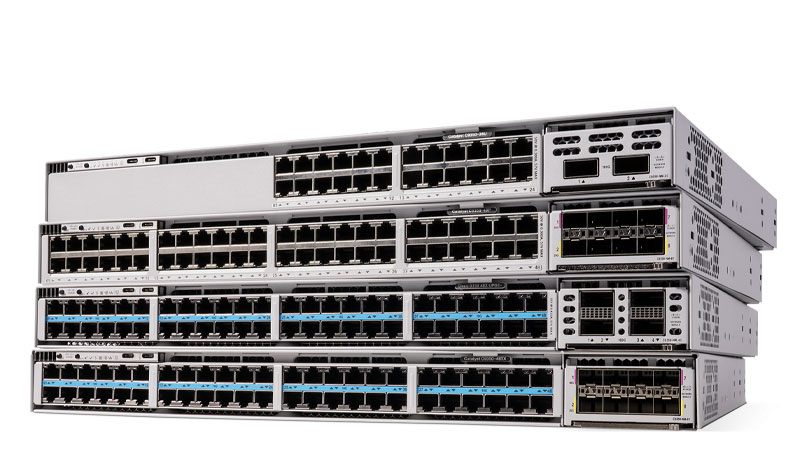
If you still have Cisco Nexus 3064-T switches (PID N3K-C3064TQ-10GT) racked at the top of your server rows, they are now well past every Cisco lifecycle milestone that matters. The 3064-T went End of Sale on June 7, 2016 and reached its Last Day of Support on June 30, 2021. From that date forward Cisco provides no NX-OS software fixes, no PSIRT security patches, and no TAC support or RMA hardware replacement for this platform. The switch still forwards packets at line rate, which is precisely why these units quietly survive in production long after they should have been retired. This guide explains what the end-of-life dates actually mean for a live fabric, why the recommended Nexus 93108TC-FX3 is a genuine generational upgrade rather than a like-for-like swap, and how to plan a clean refresh.
3064-T lifecycle at a glance: End of Sale: June 7, 2016. Last Day of Support (LDoS): June 30, 2021. Both dates have now passed by years. The full milestone record lives on the EoL detail page for this PID.
What the Nexus 3064-T actually was
The Nexus 3064-T (N3K-C3064TQ-10GT) was the 10GBASE-T copper variant of the original Nexus 3064 line, a compact 1RU top-of-rack switch built for low-latency server access over twisted pair. It delivered 48 RJ45 ports running 100M/1G/10GBASE-T, plus four QSFP+ ports for 40G uplinks (each breakable into 4x10G), for a non-blocking switching capacity around 1.28 Tbps with cut-through latency in the low microseconds. Built on a Broadcom Trident+ class ASIC and running NX-OS in standalone mode, it was a popular choice for connecting 10GBASE-T server NICs in rows where structured copper was already pulled and re-cabling to fiber was unattractive. For 2012-era data center access it was an excellent, dense copper ToR. By today's standards its uplinks, buffers, encryption, and telemetry are a generation behind.
Why acting now matters
The dangerous thing about an end-of-life switch is not that it stops working. It is that it keeps working flawlessly while the support floor disappears beneath it. After LDoS, three concrete exposures stack up:
- No PSIRT security patches. When a new NX-OS vulnerability is disclosed, the 3064-T will not receive a fixed image. Its software train is frozen, so any CVE affecting that code path on this hardware is permanent and unremediable by patching.
- No TAC or RMA. A failed unit cannot be opened as a Cisco support case or swapped under a service contract. Your only recovery is a cold spare you stockpiled before LDoS or a secondary-market unit of the same dead-end model.
- Audit and compliance exposure. The frameworks federal, DoD, SLED, and healthcare buyers live under, FedRAMP, CMMC, the HIPAA Security Rule, PCI DSS, and CISA directives, expect supported, patchable infrastructure. An unsupported access switch that cannot receive fixes is a finding waiting to happen, and 'the vendor no longer ships patches for this model' is not a defensible remediation plan.
There is also a software ceiling. The 3064-T tops out on older NX-OS 7.x-class trains that lack modern VXLAN EVPN scale, streaming telemetry, and the security features auditors now expect. As you modernize spines and fabric controllers, a Trident+ ToR cannot keep pace, it ages out alongside the management plane built around it.
What each milestone means in practice
- End of Sale (2016-06-07): the last day Cisco accepted new orders for the 3064-T. Everything after this date is consuming the finite support tail.
- Last Day of Support / LDoS (2021-06-30): the hard wall. No TAC, no RMA, no software or security fixes of any kind. From this date the hardware is entirely on its own.
The recommended replacement: Nexus 93108TC-FX3
Cisco directs 3064-T copper deployments to the 10GBASE-T-capable members of the Nexus 9300 fixed family, with the Nexus 93108TC-FX3 (N9K-C93108TC-FX3) as the natural copper successor. It preserves the role you bought the 3064-T for, a dense 1RU copper access/leaf switch, while replacing nearly everything underneath it. Where it improves on the 3064-T:
- Multigigabit copper access. The FX3 offers 48 ports of 100M/1/2.5/5/10GBASE-T on RJ45. The added 2.5G and 5G (NBASE-T) rates let it serve modern multi-rate server and appliance NICs that the fixed-10G 3064-T could not negotiate, while remaining backward compatible with the Cat6/6A copper you already ran.
- 100G uplinks. Six QSFP28 uplink ports replace the 3064-T's four QSFP+ cages. Each QSFP28 accepts 40G or 100G optics (and breakout), so spine-facing capacity jumps from a 160G ceiling to as much as 600G, a real fix for oversubscription as east-west traffic has grown.
- Cloud Scale ASIC. The FX3 runs Cisco's Cloud Scale silicon (LS1800FX3 class) with far larger shared buffers, intelligent buffer management, and hardware VXLAN EVPN at scale, addressing the microburst and incast behavior that punishes shallow-buffer Trident+ switches in modern storage and AI/ML server rows.
- Line-rate MACsec. The FX3 supports IEEE 802.1AE MACsec encryption in hardware on its ports, a capability the 3064-T never had and one that increasingly appears in federal and healthcare segmentation requirements.
- Telemetry and precision timing. Streaming telemetry (model-driven gRPC/gNMI), flow analytics, plus PTP (IEEE 1588) and SyncE give you the observability and timing accuracy expected of a current fabric, none of which the 3064-T offered.
- Dual personality. The same hardware runs in NX-OS standalone mode or as an ACI leaf, so the FX3 fits a traditional NX-OS design today and an ACI fabric later without a hardware change.
Match the role, not just the port count: The 93108TC-FX3 maps cleanly to a 48-port copper ToR. If your 3064-T sat in a higher-throughput or SFP+/SFP28 fiber role, look at sibling Nexus 9300-FX3 models (for example the 93180YC-FX3 for 10/25G fiber access). Browse the current Nexus 9300 lineup in our catalog and we'll size the exact variant to your cabling and oversubscription target.
Licensing: the model has changed
The 3064-T lived in the era of perpetual, per-box NX-OS feature licenses (LAN Base / LAN Enterprise style entitlements installed on the switch). The 93108TC-FX3 uses Cisco Smart Licensing with the NX-OS subscription tiers, Essentials for base Layer 2/3 and Advantage for advanced features such as VXLAN EVPN, segment routing, and richer telemetry, tracked through your Smart Account, with optional Day-2 Operations and Nexus Dashboard add-ons. Budget for the subscription term, not just the hardware, and provision the Smart Account before deployment so each switch registers and licenses cleanly. This is the line item teams most often forget when costing the refresh.
A practical migration plan
1. Assessment and inventory
Pull an exact count of N3K-C3064TQ-10GT units and capture, per switch: rack location and RU, server port utilization (how many of the 48 copper ports are live and at what speed), QSFP+ uplink usage and the spine/aggregation they connect to, VLAN/VRF and VXLAN mappings, NX-OS version, and power draw plus airflow direction (port-side intake vs exhaust). Note any 3064 (SFP+) siblings co-located so you scope one combined refresh rather than several.
2. License transition
Stand up your Smart Account and confirm the right NX-OS tier (Essentials vs Advantage) for each switch's feature set before any hardware ships. Map every perpetual feature you rely on today to its Smart Licensing equivalent so nothing you depend on lands in a tier you didn't buy. Stage entitlements so new switches register on first boot.
3. Config and feature parity
Rebuild the running configuration on the FX3 with NX-OS feature parity in mind. Most interface, VLAN, VRF, routing (OSPF/BGP), vPC, and ACL constructs port across with minor syntax updates, but validate behaviors that differ between Trident+ NX-OS and Cloud Scale NX-OS, buffer/QoS policies, vPC peer settings, and any TCAM carving (the FX3's flexible forwarding tables are configured differently). Run a config diff against the legacy switch so nothing silently drops, and decide now whether you'll enable MACsec, VXLAN EVPN, or telemetry the 3064-T never ran.
4. Physical: rack, power, uplinks, and optics
Both are 1RU, so the rack slot carries over. Confirm power: the FX3 uses dual hot-swappable PSUs, and match airflow direction (port-side intake or exhaust) to your hot/cold aisle exactly as the 3064-T was set. Copper access cabling reuses your existing Cat6/6A RJ45 runs. The uplinks are the real change, QSFP+ (40G) on the 3064-T becomes QSFP28 (40/100G) on the FX3, so plan new uplink optics, AOCs, or breakout cables to the spine, and verify Cat6A on any runs you intend to push at 10G over distance.
5. Phased cutover
Migrate rack by rack, not all at once. In a vPC ToR pair, replace one peer at a time so the rack stays dual-homed throughout, drain traffic to the surviving peer, swap in the FX3, rejoin the vPC domain, validate, then do the second. Confirm server NIC negotiation (especially 2.5G/5G/10G auto-negotiation), uplink reachability, and routing adjacency before declaring a rack done. Keep a rollback path until each rack is validated.
6. Secure decommission
Decommissioned 3064-T switches still hold running configuration, credentials, SNMP/TACACS secrets, and certificates. Wipe each switch (erase startup-config and any stored keys), remove it from your NMS, monitoring, and asset inventory, and for federal and healthcare environments follow your media-sanitization and asset-disposal policy with documented chain of custody. Do not let a retired switch leave the building with live config on it.
Procurement notes for government and enterprise buyers
Source replacements through an authorized Cisco partner. For US federal, DoD, and SLED buyers, confirm TAA compliance and country-of-origin documentation up front, validate that units carry genuine Cisco serials with clean Smart Licensing entitlement, and plan for current lead times on Nexus 9300-FX3 hardware rather than assuming stock. Government Purchase Card (GPC) orders, contract vehicles, and quote-to-PO timelines all benefit from engaging the partner early so licensing, TAA paperwork, optics, and delivery align with your fiscal calendar. Buying gray-market or used 3064-T units to extend a dead platform only deepens the audit and supply-chain problem it was meant to solve.
Ready to scope the swap? Review the full milestone detail for this model on the N3K-C3064TQ-10GT EoL page, browse the current Nexus 9300 lineup in our catalog, and see the broader migration picture on the Cisco EoL hub. When you're ready, get a refresh quote and we'll size the 93108TC-FX3 fleet, NX-OS licensing, uplink optics, and cutover to your data center.
Frequently asked questions
Is the Cisco Nexus 3064-T (N3K-C3064TQ-10GT) still supported?
No. The Nexus 3064-T reached its Last Day of Support on June 30, 2021. Cisco no longer provides NX-OS software fixes, PSIRT security patches, TAC support, or RMA hardware replacement for this PID. The switch still forwards traffic, which is exactly why it lingers in racks, but it is unpatchable and unsupported, creating real audit and compliance exposure for federal, DoD, healthcare, and enterprise operators.
What is the recommended replacement for the Nexus 3064-T?
Cisco directs 3064-T copper deployments to the 10GBASE-T-capable Nexus 9300 family, specifically the Nexus 93108TC-FX3 (N9K-C93108TC-FX3). It keeps the 48-port RJ45 access role but upgrades to multigigabit copper (100M/1/2.5/5/10G), 6x QSFP28 uplinks at 40/100G, a Cloud Scale ASIC, MACsec, hardware telemetry, and dual-personality NX-OS or ACI operation on a long support runway.
What's the difference between the 3064-T and the 93108TC-FX3?
Both are 1RU switches with 48 copper access ports, but the 3064-T offers fixed 10GBASE-T plus 40G QSFP+ uplinks on a 2012-era Trident+ ASIC limited to NX-OS standalone. The 93108TC-FX3 adds mGig copper (2.5G/5G for NBASE-T endpoints), 100G QSFP28 uplinks, line-rate MACsec encryption, streaming telemetry, PTP/SyncE timing, deep VXLAN EVPN support, and the option to run in ACI fabric mode, roughly an order of magnitude more uplink capacity and a modern feature set.
Does migrating off the 3064-T change Cisco licensing?
Yes. The 3064-T era used perpetual NX-OS feature licenses (e.g., LAN Enterprise/LAN Base) installed on the box. The 93108TC-FX3 uses Cisco Smart Licensing with the NX-OS subscription tiers, Essentials and Advantage, tracked in your Smart Account, plus optional Day-2 Operations and Nexus Dashboard add-ons. Provision the Smart Account and stage entitlements before deployment so switches register and license cleanly.
Can I reuse my existing optics, twinax, and copper cabling?
Copper access cabling generally carries over: the 93108TC-FX3 uses RJ45 and is backward compatible with the Cat6/6A you already ran for 10GBASE-T. The uplinks change, the 3064-T used QSFP+ (40G), while the FX3 uses QSFP28 cages that accept 40G or 100G optics and breakout cables. Plan new uplink optics/AOC to the spine and verify Cat6A for any new 10G runs; older Cat6 may cap distance at 10G.
Can I just buy more Nexus 3064-T units to extend the deployment?
It's strongly discouraged. The 3064-T is years past Last Day of Support, so any units are unsupported and unpatchable on arrival and usually gray-market with no clean entitlement. For government and healthcare buyers this deepens the audit and supply-chain problem rather than solving it. Refresh to the supported Nexus 93108TC-FX3 through an authorized Cisco partner with TAA documentation instead.
Uniqcli Team
The Uniqcli Team is an authorized Cisco partner specializing in Catalyst wireless, switching, datacenter fabric, licensing, and managed services for U.S. federal, state, local, and education customers. We scope Cisco bills of materials, validate procurement paths (TAA, FIPS, contract vehicles), and deliver design, deployment, and managed operations.
Ready to scope your Cisco build?
Build a quoteRelated reading
View all → Guides
Cisco Nexus 9396PX EoL: Migrate to Nexus 93180YC-FX3
The Nexus 9396PX (N9K-C9396PX) passed Last Day of Support on February 19, 2023, here is why this original 9300 leaf has to come out and how to refresh cleanly to the Cloud Scale 93180YC-FX3.
April 2, 2026 · 10 min readGuidesCisco Nexus 5548UP EoL: Migrate to the Nexus 93180YC-FX
The Nexus 5548UP passed Last Day of Support on May 31, 2024. Here is what each milestone means, why an unpatchable top-of-rack switch is an audit liability, and how to migrate cleanly to the Cloud Scale Nexus 93180YC-FX.
January 30, 2026 · 8 min read Guides
Cisco Catalyst 4900M EoL: Migrate to Nexus 9300 (93180YC-FX3)
The Catalyst 4900M (WS-C4900M) passed Last Day of Support on October 5, 2021. Here's why it has to leave the rack and how to migrate cleanly to the Nexus 9300 N9K-C93180YC-FX3 top-of-rack switch.
May 5, 2026 · 8 min readGuidesCisco Nexus 6001-64T EoL: Migrate to Nexus 93180YC-FX3
The Nexus 6001-64T (N6K-C6001-64T) passed Last Day of Support on April 30, 2022. Here is what each milestone means, why the 10GBASE-T top-of-rack switch has to come out, and how to refresh cleanly to the Cloud Scale Nexus 93180YC-FX3.
April 19, 2026 · 7 min readGuidesNexus 3064 EoL: Migration to Nexus 9300 (93180YC-FX3)
The Nexus 3064 (N3K-C3064PQ-10GE) passed Last Day of Support on June 30, 2021. Here's why it must come out and how to migrate cleanly to the Nexus 9300 (N9K-C93180YC-FX3), 25G access, 100G uplinks, VXLAN/EVPN, and MACsec.
May 9, 2026 · 8 min readGuidesNexus 93128TX EoL: Migration to the Nexus 93108TC-FX3
The Nexus 93128TX (N9K-C93128TX) passed Last Day of Support on October 31, 2022. Here is what each milestone means, why the 93108TC-FX3 is the right copper-leaf successor, and a concrete, low-risk migration plan for federal, healthcare, and enterprise data centers.
April 4, 2026 · 9 min read