
Cisco Duo Editions and Pricing Guide (2026): Essentials vs. Advantage vs. Premier
Cisco Duo ships in four editions with clearly split feature lines. Here is what Free, Essentials, Advantage, and Premier actually include, how per-user licensing works, and how to buy it through a partner.
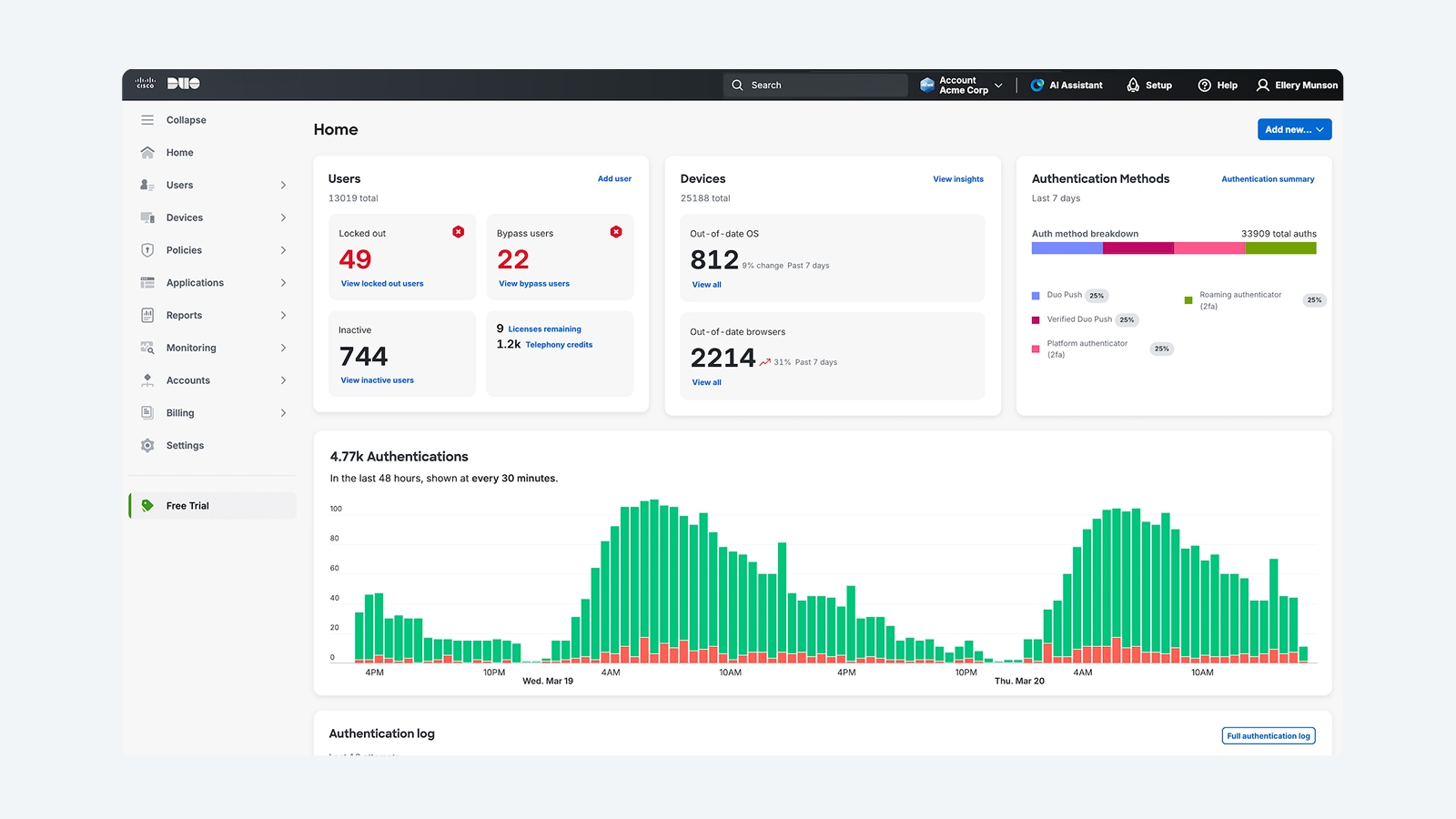
Cisco Duo is sold in four editions on a per-user subscription: Duo Free (up to 10 users, basic MFA), Duo Essentials (phishing-resistant MFA, SSO, passwordless, unlimited app integrations), Duo Advantage (adds Cisco Identity Intelligence, Duo Passport, risk-based authentication, and Active Directory Defense), and Duo Premier (adds VPN-less remote access via Duo Network Gateway and full device trust). Most mid-size and enterprise buyers land on Essentials or Advantage; Premier suits organizations replacing legacy VPN with zero-trust access.
What is Cisco Duo, and why does the edition matter?
Cisco Duo is Cisco's identity and access security platform: multi-factor authentication (MFA), single sign-on (SSO), device trust, and adaptive access policy, delivered as a cloud service and licensed per user rather than per device. It sits at the front door of every application, VPN, VDI session, and cloud login, which is why the edition you buy determines not just what a user sees at login but how much of your identity attack surface Duo actually covers. Buying Free or Essentials when you need Advantage's risk-based signals is a common and expensive mistake, because Duo does not let you mix and match features across tiers, and re-licensing a mid-rollout deployment means re-touching every group policy.
Cisco has kept the four-tier structure (Free, Essentials, Advantage, Premier) stable for several cycles now, but feature lines move between tiers as Cisco folds in acquired capability, most recently Cisco Identity Intelligence and agentic-AI access controls. If you last evaluated Duo more than a year ago, assume the comparison has shifted and re-check current entitlements before you size a purchase.
Cisco Duo editions compared: Free, Essentials, Advantage, Premier
| Edition | Typical list price | Core capability | Best fit |
|---|---|---|---|
| Duo Free | No cost, capped at 10 users | Push/passcode MFA, free authenticator app, basic integrations | Very small teams or a proof-of-concept before a paid rollout |
| Duo Essentials | Entry per-user subscription tier | Phishing-resistant MFA, secure SSO, passwordless authentication, Duo Directory, Trusted Endpoints, unlimited app integrations | Organizations standardizing MFA + SSO across SaaS and on-prem apps |
| Duo Advantage | Mid per-user subscription tier (most widely deployed) | Everything in Essentials plus Cisco Identity Intelligence (cross-identity visibility, ISPM, ITDR), Duo Passport, risk-based authentication, Active Directory Defense, session theft protection | Organizations that need identity threat detection and adaptive risk-based access, not just login MFA |
| Duo Premier | Top per-user subscription tier | Everything in Advantage plus VPN-less remote access via Duo Network Gateway, complete device trust with endpoint posture checks, agentic-AI identity governance | Organizations retiring legacy VPN or governing AI-agent access under zero trust |
List pricing for the paid tiers scales roughly 1x / 2x / 3x moving from Essentials to Advantage to Premier on a per-user, per-month basis, though actual contract pricing depends on user count, term length, and any Cisco Enterprise Agreement (EA) discounting already in place. Treat any number you see quoted publicly as directional. Request a formal quote against your user count and term for a number you can budget against.
What does each Duo tier actually unlock?
Duo Free: MFA for very small teams
Duo Free caps out at 10 users and gives you push-based and passcode MFA plus the free Duo Mobile authenticator app. It is a real product, not a crippled trial, but it lacks SSO, passwordless login, and any device-trust or risk signal. Most organizations outgrow it the moment they need to protect more than a handful of admin accounts or add a second application behind Duo.
Duo Essentials: MFA, SSO, and passwordless done right
Essentials is where Duo becomes a real identity layer. It includes phishing-resistant MFA (WebAuthn/FIDO2, Duo Mobile push with number matching), secure SSO across your SaaS and on-prem apps through Duo's own broker, passwordless authentication, Duo Directory (a lightweight built-in user directory when you do not want to sync a full Active Directory or Entra ID tenant), Trusted Endpoints (verifying a device is managed before granting access), and unlimited application integrations. For most K-12, higher-ed, and mid-size enterprise buyers doing a straightforward MFA + SSO rollout, Essentials covers the requirement without paying for capability that goes unused.
Duo Advantage: identity threat detection and adaptive access
Advantage is the most commonly deployed paid tier, and the jump from Essentials is substantial. It adds Cisco Identity Intelligence, which gives cross-identity visibility across cloud and on-prem identity providers, Identity Security Posture Management (ISPM) to flag risky configurations like dormant admin accounts or missing MFA enrollment, and Identity Threat Detection and Response (ITDR) to catch identity-based attacks such as credential stuffing or session hijacking in progress. Advantage also introduces Duo Passport, a single authenticated session that persists across an approved set of applications so users are not re-prompted for MFA constantly, risk-based authentication that steps up verification only when a login looks anomalous, and Active Directory Defense, which detects attacks against on-prem AD such as Kerberoasting or DCSync attempts. If your compliance framework (CMMC, NIST 800-53, FedRAMP-adjacent state requirements) asks for continuous identity risk monitoring rather than static MFA, Advantage is usually the floor, not Essentials.
Duo Premier: zero-trust remote access and device trust
Premier adds everything needed to retire a traditional remote-access VPN. VPN-less remote access through the Duo Network Gateway lets users reach internal web apps and resources without a full-tunnel VPN client, evaluating device posture and identity risk on every request instead of granting broad network access after one login. Premier also completes device trust with endpoint protection verification, checking not just that a device is managed but that its security agent is current and healthy before granting access. Cisco's most recent Premier addition is agentic-AI identity governance: discovering AI agents operating in the environment, registering them in a directory, assigning each one an accountable human owner, and enforcing scoped, time-bound access policies, relevant to any organization that has started deploying autonomous or semi-autonomous AI tooling against production systems.
How does Duo per-user licensing actually work?
Duo licenses one subscription per active user, not per device, so a person authenticating from a laptop, a phone, and a second workstation still consumes a single license. Self-service subscriptions purchased directly are sold in fixed increments: 10-user increments for organizations under 100 total users, and 25-user increments once you cross 100. Larger deployments, and anything tied to an existing Cisco Enterprise Agreement, are typically quoted and provisioned outside those public increments, with license counts matched to your actual headcount or a true-up mechanism built into the EA term.
A few licensing details trip up first-time buyers. Mixing editions within one organization (for example, Essentials for general staff and Premier for a smaller privileged-access group) is supported and common, but it means managing more than one SKU and more than one renewal date unless you align terms at purchase. Duo subscriptions also renew annually by default; multi-year terms are available and usually cheaper per year but require committing to a user count up front. If your organization is growing quickly, ask about true-up terms rather than over-buying seats you will not use for a year.
What does a typical Duo rollout look like?
Most rollouts follow the same shape regardless of edition. First, connect Duo to your existing directory, Active Directory via Duo's Authentication Proxy, or Entra ID/Okta via SAML, so user accounts and group membership sync automatically instead of being managed by hand in Duo Directory. Second, protect the highest-risk applications first: VPN concentrators, RDP/VDI gateways, and privileged admin consoles, before rolling MFA out broadly to every SaaS login. Third, enroll users in phases by department or site, giving each group a short enrollment window and a fallback method (hardware token or SMS as a last resort, not a primary factor) so a lost phone does not become a help-desk fire drill.
- Week 1-2: directory sync, policy design, and pilot group enrollment (typically IT and a volunteer department)
- Week 3-4: protect VPN, VDI, and privileged admin access first, since these carry the highest breach impact
- Month 2: phased enrollment across remaining departments or sites, with a defined fallback authentication method
- Ongoing: policy tuning (risk-based rules on Advantage/Premier), Trusted Endpoints enforcement, and periodic access reviews using Identity Intelligence reporting
Organizations moving off legacy VPN concentrators onto Duo Premier's VPN-less access typically run the Duo Network Gateway in parallel with the existing VPN for a transition period, migrating application-by-application rather than cutting over all remote access at once. That staged approach avoids a single point of failure during the switch and gives your help desk time to build muscle memory on the new access model before the old one goes away.
How do government and education buyers purchase Duo?
Duo subscriptions are software, not hardware, so TAA country-of-origin rules that govern physical Cisco gear do not apply the same way, but public-sector and education procurement still typically requires a formal quote, a purchase order, and GPC (government purchase card) or PO-based payment rather than a self-service credit card checkout. Buying through an authorized partner also gets your renewal dates, seat counts, and any bundled hardware (like the appliances that front a VPN-less rollout) tracked in one Cisco Smart Account instead of scattered across departmental logins, which matters the first time an auditor asks for a license inventory.
You can browse current Duo per-user licensing alongside the rest of the Cisco security portfolio in our security catalog, and if you need a formal quote sized to your actual user count, term length, and edition mix, request a quote and we will handle the Smart Account setup and any TAA or GPC paperwork your procurement office requires.
Which Duo edition should you actually buy?
If your requirement is stated as "add MFA and SSO," Essentials satisfies it and Advantage is likely overkill. If your requirement includes any language about continuous monitoring, identity risk, or detecting compromised accounts, budget for Advantage from the start; trying to retrofit Identity Intelligence into an Essentials deployment later means a licensing change, not a feature flag. Premier is a narrower decision: buy it when you have a concrete VPN-replacement project or a device-trust mandate on the roadmap, not speculatively. For most first-time Duo buyers outside of a specific compliance driver, Advantage is the edition that avoids both under-buying and over-buying, which is also why Cisco lists it as the most commonly selected tier.
Frequently asked questions
What are the current Cisco Duo editions?
Cisco Duo ships in four editions: Duo Free (capped at 10 users, basic push/passcode MFA), Duo Essentials (phishing-resistant MFA, SSO, passwordless, unlimited app integrations), Duo Advantage (adds Cisco Identity Intelligence, Duo Passport, risk-based authentication, and Active Directory Defense), and Duo Premier (adds VPN-less remote access via Duo Network Gateway and full device trust). Cisco has kept this four-tier structure stable, though specific features shift between tiers as new capability ships.
What is the difference between Duo Essentials and Duo Advantage?
Essentials covers core MFA, SSO, and passwordless login with unlimited app integrations. Advantage includes everything in Essentials and adds Cisco Identity Intelligence (cross-identity visibility, posture management, and threat detection), Duo Passport for persistent authenticated sessions, risk-based step-up authentication, and Active Directory Defense against on-prem AD attacks. Choose Advantage if you need to detect identity-based attacks in progress, not just gate logins with MFA.
Does Cisco Duo have a free plan?
Yes. Duo Free supports up to 10 users with core push and passcode multi-factor authentication and the free Duo Mobile app, at no cost. It does not include SSO, passwordless authentication, or any device-trust or risk-based features, so most organizations outgrow it once they need to protect more than a handful of accounts or more than one application.
How is Cisco Duo licensed and priced?
Duo is licensed per active user per month, not per device, so one person using multiple devices consumes a single license. Self-service subscriptions are sold in increments of 10 users under 100 total users, and increments of 25 above that; larger deployments and Cisco Enterprise Agreement customers are quoted outside those public increments. Paid tiers scale from Essentials up through Advantage and Premier, each roughly a step up in per-user list price for added capability.
Is Cisco Duo Premier worth it over Advantage?
Premier is worth the added cost specifically if you plan to replace a legacy VPN with zero-trust, VPN-less access through the Duo Network Gateway, or if you need complete device trust with endpoint posture verification. If your project is limited to MFA, SSO, and identity threat detection, Advantage covers it and Premier's remote-access and device-trust features would go unused.
Can I buy Cisco Duo bundled with other Cisco security products?
Yes. Cisco sells Duo standalone or bundled into its User Protection Suite alongside Secure Access, Secure Endpoint, and email threat defense as one subscription. The suite is worth pricing out if you intend to deploy several of the bundled components, but it is typically poor value if Duo is the only capability you need, so get quotes for both structures before deciding.
Uniqcli Team
The Uniqcli Team is an authorized Cisco partner specializing in Catalyst wireless, switching, datacenter fabric, licensing, and managed services for U.S. federal, state, local, and education customers. We scope Cisco bills of materials, validate procurement paths (TAA, FIPS, contract vehicles), and deliver design, deployment, and managed operations.
Ready to scope your Cisco build?
Build a quoteRelated reading
View all → Guides
Cisco Umbrella Packages Explained: DNS vs SIG, Essentials vs Advantage
Cisco Umbrella still ships as four packages, DNS Security Essentials, DNS Security Advantage, SIG Essentials, and SIG Advantage, even as new capability lands in Cisco Secure Access. Here's what each tier actually includes and how to license it.
July 3, 2026 · 7 min read Guides
Cisco ISE Licensing Explained: Essentials, Advantage, and Premier Tiers Demystified
A plain-English guide to Cisco ISE license tiers: what Essentials, Advantage, and Premier each add, how endpoint-count subscriptions and the separate Device Administration license work, and the cost drivers behind your quote.
June 11, 2026 · 11 min read Guides
Cisco Licensing Cost Explained: Essentials vs Advantage vs Premier
Cisco hardware sticker prices are only the opening number. Here is how Essentials, Advantage, and Premier licensing tiers, subscription terms, and SmartNet quietly decide what you actually pay.
March 26, 2026 · 9 min read Guides
Cisco ISE Essentials vs Advantage vs Premier: License Tiers Explained
Cisco ISE Essentials vs Advantage license tiers, and where Premier fits above them, explained at the feature level, plus how endpoint count, term length, and legacy Base/Plus/Apex naming factor in.
July 11, 2026 · 5 min read Guides
Cisco XDR Pricing and Licensing Explained: Tiers, Costs, and What Drives the Quote
Cisco XDR pricing has no public list price. Here is how the three tiers, telemetry volume, retention, and Enterprise Agreement bundling drive your quote, and how to size it before you ask.
June 15, 2026 · 11 min read Guides
How Much Does Cisco ISE Cost?
Cisco ISE pricing starts from about $15,000 for a real deployment, but the per-endpoint license tier, subscription term, node sizing, and SmartNet are what actually set your number. Here is how to budget it honestly.
February 25, 2026 · 9 min read