
Cisco ISE Essentials vs Advantage vs Premier: License Tiers Explained
Cisco ISE Essentials vs Advantage license tiers, and where Premier fits above them, explained at the feature level, plus how endpoint count, term length, and legacy Base/Plus/Apex naming factor in.
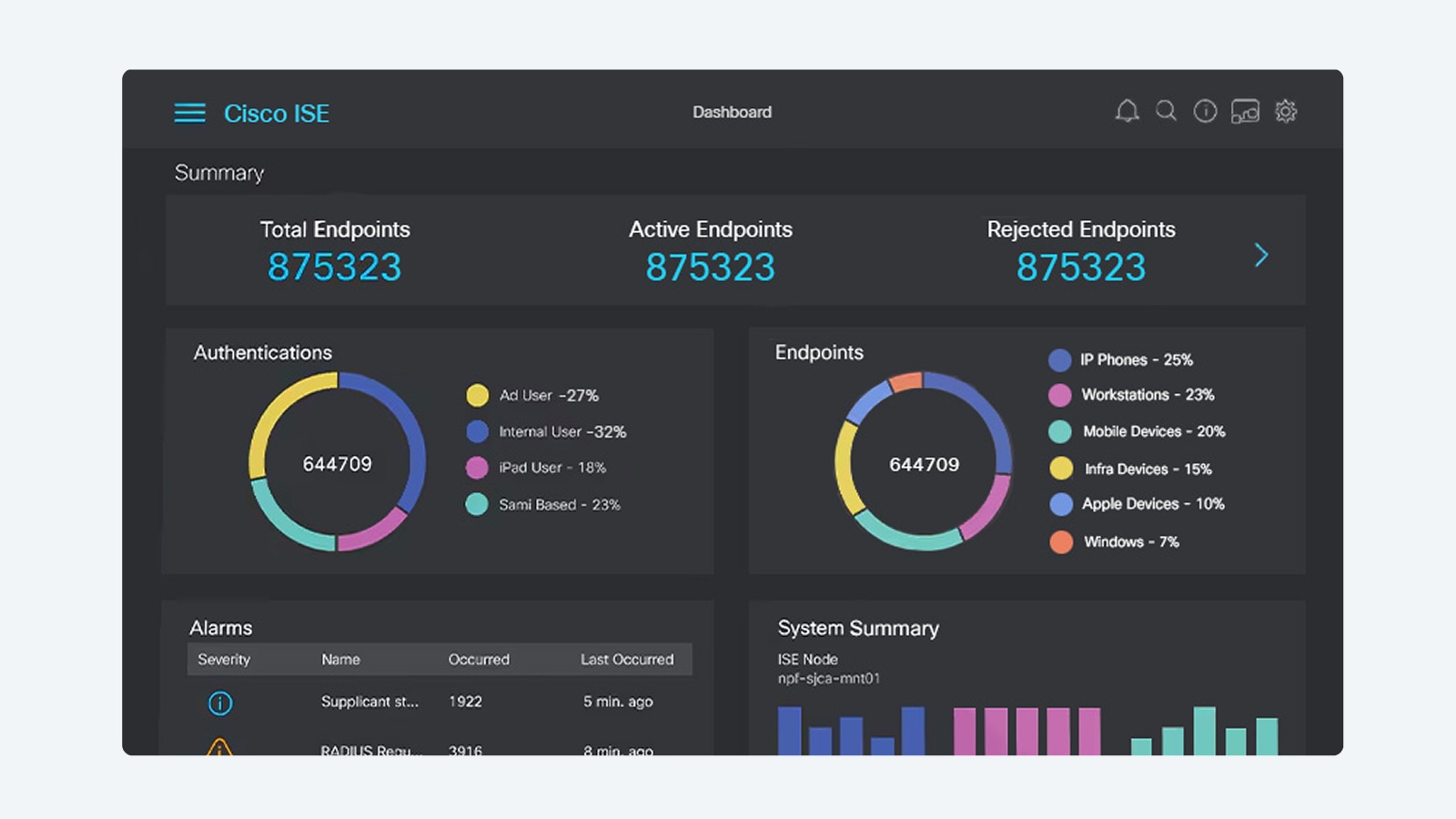
Cisco ISE's licensing is built as three cumulative tiers, Essentials, Advantage, and Premier, where each tier adds capability on top of the one below it rather than replacing it. Essentials covers foundational AAA: 802.1X, MAB, and basic guest access. Advantage layers on profiling, BYOD onboarding, and TrustSec segmentation. Premier adds the compliance-oriented capabilities: posture assessment and rapid threat containment workflows. Buyers get into trouble by picking a tier based on endpoint count alone and ignoring which features they actually need, or by making the opposite mistake, over-buying Premier capability for a network that only ever needed basic authentication. The tier decision and the endpoint-count decision are two separate axes, and both belong in a validated quote before you commit to either.
At a glance
Treat this as a starting map, not a final spec sheet, exact feature-to-tier placement can shift between releases, so confirm the current breakdown for your version in a validated quote.
| Tier | Adds on top of the tier below | Typical use case |
|---|---|---|
| Essentials | Core AAA, 802.1X, MAB, basic guest access, REST API access | Baseline authentication for a network that doesn't yet need profiling or segmentation |
| Advantage | Device profiling, BYOD self-onboarding, TrustSec Security Group Tags, pxGrid context sharing | Networks that need to know what's connecting and enforce segmentation, not just authenticate it |
| Premier | Posture assessment, compliance-oriented workflows, rapid threat containment, MDM integration | Regulated or security-mature environments that need compliance evidence and automated response |
| Licensing structure | Cumulative, each tier requires the ones below it | Applies across all three tiers |
| Term options | Subscription terms, typically sold across multiple commitment lengths | Longer terms generally improve effective annual cost |
| Scale basis | Priced per endpoint count, independent of tier | Endpoint count and tier are chosen separately |
| Legacy naming | Older quotes may reference Base, Plus, and Apex tiers from Cisco's prior licensing generation | Confirm current tier name and mapping in a validated quote |
What each tier is actually for
Think of the three tiers as answering three progressively harder questions. Essentials answers "can this device authenticate", 802.1X and MAB against your identity store, plus a basic guest workflow, and nothing more. Advantage answers "what is this device and where should it be allowed to go", profiling to identify device type, self-service BYOD onboarding, and TrustSec Security Group Tags to enforce segmentation by group rather than static VLAN. Premier answers "is this device still trustworthy right now, and can we prove it", posture assessment against endpoint compliance state, rapid threat containment workflows that can pull a compromised device out of the network automatically, and MDM integration for mobile compliance signals. Exact feature-to-tier placement can shift between releases, so confirm the current breakdown for Cisco ISE in a validated quote rather than assuming a mapping from an older deployment still holds.
Cumulative tiers vs. legacy Base/Plus/Apex naming
Cisco's ISE licensing has gone through more than one naming generation. Older deployments and some existing quotes still reference Base, Plus, and Apex license SKUs, which map conceptually to today's Essentials, Advantage, and Premier structure but shouldn't be assumed to match feature-for-feature. If you're renewing an existing ISE deployment, confirm which generation your current entitlement is on before assuming a like-for-like upgrade path, this is exactly the kind of detail to nail down in a validated quote rather than infer from a tier name alone, since a straight rename assumption can leave you either under-licensed for a feature you're already using or paying for one you never turned on.
Tier and endpoint count are two different decisions
Buyers regularly conflate "how many devices" with "how much capability," but they're independent line items on a quote. You can buy Essentials for a large endpoint count or Premier for a small one, tier and scale don't move together automatically. Undersizing tier, staying on Essentials when you actually need TrustSec segmentation, creates rework later when the network team has to re-quote and re-license mid-deployment. Oversizing tier, buying Premier and never turning on posture or rapid threat containment, means paying for unused capability indefinitely. The more reliable order of operations is to map required features to a tier first, then size endpoint count, then choose a term length, not the reverse. Write both numbers down separately on the quote request itself, so neither one quietly drives the other during negotiation.
The Device Administration add-on: a separate axis entirely
Cisco also licenses Device Administration, the TACACS+ capability for authenticating and auditing network device administrators, separately from the Essentials, Advantage, and Premier data-plane tiers. This is easy to miss if you're assuming NAC and device-admin AAA are bundled together, and it's worth flagging explicitly at quote time if you plan to use ISE for both endpoint access control and TACACS+ login control on your own routers and switches. Confirm inclusion as its own line item in a validated quote rather than assuming it rides along with whichever data-plane tier you select.
Term length and renewal timing
ISE subscriptions are sold across multiple commitment lengths, and the term you choose affects both effective annual cost and how often you're back at the negotiating table. A longer term generally locks in a better effective rate but commits you to an endpoint count and tier for the full period, so any major network growth or a shift in required capability mid-term means a true-up conversation rather than a clean renewal. A shorter term costs more per year but keeps sizing decisions closer to actual usage. Neither is universally right, a stable, slow-growth network favors the longer commitment, while an organization mid-expansion or mid-architecture-change may prefer the flexibility of shorter terms until the endpoint count and required tier settle down.
Which should you choose?
- Choose Essentials if you only need 802.1X/MAB authentication and basic guest access today.
- Choose Advantage once you need to profile devices, onboard BYOD, or enforce TrustSec segmentation.
- Choose Premier if you need posture assessment, compliance evidence, or automated threat containment workflows.
- Size endpoint count separately from tier, don't let device-count assumptions drive a tier decision or vice versa.
- Add Device Administration explicitly if you also need TACACS+ control over network device logins.
- If you're renewing a legacy Base, Plus, or Apex entitlement, confirm the current tier mapping before assuming a direct swap.
Frequently asked questions
What's the difference between Cisco ISE Essentials and Advantage?
Essentials covers foundational authentication, 802.1X, MAB, and basic guest access. Advantage builds on top of it with device profiling, BYOD self-onboarding, and TrustSec Security Group Tag segmentation. If you need to know what's connecting to the network and control it by group rather than just authenticate a login, Advantage is the tier where that capability lives.
Do I need Premier to use posture assessment in Cisco ISE?
Posture assessment and the other compliance-oriented capabilities are generally positioned in the Premier tier, on top of Advantage. Exact feature-to-tier placement can shift between releases, so confirm posture is included for the specific tier and version in your validated quote rather than assuming based on a prior deployment.
Are Cisco ISE license tiers cumulative?
Yes. Each tier is additive, Advantage requires and includes Essentials, and Premier requires and includes Advantage. You can't buy Premier-only capability without the tiers underneath it, which is part of why sizing tier correctly from the start matters.
What happened to the old Base, Plus, and Apex ISE licenses?
Cisco's ISE licensing has used more than one naming generation. Base, Plus, and Apex were the prior structure and still appear on some existing entitlements and quotes; Essentials, Advantage, and Premier are the current subscription tier names. They map conceptually to the older structure but shouldn't be assumed to match feature-for-feature, confirm the mapping for your specific renewal in a validated quote.
Is Cisco ISE licensed per endpoint or a flat fee?
Per endpoint, scaled by count and term length, independent of which tier you choose. A given tier can be purchased for a small endpoint count or a very large one, endpoint count and tier are two separate decisions on the quote.
Does TACACS+ device administration come with any ISE tier?
Device Administration, the TACACS+ capability for authenticating logins to network devices themselves, is generally licensed as its own add-on rather than automatically bundled into Essentials, Advantage, or Premier. If you plan to use ISE for TACACS+ device admin as well as endpoint NAC, confirm it's included as a line item in your quote.
Uniqcli Team
The Uniqcli Team is an authorized Cisco partner specializing in Catalyst wireless, switching, datacenter fabric, licensing, and managed services for U.S. federal, state, local, and education customers. We scope Cisco bills of materials, validate procurement paths (TAA, FIPS, contract vehicles), and deliver design, deployment, and managed operations.
Ready to scope your Cisco build?
Build a quoteRelated reading
View all → Guides
Cisco ISE Licensing Explained: Essentials, Advantage, and Premier Tiers Demystified
A plain-English guide to Cisco ISE license tiers: what Essentials, Advantage, and Premier each add, how endpoint-count subscriptions and the separate Device Administration license work, and the cost drivers behind your quote.
June 11, 2026 · 11 min read Guides
Cisco Licensing Cost Explained: Essentials vs Advantage vs Premier
Cisco hardware sticker prices are only the opening number. Here is how Essentials, Advantage, and Premier licensing tiers, subscription terms, and SmartNet quietly decide what you actually pay.
March 26, 2026 · 9 min read Guides
Cisco DNA Essentials vs Advantage: Choosing the Right Subscription Tier
Cisco DNA Essentials vs Advantage is a separate decision from the perpetual Network Essentials/Advantage choice on the switch itself. Here's how the two axes fit together, and where the retired Premier tier went.
July 12, 2026 · 7 min read Guides
Cisco XDR Pricing and Licensing Explained: Tiers, Costs, and What Drives the Quote
Cisco XDR pricing has no public list price. Here is how the three tiers, telemetry volume, retention, and Enterprise Agreement bundling drive your quote, and how to size it before you ask.
June 15, 2026 · 11 min read Guides
Cisco wireless licensing for Wi-Fi 7 explained
Wi-Fi 7 access points are the easy part. The licensing model behind them, from the Catalyst 9800 controller to per-AP subscriptions and Smart Account hygiene, is where budgets and deployments actually get decided. Here is how Cisco wireless licensing really works for a Wi-Fi 7 refresh, and how to size it before you buy.
May 15, 2026 · 10 min read Guides
How Much Does Cisco ISE Cost?
Cisco ISE pricing starts from about $15,000 for a real deployment, but the per-endpoint license tier, subscription term, node sizing, and SmartNet are what actually set your number. Here is how to budget it honestly.
February 25, 2026 · 9 min read