
On-prem vs cloud packet core for private 5G
The packet core is the brain of a private 5G network, and where you run it shapes latency, data residency, and your security accreditation. Here is how on-prem and cloud-hosted core models actually compare for federal, healthcare, and industrial deployments.
Key takeaways
- The packet core decision is really a data-path and trust-boundary decision: on-prem keeps the user-plane and subscriber data inside your facility, while cloud-hosted moves the control plane (and sometimes more) off-site.
- Control and User Plane Separation (CUPS) lets you split the difference, anchoring the user plane locally for low latency while running the control plane in a Cisco-managed cloud.
- For air-gapped DoD, classified, and OT environments, a fully on-prem core is often the only model that survives a STIG and NIST 800-53 accreditation review.
- Cloud-hosted cores win on speed to deploy, elastic scale, and lifecycle simplicity, but they assume reliable backhaul and an acceptable data-residency posture.
- Spectrum, SIM and identity management, and uplink resilience matter as much as the core architecture itself when you size a real deployment.
- Most enterprises land on a hybrid: local breakout for the workloads that cannot tolerate latency or egress, cloud-managed everything else.
What the packet core actually does, and why placement matters
Every private 5G network has a packet core. It is the software that authenticates devices, sets up sessions, enforces policy, and routes traffic between your radios and the applications those devices talk to. In 5G standalone terms, it is split into a control plane that handles signaling and a user plane that forwards the actual packets. When people argue about "on-prem versus cloud packet core," what they are really arguing about is where each of those planes lives and, by extension, where your subscriber data and your trust boundary sit.
That placement decision cascades into almost everything that matters operationally. Put the user plane in a regional cloud and a robot on your factory floor now depends on a wide-area link for every motion-control packet. Keep it on-site and you own the rack, the power, and the patch cycle. Cisco's own Private 5G offer is built as a managed, as-a-service model precisely because most enterprises do not want to run mobile core software the way a carrier does, but the underlying core, Cisco's Ultra Cloud Core, can be anchored in very different places depending on the requirement.
Before you can choose, you have to be honest about three questions: how much latency your most demanding workload tolerates, where your data is legally allowed to rest, and who is accountable for keeping the core patched and accredited. We walk customers through exactly those questions on our private 5G and provider mobility pages, because the right answer is rarely the same for a hospital, a Marine Corps depot, and an automotive plant.
The on-prem packet core: control stays inside the fence
An on-prem core runs the mobile core software, both control and user plane, on compute you operate inside your own facility. In a Cisco design that typically means the core hosted on Cisco UCS servers in your data center or a ruggedized edge enclosure, with traffic from the radios never leaving the building unless you explicitly route it out. For a classified enclave or an air-gapped industrial network, this is not a preference. It is a hard requirement.
The advantages are concrete. Latency is bounded by your LAN, not your WAN, so deterministic OT traffic and machine-vision workloads behave predictably. Subscriber data, SIM identities, and session records stay on hardware you physically control, which makes a NIST SP 800-53 control mapping and a DISA STIG review far more straightforward to defend. And the network keeps running even if your internet uplink goes dark, which is the scenario that disqualifies most cloud models for tactical and life-safety use.
The trade is operational weight. You own the patching, the high-availability design, the spares, and the accreditation paperwork for the core itself. That is real work, and it is why most on-prem cores in regulated environments are run as a co-managed engagement rather than left to an in-house team. Our lifecycle services and managed operations practices exist to carry that load, and our defense team scopes the air-gapped variants specifically for DoD and federal customers.
The cloud-hosted packet core: speed, scale, and a managed lifecycle
A cloud-hosted core runs the mobile core software in a provider-operated cloud, with Cisco itself running the Ultra Cloud Core as a service in the case of Cisco Private 5G. Your site keeps the radios and a small amount of local networking gear, and the heavy lifting, control-plane signaling, policy, lifecycle, and upgrades, happens off-site. For a multi-site retailer or a campus that just needs reliable coverage without a NOC, this is the path of least resistance.
The benefits track what you would expect from any well-run SaaS. You deploy in weeks instead of quarters because there is no core to rack and accredit. Capacity scales elastically as you add devices. Patching and version upgrades are handled by the provider on a continuous basis, which closes the vulnerability window that an under-resourced internal team often leaves open. Cisco ties this into adjacent managed platforms like IoT Control Center for SIM lifecycle and the broader Mobility Services Platform for service orchestration.
The assumptions are the catch. A cloud-hosted core presumes you have reliable, low-jitter backhaul, because if the user plane is also remote, every device session rides that link. It presumes your data-residency rules permit subscriber and session data to live in a provider cloud, which is frequently a non-starter for federal and healthcare workloads. And it shifts a chunk of your security posture onto the provider's accreditation boundary, which you need to inherit and document rather than control directly. We map those dependencies up front through our security services and observability practices so the model does not surprise an auditor later.
CUPS and the hybrid model most real deployments actually use
The on-prem-versus-cloud framing is a useful starting point, but the 5G standard gives you a third option that most mature deployments end up choosing. Control and User Plane Separation, or CUPS, lets you run the control plane in one place and the user plane in another. In practice that usually means the control plane lives in a Cisco-managed cloud, with all its lifecycle and scale benefits, while a local user-plane function sits at your site so packets break out onto your LAN with single-digit-millisecond latency.
This hybrid is what lets a manufacturer get cloud-grade operations and on-prem-grade latency at the same time. The motion-control traffic on the plant floor never leaves the building. The signaling, policy, and software updates ride the cloud. You can even run multiple local breakouts across sites while managing them from a single control plane, which is far cleaner than standing up a full core at every location. We design these splits regularly through our services/design and deployment teams, and we sequence them so production stays up during cutover.
The hybrid is not free of decisions. You still have to decide which traffic classes get local breakout versus central routing, how the local user-plane node fails over, and how you keep the control-plane link resilient. But for the majority of enterprise and SLED deployments, CUPS resolves the false binary. You are not choosing between latency and lifecycle. You are choosing where to draw the line between them, and that line can move as your requirements change.
Security, compliance, and the accreditation reality
For our federal, DoD, and healthcare customers, the architecture conversation is downstream of the compliance conversation. The question is not "which is faster to deploy," it is "which model can I actually accredit." A fully on-prem core gives you a clean, self-contained boundary that maps directly to NIST 800-53 families and survives a STIG assessment because every component is inside your authorization boundary. For classified and air-gapped systems, there is no cloud variant that clears the bar.
Cloud-hosted and hybrid models are absolutely viable for many regulated workloads, but they require you to inherit and document the provider's controls rather than own them outright. That is doable, FedRAMP-authorized services exist for exactly this, but it changes the paperwork and the shared-responsibility split. You also have to think about identity: device authentication in private 5G leans on SIM credentials, and tying that into your existing Cisco Identity Services Engine and segmentation policy keeps the 5G network from becoming an unmanaged island.
Spectrum is the other compliance dimension people underestimate. In the US, private 5G commonly runs on CBRS, which is governed by FCC rules and a dynamic SAS coordination layer, and the device ecosystem is shaped by industry bodies like the Wi-Fi Alliance and IEEE for the broader wireless picture. None of that is optional, and getting the spectrum and identity model wrong will undermine the cleanest packet-core design. Our defense and government teams scope all of it together rather than treating the core in isolation.
Cost, lifecycle, and how procurement actually shakes out
The cost comparison is not on-prem-expensive versus cloud-cheap. It is capital plus operational burden versus subscription plus dependency. An on-prem core carries an upfront hardware and integration cost, but it converts to a predictable, owned asset you can run for years under a support contract. A cloud-hosted core has little upfront cost and a recurring subscription, but you are buying an ongoing dependency on the provider's roadmap and SLA. Over a five-year horizon the totals are often closer than either vendor's pitch suggests.
Lifecycle is where the models diverge most. With a cloud core, upgrades and patches are continuous and handled for you. With an on-prem core, you own the cadence, which is exactly why pairing the hardware with Cisco Smart Net Total Care and a clear end-of-life plan under the Cisco EoS/EoL policy matters. A core that falls off support is a core that fails its next audit. When that support window comes due, our SmartNet renewal path keeps the coverage continuous.
Procurement shapes the decision more than most architects expect, especially in the public sector. On-prem hardware and integration can be purchased by agencies that hold their own federal contract vehicles, including SEWP or a GSA Schedule, which makes the buy predictable for a Schedule holder. Uniqcli holds none of those vehicles, so we sell through GPC purchases, Simplified Acquisition, and direct FAR-based purchase orders. We work the procurement path through our procurement practice so the architecture you choose is one you can actually buy on the path available to you, not just one that looks good on a diagram.
A decision framework you can actually use
Strip away the vendor framing and the choice comes down to a short sequence of questions, answered in order. First: is any part of this network air-gapped or carrying classified data? If yes, you are on-prem, full stop, and the rest of the questions are about how to operate it. Second: can your data-residency rules tolerate subscriber and session data in a provider cloud? If no, you are on-prem or a tightly scoped hybrid with local data retention.
Third: what is the latency budget of your most demanding workload, and is your backhaul good enough to meet it if the user plane is remote? If the answer is tight latency on shaky backhaul, anchor the user plane locally with CUPS even if the control plane goes to the cloud. Fourth: does your team have the staff and accreditation capacity to run a core, or do you need that carried for you? That answer points you toward a managed or co-managed model regardless of where the bits physically run.
Run through those four and the architecture usually picks itself. A DoD depot lands on-prem and air-gapped. A hospital lands on hybrid with local breakout and strict data retention. A multi-site logistics operator lands on cloud-hosted with managed lifecycle. The mistake is starting from "cloud is modern" or "on-prem is safe" instead of starting from the workload. If you want a second set of eyes on where your deployment falls, our networking and private 5G teams will run the framework with you against your real sites and your real compliance scope.
Cisco products involved
- Cisco Private 5G
- Cisco Ultra Cloud Core / Converged Packet Core
- Cisco Mobility Services Platform
- Cisco IoT Control Center
- Cisco UCS Servers
- Cisco Identity Services Engine
- Cisco Smart Net Total Care
Bottom line: There is no universally correct packet-core location, only the one that matches your latency budget, your data-residency rules, and your accreditation boundary. Tell us your sites and your compliance scope and we will size the right model with you on a private 5G quote.
Frequently asked questions
Does Cisco Private 5G force me into a cloud-only packet core?
No. Cisco Private 5G is delivered as a managed service, but the underlying Ultra Cloud Core can be anchored on-prem, hosted in a Cisco-managed cloud, or split using CUPS so the user plane stays local while the control plane runs in the cloud. The deployment model is a design choice, not a fixed product limitation.
Can a private 5G packet core be fully air-gapped for classified use?
Yes. A fully on-prem core running both control and user plane on hardware inside your facility can operate disconnected from any external network, which is what air-gapped and classified DoD environments require. This is the only model that reliably clears a STIG and NIST 800-53 accreditation for those use cases, and it is what our defense team scopes for federal customers.
What is CUPS and why does it matter for the on-prem versus cloud debate?
CUPS, or Control and User Plane Separation, is a 5G standard capability that lets you run the control plane and user plane in different locations. It matters because it dissolves the either-or choice: you can keep the user plane local for low latency and data residency while running the control plane in the cloud for elastic scale and managed lifecycle. Most mature enterprise deployments end up using it.
Which model is cheaper over five years, on-prem or cloud-hosted?
It depends more on operational burden than on sticker price. On-prem carries upfront hardware and integration cost but becomes a predictable owned asset under a support contract like Smart Net Total Care. Cloud-hosted has low upfront cost but an ongoing subscription and provider dependency. Over a five-year horizon the totals are often closer than either pitch suggests, so the deciding factor is usually compliance and staffing rather than raw cost.
How does data residency affect the choice for healthcare and federal workloads?
It is frequently the deciding factor. If your rules require subscriber data, session records, and SIM identities to stay on hardware you control, a fully on-prem core or a hybrid with strict local data retention is the only compliant option. Cloud-hosted cores are viable where you can inherit and document a FedRAMP-authorized provider boundary, but for many classified and PHI workloads that is not permitted.
Do I still need to think about spectrum and identity separately from the core?
Yes. In the US private 5G commonly runs on CBRS spectrum governed by FCC rules and a SAS coordination layer, and device authentication relies on SIM credentials that should tie into your existing Cisco Identity Services Engine and segmentation policy. A clean packet-core design will still fail in practice if the spectrum and identity model are wrong, so they need to be scoped together.
Uniqcli Team
The Uniqcli Team is an authorized Cisco partner specializing in Catalyst wireless, switching, datacenter fabric, licensing, and managed services for U.S. federal, state, local, and education customers. We scope Cisco bills of materials, validate procurement paths (TAA, FIPS, contract vehicles), and deliver design, deployment, and managed operations.
Ready to scope your Cisco build?
Build a quoteRelated reading
View all →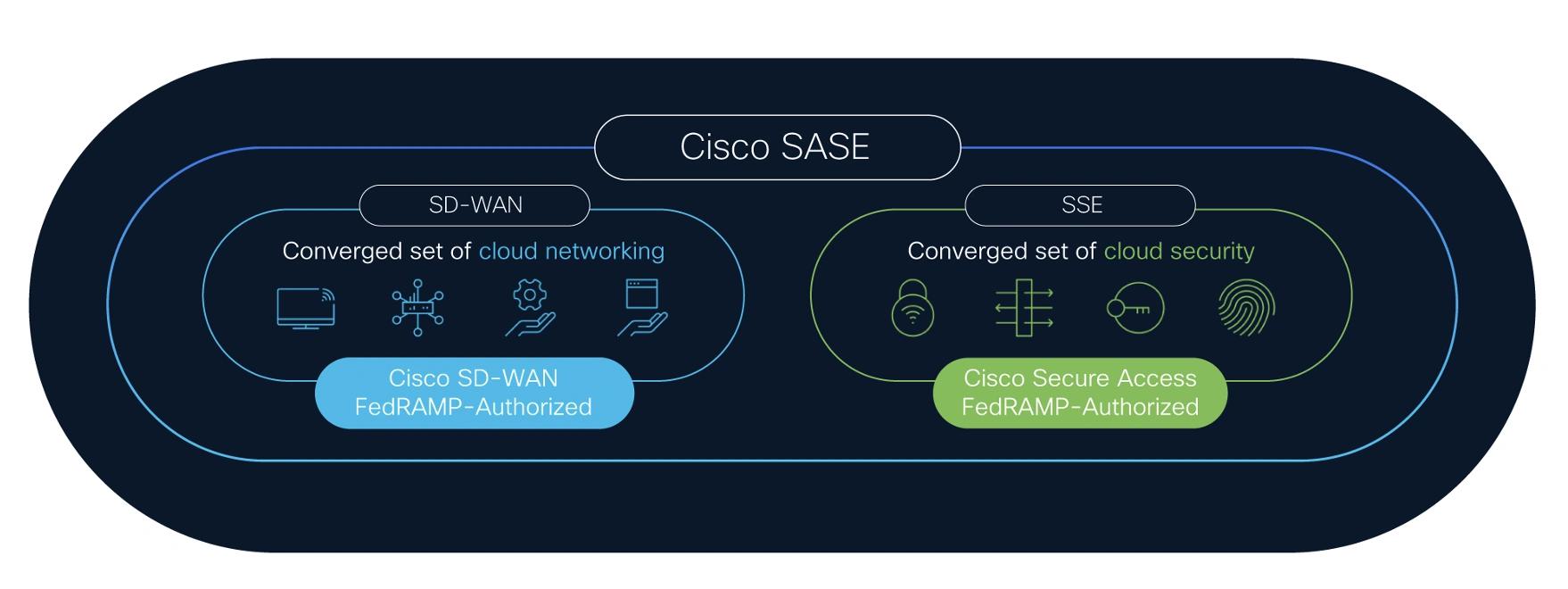 Guides
Multicloud fabric: connecting federal workloads across clouds without losing control
Federal teams run workloads across AWS, Azure, Google Cloud and on-prem at the same time. A multicloud fabric gives you one consistent policy, segmentation, and visibility layer so the mission moves between clouds without the control plane fracturing or the ATO slipping.
June 2, 2026 · 11 min read Compliance
Zero Trust for federal agencies: Hypershield, ISE, and Secure Access explained
Federal mandates pushed Zero Trust from buzzword to deadline. Here is how Cisco Hypershield, Identity Services Engine, and Secure Access fit a real agency architecture, and where each one earns its place.
May 22, 2026 · 11 min read Insights
5 signs your federal data center isn't AI-ready
AI workloads punish the weak points in a data center that ran general-purpose apps just fine. Here are five concrete signs a federal facility is not ready for GPU clusters yet, and what to fix before the hardware arrives.
May 26, 2026 · 9 min read Insights
AgenticOps: what AI-driven network operations means for lean federal IT teams
Cisco is folding AI agents into the network management stack. For federal IT shops running lean, the promise is fewer manual touches on routine operations. Here is what AgenticOps actually changes, where it earns trust, and how to adopt it without giving up the controls auditors expect.
June 3, 2026 · 11 min read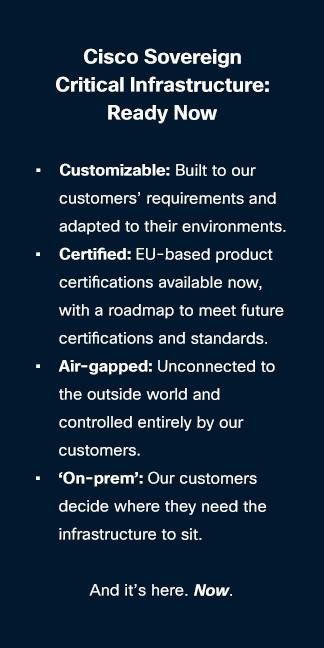 Insights
Sovereign and on-prem AI: keeping government AI workloads in-country with Cisco
Classification rules, data residency law, and the simple question of who holds the keys are pulling government AI out of the public cloud and back behind the agency boundary. Here is what a sovereign, on-premises AI footprint actually demands, and where Cisco hardware and security fit the build.
May 14, 2026 · 11 min read Insights
The networking supercycle: what tripling AI traffic means for federal data center planning
Cisco leadership is calling this a networking supercycle, with AI traffic on track to triple inside three years. For federal data centers, that is a capacity, power, and procurement problem you size now, before the accelerators land on the loading dock.
June 4, 2026 · 11 min read