
Cisco Competitors: How Cisco Stacks Up Against Arista, Juniper/HPE, Aruba, Fortinet, and More
No single vendor wins every domain. Here's an honest, domain-by-domain breakdown of where Cisco leads, where Arista, HPE (Juniper), Aruba, Fortinet, Palo Alto, and Ubiquiti are genuinely stronger, and what that means for your buy decision.
The real answer to "who competes with Cisco" depends on the domain: Arista leads in hyperscale/AI data center switching, HPE (via its 2025 Juniper acquisition) now leads on campus automation and SD-WAN simplicity, HPE Aruba edges Cisco Meraki on large dense wireless, and Fortinet/Palo Alto trade blows with Cisco in firewalls. Cisco's edge is breadth: one architecture spanning campus, data center, security, and collaboration, plus the deepest bench of TAA-compliant options in the industry and a support ecosystem rivals can't match at scale.
Who are Cisco's biggest competitors in 2026?
Cisco doesn't have one arch-rival, it has a different challenger in nearly every category. Arista Networks dominates high-performance data center and AI-cluster switching. HPE, after closing its $14 billion acquisition of Juniper Networks in mid-2025, now fields a combined campus, WAN, and data center portfolio under HPE Networking. HPE Aruba Networking remains the sharpest challenger in enterprise Wi-Fi. Fortinet and Palo Alto Networks are the firewall vendors security teams shortlist against Cisco Secure Firewall by default. Ubiquiti undercuts everyone on price in the SMB tier. Each is excellent in its lane. The mistake buyers make is assuming a single-domain leader is an enterprise-wide winner.
Extreme Networks, Nokia, and Huawei round out the field in narrower pockets (K-12 refresh cycles, service-provider transport, and non-U.S. markets), but for a U.S. government, education, or enterprise buyer, the six vendors above are the ones that actually show up in competitive bids against Cisco.
| Domain | Cisco position | Strongest challenger | Where the challenger wins | Where Cisco wins |
|---|---|---|---|---|
| Data center switching (leaf-spine, AI fabric) | Nexus 9000, Cisco 8000, new N9300/8100 on Silicon One G300 | Arista Networks (7000 series, EOS, CloudVision) | Cloud-operator-style automation, ultra-low-latency AI/ML fabrics, hyperscaler pedigree | ACI/NX-OS maturity, unified fabric-to-campus policy, deeper federal/enterprise install base |
| Campus & branch / SD-WAN | Catalyst 9000 (incl. new Catalyst 9550 core), Catalyst SD-WAN, Meraki | HPE (Juniper Networks), Mist AI, EX/SRX, Session Smart Routing | AI-driven RF/network assurance (Mist AI), simpler intent-based automation | Breadth of the Catalyst/Meraki/ISE stack, largest campus install base, TAA hardware options |
| Enterprise Wi-Fi | Meraki MR/CW series, Catalyst wireless + ISE | HPE Aruba Networking (AOS-10, Aruba Central, AP-755 Wi-Fi 7) | Dense/large-venue RF tuning (AirMatch, ClientMatch), often lower 5-year subscription TCO | Turnkey cloud simplicity, tightest integration with Cisco switching + Umbrella + XDR |
| Firewall / NGFW | Secure Firewall (Firepower), Hypershield fabric-embedded security | Palo Alto Networks (vision leader) and Fortinet (execution leader, custom ASICs) | Palo Alto: platform vision and Panorama-based policy; Fortinet: throughput-per-watt, huge installed base | Native integration with switching/routing fabric; Hypershield's embedded, fabric-wide enforcement model |
| SMB / branch-in-a-box | Meraki Go, small Catalyst/Business switches | Ubiquiti (UniFi) | Sharply lower upfront cost, no mandatory license fees | Vendor-backed support, security depth (Umbrella, Air Marshal, IPS/IDS), compliance documentation (HIPAA/SOC 2/FedRAMP) |
| Federal / TAA / GPC procurement | Broad TAA-compliant SKU coverage across Catalyst, Nexus, ISR/ASR, wireless | Varies by category (Juniper, Aruba, Fortinet all field TAA lines) | Case-by-case pricing or niche capability fit | Depth and breadth of TAA-compliant catalog + Smart Account/procurement paperwork familiarity |
Cisco vs Arista: who wins in the data center?
In pure data center and AI-fabric switching, Arista is the competitor Cisco takes most seriously. Its EOS operating system and CloudVision management platform earned a Leader placement alongside Cisco, Juniper, and Huawei in Gartner's March 2025 Magic Quadrant for data center switching, with Arista scoring highest on ability to execute (Gartner has since replaced that Magic Quadrant with a Market Guide), and Arista is often the first name mentioned in hyperscale and AI-cluster RFPs thanks to its cloud-operator DNA and low-latency fabric performance. If your workload is a greenfield AI training cluster or a cloud-style leaf-spine build with minimal legacy dependencies, Arista is a legitimate shortlist entry.
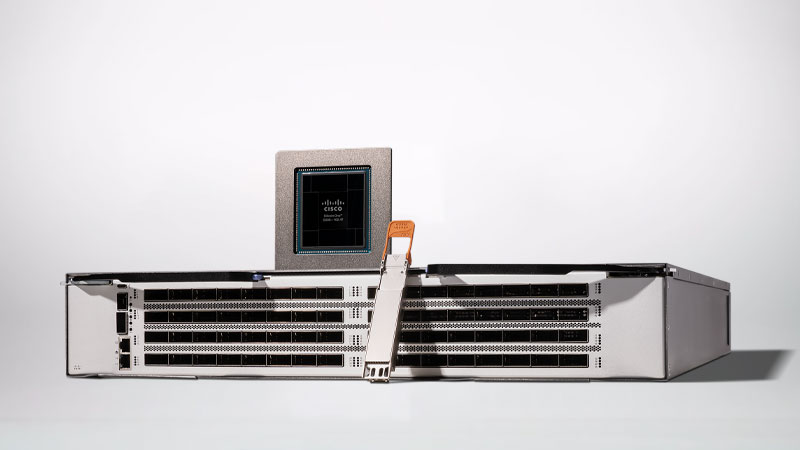
Cisco's counter is the breadth of the Nexus 9000 family plus the new Silicon One G300-based systems, the Cisco N9300 (enterprise) and Cisco 8100 (hyperscale), targeted for late-2026 availability at 102.4 Tbps of switching capacity. For buyers who need the data center fabric to talk natively to ACI-based campus policy, existing NX-OS tooling, or a single Cisco TAC relationship spanning switches, security, and compute, Cisco wins on total-architecture fit rather than raw fabric benchmarks. Browse current Nexus and Catalyst data center switching to compare specific PIDs.
Cisco vs Juniper (now HPE): what changed after the acquisition?
This comparison changed fundamentally in 2025. HPE closed its acquisition of Juniper Networks, folding Juniper's Mist AI-driven networking, EX-series switches, SRX firewalls, and Session Smart routing into a combined HPE Networking division, doubling HPE's networking business overnight and creating a competitor spanning campus, WAN, data center, and (via the separate HPE Aruba Networking line) Wi-Fi. Under the DOJ settlement tied to the deal, HPE must divest its Instant On campus/branch Wi-Fi business to a DOJ-approved buyer and auction a license to the Mist AIOps source code; as of mid-2026 court filings showed the Instant On sale still hunting for a buyer, and none of it removes the overlap between the Juniper and Aruba wireless lines inside HPE.
Where the combined HPE/Juniper story is genuinely strong: Mist AI's natural-language network assurance and self-driving RF troubleshooting lead most competitors on AIOps maturity, and Session Smart Routing is a simpler operational model for distributed branch WAN than legacy IWAN-style deployments. Where Cisco still leads: the sheer size of the Catalyst install base, tighter native integration between switching, wireless, ISE-based access control, and Secure Firewall, and, critically for this audience, a deeper bench of TAA-compliant SKUs across the campus and branch catalog, refreshed in 2026 around the new Catalyst 9550 core switch.
Cisco vs HPE Aruba: which wins for enterprise Wi-Fi?
Both vendors now ship Wi-Fi 7 hardware with comparable radio performance, Cisco's CW9178I against HPE Aruba's AP-755, both supporting tri-band 6 GHz Multi-Link Operation. The real difference is operating philosophy. Meraki is opinionated and turnkey: one cloud dashboard covers switching, wireless, security cameras, and SD-WAN, making it the default pick for retail chains, K-12 districts, and distributed mid-market sites with lean IT staff. Aruba Central (AOS-10) is more configurable and generally the stronger choice for very large or dense deployments, where AirMatch RF optimization and ClientMatch load balancing are decisive, think stadiums, hospitals, and large university campuses. Five-year TCO comparisons often come out in Aruba's favor on subscription licensing, though Meraki sometimes wins on operational labor cost for smaller IT teams; run the numbers on your own AP count and license tier rather than trusting a published percentage.
Neither answer is universal. Standardizing wireless across 40 branches with a two-person network team favors Meraki's simplicity. Covering a 20,000-seat arena or a research hospital with thousands of concurrent clients per floor is where Aruba's RF tuning depth earns its extra configuration overhead.
Cisco Secure Firewall vs Fortinet vs Palo Alto Networks
Fortinet, Palo Alto Networks, Check Point, and Cisco are the four names on most enterprise firewall shortlists. In Gartner's Magic Quadrant for Hybrid Mesh Firewall (the successor to the network firewall Magic Quadrant, published in August 2025 and again in September 2026), Fortinet, Palo Alto Networks, and Check Point are Leaders, while Cisco is placed as a Visionary. The split is fairly clean: Palo Alto Networks rates highest on "completeness of vision", its Panorama-based policy platform and Prisma cloud-security integration are the reference other vendors get measured against. Fortinet rates highest on execution, driven by custom ASIC silicon delivering strong throughput-per-watt and the largest installed base of the three (Fortinet now reports more than 1,000,000 customers). Cisco lands in the Visionary quadrant, and Gartner's reasoning is worth reading: strong secure-access and segmentation features, but overlapping product lines and weaker single-pane management. Secure Firewall (Firepower) is differentiated less by raw inspection benchmarks and more by how tightly it plugs into the rest of the Cisco stack, SD-WAN, ISE-based segmentation, and Hypershield, Cisco's fabric-embedded security architecture. Hypershield's distributed exploit protection has been generally available on Linux and Kubernetes workloads since August 2024 and on Cisco N9300 Smart Switches since 2025, giving customers virtual-patching coverage across switch ports and workloads ahead of formal CVE patches.
For a buyer already standardized on Cisco networking, Secure Firewall plus Hypershield is the lowest-friction security layer to add, it consumes the same telemetry as your switches and access points instead of bolting on a parallel management plane. For a greenfield security-first buyer with no existing Cisco footprint, Palo Alto or Fortinet are entirely defensible choices on their own merits.
Cisco vs Ubiquiti: is UniFi good enough for a growing business?
Ubiquiti's UniFi line wins on price outright. A 25-person office running Cisco Meraki can cost several times as much over five years as equivalent UniFi hardware, since UniFi carries no mandatory recurring license fees and Meraki hardware needs a current license to keep operating. For a genuinely small office with a handful of users and no compliance mandate, that math is hard to argue with. The gap shows as the business grows: UniFi firmware is less rigorously vetted before release, support is largely community-driven rather than vendor-backed with SLAs, and the security feature set, no equivalent to Meraki's Air Marshal wireless intrusion detection, no native adaptive policy enforcement, no DNS-layer security comparable to Cisco Umbrella, falls short the moment HIPAA, SOC 2, or FedRAMP documentation enters the conversation. UniFi hardware scales well past small-office client counts; the practical ceiling is organizational rather than technical, and it arrives the moment you need vendor SLAs, audited security documentation, or a TAC engineer on the phone at 2 a.m.
Where Cisco still wins outright
- Breadth of a single architecture, campus, data center, WAN, wireless, security, and collaboration built to share policy and telemetry, versus stitching together point products from multiple vendors.
- TAA-compliant catalog depth, Cisco offers TAA-compliant options (often the ++ part numbers) across most major hardware categories, not just a narrow federal sub-line; TAA status is still confirmed per part number and lot, but that breadth simplifies Trade Agreements Act compliance for GPC and federal procurement.
- Government/DoD procurement familiarity, Cisco gear has the longest track record moving through federal certification pipelines. Note that DISA sunset the DoDIN APL program on September 30, 2025 (remaining testing wrapped by December 31, 2025, and the repository of approved products stays available through FY2026), with cybersecurity requirements shifting to DISA's RME Vendor STIG program and interoperability governed by the UCR-CORE document. Platforms that completed DoDIN APL certification now carry that as a past credential rather than an active listing, but Cisco's long experience with DoD certification pipelines remains a real advantage over vendors with thinner federal sales history.
- One-throat-to-choke support, a single TAC relationship and a single Smart Account covering switching, security, and wireless licensing, instead of separate support contracts and separate license portals per vendor.
- Largest deployed base, more engineers trained on Cisco, more documentation, more third-party tooling built against Cisco APIs than any single competitor.
How to decide: a practical framework
Start from the workload, not the brand. Building an AI training cluster or hyperscale-style fabric? Put Arista and the new Silicon One-based Cisco N9300/8100 systems side by side. Refreshing a campus with heavy compliance requirements? Cisco's TAA-compliant Catalyst and ISE stack is the safer default over a still-consolidating HPE/Juniper portfolio. Wireless density your hardest problem? Benchmark Aruba AOS-10 against Meraki in your actual floor plan, not a vendor's marketing lab. Security the driver? Palo Alto and Fortinet both deserve a genuine bake-off against Secure Firewall, don't assume incumbency wins by default.
Because Uniqcli is an authorized Cisco partner, we quote Cisco hardware and licensing below list price and handle Smart Account setup and TAA/GPC procurement paperwork as part of the deal, but we'll tell you plainly when a competitor is the better technical fit for a specific domain. Browse the current Cisco catalog for TAA-compliant PIDs across campus, data center, security, and wireless, or request a quote and we'll scope the right mix for your environment.
Frequently asked questions
Who is Cisco's biggest competitor?
There's no single biggest competitor, it depends on the product category. Arista Networks leads in high-performance data center and AI-fabric switching. HPE, after acquiring Juniper Networks in 2025, is now the closest full-portfolio rival across campus, WAN, and data center. HPE Aruba Networking is the strongest wireless-specific challenger, and Fortinet and Palo Alto Networks are the top firewall competitors.
Is Arista better than Cisco?
Arista is generally considered stronger for hyperscale and AI-cluster data center switching, with EOS and CloudVision earning high marks for cloud-operator-style automation and low-latency fabric performance. Cisco remains stronger for buyers who need data center switching to integrate with campus, security, and wireless under one architecture and one TAC relationship, and for organizations needing TAA-compliant procurement paths.
Did HPE really buy Juniper Networks?
Yes. HPE closed its $14 billion acquisition of Juniper Networks in July 2025, combining Juniper's Mist AI-driven networking, EX switches, and SRX firewalls with HPE's existing portfolio under a new HPE Networking division. As part of the DOJ settlement, HPE must divest its Instant On campus/branch Wi-Fi business to a DOJ-approved buyer and license Juniper's Mist AIOps source code to a competitor; the Instant On sale was still unresolved as of mid-2026.
Is Ubiquiti a real alternative to Cisco for a small business?
For a small office with no compliance requirements and no need for vendor-backed support SLAs, UniFi's low upfront cost with no recurring license fees is compelling. Past that size, or anywhere HIPAA, SOC 2, or FedRAMP documentation is required, Cisco's vendor-backed support, security depth, and compliance documentation make it the safer choice.
Is Fortinet or Palo Alto Networks better than Cisco for firewalls?
Palo Alto Networks generally rates highest for security platform vision, Fortinet rates highest for execution and throughput efficiency via custom ASICs, and Cisco Secure Firewall differentiates through native integration with Cisco's broader networking stack plus Hypershield's fabric-embedded exploit prevention. Palo Alto Networks and Fortinet are Gartner Leaders in the Hybrid Mesh Firewall Magic Quadrant while Cisco is placed as a Visionary, so the right choice depends heavily on whether you are standardized on Cisco networking already.
What is the DoDIN APL and does Cisco still need to be on it?
DoDIN APL (Approved Products List) was DISA's certification list for products on Department of Defense networks. DISA sunset the program on September 30, 2025, completed remaining testing by December 31, 2025, and keeps the repository of approved products available through FY2026; cybersecurity requirements moved to DISA's RME Vendor STIG program and interoperability to the UCR-CORE document. A product that completed DoDIN APL certification carries that as a past credential, not a current listing, and Cisco's long track record in DoD certification processes remains an advantage under the replacement framework.
Uniqcli Team
The Uniqcli Team is an authorized Cisco partner specializing in Catalyst wireless, switching, datacenter fabric, licensing, and managed services for U.S. federal, state, local, and education customers. We scope Cisco bills of materials, validate procurement paths (TAA, FIPS, contract vehicles), and deliver design, deployment, and managed operations.
Ready to scope your Cisco build?
Build a quoteRelated reading
View all → Insights
Cisco Meraki for Government: FedRAMP, TAA, and the Gov Region
Meraki for Government is a separate, FedRAMP Moderate dashboard region with a FIPS firmware requirement. TAA is a different check, done per part number. Here is how the pieces fit on a real order.
September 12, 2026 · 11 min read Insights
Cisco ISE Alternatives Compared: When to Stay, When to Switch, and the NAC Trade-offs
An honest Cisco ISE alternative comparison against Aruba ClearPass, FortiNAC, Forescout, NPS, and cloud-native NAC, plus a clear framework for when to stay on ISE and when to switch.
June 9, 2026 · 10 min read Insights
The networking supercycle: what tripling AI traffic means for federal data center planning
Cisco leadership is calling this a networking supercycle, with AI traffic on track to triple inside three years. For federal data centers, that is a capacity, power, and procurement problem you size now, before the accelerators land on the loading dock.
June 4, 2026 · 11 min read Insights
When Wi-Fi 6E is still the right choice
Wi-Fi 7 is not automatically the upgrade your building needs. Here is the 2026 case for choosing Cisco Wi-Fi 6E when your clients, switching, density, and budget actually say so.
April 4, 2026 · 12 min read Insights
Is Wi-Fi 6E worth it, or should you skip to Wi-Fi 7
Wi-Fi 6E opened the 6 GHz band and still ships in capable Cisco access points, but Wi-Fi 7 adds Multi-Link Operation, 320 MHz channels, and 4K-QAM. Here is how to decide which one belongs in your next refresh, and when waiting actually costs you.
February 27, 2026 · 10 min read Insights
The cons of staying on Wi-Fi 6 instead of Wi-Fi 7
Wi-Fi 6 still carries most enterprise networks, and nobody is telling you it broke. But specifying it for new spend in 2026 quietly forfeits spectrum, density headroom, latency, and a full refresh cycle of economics. Here is what standing pat actually costs, in concrete terms.
February 22, 2026 · 12 min read