
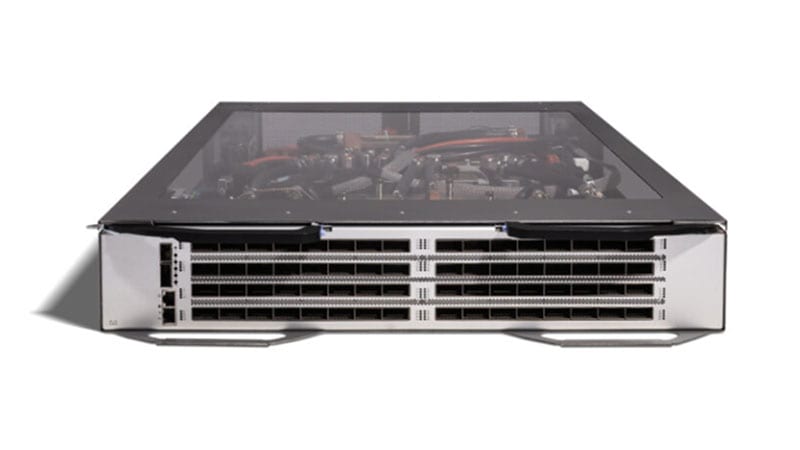
If you still run Cisco Nexus 3524-X switches (PID N3K-C3524P-10GX) as top-of-rack leaves, the clock is now the loud part of the conversation. This platform reached End of Sale on January 31, 2022, and its Last Day of Support (LDoS) is January 31, 2027. After that date Cisco issues no software fixes, no PSIRT security patches, and no TAC or RMA hardware replacement for this model. The switch keeps forwarding frames at the same sub-microsecond latency it always did, which is precisely why it lingers in trading fabrics and HPC racks long past the point where it should have been retired. This guide explains what each milestone means for a running fabric, why the recommended Nexus 93180YC-FX3 is a genuine generational jump rather than a like-for-like swap, and how to plan a controlled refresh.
What the Nexus 3524-X actually was
The 3524-X is a 1RU, 24-port SFP+ switch delivering 1/10 Gigabit Ethernet on every port (480 Gbps non-blocking). Its claim to fame was never density, it was latency: Cisco's Algo Boost technology pushed port-to-port forwarding down into the roughly 190-250 nanosecond range, which is why the 3500 line became a fixture in high-frequency trading, market-data distribution, and tightly coupled HPC clusters. Algo Boost also brought hardware features that mattered to those buyers: line-rate Layer 2/3 NAT, Active Buffer Monitoring for microburst visibility, hardware IEEE 1588v2 PTP for sub-microsecond time sync, and warp mode for the absolute lowest latency. It runs standalone NX-OS, draws relatively little power, and was sized for a single dense rack of 10G servers feeding upstream spines.
The hardware limitation is structural. Twenty-four ports of 10G with no native 25G or 100G means the 3524-X cannot front modern servers (which ship 25G NICs as standard) and cannot ride 100G spine uplinks without a media-conversion penalty. The ASIC generation predates VXLAN/EVPN at the scale data centers now expect, and the limited table sizes and buffer architecture cap what you can layer on top. It was a precision instrument for one job; the rest of the fabric moved on around it.
Why acting now matters
The risk in an EoL switch is not that it fails on day one. It is that it keeps running while the entire support floor disappears beneath it. Three exposures stack up the moment LDoS passes:
- No PSIRT security patches. When a new NX-OS vulnerability is disclosed, the 3524-X will not get a fixed image. Whatever build it is frozen on is the build it dies on, and any CVE in that code path on this platform is permanent and unremediable.
- No TAC or RMA. A failed unit cannot be opened as a support case or swapped under a service contract. Your only recovery is a spare you stockpiled before LDoS or a secondary-market unit of the same dead-end model, a poor position for a switch sitting in a revenue-bearing trading path.
- Audit and compliance exposure. The frameworks federal, DoD, SLED, and healthcare buyers operate under (FedRAMP, CMMC 2.0, HIPAA Security Rule, PCI DSS, and CISA BOD directives) expect supported, patchable infrastructure. An unsupported, unpatchable data-center switch is a finding waiting to be written, and 'the vendor no longer ships fixes' is not a defensible remediation plan.
What each milestone date means in practice
- End of Sale (2022-01-31): the last day Cisco accepted new orders. Everything after this date is drawing down the support tail, not extending it.
- Last Day of Support / LDoS (2027-01-31): the hard wall. No TAC, no RMA, no software or security fixes of any kind. From this date the hardware is entirely on its own.
- The window between the two is your planning runway. Budgeting, lab validation, and phased cutover all need to land before January 2027, and on long-lead optics and TAA-compliant hardware that timeline is tighter than it looks.
The recommended replacement: Nexus 93180YC-FX3
Cisco's migration path for the 3500 line is the Nexus 9300 family, specifically the 93180YC-FX3 (N9K-C93180YC-FX3). It is built on Cisco's Cloud Scale ASIC and is a different class of machine. In one 1RU box you get 48 downlink ports at 1/10/25-Gbps (SFP28) plus 6 uplink ports at 40/100-Gbps (QSFP28), for 3.6 Tbps of switching capacity. That is twice the port count of the 3524-X with every downlink capable of 25G and every uplink capable of 100G, the exact two speeds the older switch could not reach.
For this product type, the concrete gains are:
- 25G to the server, 100G to the spine. Modern compute ships 25G NICs and leaf-spine fabrics are 100G; the FX3 speaks both natively, eliminating the breakout and media-conversion gymnastics a 10G-only 3524-X forces.
- Latency stays competitive. The Cloud Scale ASIC keeps forwarding in the sub-microsecond range, so latency-sensitive HFT and HPC workloads keep the low-latency behavior the 3500 was bought for, now with hardware PTP, SyncE, and high-resolution timestamping for time-sensitive trading.
- VXLAN/EVPN and dual-mode operation. The FX3 runs standalone NX-OS or as an ACI leaf, with hardware VXLAN bridging/routing and EVPN, the spine-leaf and overlay capabilities the 3524-X never had.
- Line-rate security and telemetry. MACsec encryption on the ports, plus streaming telemetry, sFlow, and Cisco's flow-table analytics give you the visibility and data-in-motion protection that compliance regimes increasingly require.
- NX-OS Smart Licensing. The FX3 uses Smart Licensing Using Policy with tiered NX-OS feature licenses (Essentials and Advantage, with optional add-ons). Entitlements live in your Smart Account and follow the deployment rather than being baked into a feature set per box, which simplifies audits and true-ups.
A practical migration plan
1. Assessment and inventory
Pull the exact PID, serial, NX-OS version, and per-port utilization from every 3524-X in the fabric. Flag which ports are doing real 10G work versus sitting idle, capture the latency-sensitive flows (PTP domains, multicast market-data groups, warp-mode interfaces), and document upstream spine connectivity. This inventory is also what an authorized partner needs to quote accurately and to confirm TAA status on the replacements.
2. License transition
Stand up (or confirm) a Cisco Smart Account and Virtual Account before hardware lands. Map the NX-OS features you actually use on the 3524-X to the FX3 tiers (most leaf functions land in Essentials; VXLAN/EVPN and advanced segmentation pull in Advantage). Pre-stage the licenses so the new switches register on first boot instead of running in evaluation mode.
3. Config and feature parity
Do not blind-paste old configs. NX-OS has moved on, and several 3500-era constructs (warp mode, specific Algo Boost knobs) map to different mechanisms on Cloud Scale. Rebuild the config around FX3 equivalents, hardware PTP profiles, buffer and microburst monitoring, NAT where still needed, and validate latency and PTP accuracy in a lab against your actual traffic profile before any production port moves. For HFT fabrics, measure port-to-port latency on the bench so the trading desk signs off on numbers, not promises.
4. Physical: rack, power, uplinks, optics
The FX3 is 1RU like the 3524-X but draws more power and pushes more heat, so confirm per-rack power budget and that front-to-back versus back-to-front airflow matches your hot and cold aisle. Plan optics deliberately: 10G servers can reuse SFP+ optics in the SFP28 cages, but the upgrade value is in moving servers to 25G (SFP28) and spines to 100G (QSFP28). Optics and DAC/AOC cabling are frequently the longest-lead and most underestimated line items, so order them with the switches.
5. Phased cutover
Migrate rack by rack, never the whole fabric at once. Cable an FX3 in parallel with the 3524-X it replaces, bring it up on the spine, validate routing, overlay, and latency, then move server connections in maintenance windows. Keep the old switch powered and reversible until the new leaf has carried production load cleanly through a full business cycle (for trading, a full market session including open and close).
6. Secure decommission
Once retired, wipe NX-OS configuration and any stored credentials and keys, then dispose through a process that satisfies your data-handling and chain-of-custody requirements: NIST 800-88 media sanitization and a certificate of destruction for federal, DoD, and healthcare environments. Do not let a decommissioned switch with live config sit on a shelf.
Procurement notes for regulated buyers
For federal, DoD, and SLED purchases, confirm TAA-compliant country of origin and request the relevant documentation up front; the FX3 is available in TAA-compliant configurations through authorized channels. If your agency's own GSA or GPC vehicle applies to this purchase, line up the SKUs and licenses against that contract early. Switch and optics lead times move with demand, so a refresh aimed at the January 2027 LDoS should be scoped and ordered well ahead of that wall. Buying through an authorized Cisco partner protects warranty, Smart Licensing entitlement, and TAA traceability; gray-market FX3 units can void support and break the very compliance posture you are refreshing to fix.
Start with the live milestone record on the Nexus 3524-X EoL detail page, browse the broader Cisco end-of-life catalog to catch other aging gear in the same racks, and check current Nexus 9300 availability and pricing. When you are ready to scope the refresh, get a quote and we will map your 3524-X fleet to TAA-compliant 93180YC-FX3 hardware, optics, and NX-OS licensing before the support wall arrives.
Frequently asked questions
When does the Cisco Nexus 3524-X reach end of support?
The Nexus 3524-X (N3K-C3524P-10GX) reached End of Sale on January 31, 2022, and its Last Day of Support (LDoS) is January 31, 2027. After LDoS there are no software fixes, no PSIRT security patches, and no TAC or RMA hardware replacement for the platform.
What replaces the Nexus 3524-X?
Cisco's recommended migration is the Nexus 9300 family, specifically the 93180YC-FX3 (N9K-C93180YC-FX3). It provides 48 ports of 1/10/25G plus 6 ports of 40/100G in 1RU on the Cloud Scale ASIC, double the density of the 3524-X with native 25G and 100G the older switch could not reach.
Will I lose the low-latency behavior I bought the 3524-X for?
No. The 3524-X used Algo Boost for sub-microsecond forwarding in HFT and HPC fabrics. The 93180YC-FX3's Cloud Scale ASIC keeps forwarding in the sub-microsecond range and adds hardware PTP, SyncE, and high-resolution timestamping. Validate port-to-port latency on the bench against your traffic profile before cutover so the trading desk signs off on measured numbers.
How does licensing change moving from the 3524-X to the FX3?
The FX3 uses NX-OS Smart Licensing Using Policy with tiered feature licenses (Essentials and Advantage, plus optional add-ons) held in your Smart Account. Most leaf functions fall under Essentials; VXLAN/EVPN and advanced segmentation pull in Advantage. Set up the Smart Account and pre-stage entitlements before hardware arrives so switches register on first boot.
Is the Nexus 93180YC-FX3 available TAA-compliant for federal buyers?
Yes. The 93180YC-FX3 is available in TAA-compliant configurations through authorized channels. For federal, DoD, and SLED purchases, request country-of-origin documentation up front and align SKUs and licenses to your agency's own GSA or GPC contract early, since switch and optics lead times can be long ahead of the January 2027 LDoS.
Uniqcli Team
The Uniqcli Team is an authorized Cisco partner specializing in Catalyst wireless, switching, datacenter fabric, licensing, and managed services for U.S. federal, state, local, and education customers. We scope Cisco bills of materials, validate procurement paths (TAA, FIPS, contract vehicles), and deliver design, deployment, and managed operations.
Ready to scope your Cisco build?
Build a quoteRelated reading
View all → Guides
Cisco Catalyst 4900M EoL: Migrate to Nexus 9300 (93180YC-FX3)
The Catalyst 4900M (WS-C4900M) passed Last Day of Support on October 5, 2021. Here's why it has to leave the rack and how to migrate cleanly to the Nexus 9300 N9K-C93180YC-FX3 top-of-rack switch.
May 5, 2026 · 8 min readGuidesCisco Nexus 9396PX EoL: Migrate to Nexus 93180YC-FX3
The Nexus 9396PX (N9K-C9396PX) passed Last Day of Support on February 19, 2023, here is why this original 9300 leaf has to come out and how to refresh cleanly to the Cloud Scale 93180YC-FX3.
April 2, 2026 · 10 min readGuidesCisco Nexus 5548P EoL: Migrate to Nexus 9300 (93180YC-FX3)
The Nexus 5548P passed Last Day of Support on September 30, 2020, no patches, no TAC, no RMA. Here is why it must come out of the rack and how to migrate cleanly to the Nexus 9300 (N9K-C93180YC-FX3).
May 27, 2026 · 8 min readGuidesNexus 3064 EoL: Migration to Nexus 9300 (93180YC-FX3)
The Nexus 3064 (N3K-C3064PQ-10GE) passed Last Day of Support on June 30, 2021. Here's why it must come out and how to migrate cleanly to the Nexus 9300 (N9K-C93180YC-FX3), 25G access, 100G uplinks, VXLAN/EVPN, and MACsec.
May 9, 2026 · 8 min readGuidesNexus 9372PX EoL: Migrate to the Nexus 93180YC-FX
The Nexus 9372PX (N9K-C9372PX) passed Last Day of Support on February 28, 2023. Here is what each milestone means, why a first-gen 10G leaf has to come out, and how to refresh cleanly to the Cloud Scale Nexus 93180YC-FX.
February 12, 2026 · 8 min readGuidesCisco Nexus 6001-64T EoL: Migrate to Nexus 93180YC-FX3
The Nexus 6001-64T (N6K-C6001-64T) passed Last Day of Support on April 30, 2022. Here is what each milestone means, why the 10GBASE-T top-of-rack switch has to come out, and how to refresh cleanly to the Cloud Scale Nexus 93180YC-FX3.
April 19, 2026 · 7 min read