
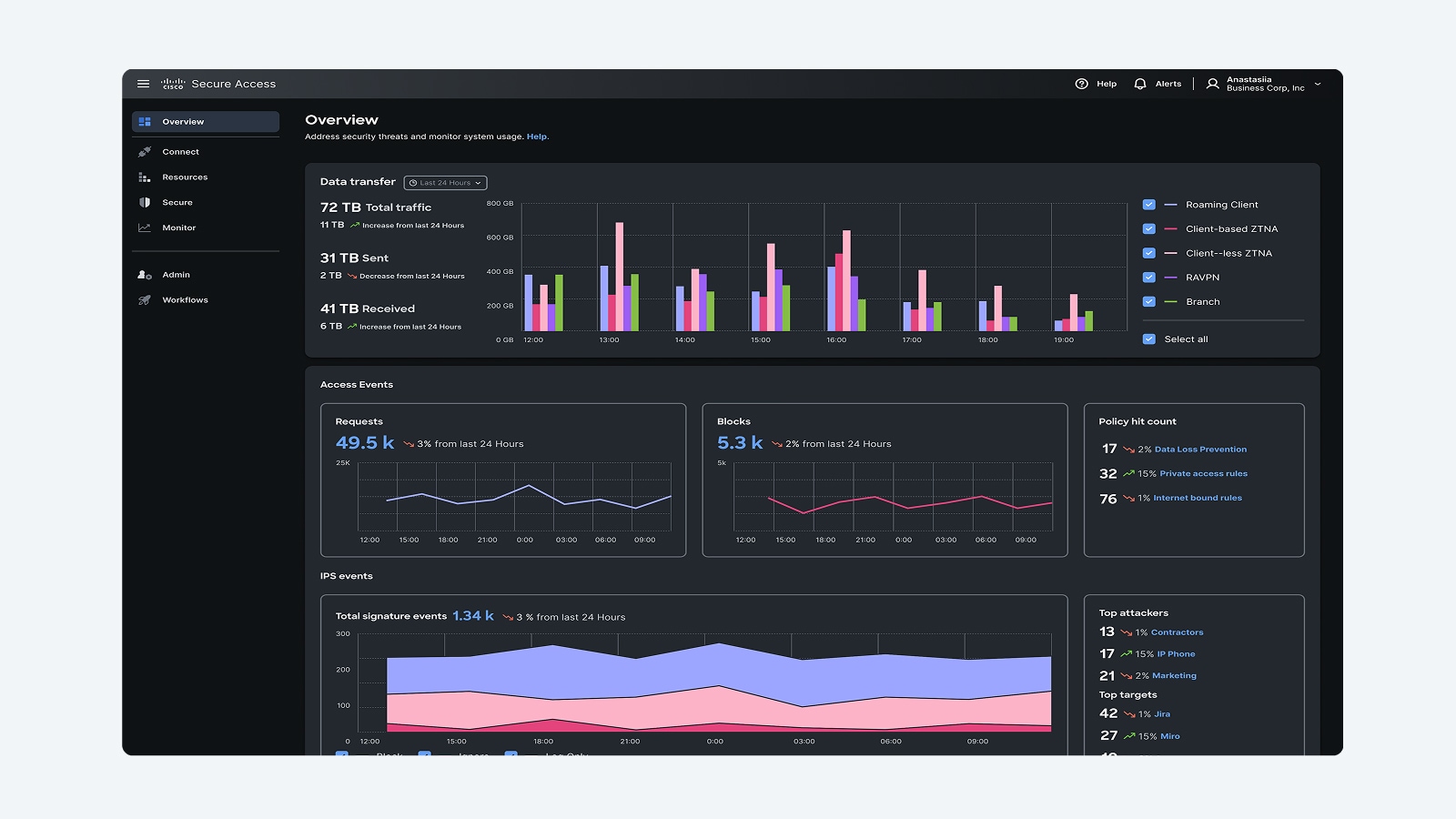
Cisco Secure Endpoint vs CrowdStrike Falcon is a comparison worth having honestly rather than as a sales pitch. CrowdStrike Falcon has built the strongest mindshare in endpoint detection and response of any platform on the market, consistently referenced as a category leader by analysts and SOC teams alike, with a lightweight agent and a large, well-known threat-intelligence operation behind it. Cisco Secure Endpoint, the current name for the platform many still call Cisco AMP for Endpoints, is a mature EDR with a genuinely different center of gravity: retrospective detection and native correlation into the rest of the Cisco security stack.
Short version: if endpoint detection efficacy and analyst-facing threat-hunting tools are the top decision criteria on their own, CrowdStrike's reputation in that specific category is hard to argue with. If you are already standardized on Cisco network and security infrastructure and want endpoint telemetry correlated automatically with network, identity, email, and DNS signal instead of living in a separate console, Cisco Secure Endpoint closes that gap in a way a standalone EDR agent cannot by itself.
At a glance
Both are cloud-managed, lightweight-agent EDR platforms. The difference is what surrounds the agent.
| Dimension | Cisco Secure Endpoint | CrowdStrike Falcon |
|---|---|---|
| Architecture | Cloud-managed agent with Talos-backed cloud intelligence and continuous retrospective file analysis | Cloud-native lightweight agent built around real-time indicators of attack and heavy behavioral machine learning |
| Deployment | Single lightweight agent, cloud console; integrates directly if you already run Cisco network security | Single lightweight agent, cloud console; widely cited for a minimal performance footprint and fast rollout |
| Identity & integration | Native telemetry source for Cisco XDR, correlated with network, email, identity, and DNS | Broad third-party marketplace (Falcon Fusion/Store); also ingestible as a curated source into Cisco XDR |
| Licensing model | Per-endpoint tiered SaaS subscription | Per-endpoint tiered SaaS subscription across Falcon modules |
| Ecosystem | Part of Cisco Security Cloud, Talos, XDR, ISE, SecureX-style automation | Falcon platform modules, Identity Protection, Cloud Security, Exposure Management, LogScale |
| Ops overhead | Lower incremental overhead for existing Cisco shops via shared XDR console context | A dedicated console, widely regarded as a refined, analyst-focused SOC workflow |
Detection engine and threat-hunting pedigree
Being direct about where the category currently sits: CrowdStrike has earned its reputation. Its behavioral detection engine, real-time indicators of attack, and the depth of its own threat-intelligence and managed-hunting operation are consistently cited as best-in-class by independent analysts and by SOC teams who have run both platforms side by side. If the primary requirement is the sharpest possible EDR detection engine on its own merits, evaluated in isolation from what else you run, CrowdStrike's track record in that specific lane is the one to beat, and pretending otherwise would not serve you.
Retrospective security and Talos intelligence
Cisco's differentiation is not trying to out-detect CrowdStrike feature for feature. Secure Endpoint's retrospective security model keeps watching a file after it has already been allowed to run: if new intelligence later convicts a file that looked clean at execution time, Secure Endpoint can retroactively flag and remediate it across every endpoint it touched, not just the one where it was first seen. That continuous re-evaluation is backed by Talos, one of the largest private threat-intelligence teams in the industry, drawing on Cisco's broad visibility across email, network, and DNS traffic in addition to endpoint telemetry, so the intelligence feeding Secure Endpoint is not endpoint-only in origin.
How each plugs into a broader XDR or SOC workflow
Here is the nuance worth knowing before assuming this is a binary choice: CrowdStrike Falcon itself is a supported, curated telemetry source inside Cisco XDR, alongside Secure Endpoint, SentinelOne, and Microsoft Defender for Endpoint. That means an organization can keep Falcon as its endpoint agent and still get Cisco's network-led correlation layer on top of it, rather than treating the endpoint choice and the correlation-layer choice as the same decision. Secure Endpoint's advantage inside that same architecture is that the integration is native rather than an ingested third-party source, which tends to mean tighter timeline correlation and fewer configuration steps to get endpoint and network evidence into one incident view.
Cost and consolidation for existing Cisco shops
Neither vendor publishes flat per-endpoint list pricing, and both scale cost by endpoint count, tier, and add-on modules, so any number you see quoted online should be treated as a starting point rather than a budget figure. Where the comparison becomes more than a feature checklist is total operating cost for an organization already running Cisco firewall, identity, and network infrastructure: consolidating endpoint detection onto Secure Endpoint reduces the number of separate vendor relationships, consoles, and support contracts to manage, and lets endpoint licensing potentially layer onto an existing Cisco agreement. CrowdStrike's cost case is strongest when endpoint detection quality is being evaluated as its own budget line, independent of what else is already in the stack.
A note on multi-vendor reality
It is worth naming plainly that a meaningful share of organizations end up running CrowdStrike on the endpoint while still wanting Cisco's network-aware correlation, and that is a perfectly workable architecture rather than a compromise. The decision to swap an already-mature CrowdStrike deployment purely to get native XDR integration is rarely worth the migration cost and retraining on its own; feeding Falcon into Cisco XDR usually gets most of the correlation benefit without touching the endpoint agent at all. The stronger case for Secure Endpoint specifically is a green-field decision or a genuine consolidation effort, not a forced rip-and-replace of a working CrowdStrike estate.
Which should you choose?
Weigh detection-engine reputation against how much value you get from native correlation into an existing Cisco estate.
Choose CrowdStrike Falcon if
- Endpoint detection efficacy and analyst-facing threat-hunting tools are the top priority, evaluated on their own merits
- You run a multi-vendor network and do not want endpoint choice tied to any single network security vendor
- Your SOC already standardizes on Falcon's console and workflow and has built expertise around it
- You want the broadest third-party Falcon module ecosystem, including identity and cloud security add-ons
Choose Cisco Secure Endpoint if
- You already run Cisco firewall, ISE, or Cisco XDR and want endpoint telemetry natively correlated, not ingested from a third party
- Retrospective detection backed by Talos threat intelligence fits how your team wants to handle newly convicted files
- Reducing the number of separate security vendors and consoles is an active goal, not just a nice-to-have
- You are making a green-field EDR decision rather than displacing an already-mature CrowdStrike deployment
Frequently asked questions
Is Cisco Secure Endpoint the same as Cisco AMP?
Yes. Cisco Secure Endpoint is the current name for the platform many teams still call Cisco AMP for Endpoints. It provides continuous behavioral monitoring, retrospective security, and endpoint isolation, and it integrates as a native telemetry source into Cisco XDR.
Is CrowdStrike better than Cisco Secure Endpoint?
It depends on what you are optimizing for. CrowdStrike Falcon holds strong, well-earned mindshare specifically in endpoint detection engine quality and analyst-facing threat-hunting tools. Cisco Secure Endpoint's advantage is retrospective detection backed by Talos intelligence and native correlation into a broader Cisco security stack. Neither claim of "better" holds up independent of your existing environment and priorities.
Can CrowdStrike Falcon feed into Cisco XDR?
Yes. CrowdStrike Falcon is a supported, curated third-party endpoint telemetry source for Cisco XDR, alongside SentinelOne and Microsoft Defender for Endpoint. This lets an organization keep Falcon as its endpoint agent while still getting Cisco's network-led correlation layer on top of it.
Which has a lighter endpoint footprint, Secure Endpoint or CrowdStrike?
Both are built as lightweight, cloud-managed agents, and real-world performance depends heavily on host configuration, other installed security tools, and workload type. Rather than rely on a general claim either way, validate footprint against your own device images before a full rollout.
How is Cisco Secure Endpoint licensed?
Cisco Secure Endpoint is sold as a per-endpoint, tiered SaaS subscription. Cisco does not publish flat list pricing, so the accurate number comes from a validated quote sized to your endpoint count and required capabilities.
Uniqcli Team
The Uniqcli Team is an authorized Cisco partner specializing in Catalyst wireless, switching, datacenter fabric, licensing, and managed services for U.S. federal, state, local, and education customers. We scope Cisco bills of materials, validate procurement paths (TAA, FIPS, contract vehicles), and deliver design, deployment, and managed operations.
Ready to scope your Cisco build?
Build a quoteRelated reading
View all → Insights
Cisco XDR vs Secure Endpoint vs SIEM: Which Detection Layer Do You Actually Need?
Cisco XDR vs Secure Endpoint vs SIEM, decoded: EDR watches the host, a SIEM hoards the logs, and XDR correlates across both. Here is how each layer fits, where each one stops, and how to decide what your team actually needs.
June 13, 2026 · 11 min read Guides
Fortinet vs CrowdStrike: NGFW or EDR? (They're Not Rivals)
Fortinet vs CrowdStrike is one of the most-searched security comparisons, and also one of the most confused, a next-generation firewall and an endpoint detection platform aren't competing for the same budget line. Here's how they actually fit together.
July 12, 2026 · 6 min readGuidesZscaler vs Cisco Secure Access: SSE Platforms Compared
Zscaler vs Cisco Secure Access weighs proxy-first SSE maturity against a converged platform built on Umbrella and Duo for teams migrating off traditional VPN and AnyConnect.
July 11, 2026 · 5 min readGuidesUmbrella SIG vs Zscaler ZIA: Secure Internet Gateways
Umbrella SIG vs Zscaler ZIA is an architecture question: a DNS-first layer with a proxy behind it, versus a single proxy that inspects everything, every time. Here is what actually differs.
July 11, 2026 · 5 min readGuidesCisco UTM Appliances Compared: Meraki MX vs Secure Firewall
A UTM appliance comparison for Cisco buyers: what UTM vs NGFW naming really means, then how Meraki MX and Secure Firewall stack up as Cisco's two UTM-style paths.
July 11, 2026 · 6 min readGuidesCisco Secure Firewall vs Check Point: Enterprise NGFW Comparison
Cisco Secure Firewall vs Check Point, compared on management, ecosystem integration, and licensing, with the real-world scenarios where each enterprise NGFW platform wins.
July 11, 2026 · 6 min read