

Every time a laptop, phone, IP camera, or medical device plugs into a switch port or joins a corporate SSID, your network faces a quiet question: should this thing be allowed on, and if so, with what privileges? The IEEE 802.1X standard exists to answer that question at the moment of connection, before any production traffic flows. It is the technical layer that makes real network access control possible, and it is the foundation that Cisco builds on with the Identity Services Engine.
This guide walks the 802.1X handshake end to end. We will define the three roles that every deployment depends on, follow the EAP and RADIUS messages that complete an authentication, look at how authentication methods and MAC Authentication Bypass fit together, and show where Cisco ISE acts as the policy brain that turns a yes-or-no port decision into enforceable, least-privilege access. If you administer wired, wireless, or VPN access, this is the mechanism beneath your zero-trust strategy.
What Is 802.1X and Why Port-Based Control Matters
802.1X is an IEEE standard for port-based network access control. The core idea is simple and powerful: a network port stays logically closed to ordinary traffic until the device behind it proves who or what it is. Before authentication succeeds, the only frames the port will pass are the authentication messages themselves. Once the device is validated, the port opens and applies whatever access policy the back-end server returned.
This matters because the alternative is an open network. Without port-based control, anyone who finds a live wall jack or guesses a pre-shared key can reach internal resources. 802.1X closes that gap by making identity the precondition for connectivity. It is the difference between a building where every door is propped open and one where each door checks a badge. That shift from implicit trust to verified access is exactly what the network access control discipline is built on, and 802.1X is its enforcement point at the physical and wireless edge.
Crucially, 802.1X is not limited to copper switch ports. The same model governs wireless SSIDs, VPN headends, and 5G connections. Wherever a device asks to join the network, the standard provides a consistent way to authenticate it first. That breadth is what lets a single policy follow a user from their desk to the boardroom Wi-Fi to a remote VPN session.
The Three Roles: Supplicant, Authenticator, and Authentication Server
Every 802.1X exchange involves three participants. Understanding what each one does, and what each one does not do, is the key to troubleshooting and to designing a sane policy.
The Supplicant
The supplicant is the software on the endpoint that speaks 802.1X. It presents credentials when the network asks for them. On managed Windows and macOS machines this is typically the built-in operating system supplicant or an agent such as Cisco Secure Client (formerly AnyConnect). The supplicant holds the identity, whether that is a digital certificate, a username and password, or a machine account, and it negotiates how that identity is proven.
The Authenticator
The authenticator is the switch port or wireless access point the device connects to. It is the gatekeeper, but importantly it is not the decision-maker. The authenticator enforces the port state (closed, then open with a policy) and relays messages between the supplicant and the server. It speaks 802.1X toward the endpoint and RADIUS toward the server, translating between the two. A Cisco Catalyst or Meraki switch acting as an authenticator does not know whether a certificate is valid; it only knows how to ask the server and apply the answer.
The Authentication Server
The authentication server is the brain. It receives the credentials, validates them against an identity store such as Active Directory or Microsoft Entra ID, evaluates policy, and returns an authorization decision. In a Cisco environment this is the Identity Services Engine. The server is where the real intelligence lives, and it is what separates a basic deployment from a true policy-driven one. We will return to ISE specifically once the handshake is clear.
Remember the division of labor: The supplicant proves identity, the authenticator enforces the port and relays messages, and the authentication server makes the decision. When 802.1X breaks, the first diagnostic question is always: which of the three roles is the failure in? A switch logging RADIUS timeouts points at the server path; a device that never sends EAP points at the supplicant.
The 802.1X Handshake, Step by Step
With the roles defined, here is how an authentication actually unfolds. The exchange uses two transport layers: EAP (Extensible Authentication Protocol) carried over LAN as EAPOL between the supplicant and the authenticator, and RADIUS between the authenticator and the server. EAP is the language of credentials; RADIUS is how the switch consults the server.
- Link up and initiation: The device connects and the port enters an unauthorized state. Either the switch sends an EAP-Request-Identity, or the supplicant kicks things off with an EAPOL-Start. Only authentication frames are allowed at this point.
- Identity request and response: The authenticator asks for an identity, and the supplicant replies with its identity (for example, a username or a certificate subject). The switch wraps this response in a RADIUS Access-Request and forwards it to the authentication server.
- Method negotiation and challenge: The server selects an EAP method and issues a challenge. This back-and-forth, relayed faithfully by the authenticator, is where the actual credential validation happens, such as verifying a certificate chain or completing a TLS tunnel.
- Decision: The server validates the credentials against its identity store and policy, then returns a RADIUS Access-Accept or Access-Reject. With an Accept, it can also include authorization attributes: a VLAN to assign, a downloadable ACL, a URL redirect, or a Security Group Tag.
- Port authorization: On an Accept, the authenticator moves the port to an authorized state and applies the returned policy. The device now passes traffic, but only within the limits the server dictated. On a Reject, the device is denied, quarantined, or redirected per policy.
The whole sequence completes in well under a second on a healthy network. The elegant part is that the authenticator never has to understand the credentials. It blindly relays EAP inside RADIUS and trusts the server's verdict, which is why one ISE deployment can serve thousands of switches and access points uniformly.
EAP Methods and the Role of Certificates
EAP is a framework, not a single method, and the method you choose defines how strong your authentication is. Cisco ISE acts as a full RADIUS AAA server supporting a broad range, including PAP, MS-CHAP, EAP-MD5, PEAP, EAP-FAST, EAP-TLS, EAP-TTLS, and TEAP. For most security-conscious organizations the conversation comes down to a few options.
- EAP-TLS: Certificate-based mutual authentication on both the client and server side. It is the gold standard for 802.1X because there is no password to phish or replay, only a private key the device must possess. It does require a certificate lifecycle, which ISE can help provision through its built-in certificate authority and onboarding portals.
- PEAP and EAP-TTLS: These wrap a credential exchange (often username and password) inside a server-authenticated TLS tunnel. They are easier to roll out than full client certificates but depend on protecting those credentials and on clients validating the server certificate properly.
- TEAP and EAP chaining: TEAP allows EAP chaining, which validates both the machine and the user within a single authentication session. This answers a real-world need: you can require that a device is both a corporate-owned machine and operated by an authorized user, rather than accepting either alone. EAP-FAST supports chaining as well.
The takeaway for administrators is that 802.1X is only as strong as the EAP method behind it. Certificate-based EAP-TLS, paired with EAP chaining for machine-and-user assurance, is where high-security and government environments tend to land. Cisco ISE's internal CA with OCSP-based revocation makes the certificate side manageable rather than a deal-breaker.
When Devices Cannot Authenticate: MAC Authentication Bypass
Not every device can run a supplicant. Printers, badge readers, IP cameras, building sensors, and a large share of IoT, OT, and connected medical devices simply have no way to present 802.1X credentials. Locking them out is not an option, but leaving their ports open defeats the purpose of access control. The standard answer is MAC Authentication Bypass (MAB).
With MAB, when a device fails or skips 802.1X, the switch captures its MAC address and sends that to the RADIUS server as the identity. The server checks whether the MAC is a known, approved endpoint and returns an authorization decision just as it would for a fully authenticated device. MAB is weaker than 802.1X on its own because MAC addresses can be spoofed, which is exactly why it should never stand alone. It needs to be paired with profiling, and that is where the policy server earns its keep.
Cisco ISE does not just check a MAC against a list. It profiles and classifies the endpoint, using predefined templates plus a cloud-based Multi-Factor Classification machine-learning engine that fingerprints unknown IoT, medical, and OT devices by manufacturer, model, OS, and type. So a device claiming to be a particular infusion pump can be checked against how that class of device actually behaves on the network. If a workstation suddenly appears on a port profiled for a printer, policy can flag or contain it. This combination of MAB plus profiling is central to how Cisco delivers practical network access control for the messy reality of modern device fleets.
Cisco ISE as the Policy Brain Behind 802.1X
A bare RADIUS server can complete the handshake described above and say yes or no. That is necessary but not sufficient for zero trust. The reason enterprises, federal agencies, healthcare systems, and SLED organizations standardize on Cisco ISE is that it turns the raw 802.1X decision into a rich, context-aware policy outcome. ISE is the policy decision point: it authenticates, profiles, checks posture, and authorizes every endpoint, then continuously enforces policy based on identity and context.
Several capabilities sit on top of the basic authentication flow and change what an Access-Accept can mean:
- Posture assessment: Before fully trusting a device, ISE can verify its health, checking OS patch level, antivirus status, disk encryption, and more through Cisco Secure Client, with automatic remediation for devices that fall short. An authenticated but non-compliant laptop can be granted only restricted access until it is fixed. Posture is part of the Premier tier.
- TrustSec and Security Group Tags: Instead of writing access rules around fragile IP addresses, ISE can return a Security Group Tag with the authorization. That tag follows the user and device across switches, routers, wireless, and firewalls, enabling micro- and macro-segmentation that limits lateral movement if a device is ever compromised. Segmentation enforcement is part of the Advantage tier.
- Guest and BYOD lifecycle: ISE stands up branded guest portals and self-service device onboarding with automated supplicant and certificate provisioning, including SAML 2.0 support, so visitors and personal devices get appropriate, separated access without a help-desk ticket.
- Rapid Threat Containment: Through pxGrid and Adaptive Network Control, ISE can quarantine, bounce, or shut down a port for an endpoint that becomes compromised or shows up as vulnerable. Threat-Centric NAC can change access automatically based on CVSS and threat scores from tools such as Tenable.
This is the difference between authentication and access control. 802.1X gets a verified identity to the door; ISE decides, per connection and continuously, what that identity is actually allowed to do, and adjusts when conditions change. It also shares this context with the broader Cisco security stack, including feeding identity and device context into Cisco XDR so security incidents carry the identity behind the activity.
Deployment Realities and Common Pitfalls
Rolling out 802.1X is as much an operations exercise as a security one. A few realities consistently separate smooth deployments from painful ones.
- Run in monitor mode first: Cisco supports a monitor or open mode where 802.1X authenticates and logs but does not yet block. Use it to discover every device, find the ones that need MAB, and fix misconfigured supplicants before you flip to closed mode and risk locking out a clinical floor or a production line.
- Plan the MAB and profiling inventory: The devices that cannot authenticate are usually the ones that cause outages. Profile them thoroughly before enforcement so you are not writing emergency exceptions during a cutover.
- Validate server certificates on clients: A surprising share of PEAP problems trace back to clients that do not validate the server certificate, which both breaks the trust model and causes confusing failures. Certificate-based methods avoid much of this but require lifecycle planning.
- Design for availability: ISE runs as distributed clusters across physical Secure Network Server appliances, virtual machines, or public cloud, precisely so that a node failure does not take authentication offline. If RADIUS is unreachable, every new connection fails, so redundancy is not optional.
- Confirm certifications for regulated environments: For US public sector buyers, the certified release matters. ISE is designed to meet FIPS 140, Common Criteria (NDcPP), and DoDIN APL requirements, supports DoD Common Access Card administrator login, and maps to the identity and device pillars of the CISA Zero Trust Maturity Model, but certification status varies by release and should be confirmed at quote time.
Because the appliance hardware, licensing tier (Essentials, Advantage, or Premier), and the separate Device Administration license for TACACS+ all factor into a deployment, scoping the right configuration up front saves rework. As an authorized Cisco partner, Uniqcli can source TAA-compliant Secure Network Server appliances and the appropriate ISE licensing through GSA and other government purchasing vehicles, and confirm the FIPS and Common Criteria status of the specific release. You can start that conversation by requesting a quote at /quote or reviewing available hardware on the catalog.
Bringing It Together: From Handshake to Zero Trust
802.1X is the unglamorous but essential mechanism underneath modern access control. A supplicant presents identity, an authenticator relays it and enforces the port, and an authentication server decides. EAP carries the credentials, RADIUS carries the decision, and MAB plus profiling handle the devices that cannot speak for themselves. None of it is exotic, and all of it is necessary.
What elevates this from a login mechanism to a security architecture is the policy brain behind the RADIUS Access-Accept. With Cisco ISE as that brain, an authenticated identity becomes a posture-checked, least-privilege, segmentation-aware session that the network continuously re-evaluates and can contain in seconds. That is the practical shape of zero trust at the network edge, and it is the core of how Cisco delivers network access control across wired, wireless, VPN, and 5G.
If you are planning an 802.1X rollout or modernizing an existing NAC deployment, the next step is to scope it against your environment, device mix, and compliance requirements. Request a tailored quote at /quote and Uniqcli will size the ISE licensing, appliances, and services to fit, with TAA-compliant, government-purchase-card-eligible procurement where you need it.
Frequently asked questions
What is 802.1X authentication in simple terms?
802.1X is an IEEE standard for port-based network access control. It forces a device to prove its identity before the switch port or wireless SSID it connects to will pass any normal traffic. Until authentication succeeds, the port stays closed to everything except the authentication exchange itself, so unknown and unauthorized devices never reach the production network.
What is the difference between 802.1X and RADIUS?
They work together but do different jobs. 802.1X is the framework that runs between the device and the network switch or access point and carries credentials using EAP over LAN. RADIUS is the protocol the switch uses to forward those credentials to a central server, such as Cisco ISE, which makes the actual allow or deny decision and returns the authorization. 802.1X is the front door; RADIUS is the conversation with the policy server behind it.
What is a supplicant in 802.1X?
The supplicant is the software on the endpoint that speaks 802.1X and presents credentials such as a certificate, username and password, or machine identity. On Windows and macOS it is the built-in OS supplicant or an agent like Cisco Secure Client. Devices that cannot run a supplicant, such as printers, cameras, and many IoT and medical devices, are handled instead by MAC Authentication Bypass.
Does 802.1X work for wireless and VPN, not just wired ports?
Yes. The same supplicant, authenticator, and RADIUS server model applies across wired switch ports, wireless SSIDs, VPN headends, and even 5G connections. The access point or VPN concentrator plays the authenticator role and relays EAP to the RADIUS server. Cisco ISE enforces one consistent policy across all of these connection types from a single console.
What happens to a device that fails 802.1X authentication?
The policy server decides the outcome, not the switch. ISE can deny access entirely, drop the device into a restricted or remediation VLAN, apply a downloadable ACL that limits where it can go, or redirect it to a guest or onboarding portal. This is why a NAC policy engine matters: a failed authentication becomes a controlled, least-privilege response rather than a simple open-or-closed gate.
Do I need Cisco ISE to run 802.1X?
You need a RADIUS server, and ISE is Cisco's enterprise-grade choice. A basic RADIUS server can authenticate credentials, but it cannot profile unknown devices, check posture, onboard guests and BYOD, or segment traffic with Security Group Tags. ISE adds those policy capabilities on top of standard 802.1X, which is what turns simple authentication into full network access control.
Uniqcli Team
The Uniqcli Team is an authorized Cisco partner specializing in Catalyst wireless, switching, datacenter fabric, licensing, and managed services for U.S. federal, state, local, and education customers. We scope Cisco bills of materials, validate procurement paths (TAA, FIPS, contract vehicles), and deliver design, deployment, and managed operations.
Ready to scope your Cisco build?
Build a quoteRelated reading
View all →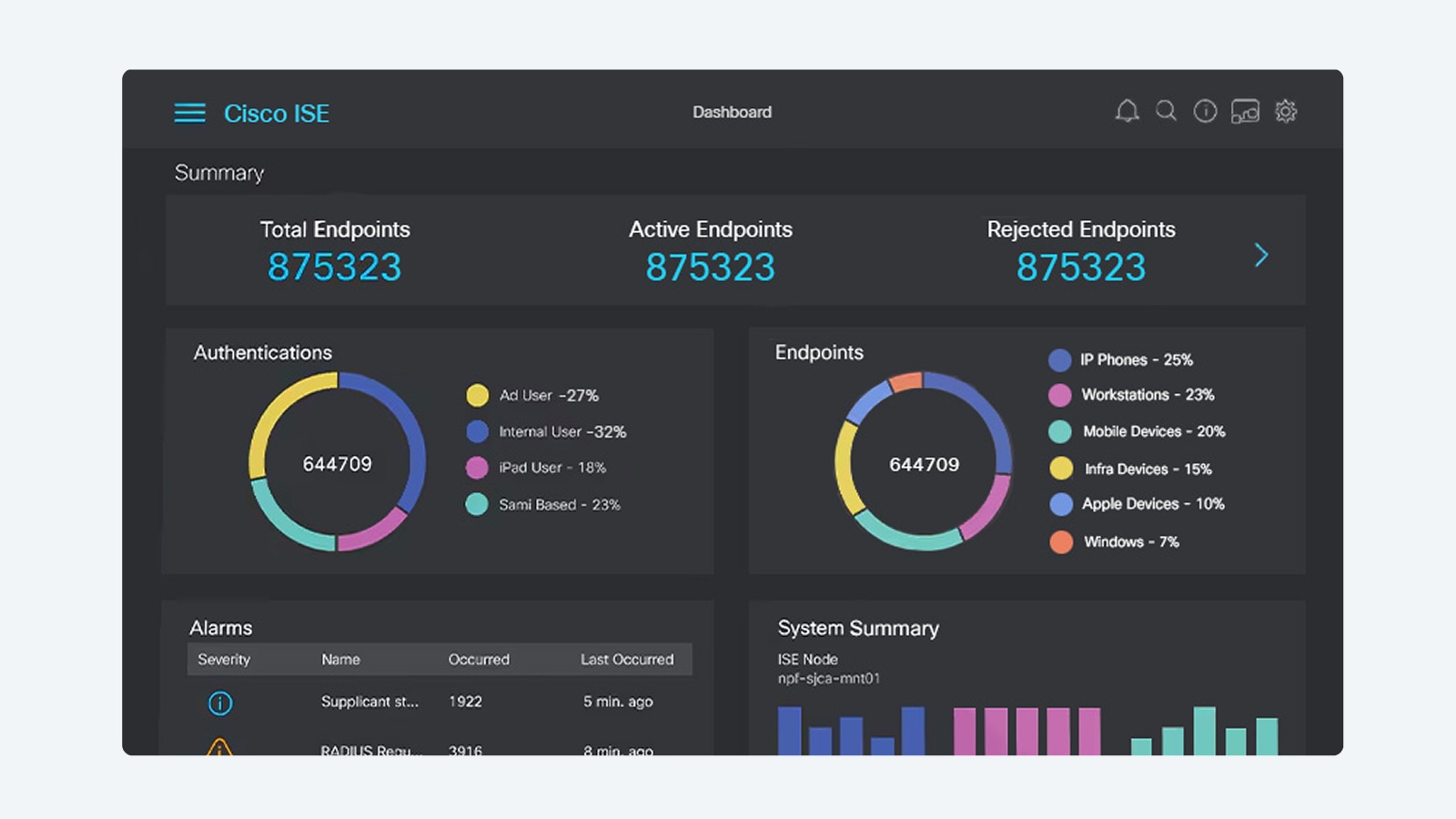 Guides
Cisco ISE vs Microsoft NPS: 802.1X on a Budget vs Full NAC
Cisco ISE vs Microsoft NPS is a budget-vs-capability question: NPS ships free with Windows Server for basic 802.1X, while ISE adds profiling, guest, posture, and segmentation NPS lacks.
July 11, 2026 · 5 min read Guides
Cisco ISE Deployment Checklist: Planning, Personas, 802.1X, Posture, and TrustSec
A field-tested planning sequence for Cisco Identity Services Engine, node personas, 802.1X rollout, posture, and TrustSec segmentation, built for federal, SLED, and healthcare teams who cannot afford a noisy cutover.
June 1, 2026 · 11 min read Guides
Zero Trust with Cisco ISE: identity-based access, explained
Zero trust falls apart when the network still trusts a switch port. Cisco Identity Services Engine moves the trust decision to who and what is connecting, then carries that decision across wired, wireless, and the firewall as enforceable policy.
May 18, 2026 · 11 min readGuidesISE vs ClearPass vs Forescout: The Three-Way NAC Shootout
Cisco ISE vs Aruba ClearPass vs Forescout is really two questions, ecosystem fit and authentication-first vs visibility-first, not one three-way bake-off. Here's how to tell which applies.
July 11, 2026 · 5 min read Guides
NAC for BYOD, Guest, and IoT: Securing Every Device That Touches the Network
A NAC solution turns BYOD, guest, IoT, and posture into four policies on one platform. Here is how Cisco ISE delivers each scenario, mapped to license tiers and zero-trust outcomes.
June 3, 2026 · 10 min read Guides
Wi-Fi generations explained: from Wi-Fi 5 to Wi-Fi 7
From Wi-Fi 5 to Wi-Fi 6, 6E, and now Wi-Fi 7, each generation changed what a wireless network can carry. Here is what actually changed under the hood, why the 6 GHz band matters, and how to map the standards to real Cisco hardware before you spec a refresh.
June 5, 2026 · 10 min read