
AgenticOps: what AI-driven network operations means for lean federal IT teams
Cisco is folding AI agents into the network management stack. For federal IT shops running lean, the promise is fewer manual touches on routine operations. Here is what AgenticOps actually changes, where it earns trust, and how to adopt it without giving up the controls auditors expect.

Key takeaways
- AgenticOps is Cisco's term for AI agents that observe, reason, and act inside network management platforms like Catalyst Center and Nexus Dashboard, moving operations from dashboards-and-tickets toward intent-and-oversight.
- For lean federal teams the value is reach, not headcount cuts: agents absorb the high-volume triage, correlation, and config-drift work that burns out a three-person shop, freeing engineers for design and accreditation.
- Keep a human in the loop on anything that changes state. Read-only and recommend-only modes are safe to adopt first; auto-remediation belongs behind change windows and approval gates.
- The accreditation story matters more than the demo. Agent actions must land inside your existing NIST 800-53 controls, STIG-hardened baselines, and audit logging before an ATO will allow them.
- Start where the data already lives. ThousandEyes, Splunk, and Catalyst Center telemetry are what the agents reason over, so observability maturity is the real prerequisite, not the AI itself.
- Adoption is a procurement and licensing exercise as much as an engineering one: platform tier, telemetry retention, and the purchase path your contracting office uses all shape what AgenticOps costs to run.
What AgenticOps actually means once you strip the marketing
AgenticOps is Cisco's name for a shift in how network operations get done. Instead of an engineer watching dashboards, opening tickets, and typing commands, software agents observe the network state, reason about what changed, and either recommend or execute a fix. The word agentic is the load-bearing part. These are not static scripts or fixed runbooks. They are AI processes that take a goal, gather context from telemetry, and decide on a sequence of steps, then report back what they did and why.
Cisco is building this capability directly into the management platforms federal teams already run. The reasoning layer surfaces through tools like Catalyst Center for campus and access, Nexus Dashboard for the data center fabric, and the broader Cisco AI Assistant that sits across them. At Cisco Live in June 2026 Cisco added Cisco Cloud Control, a single console for humans and agents across networking, security, compute, and observability, released in controlled availability in the United States first, and that is where the AgenticOps roadmap now points. The networking industry has spent more than a decade chasing intent-based and self-driving networks. AgenticOps is the current, more honest version of that goal: not a network that runs itself with nobody watching, but one where the routine reasoning is delegated and the human supervises.
The distinction that matters for a government shop is between assistive and autonomous. An assistive agent drafts the change and waits. An autonomous agent makes the change and logs it. Both are part of the AgenticOps story, and the right mix depends entirely on your risk tolerance and your accreditation boundary. Treating them as the same thing is how teams either over-trust the technology or dismiss it before it has earned a fair test.
Why lean federal teams are the natural first audience
Federal IT shops are chronically understaffed relative to the surface area they defend. A three or four person team can easily own hundreds of switches, dozens of sites, a firewall estate, and a wireless footprint, all while carrying the documentation and continuous-monitoring load that an Authority to Operate demands. The work that consumes those teams is rarely the interesting work. It is alert triage, log correlation, config drift, and the same recurring tickets that arrive every week.
This is exactly the workload agentic operations is built to absorb. When an agent can correlate a ThousandEyes path-degradation signal with a Splunk log spike and a recent config change on a Catalyst 9000 switch, it compresses what used to be a 40-minute investigation into a one-line summary an engineer can confirm in seconds. The gain is real, and it lands hardest on small teams because they have the least slack to begin with. The same automation that is a nice-to-have for a 50-person NOC is a survival tool for a four-person agency shop.
The framing that works with leadership is reach, not replacement. AgenticOps does not let an agency cut its network team. It lets the team it already has cover more ground, respond faster, and spend its scarce senior hours on architecture, segmentation, and accreditation instead of on copy-pasting show commands. For mission owners in government, that reach is the entire point, because the headcount to do it the old way is not coming.
The human-in-the-loop line you should not cross early
The fastest way to lose trust in agentic operations is to let it change state before it has earned the right. The safe adoption path runs through three gears. First, read-only: agents observe, summarize, and explain, but touch nothing. Second, recommend-only: agents propose a specific change with the exact commands and a rationale, and a human approves or rejects. Third, supervised auto-remediation: agents execute a narrow, pre-approved class of fixes inside a change window, with full logging and an easy rollback.
Most federal environments should live in the first two gears for a long time, and there is no shame in that. A recommend-only agent that turns a vague alarm into a precise, reviewable change request already delivers most of the value with almost none of the risk. The moment you allow autonomous remediation, you have created a system that can alter your accredited baseline without a human in the path, and that is a conversation your authorizing official and your security team need to own, not your automation enthusiasm.
Draw the line by blast radius, not by convenience. Resetting a flapping access port or clearing a stale DHCP binding is low-risk and reversible. Modifying an ACL, a routing policy, or anything that touches your security posture or identity enforcement through Identity Services Engine is not. Codify which action classes an agent may take autonomously, which require approval, and which are always off-limits, and put that policy under the same change control as the network itself.
Accreditation comes first, the demo comes second
A slick demo proves nothing about whether you can run AgenticOps under an ATO. The questions that decide adoption are unglamorous. Where do agent actions get logged, and are those logs immutable and shippable to your SIEM? Do the platforms that host the agents run on STIG-hardened baselines? Can you map every automated capability to a control in your security plan? Until those answers exist, an agent is a finding waiting to happen, not a productivity gain.
The good news is that the underlying frameworks already account for automation. NIST SP 800-53 treats automated mechanisms as a first-class way to satisfy controls, and several control families effectively reward automating monitoring, configuration management, and incident response. The work is showing that your agentic workflow satisfies the control as written, with evidence. Where DISA publishes a Security Technical Implementation Guide for a Cisco platform, that hardening guide becomes the baseline the agents must respect, not an obstacle to route around.
This is where most lean teams need a partner, because building the accreditation artifacts is its own discipline. As an Authorized Cisco Partner, Uniqcli maps the AgenticOps capability set to your control baseline, documents the agent action classes, and aligns the deployment with your continuous-monitoring obligations. Our lifecycle services and security services exist to make the accreditation path a deliverable rather than a scramble, so the platform passes review the first time.
The data layer is the real prerequisite
Agentic reasoning is only as good as the telemetry it reasons over. An agent cannot diagnose what it cannot see, so the honest prerequisite for AgenticOps is not the AI license, it is observability maturity. If your network is a patchwork of partial SNMP polling and ad hoc syslog, no agent will save you. If you have rich, correlated telemetry flowing into a common plane, agents become genuinely useful overnight.
Cisco's stack is built to feed this. ThousandEyes provides path and internet visibility from the agency outward, Splunk centralizes log and event data, and Catalyst Center and Nexus Dashboard hold the device-level state and assurance data. When those sources land in one place, an agent can do cross-domain correlation that a human simply does not have time to do at scale. That is why the practical first project for most teams is hardening their full-stack observability before turning on a single agent, because the telemetry is the fuel.
There is a procurement angle here too. Telemetry has a retention cost, agentic platforms have a licensing tier, and the data center side often rides different SKUs than campus. Scoping all of that against your real traffic and retention needs is part of getting the design right. Teams modernizing the fabric under an AI-ready infrastructure plan should size the observability and agentic licensing in the same pass, because bolting it on later costs more and fits worse.
A pragmatic 90-day adoption path
You do not adopt AgenticOps by flipping a switch. You adopt it by sequencing risk. A realistic first quarter starts with read-only deployment against a single domain you understand well, usually campus access through Catalyst Center, where the telemetry is rich and the failure modes are familiar. Let the agents observe and summarize for several weeks while your engineers grade their output. Accuracy you can trust is the gate to the next gear, not a calendar date.
From there, move a narrow set of high-volume, low-risk tasks into recommend-only mode and measure how often the agent's proposed change is correct and how much engineer time it saves. Keep a tight scorecard. The metrics that matter to a government CIO are mean time to resolve, percentage of tickets the agent triaged correctly, and hours of senior engineer time returned to higher-value work. Those numbers are what justify the next license tier, not vendor claims.
Only after that track record exists should anyone discuss supervised auto-remediation, and even then only for a fenced set of reversible actions inside change windows. Across the whole arc, treat day-two operations as a managed discipline. Many lean agencies pair the rollout with managed operations so there is always a human accountable for what the agents do, and so the change control, logging, and tuning happen on a cadence instead of by heroics. If you want that path scoped against your environment, talk to our team about a design engagement.
Where AgenticOps fits the rest of the Cisco estate
AgenticOps is not a standalone product you buy in isolation. It is a capability layer that draws value from the breadth of what Cisco already runs in your environment, which is both its strength and a caution. The more of the estate that feeds a common control and telemetry plane, the more the agents can reason across domains. A fragmented environment with three management tools and no shared data gets far less out of it.
On the campus and branch side, the agents lean on assurance data from Catalyst Center and visibility from ThousandEyes, and they pair naturally with segmentation and access policy. In the data center, Nexus Dashboard is the reasoning surface for fabric health and change validation. Branch and edge teams running SD-WAN gain from the same correlation between path quality and application experience. The pattern is consistent: agentic operations rewards consolidation onto Cisco's management planes and punishes sprawl.
For defense and high-assurance environments, the calculus tightens. Air-gapped or classified enclaves change what telemetry can leave the boundary and what an agent may touch, and those constraints have to be designed in, not discovered at review. Mission owners working through defense requirements should treat the data-flow and control-boundary questions as the first design conversation, because in those environments the accreditation boundary, not the feature list, decides what AgenticOps can ever do.
Buying it right: licensing, vehicles, and lifecycle
The engineering decision and the procurement decision are inseparable here. AgenticOps capability tracks platform licensing tiers, so the difference between an Essentials and an Advantage license can decide whether the agentic features you saw in a demo are even available to you. Pin down which tier unlocks the specific capability you are buying for, and confirm it against the current data sheet rather than a sales slide, because the feature-to-license mapping shifts between releases.
Federal buyers also have to clear the usual gates: lifecycle status so you are not buying near end-of-sale, TAA origin, and the right contract vehicle. Cisco documents its federal contracts and funding vehicles, and many agencies transact through NASA SEWP or GSA schedules. Uniqcli does not hold those vehicles today, so we sell through the open-market paths a contracting office already has: Government Purchase Card orders, simplified acquisitions under FAR Part 13, and FAR-based purchase orders, with WAWF invoicing for DoD. Checking the lifecycle status of every SKU against Cisco's end-of-sale notices, and the TAA status of each part number separately, is part of a clean buy either way.
This is the work an Authorized Cisco Partner is supposed to do for you. Uniqcli scopes the platform and telemetry licensing against your actual environment, validates the bill of materials against the purchase path your contracting office will actually use, attaches the right support, and ties the whole thing to an accreditation-aware deployment plan. Our procurement practice exists so that the agentic capability you want arrives correctly licensed, contract-clean, and ready to defend at review, instead of as a surprise at renewal.
Cisco products involved
- Cisco Catalyst Center
- Cisco Nexus Dashboard
- Cisco ThousandEyes
- Cisco Identity Services Engine (ISE)
- Cisco AI Assistant
- Cisco Splunk
- Cisco Catalyst 9000 switching
Bottom line: AgenticOps is not a staffing replacement, it is a force multiplier that gives a small federal team the reach of a much larger one, as long as the agents run inside the controls your authorizing official already trusts. Map your highest-volume tasks, decide where a human signs off, then request a quote to scope the platform and licensing against your accreditation boundary.
Frequently asked questions
Is AgenticOps a product I can buy as a line item?
Not exactly. AgenticOps is Cisco's term for AI agent capabilities built into management platforms you may already run, such as Catalyst Center, Nexus Dashboard, and the Cisco AI Assistant, fed by telemetry from ThousandEyes and Splunk. What you actually buy is the platform, the right license tier that unlocks the agentic features, and the telemetry to feed them. The practical scoping question is which tier and which platforms cover the workloads you want to automate.
Will AgenticOps let me reduce my network team?
That is the wrong frame, especially in government. The realistic outcome is more reach for the same team, not headcount reduction. Agents absorb high-volume triage, correlation, and config-drift work so your existing engineers can cover more ground and spend senior hours on design, segmentation, and accreditation. Lean teams benefit most precisely because they have the least slack, but you still need accountable humans supervising what the agents do.
Can agentic automation make changes inside an accredited environment?
Only under controls your authorizing official accepts. Start in read-only and recommend-only modes, where agents observe and propose but a human approves every state change. Autonomous remediation should be limited to a narrow, reversible, pre-approved set of actions inside change windows, with immutable logging shipped to your SIEM. Map every agent capability to a NIST 800-53 control and respect the STIG baseline for the host platform before anything runs unattended.
What do we need in place before AgenticOps is useful?
Observability maturity. Agents can only reason over the telemetry they receive, so rich, correlated data flowing into a common plane is the real prerequisite, not the AI license itself. If your monitoring is fragmented across partial SNMP and ad hoc syslog, fix that first. Teams typically harden ThousandEyes, Splunk, and Catalyst Center or Nexus Dashboard telemetry before enabling a single agent.
How does AgenticOps work in air-gapped or classified enclaves?
It changes the design rather than ruling it out. In high-assurance or air-gapped environments, what telemetry can leave the boundary and what an agent may touch are constrained by the accreditation boundary, so those data-flow and control questions have to be designed in from the start. For defense environments, treat the boundary as the first design conversation, because it determines the ceiling on what any agentic capability can ever do there.
How should a federal agency buy AgenticOps capability the right way?
Treat it as a combined engineering and procurement exercise. Confirm the license tier that unlocks the specific agentic features you need against the current data sheet, verify lifecycle status and TAA status on every part number, and match the buy to the purchase path your contracting office will use, whether that is a Government Purchase Card order, a simplified acquisition under FAR Part 13, or a FAR-based purchase order. An Authorized Cisco Partner like Uniqcli scopes the platform and telemetry licensing, validates the bill of materials, and ties it to an accreditation-aware deployment plan so it passes review the first time.
Uniqcli Team
The Uniqcli Team is an authorized Cisco partner specializing in Catalyst wireless, switching, datacenter fabric, licensing, and managed services for U.S. federal, state, local, and education customers. We scope Cisco bills of materials, validate procurement paths (TAA, FIPS, contract vehicles), and deliver design, deployment, and managed operations.
Ready to scope your Cisco build?
Build a quoteRelated reading
View all → Insights
The networking supercycle: what tripling AI traffic means for federal data center planning
Cisco leadership is calling this a networking supercycle, with AI traffic on track to triple inside three years. For federal data centers, that is a capacity, power, and procurement problem you size now, before the accelerators land on the loading dock.
June 4, 2026 · 11 min read Insights
5 signs your federal data center isn't AI-ready
AI workloads punish the weak points in a data center that ran general-purpose apps just fine. Here are five concrete signs a federal facility is not ready for GPU clusters yet, and what to fix before the hardware arrives.
May 26, 2026 · 9 min read Insights
On-prem vs cloud packet core for private 5G
The packet core is the brain of a private 5G network, and where you run it shapes latency, data residency, and your security accreditation. Here is how on-prem and cloud-hosted core models actually compare for federal, healthcare, and industrial deployments.
June 6, 2026 · 10 min read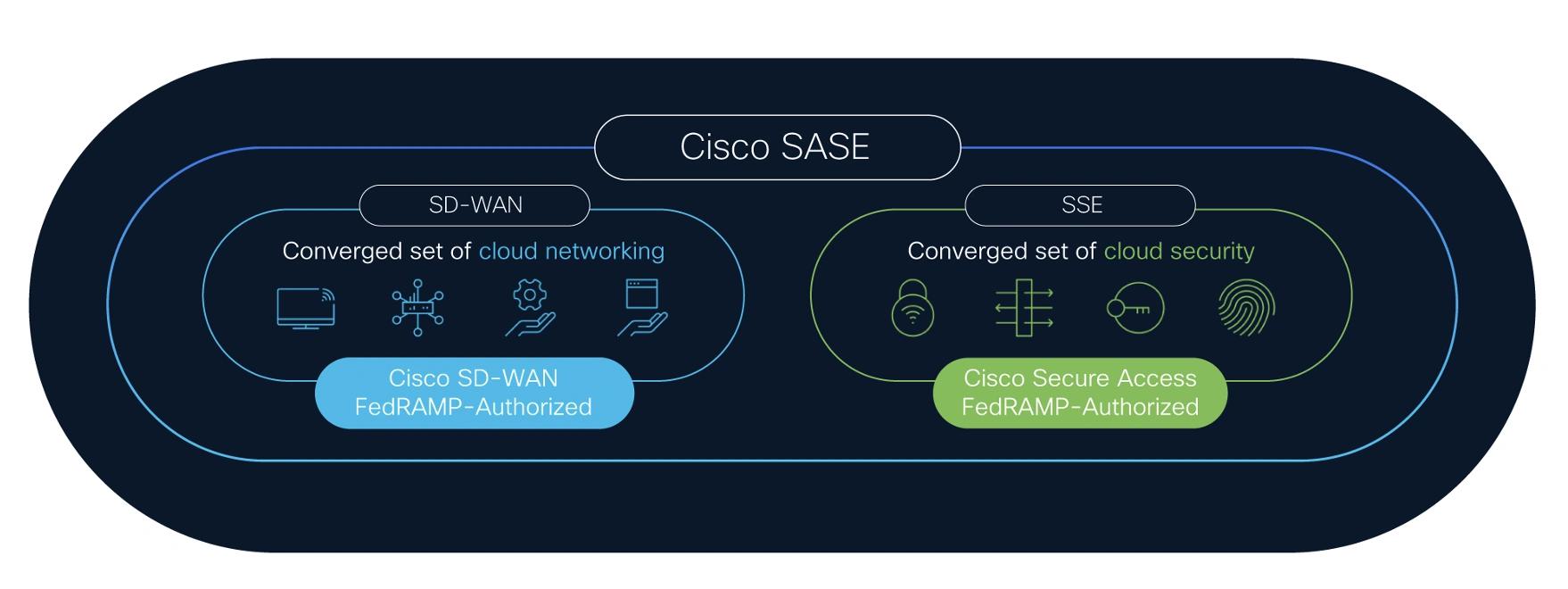 Guides
Multicloud fabric: connecting federal workloads across clouds without losing control
Federal teams run workloads across AWS, Azure, Google Cloud and on-prem at the same time. A multicloud fabric gives you one consistent policy, segmentation, and visibility layer so the mission moves between clouds without the control plane fracturing or the ATO slipping.
June 2, 2026 · 11 min read Compliance
Zero Trust for federal agencies: Hypershield, ISE, and Secure Access explained
Federal mandates pushed Zero Trust from buzzword to deadline. Here is how Cisco Hypershield, Identity Services Engine, and Secure Access fit a real agency architecture, and where each one earns its place.
May 22, 2026 · 11 min read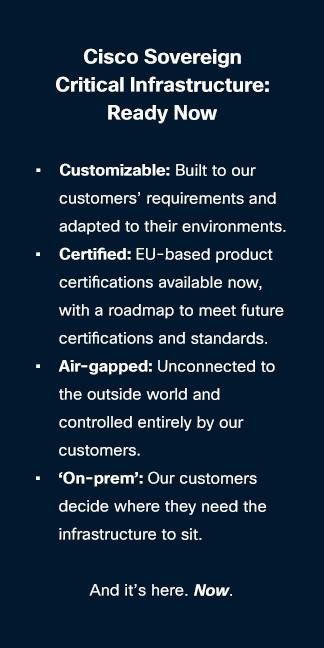 Insights
Sovereign and on-prem AI: keeping government AI workloads in-country with Cisco
Classification rules, data residency law, and the simple question of who holds the keys are pulling government AI out of the public cloud and back behind the agency boundary. Here is what a sovereign, on-premises AI footprint actually demands, and where Cisco hardware and security fit the build.
May 14, 2026 · 11 min read