
TAA-compliant AI infrastructure: the procurement path for Cisco GPU networking
An AI cluster is the most expensive and most supply-constrained buy most agencies will make this decade, which makes the procurement path as load-bearing as the architecture. Here is how to keep a Cisco GPU networking build TAA-compliant and award-ready from the first line item.

Key takeaways
- TAA governs the whole AI bill of materials, not just the switches. Optics, breakout cables, fiber, GPU servers, and even spares each carry a country-of-origin position, and one non-compliant transceiver can stall an otherwise clean award.
- The dollar value of a GPU build almost always clears the $350,000 Simplified Acquisition Threshold, so the package has to be structured for competition, either full and open or the FAR subpart 13.5 commercial-product procedures that run up to $9 million, or carry a defensible sole-source justification, with CLIN structure and origin documentation ready up front.
- NASA SEWP and the GSA Schedule both handle AI-scale infrastructure well (SEWP VI is scheduled to go live on November 1, 2026, with SEWP V ordering extended through the transition); the right vehicle is the contracting office's call and depends on the agency, the scope, and the timeline, and it should be settled before the bill of materials goes out.
- Lead time, not design, is usually the long pole on an AI build. Locking a compliant bill of materials with its purchase path settled early protects the schedule far more than chasing the last point of fabric performance.
- Cisco's AI networking stack, Silicon One, Nexus 9000, lossless Ethernet, UCS GPU compute, has TAA-compliant options at the part-number level, and several of its platforms completed DoDIN APL certification before DISA closed that program, so the same gear that wins on paper can clear procurement review.
The procurement path is the project's critical path
A GPU cluster is not a normal IT refresh. It is a large, capital-intensive, supply-constrained purchase where a single delayed line item can idle accelerators that cost more than the rest of the rack combined. For federal, state, local, and education buyers, that reality reframes the work. The architecture earns the win on paper, but the contract path is what actually delivers the hardware to the loading dock and lets the program start training. Treat procurement as an afterthought and the schedule slips by quarters, not weeks.
The governing constraint for federal buyers is the Trade Agreements Act. Every switch, transceiver, cable, and server in an AI fabric is subject to the same TAA rules as any other federal IT purchase, and the rules are unforgiving of optimism. A product is compliant only when it is manufactured or substantially transformed in the United States or a TAA-designated country, and several of the world's largest manufacturing hubs are not on the designated list. That is why the compliance posture has to be built into the bill of materials at line one, not reconstructed after a contracting officer flags it.
None of this is hypothetical for agencies moving AI from pilot to production. As models move on-premises for data residency and classification reasons, the agency itself owns the fabric design, the power and cooling envelope, and the procurement record. Our AI-ready infrastructure practice exists precisely because the networking and the contract path are inseparable on these builds, and getting either one wrong is expensive.
TAA still applies to the whole AI build
It is tempting to think of TAA as a switch-level concern. It is not. The Act applies to every deliverable on the order, and an AI fabric has a long tail of small line items that are easy to overlook. A 400G or 800G GPU back-end network is dense with optics, breakout cables, and fiber, and each of those is a separately sourced product with its own country of origin. A compliant Cisco Nexus 9000 switch paired with non-compliant transceivers is still a non-compliant order, and that is one of the most common ways a clean-looking AI quote fails review.
The U.S. government's own acquisition framework spells this out. The Federal Acquisition Regulation, which GSA publishes jointly with DoD and NASA, requires at FAR 25.403 that products acquired under covered procurements be U.S.-made or designated-country end products, and the Schedule program in particular treats TAA as a threshold condition rather than a nice-to-have. Because the TAA clause sits in the Schedule contract itself, whose aggregate value is far above the $174,000 WTO GPA supply threshold in FAR 25.402, the Act applies to orders under that Schedule regardless of how small any individual line item is. There is no de minimis exemption to hide behind for the cabling.
The practical discipline is to hold a documented country-of-origin position for every SKU before the quote leaves the building. That includes the parts nobody thinks about: optical modules, direct-attach copper, structured fiber runs, rack PDUs where they are part of the scope, and spares. When Uniqcli builds a procurement-ready Cisco package, the origin documentation travels with the bill of materials line by line, so a contracting officer can clear the entire order in one pass instead of bouncing it back for the one transceiver that lacks a paper trail.
Where TAA bites hardest on a GPU fabric
The components most likely to create a TAA problem on an AI build are rarely the marquee switches. They are the high-volume, commodity-feeling items that get sourced last and fastest. Optics top the list because a single GPU rack can require dozens of high-speed transceivers, and the cheapest available part is often the one with the worst origin story. Cables, fiber, and small accessories follow the same pattern. The lesson is that the line items with the least glamour carry the most procurement risk.
For DoD and intelligence community buyers there is a second layer beyond TAA. Many programs also require platforms to be hardened to published configuration baselines and, in some cases, listed for use on defense networks. Cisco platforms can be delivered configured against the relevant DISA STIGs, and many of the platforms in this stack completed DoDIN Approved Products List certification before DISA closed that program on September 30, 2025 (the repository of approved products stays available through FY2026, and the cybersecurity requirement now runs through the DISA RME Vendor STIG program), so the security posture and the supply-chain posture can be documented together rather than as two separate fights.
Four practical safeguards keep these items from derailing an award:
- Source optics and cables from the same compliant supply chain as the switches, and document the origin of each part number rather than the bundle.
- Confirm TAA status against the current designated-country list at quote time, because designations and sourcing both change and a position that held last year may not hold today.
- Where a program requires it, document which switches and servers completed DoDIN APL certification while that program was active and deliver them against the applicable STIG baselines so security review and procurement review do not collide.
- Keep spares and warranty-replacement units inside the same compliant lane, since a non-compliant RMA part can quietly break a maintained system's posture.
Choosing the contract vehicle before the BOM goes out
The vehicle decision shapes everything downstream: how the bill of materials is structured, what documentation has to accompany it, and how fast the award can move. AI-scale infrastructure buys fit several vehicles well, but the choice is not interchangeable. It depends on the agency, the size of the buy, the timeline, and whether the program wants full and open competition or a justified sole-source path. Picking the lane after the quote is written almost always means rewriting the quote.
NASA's SEWP is a strong fit for large IT and infrastructure purchases, including dense GPU and networking hardware, and its structure is well understood by contracting shops that buy at scale; SEWP VI is scheduled to go live on November 1, 2026, with SEWP V ordering extended through the transition, so confirm which contract an order placed this fiscal year will land on. The GSA Schedule offers broad coverage and the TAA-as-threshold certainty described above. For state, local, and education buyers, cooperative vehicles such as NASPO ValuePoint and OMNIA Partners extend similar advantages outside the federal space. When none of these fit cleanly, an open-market buy with full documentation remains a legitimate path as long as the compliance record is airtight.
A note specific to federal buyers: Cisco publishes which government contract vehicles carry its products, and Uniqcli does not hold a contract vehicle of its own today (our GSA MAS application is in progress). What we do is build the package for the purchase paths open to us now, Government Purchase Card orders, Simplified Acquisition Procedures under FAR Part 13, and FAR-based purchase orders with WAWF invoicing for DoD, and supply the origin documentation and CLIN structure a contracting officer would need if the program routes the buy through a vehicle-holding prime instead. Either way the defense procurement package and the technical design are produced as one coherent deliverable, not stitched together under deadline pressure.
Thresholds, CLINs, and the shape of the package
The economics of an AI build force a level of procurement rigor that smaller buys can sometimes skip. A meaningful GPU cluster, with its servers, back-end fabric, optics, power, and security, almost always clears the Simplified Acquisition Threshold by a wide margin. That single fact dictates the shape of the package. Above the $350,000 threshold (FAR 2.101, effective October 1, 2025) the buy either competes under full and open competition, uses the commercial-product procedures of FAR subpart 13.5 (available up to $9 million for commercial products such as networking hardware, still competed to the maximum extent practicable), or carries a defensible justification for other than full and open competition, and the documentation supporting whichever posture applies needs to exist before the quote is issued, not assembled in response to a question.
CLIN structure is where this discipline becomes concrete. Breaking the bill of materials into clean contract line item numbers, hardware, optics and cabling, software subscriptions, installation services, and sustained support, lets a contracting officer evaluate, fund, and obligate the buy without ambiguity. It also keeps the recurring elements visible. Software entitlements and SmartNet Total Care coverage are not optional extras on an AI build; they are what keep the cluster supported and patched, and they belong in the CLIN structure from the start so funding lines up with the lifecycle.
Lifecycle math reinforces the point. AI hardware is a multi-year asset, and Cisco's published end-of-sale and end-of-life policy sets the windows that should inform support terms and refresh planning. Pricing a one-year support term on a five-year asset creates a coverage gap that resurfaces as an unplanned procurement later. Our lifecycle services team co-terms support and subscriptions against the asset life so the renewal cadence is predictable instead of a surprise.
The Cisco AI networking stack, sourced to clear review
The technical building blocks of a Cisco AI fabric are well defined, and each one has TAA-compliant options, confirmed per part number and lot rather than assumed for the product family. The back-end GPU network runs on Cisco Silicon One and Nexus 9000 switching with lossless Ethernet, RoCEv2 tuned with priority flow control and explicit congestion notification, so GPUs stay fed instead of stalling on congestion. The advantage for a government buyer is that this is standard Ethernet operations, tooling, and segmentation, not a separate single-vendor island to procure and secure on its own terms.
Compute and management round out the stack. Cisco UCS GPU servers, sized against the training-versus-inference profile, sit on the fabric and are managed through Intersight and Nexus Dashboard. The Nexus 9300, Nexus 9500, and UCS product pages on this site carry the data sheet figures for interfaces, power, and capability, and those are the numbers to cite, because real procurement packages cite the data sheet rather than a sales number. We size from the data sheet and the workload, then validate the final figures before signature.
Securing the environment is part of the same scope. The cluster is wrapped in Cisco AI Defense for model discovery and runtime guardrails and Hypershield for autonomous segmentation, and the whole design is aligned to controls in NIST SP 800-53 so the security evidence is ready for an authorization review. Pulling the data center fabric and the AI security layer into one package means the architecture, the compliance posture, and the procurement record are produced together.
Sequencing the buy so lead time does not win
On almost every AI build, the long pole is not the design and not the contract, it is supply. GPU and high-speed optics lead times move with global demand, and a beautifully argued sole-source justification does not help if the parts are twelve weeks out and the obligation deadline is sooner. The way to protect the program is to compress the procurement front of the timeline so the order is placed the moment funding is available.
That argues for locking three things early and in parallel: the compliant bill of materials with documented origins, the contract vehicle, and the support and licensing terms. When those are settled before the fiscal pressure hits, the buy can move on the first attempt rather than cycling through clarification requests. Standardizing on Ethernet rather than a proprietary fabric also keeps the supply base broad, which matters when the constrained part is the very thing you cannot wait on.
This is the discipline behind a Uniqcli AI engagement. We produce a single validated Cisco bill of materials, fabric, GPU compute, optics, cabling, and security, with TAA-compliant SKUs, CLIN structure, and the purchase path documented, and our design services and deployment teams stage and turn up the cluster so it clears procurement and powers on the first time. The design wins the evaluation, but the procurement path is what gets the GPUs racked before the demand curve moves again.
Cisco products involved
- Cisco Silicon One
- Cisco Nexus 9000 Series
- Cisco UCS GPU servers
- Cisco AI Defense
- Cisco Hypershield
- Cisco Intersight
- Cisco Nexus Dashboard
- Cisco SmartNet Total Care
Uniqcli can return a TAA-compliant AI infrastructure quote structured for a purchase-card, Simplified Acquisition, or FAR-based purchase order award.
Bottom line: On an AI build the architecture earns the win, but the TAA posture and the contract vehicle are what actually deliver the GPUs on schedule. Request a TAA-compliant Cisco AI quote and we will document the compliance position, CLIN structure, and purchase path before the bill of materials goes out.
Frequently asked questions
Does TAA apply to optics and cabling, or only the switches?
It applies to every line item. Transceivers, breakout cables, fiber, GPU servers, and spares each need a documented country-of-origin position. A compliant Nexus 9000 switch paired with non-compliant optics is still a non-compliant order, which is one of the most common reasons an AI quote stalls in review. We hold an origin position per SKU so the whole bill of materials clears in one pass.
Which contract vehicle is best for a government AI build?
NASA SEWP (SEWP VI is scheduled to go live November 1, 2026) and the GSA Schedule both handle AI-scale infrastructure well, and for state, local, and education buyers NASPO ValuePoint and OMNIA Partners extend similar advantages. The right one depends on the agency, the scope, and the timeline, and it is the contracting office's decision. Uniqcli does not hold a contract vehicle today, so we quote for purchase-card, Simplified Acquisition, and FAR-based purchase order awards, and we build the origin documentation and CLIN structure so the package can also travel with a vehicle-holding prime if the program goes that route.
How long does AI hardware take to procure, and what drives the delay?
Lead time, not design, is usually the long pole. GPU and high-speed optics availability moves with global demand, so the schedule is protected by locking a compliant bill of materials, its purchase path, and the support terms early. Standardizing on Ethernet rather than a proprietary fabric also keeps the supply base broad, which helps when the constrained part is the one you cannot wait on.
Is a Cisco AI fabric suitable for DoD and classified environments?
Yes. Several of the platforms in the stack completed DoDIN APL certification before DISA closed that program on September 30, 2025, the fabric can be configured against the applicable DISA STIG baselines, and the architecture maps to NIST SP 800-53 controls so the authorization review and the procurement review clear together. We source TAA-compliant SKUs with country-of-origin documentation and structure the package CLIN by CLIN for full and open competition or a defensible sole-source path.
Why does it matter that the build clears the Simplified Acquisition Threshold?
Because a meaningful GPU cluster almost always exceeds the $350,000 threshold, the package has to be structured for competition, full and open or the FAR subpart 13.5 commercial-product procedures that run up to $9 million, or carry a documented justification for other than full and open competition before the quote is issued. Clean CLIN structure, hardware, optics, software, services, and support, lets a contracting officer evaluate, fund, and obligate the buy without sending it back for clarification.
Can Uniqcli deliver the AI cluster as one quote-ready package?
Yes. We size the back-end fabric, GPU servers, optics, cabling, and security into a single validated Cisco bill of materials with TAA-compliant SKUs, then stage, configure, and deploy it as one engagement. You get a defensible design and a procurement-ready BOM rather than stitching switching, compute, and security together from separate quotes.
Uniqcli Team
The Uniqcli Team is an authorized Cisco partner specializing in Catalyst wireless, switching, datacenter fabric, licensing, and managed services for U.S. federal, state, local, and education customers. We scope Cisco bills of materials, validate procurement paths (TAA, FIPS, contract vehicles), and deliver design, deployment, and managed operations.
Ready to scope your Cisco build?
Build a quoteRelated reading
View all → Insights
The networking supercycle: what tripling AI traffic means for federal data center planning
Cisco leadership is calling this a networking supercycle, with AI traffic on track to triple inside three years. For federal data centers, that is a capacity, power, and procurement problem you size now, before the accelerators land on the loading dock.
June 4, 2026 · 11 min read Guides
AI-ready data centers for government: sizing the GPU network with Cisco Silicon One and Nexus
Standing up a GPU cluster for a federal mission is a network-sizing problem before it is a compute problem. Here is how to size the AI back-end fabric with Cisco Silicon One and Nexus 9000, keep it lossless, and buy it through a purchase path that clears review.
May 30, 2026 · 11 min read Compliance
Cisco SEWP Quote Guide for Federal Buyers
NASA SEWP is one of the busiest IT contracts in the federal government, and with SEWP VI awarded and going live on November 1, 2026, it remains a fast lane for Cisco hardware when you set the buy up correctly. Here is how the vehicle works, what makes a quote clear on the first pass, and the mistakes that push an award past fiscal year end.
May 22, 2026 · 10 min read Compliance
TAA-compliant Cisco procurement: a practical buyer's guide for public sector
A field-tested walkthrough of how public sector buyers source Cisco gear that holds up to a Trade Agreements Act audit, from country-of-origin proof to contract vehicles and the paperwork that closes the deal.
May 4, 2026 · 9 min read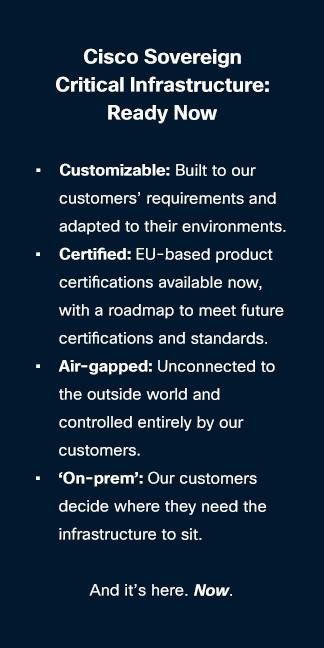 Insights
Sovereign and on-prem AI: keeping government AI workloads in-country with Cisco
Classification rules, data residency law, and the simple question of who holds the keys are pulling government AI out of the public cloud and back behind the agency boundary. Here is what a sovereign, on-premises AI footprint actually demands, and where Cisco hardware and security fit the build.
May 14, 2026 · 11 min read News
NewsSalt Typhoon, One Year On: Why Trusted, Monitored Network Infrastructure Matters
A year after Salt Typhoon burrowed into at least nine US carriers and, per the FBI, 200-plus organizations across 80 countries, lawmakers are still demanding proof the intruders are gone. The story has shifted from breach to persistence, and persistence is a procurement and operations problem as much as a security one.
June 7, 2026 · 9 min read