
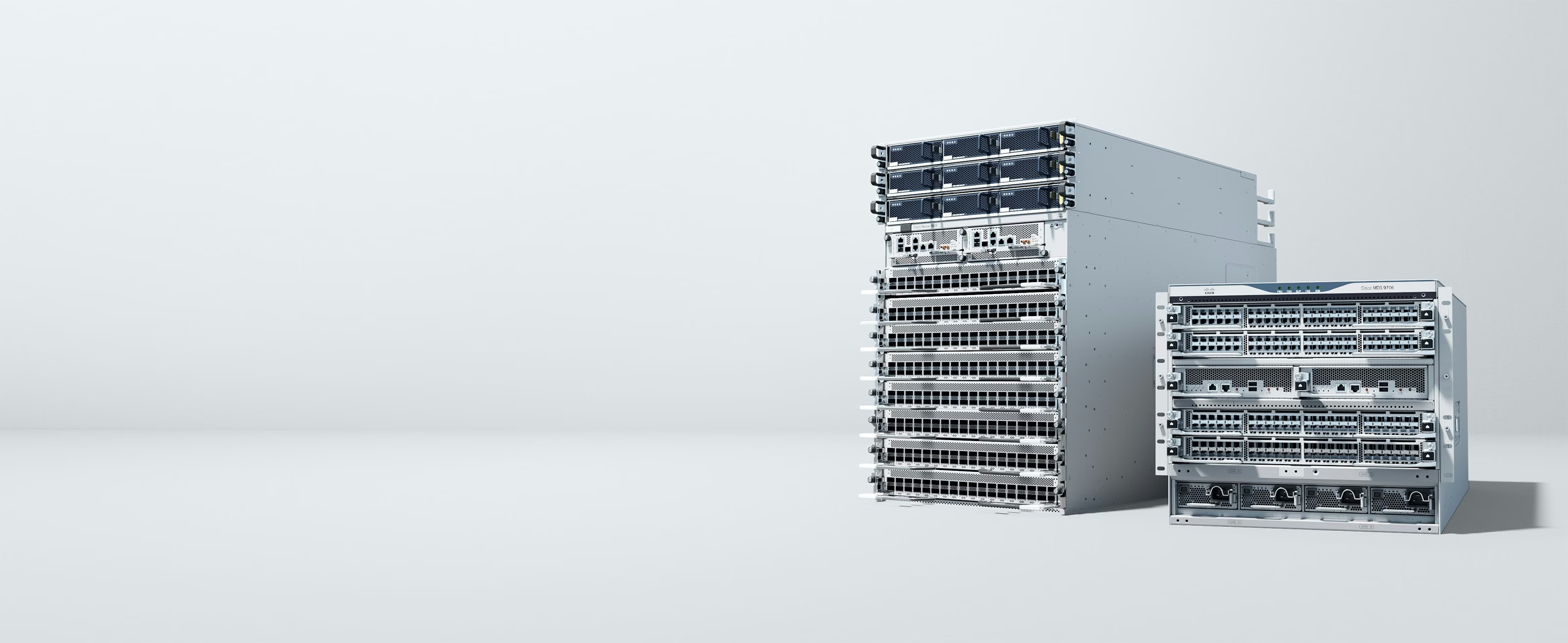
Cisco Nexus 9500 Series
Modular data center spine and core. The Nexus 9500 chassis scales spine density with cloud-scale line cards and fabric modules for 1G to 400G (800G-capable) — the aggregation point for large spine-leaf and AI fabrics.
Why Cisco Nexus 9500 Series
The Nexus 9500 is the modular chassis that scales the data center spine as the fabric grows. Rather than spreading across many fixed spines, one 9500 terminates hundreds of high-speed links and grows by adding cloud-scale line cards and fabric modules. It is the natural spine for larger spine-leaf designs and the aggregation tier for GPU clusters, where per-slot bisection bandwidth is what an all-to-all traffic pattern actually needs. Let the leaf count and growth curve decide between a fixed 9300 spine and a modular 9500 spine.
- 4-, 8-, and 16-slot chassis (9504/9508/9516) that scale by adding line cards.
- Cloud-scale EX/FX/FX3/GX line cards from 1G to 400G; 800G-capable fabric modules.
- Internal Clos fabric with multi-terabit-per-slot bandwidth.
- ACI spine or NX-OS, the aggregation point for large and AI fabrics.
What the platform brings
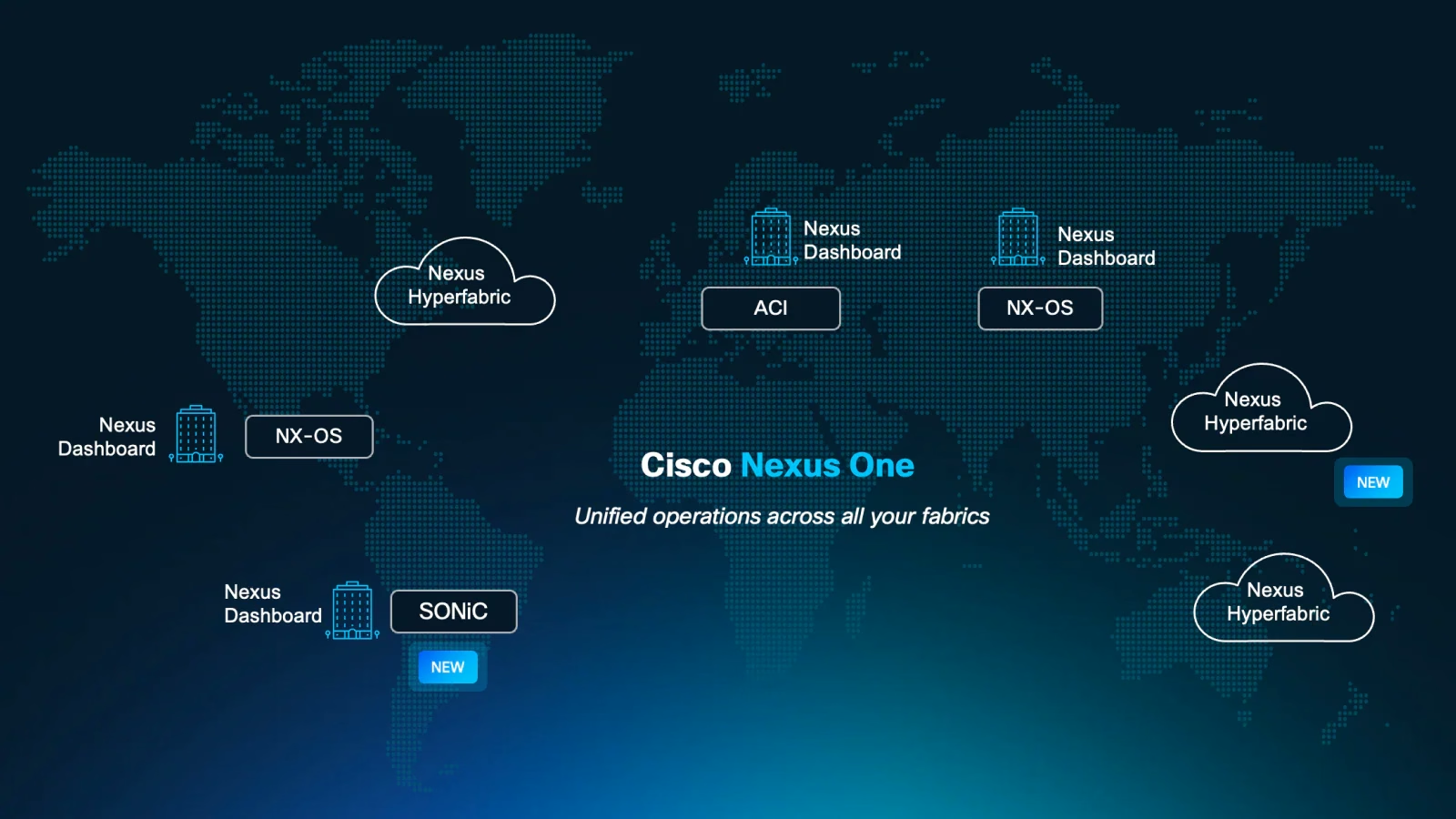
Dual operating modes: NX-OS and ACI
Every Nexus 9500 chassis runs in either Cisco NX-OS mode for traditional Layer 2/3, VXLAN with a BGP-EVPN control plane, Segment Routing, and MPLS, or Cisco ACI mode for a policy-based, automated data center fabric. The supervisor, system controller, power supplies, and line cards are common across all three chassis.
Cloud-Scale ASIC line cards
Line cards are built on Cisco cloud-scale ASICs that deliver foundational L2/L3 plus smart buffering, integrated line-rate security, and real-time streaming telemetry over multispeed Ethernet ports. The latest 400-Gigabit cloud-scale ASICs add Segment Routing over IPv6 (SRv6) and enhanced streaming telemetry.
Midplane-free Clos fabric
The 9500 is the first Cisco switch chassis designed without a midplane; line cards connect directly to rear fabric modules in a Clos fabric, and all line-card traffic is load balanced across every fabric module. This delivers optimal front-to-back airflow and lower power draw.
Full hardware redundancy and graceful degradation
Chassis are built with redundant supervisors, system controllers, power supplies, and fan trays to eliminate any single point of failure. Support for up to six fabric modules means the switch keeps forwarding at reduced capacity if a fabric module fails, with all transceivers pluggable for maximum MTBF.
MACsec line-rate encryption
Cloud-scale line cards including the X9716D-GX, X9736C-FX3, X9736C-FX, X9732C-FX, and X9788TC-FX support MACsec, providing integrated line-rate encryption for data in motion across the fabric.
Multispeed port density from 1G to 400G
A single chassis mixes 1-, 10-, 25-, 40-, 50-, 100-, 200-, and 400-Gigabit Ethernet interfaces, with QSFP-DD 400G, QSFP28 100G, and QSFP+ 40G modules coexisting so organizations can migrate speeds without changing port density.
Cisco Nexus 9500 Series by the numbers
- Chassis options
- 9504 (4 slots), 9508 (8 slots), 9516 (16 slots)
- Rack units
- 7 RU (9504), 13 RU (9508), 21 RU (9516)
- Line-card bandwidth per slot
- Up to 6.4 Tbps per slot
- Fabric module capacity per slot
- Up to 1.6 Tbps per slot (FM-G)
- Max 400G port density
- Up to 256 400-Gigabit Ethernet ports
- Forwarding latency
- 5 microseconds or less, nonblocking
- Fabric modules per chassis
- Up to 6 of the same type
- Packet buffer per line card
- Up to 160 MB
- LPM IPv4 routes / MAC entries
- Up to 2 million IPv4 routes, up to 1 million MAC addresses
- Power supply efficiency
- 80 PLUS Platinum (3000W); 80 PLUS Titanium (3150W HV AC/DC)
Figures are from the published family data sheet and vary by model and configuration. Confirm exact specs for your SKUs in a validated quote.
Find the Cisco Nexus 9500 Series model that fits
Compare the models in this family. Open any datasheet to read the full specs right here.
Modular chassis
Nexus 9504 / 9508 / 9516
4-, 8-, and 16-slot spine/core chassis.
- Scales by line card
- Redundant fabric modules
- Internal Clos fabric
Line cards
Cloud-scale line cards (EX/FX/FX3/GX)
Mixed-generation line cards in one chassis.
- 1G to 400G
- VXLAN/EVPN and ACI
- Deep buffers
Fabric modules
FM-G / FM-E2 fabric modules
Per-slot fabric capacity.
- Up to multi-Tbps per slot
- 800G-capable
Datasheets & guides
Built for deployments like these
- Spine node in a Cisco ACI or NX-OS spine-leaf data center fabric
- Border gateway between Layer 2 and Layer 3 networks
- Core and aggregation layer in a classical three-tier data center network
- High-density 10/40/100/400G aggregation for scale-out multinode applications
- End-of-row access layer switch consolidating 1/10/25G server access
Cisco Nexus 9500 Series questions, answered
How many chassis sizes are available and how do they differ?
There are three modular chassis: the 9504 with 4 line-card slots (7 RU), the 9508 with 8 slots (13 RU), and the 9516 with 16 slots (21 RU). The supervisors, system controller, power supplies, and line cards are common across all three; each chassis has its own fabric modules and fan trays that plug in vertically at the rear.
What is the maximum port density?
Using cloud-scale line cards, a Nexus 9500 can be configured with up to 256 400-Gigabit Ethernet ports, or alternatively up to 1024 100G ports, 2048 50G ports, 1024 40G ports, 2304 25G ports, or 2304 1/10G ports. Each line card slot provides up to 6.4 Tbps, and each cloud-scale fabric module provides up to 1.6 Tbps per slot.
Does the platform keep running if a fabric module fails?
Yes. The 9500 uses a Clos fabric that load balances all line-card traffic across every fabric module. With up to six fabric modules supported, the switch continues to operate if a fabric module is lost, albeit at lower switching capacity, as the remaining modules keep providing capacity to the line cards. Supervisors, system controllers, power supplies, and fan trays are also redundant.
Which line cards support MACsec encryption?
Per the cloud-scale line card use-case summary, MACsec is supported on the X9716D-GX, X9736C-FX3, X9736C-FX, X9732C-FX, and X9788TC-FX line cards. The X9732C-EX, X9736C-EX, and X97160YC-EX line cards do not support MACsec.
Quote Cisco Nexus 9500 Series for your build.
Send your requirements for a procurement-ready quote, or build an instant budgetary estimate first.