
Sovereign and on-prem AI: keeping government AI workloads in-country with Cisco
Classification rules, data residency law, and the simple question of who holds the keys are pulling government AI out of the public cloud and back behind the agency boundary. Here is what a sovereign, on-premises AI footprint actually demands, and where Cisco hardware and security fit the build.
Key takeaways
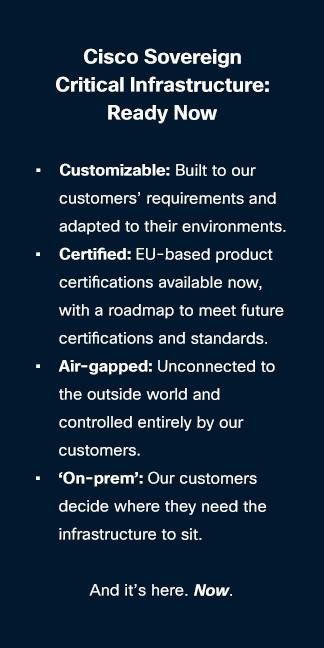
- Sovereign AI is a control problem, not a location preference. The agency has to own the data, the model weights, the keys, the logs, and the audit evidence, and prove all of it stayed inside the boundary.
- Sovereignty turns AI from a subscription into a capital build. You now own the GPU servers, the lossless back-end fabric, the power and cooling, and the security wrapped around the whole enclave.
- The network is the long pole, not the GPUs. East-west GPU-to-GPU traffic is bursty, lossless, and latency-critical, and an undersized fabric strands the most expensive hardware in the building.
- Security has to live inside the boundary. Identity-aware access with ISE, in-fabric segmentation with Hypershield, and model-layer protection with AI Defense keep the enclave defensible without phoning home.
- Air-gap is a spectrum. Most agencies need a controlled enclave with strict egress rules; the most sensitive missions need full physical isolation. Scope to the classification, not the brochure.
- Procurement is where sovereign builds succeed or stall. Every SKU has to clear TAA origin and lifecycle status, DoD buyers may still ask whether a platform completed DoDIN APL certification before the program sunset, and all of it has to move through a purchase path the agency can actually award against.
Why government AI is leaving the public cloud
For most of the last decade the default answer to any new workload was the cloud. AI is breaking that reflex inside government. The moment a model touches classified material, controlled unclassified information, or citizen records governed by residency law, the calculus flips. You cannot send that data to a shared, multi-tenant AI service and still hold the line on where it lives and who can reach it. The workload has to come home, which means it lands on infrastructure the agency owns and runs.
Sovereign AI is the plain-language version of that requirement. An agency's AI workloads, and the data behind them, stay under its control and inside its jurisdiction. That is not a philosophical stance, it is a set of hard constraints driven by policy and law. The federal security baseline in NIST SP 800-53 frames access control, audit, and boundary protection as things you have to demonstrate, not just assert, and a public AI endpoint makes that demonstration nearly impossible for sensitive data.
The practical effect is that AI becomes a build instead of a click. Where a commercial team spins up a managed model and moves on, a federal mission owner has to stand up the compute, the network, the storage, the power, and the security as a single controlled environment. That is a heavier lift, but for the data that matters most it is often the only compliant path, and increasingly it is the one our government practice is asked to scope first.
What 'sovereign' actually requires
Sovereignty gets thrown around loosely, so it helps to pin down what the word has to mean before any hardware is ordered. The bar is not simply running a model in a US data center. It is the ability to prove, on demand, that the data and the model never left the boundary and that only authorized people and systems ever touched them. That proof obligation shapes every design decision downstream.
In concrete terms, a sovereign AI footprint has to satisfy four things at once, and missing any one of them undercuts the rest. These are the requirements we work through with mission owners before a bill of materials exists, because each one maps to specific infrastructure and policy choices rather than a single product:
- Data residency: training data, fine-tuning sets, and model weights stay inside the agency boundary and never transit a third-party service.
- Control: the agency holds the encryption keys, the logs, and the lifecycle of the environment, not a vendor or a hyperscaler.
- Isolation: segmentation that matches the classification, up to and including a fully air-gapped enclave for the most sensitive missions.
- Auditability: durable evidence that residency and access controls held, packaged for an assessor or an inspector general without a scramble.
Sovereignty makes AI an infrastructure problem
Once you accept those four requirements, the shape of the project changes. AI stops being a model you consume and becomes a data center you operate. The agency now owns the GPU servers, the fabric that feeds them, the storage that holds the data, the power and cooling that keep it alive, and the security that wraps the whole thing. Each of those layers carries its own sizing, sourcing, and compliance work, and they have to be planned together rather than bolted on in sequence.
The piece teams underestimate most is the network. GPU clusters do not generate the polite north-south, user-to-application traffic that classic three-tier designs assumed. They produce enormous east-west, machine-to-machine flows that are bursty, loss-sensitive, and latency-critical. A back-end fabric that cannot keep the accelerators fed will strand the most expensive hardware in the building, which is why we treat the fabric as a first-class part of the compute order in every AI-ready data center build, not a follow-on purchase.
Power and cooling deserve the same early attention. A dense GPU rack can pull more than a traditional row, and many federal facilities were never provisioned for that load. Getting the electrical and thermal envelope right is part of the design, not a facilities afterthought, and it frequently determines how much AI a given site can realistically host. Scoping the full stack together is the core of how we approach AI infrastructure for agencies that have to defend the build in a budget request.
Where Cisco fits a sovereign footprint
Cisco's relevance here is that it covers the layers that turn sovereign AI from an idea into a running, defensible environment. On the network side, Cisco Nexus 9000 switching and Silicon One ASICs build the lossless, high-radix back-end fabric that GPU-to-GPU traffic demands, plus the front-end connectivity to storage and the rest of the agency network. Because that fabric is standards-based Ethernet rather than a proprietary interconnect, an agency can keep it open and multi-vendor instead of locking into a single island.
Compute and operations round out the picture. Cisco UCS servers configured for AI host the accelerators, while Nexus Dashboard provides cloud-style operations and assurance without sending any telemetry off-premises, which is exactly the property a sovereign environment needs. That last point is worth dwelling on: sovereign does not mean primitive. You can run modern, automated operations inside the boundary, and the observability layer is what keeps a hand-built enclave maintainable instead of brittle.
Security is the part that has to live inside the boundary rather than depend on a cloud service reaching in. Cisco Hypershield enforces segmentation and policy in the fabric itself, AI Defense protects the model and inference layer, and Cisco Identity Services Engine and Secure Access provide identity-aware control over who and what can reach the enclave. Wrapping the AI environment in that security stack is how the access-control and audit requirements stop being aspirations and start being enforced.
Isolation, air-gap, and the spectrum in between
Air-gapped is the phrase everyone reaches for, but it describes one end of a spectrum rather than a single setting. A true air gap means no network path in or out at all, with media transfer tightly controlled and logged. That is the right posture for the most sensitive missions, and it is achievable, but it also imposes real operational cost: patching, model updates, and data ingest all become deliberate, controlled events rather than background processes.
Most agencies land somewhere short of full physical isolation. A controlled enclave with strictly governed egress, identity-gated access, and in-fabric segmentation often satisfies the requirement while keeping the environment operable. The right level is a function of classification and mission, and the secure configuration baselines published in the DoD STIGs are a useful reference point for hardening the platforms regardless of where on the spectrum a given enclave sits.
Whatever the isolation level, the security architecture has to assume the boundary is the perimeter. That means identity-aware access at every entry point, segmentation that limits blast radius if something gets in, and continuous evidence that the controls held. For DoD customers in particular, our defense practice scopes the enclave to the classification level and the accreditation path, because an environment that cannot pass assessment is not sovereign in any way that counts.
Procurement is where sovereign builds win or stall
A sovereign AI environment can be perfectly designed and still die in acquisition. The hardware is regulated, the lead times are long, and every line item has to clear compliance review before a contracting officer will sign. That is why the procurement path, not the architecture, usually sets the schedule on these projects. The teams that lock a compliant bill of materials and a contract vehicle early are the ones that hit their timelines.
The compliance work is unforgiving at the SKU level. Every switch, server, optic, and cable has to meet TAA country-of-origin rules, which are set per part number and lot rather than per brand, sit in a healthy place on the Cisco end-of-life and end-of-sale policy, and, for DoD missions, show whether the platform completed DoDIN APL certification before DISA sunset the program on September 30, 2025. DISA keeps the repository available through FY2026 and has moved the cybersecurity requirements to its vendor STIG program, so treat a prior APL listing as historical evidence, not a live gate. Production gear also needs a support posture, which is where wrapping the build in Smart Net Total Care keeps the environment serviceable for its full life rather than just through go-live.
Then there is the question of how the agency actually buys it. AI-scale infrastructure moves well through established vehicles, and the right one depends on the agency and the scope. Cisco documents its federal contracts and funding vehicles, and agencies frequently award AI builds through NASA SEWP or a GSA schedule. Uniqcli does not hold those vehicles today (our GSA MAS application is in progress), so where we fit is the direct path: Government Purchase Card orders, simplified acquisition under FAR Part 13, FAR-based purchase orders, and WAWF/PIEE invoicing for DoD, with the TAA and lifecycle documentation a contracting officer needs attached to the quote. You can start that conversation through our procurement practice.
A practical sequence for standing it up
Because a sovereign environment touches compute, network, power, security, and acquisition at once, the order of operations matters as much as the components. The failure mode we see most often is buying GPUs first and figuring out the network, the facility, and the compliance path afterward, which leaves expensive accelerators idle while the rest of the build catches up. Sequencing it deliberately avoids that trap.
The path that works starts from the data and the mission, not the hardware. Establish the classification and residency requirements, derive the isolation level from them, then size the fabric and compute to the model plan rather than to last year's traffic. Validate the bill of materials against TAA and any prior DoDIN APL requirement the mission still carries, settle the purchase path, and only then place the order. Our lifecycle services team works each of these steps with the mission owner:
- Fix the requirements first: classification, residency, and the audit evidence you will owe an assessor.
- Size the back-end and front-end fabric to the GPU and rack plan, with power and cooling validated against the facility.
- Architect security inside the boundary: identity-aware access, in-fabric segmentation, and model-layer protection.
- Validate every SKU for TAA origin and lifecycle health, and confirm any prior DoDIN APL certification the mission still asks for.
- Settle the purchase path and the support posture before the build, not after.
What sovereign AI buys you beyond compliance
It is easy to frame sovereign AI purely as a compliance burden, but the control it gives back has real operational value. When the keys, the logs, and the model weights stay inside the agency, you can answer questions a public service simply cannot: exactly what data trained the model, exactly who queried it, and exactly where every byte lived. For mission systems, that traceability is not a nice-to-have, it is the foundation of trust in the model's output.
There is also a durability argument. A sustained AI workload running on owned infrastructure is frequently more economical over its life than a metered cloud service, and it insulates the mission from a vendor changing terms, pricing, or data-handling policy. The agency controls the refresh cycle and the roadmap, which is exactly the autonomy that the word sovereign is supposed to deliver.
None of that happens by accident. It comes from designing the environment as a coherent system, sourcing it compliantly, and operating it with discipline. That is the work, and it is the work our team does with federal and DoD customers every day, from the first design session through deployment and lifecycle support.
Cisco products involved
- Cisco Nexus 9000
- Cisco Silicon One
- Cisco UCS for AI
- Cisco Hypershield
- Cisco AI Defense
- Cisco Identity Services Engine (ISE)
- Cisco Secure Access
- Cisco Nexus Dashboard
Uniqcli can scope a sovereign, on-prem AI build and quote the Cisco compute and fabric.
Bottom line: Sovereign AI is less about where the model runs and more about who holds the keys, the data, and the evidence, and that is an infrastructure decision you make once and live with for years. Request a sovereign AI infrastructure quote and we will size the Cisco fabric, compute, and security to your classification and source it award-ready.
Frequently asked questions
What is sovereign AI?
AI workloads and the data behind them that stay under an agency's control and inside its jurisdiction, running on-premises or in a controlled environment rather than in a shared public AI cloud. The agency owns the keys, the logs, the model weights, and the audit evidence.
Can a sovereign AI environment be fully air-gapped?
Yes. For the most sensitive missions the enclave can be physically isolated, with the GPU fabric, storage, and security all inside the boundary and no network path in or out. Most agencies land on a controlled enclave with strict egress rules instead, and we scope to the isolation level the classification requires.
Is on-prem AI more expensive than cloud?
It is a capital build rather than a subscription, but for sustained workloads and strict residency requirements it is often more economical over its life and is sometimes the only compliant option. It also removes exposure to a vendor changing pricing or data-handling terms.
Which Cisco products underpin a sovereign AI build?
Nexus 9000 and Silicon One for the GPU fabric, UCS servers for the compute, Nexus Dashboard for on-prem operations, and Hypershield, AI Defense, ISE, and Secure Access for security inside the boundary. The exact mix depends on scale and classification.
What makes sovereign AI hard to procure?
Every SKU has to clear TAA country-of-origin rules, sit in a healthy lifecycle position, and, for DoD, show whether the platform completed DoDIN APL certification before the program sunset in September 2025, all through a purchase path the agency can award against. The procurement path, not the architecture, is usually the longest part of the timeline, which is why we lock the compliant bill of materials early.
How do I size the network for an on-prem AI build?
Size the back-end fabric to the GPU and rack plan, not to historical traffic, because GPU-to-GPU flows are bursty, lossless, and latency-critical. An undersized fabric strands the accelerators, so we model the leaf-spine design, optics, and cabling against the compute plan from the start.
Uniqcli Team
The Uniqcli Team is an authorized Cisco partner specializing in Catalyst wireless, switching, datacenter fabric, licensing, and managed services for U.S. federal, state, local, and education customers. We scope Cisco bills of materials, validate procurement paths (TAA, FIPS, contract vehicles), and deliver design, deployment, and managed operations.
Ready to scope your Cisco build?
Build a quoteRelated reading
View all → Guides
AI-ready data centers for government: sizing the GPU network with Cisco Silicon One and Nexus
Standing up a GPU cluster for a federal mission is a network-sizing problem before it is a compute problem. Here is how to size the AI back-end fabric with Cisco Silicon One and Nexus 9000, keep it lossless, and buy it through a purchase path that clears review.
May 30, 2026 · 11 min read Insights
The networking supercycle: what tripling AI traffic means for federal data center planning
Cisco leadership is calling this a networking supercycle, with AI traffic on track to triple inside three years. For federal data centers, that is a capacity, power, and procurement problem you size now, before the accelerators land on the loading dock.
June 4, 2026 · 11 min read Compliance
TAA-compliant AI infrastructure: the procurement path for Cisco GPU networking
An AI cluster is the most expensive and most supply-constrained buy most agencies will make this decade, which makes the procurement path as load-bearing as the architecture. Here is how to keep a Cisco GPU networking build TAA-compliant and award-ready from the first line item.
May 16, 2026 · 12 min read Insights
Ethernet for AI vs InfiniBand: why agencies are standardizing on Cisco AI networking
InfiniBand built the first generation of GPU clusters, but a maturing Ethernet stack now carries production AI traffic at scale. Here is why federal, defense, and SLED buyers are standardizing on Cisco Ethernet for AI, and what that choice changes about procurement, lifecycle, and security posture.
May 28, 2026 · 10 min read Insights
5 signs your federal data center isn't AI-ready
AI workloads punish the weak points in a data center that ran general-purpose apps just fine. Here are five concrete signs a federal facility is not ready for GPU clusters yet, and what to fix before the hardware arrives.
May 26, 2026 · 9 min read Insights
On-prem vs cloud packet core for private 5G
The packet core is the brain of a private 5G network, and where you run it shapes latency, data residency, and your security accreditation. Here is how on-prem and cloud-hosted core models actually compare for federal, healthcare, and industrial deployments.
June 6, 2026 · 10 min read